
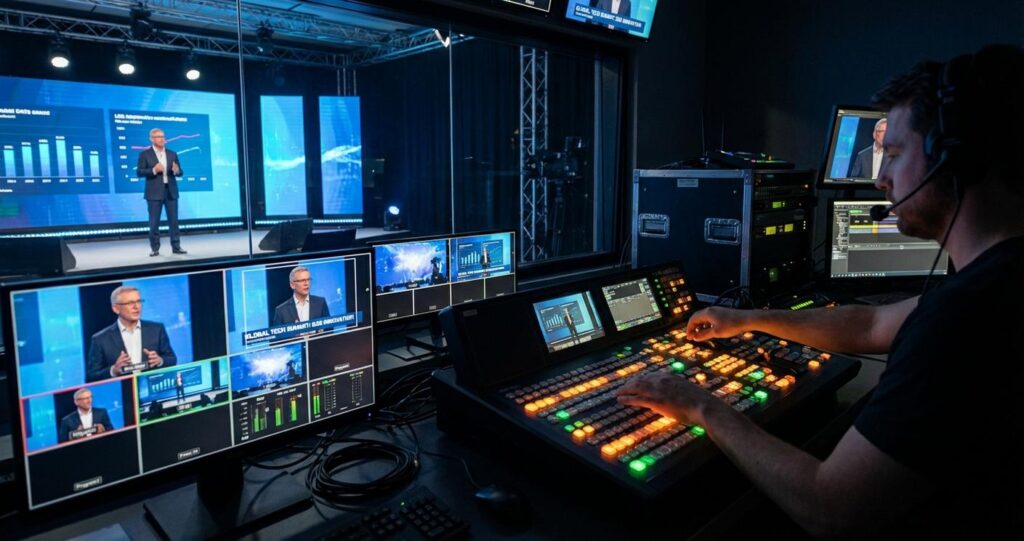
In the context of B2B event streaming and hybrid productions, the perceived authority of an executive is not solely a function of their message; it is heavily influenced by the technical quality of its delivery. For an audience of corporate event planners, AV professionals, and enterprise IT directors, the distinction between a consumer-grade webcast and a professional broadcast is immediately apparent. Sub-par production value, characterized by unstable video, unintelligible audio, and amateurish visuals, directly undermines the credibility of the speaker and, by extension, the brand they represent. This is not a matter of aesthetics; it is a critical component of corporate communication strategy. Professional production value is the technical framework that ensures a message is received with clarity, confidence, and authority. It is achieved through a meticulous integration of broadcast-grade hardware, resilient network architecture, and expertly managed workflows that eliminate technical distractions and focus the audience entirely on the executive’s strategic narrative.
Mastering the Signal Chain: The Foundation of Professional Production
The integrity of any live stream begins with the physical signal chain. The journey from camera sensor and microphone diaphragm to the encoder must be pristine. Compromises at this foundational stage will be amplified throughout the distribution workflow, resulting in a final product that feels unprofessional and detracts from the executive’s presence. Enterprise-grade productions demand enterprise-grade signal transport and management from the very first connection.
Baseband Video Transport: 12G-SDI as the Enterprise Standard
While HDMI is ubiquitous in consumer and prosumer environments, its limitations become critical liabilities in professional event production. The Serial Digital Interface (SDI) is the broadcast industry standard for valid reasons. Specifically, 12G-SDI supports uncompressed 4K/UHD video at 60 frames per second over a single coaxial cable for distances up to 100 meters. Its BNC connectors feature a locking mechanism, preventing accidental disconnection, a common point of failure in high-traffic event spaces. This physical security is paramount. Furthermore, SDI can carry embedded data, including up to 16 channels of digital audio, timecode, and ancillary data, simplifying cabling and ensuring perfect synchronization between video and audio sources within the production switcher.
Architecting Audio Integrity: From Microphone to Codec
Poor audio is the most frequent and jarring failure in corporate streaming. The solution begins with professional audio connections. Balanced XLR cables with high common-mode rejection ratios are essential to eliminate electrical interference and hum over long cable runs from a podium or lavalier microphone receiver. For more complex hybrid events, Audio-over-IP (AoIP) protocols like Dante have become the standard, allowing for hundreds of high-quality audio channels to be routed over a standard gigabit network with extremely low latency. A dedicated hardware audio mixing console, operated by a skilled A1 engineer, provides granular control over equalization, dynamics, and mix-minus feeds for remote presenters, ensuring that every word from an executive is delivered with absolute clarity and consistent levels, free from the feedback and echo that plague software-based solutions.
The IP-Based Fabric: NDI and Network Infrastructure
Modern production workflows increasingly leverage IP-based transport. Network Device Interface (NDI) technology allows for the transport of high-quality, low-latency video and audio over a standard Ethernet network. However, its implementation requires a robust network fabric. This is not a task for unmanaged, consumer-grade switches. A professional production network is built on managed switches with sufficient backplane capacity, configured with separate VLANs (Virtual Local Area Networks) to isolate video traffic from general data. Quality of Service (QoS) protocols must be implemented to prioritize NDI and SRT packets, ensuring that time-sensitive video data is not delayed by less critical network traffic. This managed network approach is fundamental to building a reliable, scalable, and flexible production environment.
Encoding and Transport: Delivering a Flawless Signal to a Global Audience
Once a pristine signal is created within the venue, it must be encoded and transported to the audience with maximum efficiency and reliability. The choice of codec and transport protocol is a critical technical decision that directly impacts the quality of experience for every viewer, whether they are in a corporate boardroom across the country or watching on a mobile device internationally.
Codec Optimization: H.264 vs. H.265 for B2B Streaming
The H.264 (Advanced Video Coding, or AVC) codec is the long-standing incumbent, offering universal playback compatibility across virtually all devices and platforms. For streams targeting a broad, unknown audience, it remains a safe choice. However, H.265 (High Efficiency Video Coding, or HEVC) offers a significant advantage: it provides comparable video quality at roughly 50% of the bitrate of H.264. For B2B events where bandwidth may be constrained, or for delivering high-resolution 4K/UHD streams, H.265 is technically superior. The trade-off is the increased computational power required for encoding and decoding, and less universal native support in older browsers. A proper technical evaluation of the target audience’s devices and the available network uplink bandwidth is necessary to make the optimal choice.
The Protocol Imperative: Why SRT Outperforms RTMP for Enterprise Use
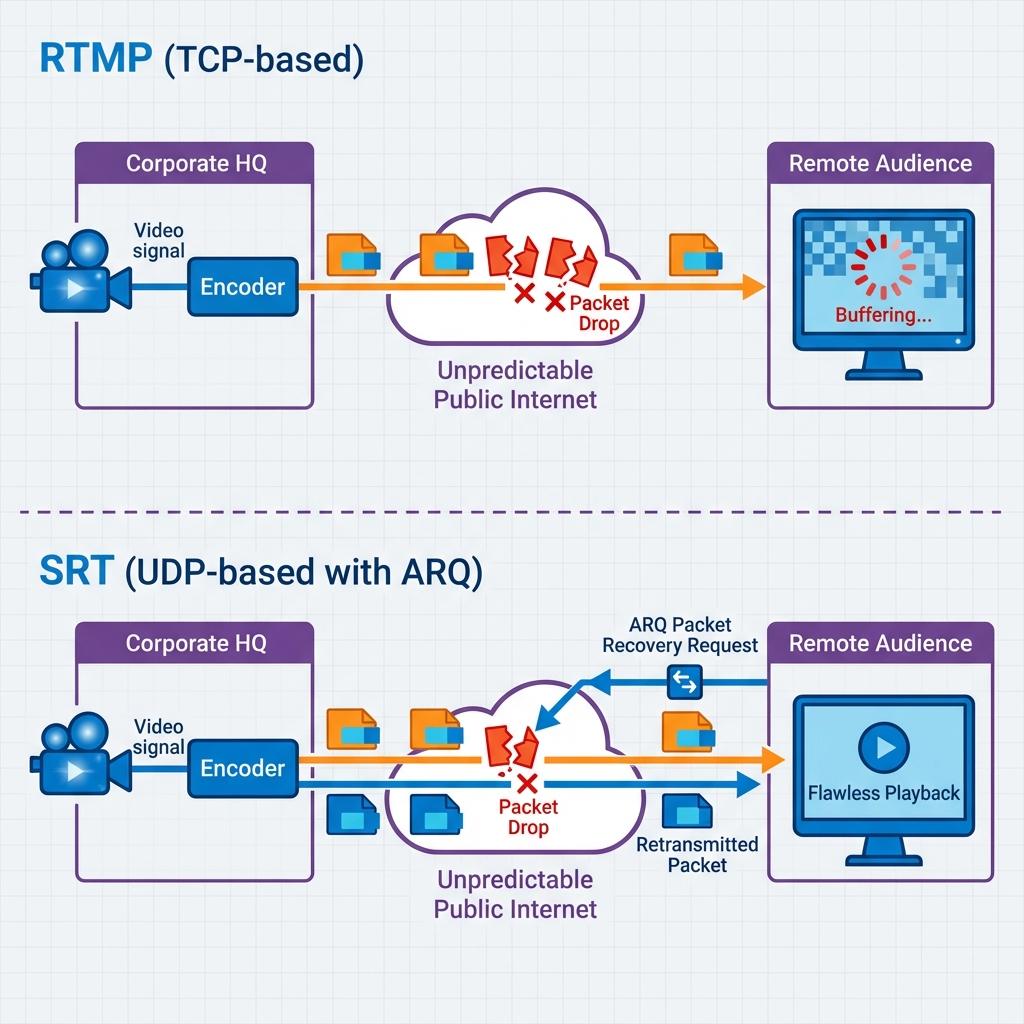
For decades, the Real-Time Messaging Protocol (RTMP) was the de facto standard for streaming. However, it is a TCP-based protocol that suffers from significant latency increases and instability over networks with packet loss. Secure Reliable Transport (SRT) is the modern, open-source replacement designed for professional broadcast contribution. SRT is a UDP-based protocol that includes a sophisticated ARQ (Automatic Repeat Request) error-correction mechanism, allowing it to recover from packet loss with minimal latency impact. It also includes AES 128/256-bit encryption, a critical security feature for sensitive corporate communications. For any executive town hall or investor briefing, SRT provides a demonstrably more stable, secure, and low-latency connection from the event encoder to the streaming platform compared to RTMP.
Implementing Adaptive Bitrate (ABR) for Audience-Wide QoS
It is a certainty that the audience for a corporate stream will have a wide variety of network conditions. Adaptive Bitrate (ABR) streaming is the solution to ensure a smooth playback experience for all. The process involves creating multiple, simultaneous encodes of the source video at different resolutions and bitrates, for example: 1080p at 6 Mbps, 720p at 3 Mbps, 540p at 1.5 Mbps, and 360p at 800 kbps. These encoded streams are segmented into small chunks. The viewer’s player intelligently requests the highest quality chunk their current network speed can reliably download, seamlessly switching up or down the “ladder” as conditions change. This prevents buffering and stalling, providing a continuous, high-quality experience that reflects positively on the organization.
The Art of Live Production: Crafting a Compelling Narrative in Real Time
Technical stability is the foundation, but a truly authoritative presentation is crafted through dynamic live production techniques. A static, single-camera shot of a podium is unengaging. A multi-camera production with professional graphics and seamless switching transforms a simple presentation into a compelling broadcast event that holds audience attention and reinforces the importance of the message.
The Production Switcher: The Heart of the Live Edit
The production switcher, or vision mixer, is the operational hub of a live event. A skilled technical director uses this device to cut, dissolve, and wipe between multiple camera sources in real-time. This allows for dynamic coverage, such as switching from a wide shot of the stage to a tight shot of the executive for emphasis, or to a shot of the audience for reaction. Modern switchers have multiple M/E (Mix/Effects) buses, allowing for the composition of complex scenes, such as a picture-in-picture effect showing the speaker alongside their presentation slides. The use of downstream keyers (DSK) allows for the overlay of professionally designed lower-third graphics to identify speakers without compromising the primary video.
Leveraging ISO Recording for High-Value Post-Event Assets
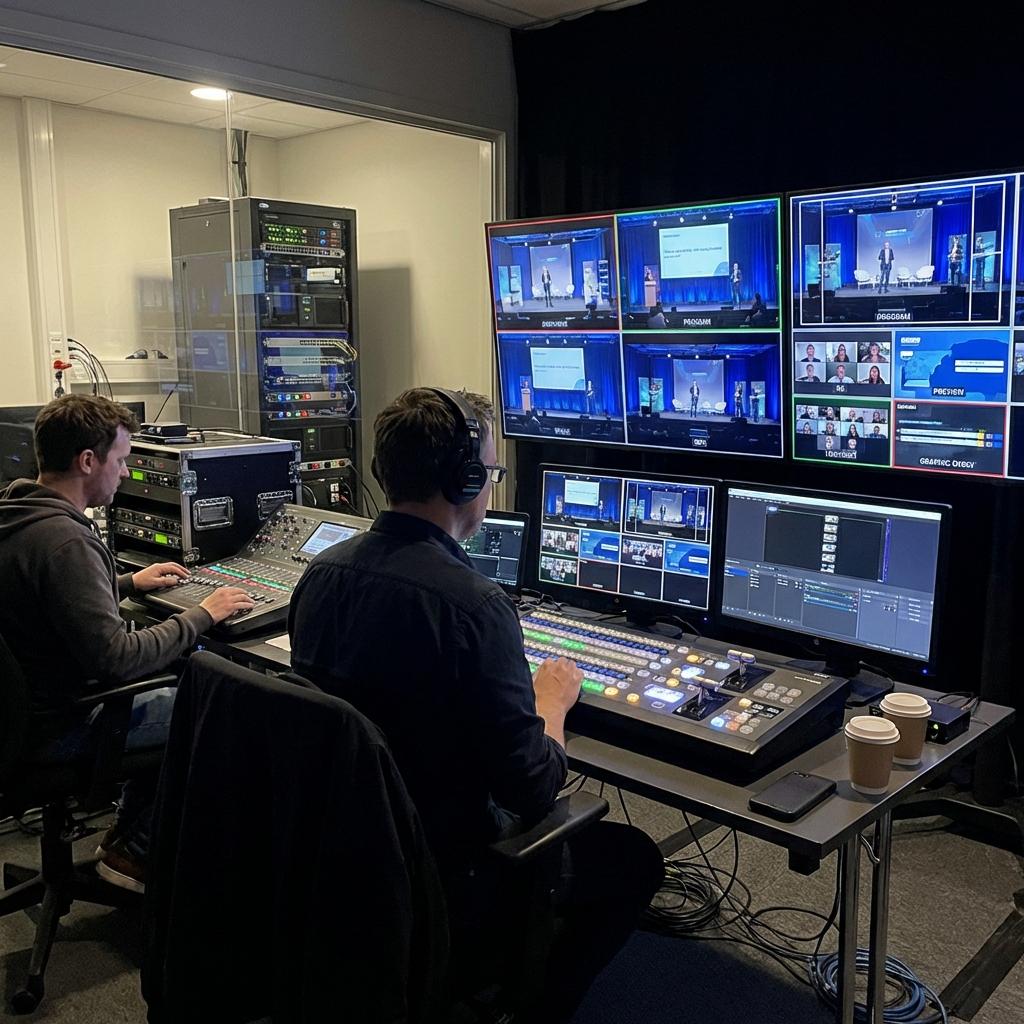
A significant benefit of a professional production workflow is the ability to perform isolated (ISO) recordings of every camera feed, in addition to the final program output. This provides immense value post-event. Instead of being left with only the live-switched program feed, the marketing or communications team has access to all camera angles. This allows for a more polished and refined video-on-demand (VOD) version to be created, where cuts can be retimed, mistakes removed, and new graphics added. High-quality clips can be easily extracted for social media, internal communications, and future promotional materials, dramatically increasing the ROI of the event.
Integrating Professional Graphics and Data Overlays
Broadcast-grade graphics elevate a stream from a simple webcast to a professional production. This includes animated logo bugs, lower-thirds with speaker titles, and full-screen title cards. For financial presentations or data-heavy keynotes, direct integration with data sources can allow for real-time overlays of charts and statistics, visually reinforcing the executive’s points. These elements, when executed with brand consistency and technical precision, create a cohesive and authoritative viewing experience that mirrors what audiences expect from major broadcast networks.
Enterprise-Grade Resiliency: Architecting for Zero-Failure Events
For a mission-critical B2B event, there is no tolerance for failure. A dropped stream during a CEO’s keynote or an investor relations call can have significant negative consequences. Therefore, every component of the production and delivery workflow must be architected with redundancy and failover capabilities. This is the hallmark of a truly professional streaming solution.
Building Redundant Signal Paths with Network Bonding and SRT
The single most likely point of failure is the venue’s internet connection. To mitigate this, professional streaming solutions employ path redundancy. Network bonding hardware can combine multiple internet sources, such as a primary fiber line, a secondary cable connection, and multiple 5G cellular modems, into a single, highly resilient uplink. Furthermore, SRT’s stream-duplication capabilities can be used to send two identical streams from the encoder over completely separate network paths to two different geographic server ingest points. If one path fails, the other continues uninterrupted, providing seamless failover that is transparent to the audience.
Hardware and Power Fault Tolerance
Professional-grade hardware is designed for continuous operation. Critical components like encoders, switchers, and routers should be equipped with dual, redundant power supply units (PSUs). The entire production rack should be powered through an enterprise-grade uninterruptible power supply (UPS) to protect against power sags or brief outages. For ultimate protection, a 1+1 or N+1 redundancy model is employed for encoders, where a secondary backup encoder is configured with the exact same settings as the primary, ready to take over the stream instantly if the primary unit fails.
Proactive Monitoring: Waveforms, Scopes, and Real-Time Analytics
A professional production is not a “set it and forget it” operation. It requires constant, proactive monitoring. Technical operators use tools like waveform monitors and vectorscopes to ensure video signals are within legal broadcast limits for brightness and color. Audio loudness meters ensure levels comply with standards like EBU R 128. Real-time stream analytics provide data on bitrate, frame rate, and network RTT (Round-Trip Time), allowing the engineering team to identify and resolve potential issues before they impact the viewing experience. This constant vigilance is the key to delivering a flawless, high-quality stream from start to finish.
Conclusion: Production Value as a Strategic Imperative
In the competitive B2B landscape, every touchpoint with stakeholders is a reflection of the brand’s competence and market position. Choosing to invest in professional production for executive communications is a strategic decision to project authority, confidence, and technical leadership. The meticulous management of the signal chain, the implementation of resilient transport protocols like SRT, the dynamic execution of a multi-camera production, and the architecture of a zero-failure, redundant workflow are not mere technical details. They are the essential building blocks that uphold and enhance executive authority in the digital and hybrid event arena. By prioritizing professional production value, organizations provide their leadership with a platform that is as powerful and reliable as the message itself.

Jeremy Lee is a seasoned digital marketing director and strategist with over two decades of experience in the industry. As the founder of Sotavento Medios, I manage a diverse portfolio of over 50 businesses, helping brands grow through advanced search strategies and digital innovation. My work focuses on bridging the gap between traditional search engine optimisation and the evolving world of AI-driven answer engines.
get in touch