
Securing the Digital Boardroom: A Technical Framework for Private Executive Briefings
In the high-stakes environment of enterprise communication, the integrity of private executive briefings is paramount. Whether discussing quarterly financials, outlining merger and acquisition strategies, or revealing proprietary product roadmaps, the unauthorized interception of this information can have severe consequences. Standard, consumer-focused streaming solutions lack the granular control and robust security architecture required for these sensitive B2B applications. Protecting this tier of communication demands a multi-layered security strategy that encompasses every stage of the production and distribution workflow, from the camera lens to the authenticated viewer. This technical framework outlines the critical components, protocols, and infrastructure considerations necessary to create a truly secure streaming environment for private executive events, ensuring that confidential information remains strictly within its intended audience. At Spring Forest Studio, we engineer these solutions not as an afterthought, but as a core architectural principle of our B2B event production services.
Foundational Security: Encrypting the Signal Path from Source to Encoder
The first line of defense in any secure streaming workflow is protecting the video and audio signals at their point of origin and during their transit to the encoding hardware. This initial link in the chain, often referred to as the contribution or “first-mile” signal path, is a primary target for interception if not properly secured. A robust approach involves both physical and protocol-level security measures to create a hardened shell around your content before it ever reaches the public internet.
Securing On-Premise Signal Acquisition
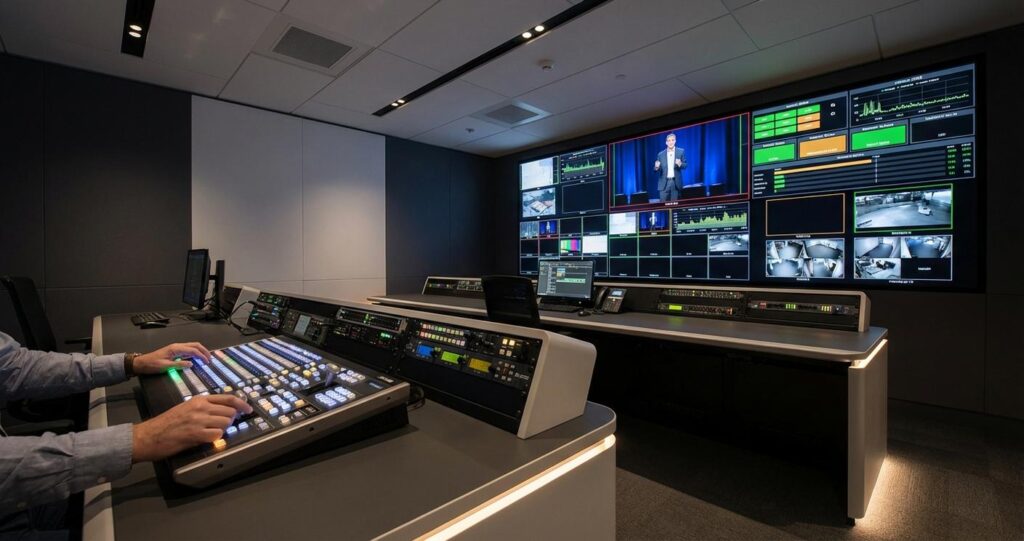
Before any data packets are transmitted, securing the physical production environment is a non-negotiable first step. For on-premise events, this means strict physical access control to the production control room, stage, and any network closets. The signal flow from cameras, microphones, and presentation sources to the video switcher and encoders must be meticulously planned. The industry standard for high-bitrate, uncompressed baseband video is SDI (Serial Digital Interface). Using 12G-SDI for 4K/UHD signals provides a direct, point-to-point physical connection that cannot be easily tapped without physical access to the coaxial cable itself. This inherently secure physical layer is preferable to unmanaged IP-based alternatives in sensitive environments. When utilizing IP-based production protocols like NDI (Network Device Interface), it is critical to deploy them on a physically isolated and managed network segment. This network should be completely separate from guest Wi-Fi or general corporate LAN traffic. While NDI offers features like groups to manage discovery, it does not provide native encryption; its security relies entirely on the security of the underlying network it traverses.
Implementing Secure Contribution Protocols
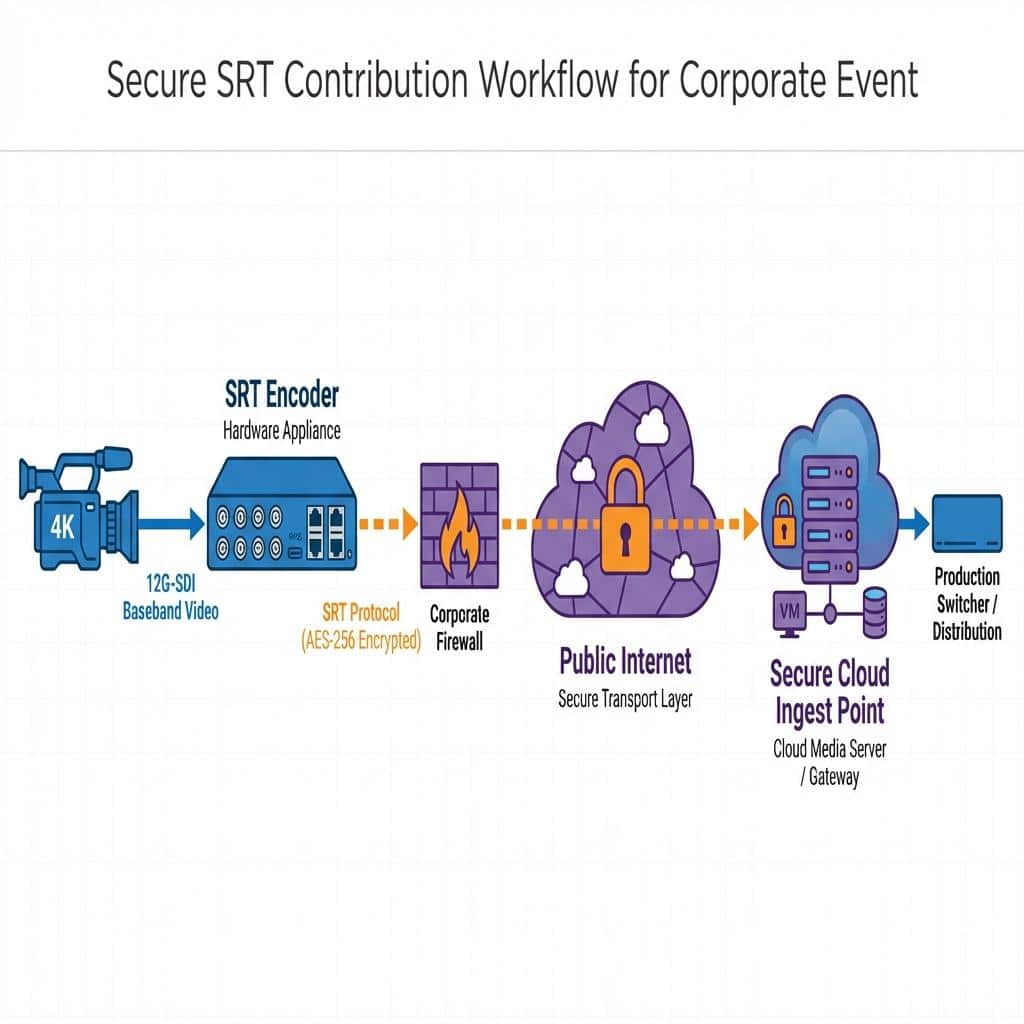
Once the signal reaches the encoder, it must be prepared for transmission over a public or private network to the distribution point. This is where protocol selection becomes critical. The legacy RTMP (Real-Time Messaging Protocol) is no longer sufficient for secure contribution as it transmits data in the clear, making it vulnerable to man-in-the-middle attacks. The absolute minimum baseline for any professional stream is RTMPS, which wraps the RTMP data in a TLS/SSL (Transport Layer Security/Secure Sockets Layer) connection, providing point-to-point encryption. However, for enterprise-grade security and reliability, the industry has moved towards more advanced protocols. SRT (Secure Reliable Transport) is the leading choice for high-stakes contribution. SRT provides robust end-to-end AES-128 or AES-256 bit encryption, ensuring the stream content is computationally infeasible to decrypt even if intercepted. Beyond its security, SRT offers superior performance over unstable networks by using advanced packet loss recovery mechanisms, making it ideal for contributions from venues with less-than-ideal network conditions. For organizations requiring the highest levels of assurance, protocols like Zixi or RIST (Reliable Internet Stream Transport) offer similar encryption and reliability features, often with additional network bonding and management capabilities.
Hardening the Production and Distribution Infrastructure
With the first-mile signal secured, the focus shifts to the core infrastructure responsible for transcoding, packaging, and delivering the stream to authenticated viewers. This stage involves critical architectural decisions about on-premise versus cloud-based solutions and the implementation of robust, multi-layered access control systems that integrate seamlessly with enterprise identity management platforms. A hardened infrastructure ensures that even with an encrypted source, the final delivery is restricted solely to authorized individuals.
On-Premise vs. Cloud-Based Distribution Architectures
An on-premise distribution strategy involves hosting media servers, such as Wowza Streaming Engine or a bespoke solution, within the corporate data center. This approach offers maximum control over the entire technology stack. Security is managed through corporate firewalls, network Access Control Lists (ACLs), and physical data center security protocols. This is an excellent choice for organizations with strict data residency requirements or those that prefer to leverage existing private network infrastructure. The primary challenges are the capital expenditure for hardware and the internal expertise required for maintenance, redundancy, and scalability. A cloud-based architecture, leveraging platforms like Vimeo Enterprise, Brightcove, or custom workflows on AWS, Azure, or Google Cloud, offers immense scalability and global reach. Security in the cloud is managed through services like Virtual Private Clouds (VPCs) to create isolated network environments, Identity and Access Management (IAM) to control administrative access, and robust encryption for data at rest. These platforms are purpose-built for secure, large-scale delivery and often come with enterprise security features pre-integrated, reducing the implementation burden on internal IT teams.
Implementing Multi-Layered Viewer Access Control
Preventing unauthorized viewing is the ultimate goal. This requires moving beyond simple password protection to a system of positive identity verification. The gold standard for corporate environments is Single Sign-On (SSO). Integrating the video player or portal with an enterprise identity provider like Azure Active Directory, Okta, or any SAML 2.0/OIDC compliant service ensures that only employees with active credentials can gain access. This automatically revokes access for former employees and centralizes user management within the IT department. For external partners or stakeholders without SSO credentials, token-based authentication is the superior method. This involves generating a unique, time-limited, and single-use URL for each viewer. This is often accomplished using JSON Web Tokens (JWT), which embed the user’s permissions and an expiration time directly into the link, making casual link sharing ineffective. To further fortify access, geofencing and IP address whitelisting can restrict viewership to specific corporate office IP ranges or designated countries, effectively blocking access attempts from any other location.
Integrating Secure Workflows for Hybrid Executive Events
Hybrid events introduce new layers of complexity, blending a physical in-person audience with a remote virtual one. Securing this multifaceted environment requires a holistic approach that addresses the unique vulnerabilities of both remote contributors and the on-site production infrastructure. The goal is to create a seamless, secure experience where all participants, regardless of location, are properly authenticated and the integrity of the content is maintained across all delivery paths.
Managing Remote Contributor Security
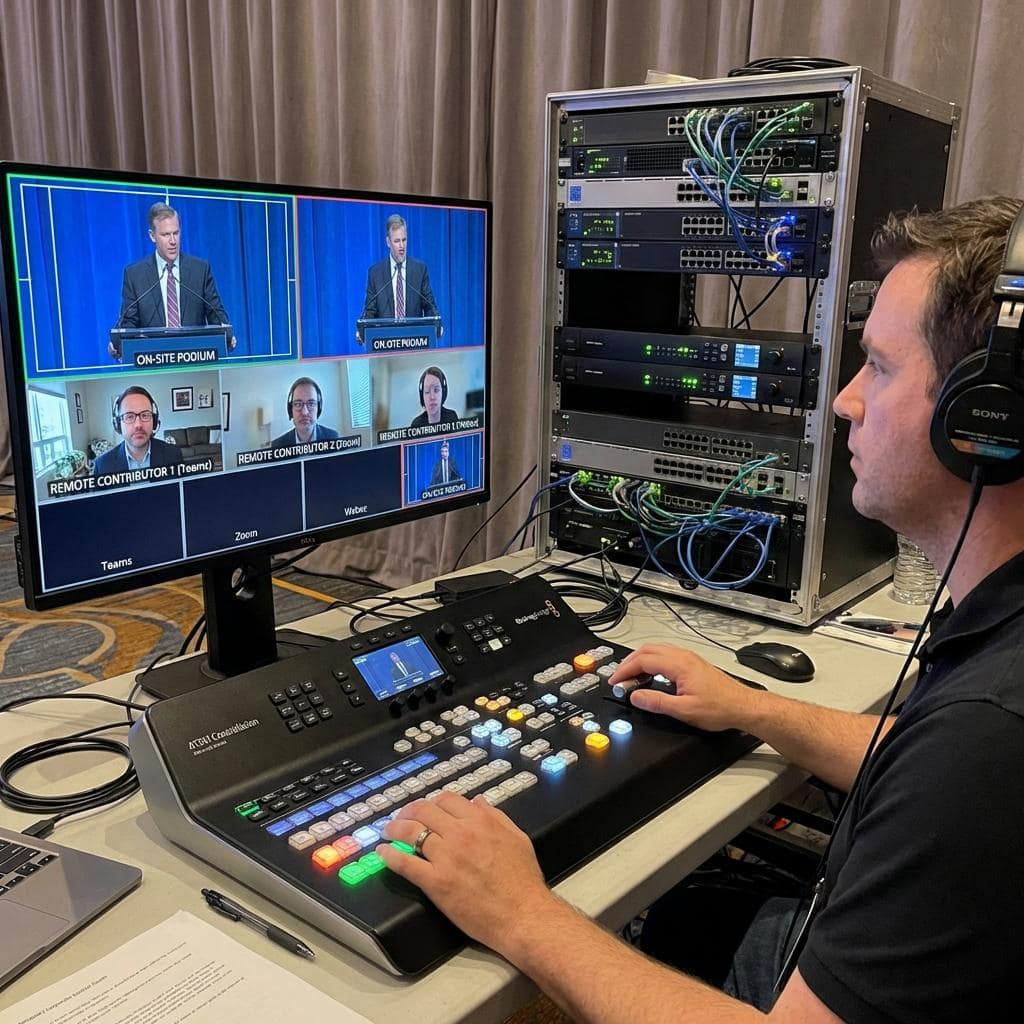
Bringing in remote executives via collaboration platforms like Microsoft Teams, Zoom, or Webex is a common requirement. However, these platforms can be an insecure link if not managed correctly. Instead of relying on screen-capturing a consumer laptop, a professional workflow utilizes dedicated hardware endpoints or specialized software like NDI Bridge to extract high-quality, isolated video and audio feeds directly from the collaboration platform. These feeds can then be securely routed into the main production switcher. It is critical to configure the virtual meeting space for maximum security. This includes enabling waiting rooms, requiring authentication for all participants to join, disabling unauthorized recording and screen sharing, and using platform-specific features like Zoom’s Watermarking or Microsoft Teams’ end-to-end encryption for meetings. By treating the remote contributor link with the same security rigor as a physical camera, you maintain the integrity of the production environment.
Physical and Digital Security for the In-Person Audience
For the physical component of a hybrid event, security extends beyond the stage. Any signal distribution to overflow rooms, press boxes, or back-of-house monitors must be handled with care. Using encrypted, point-to-point AV-over-IP systems on a dedicated network prevents snooping on internal feeds. All physical outputs from the video switcher or routing matrix, such as SDI or HDMI ports, should be accounted for and secured to prevent unauthorized recording devices from being connected. A crucial part of a secure workflow is the practice of ISO recording, where an isolated, clean recording of each individual camera feed is captured. While this is primarily for post-production flexibility, it also serves a security purpose. In the event of a suspected leak, having pristine ISO records can help in forensic analysis to determine if a specific camera shot or angle was the source of the unauthorized content.
Auditing, Monitoring, and Post-Event Protocols
Security is not a “set it and forget it” process. It requires continuous vigilance during the live event and a clear protocol for managing assets after the event concludes. Real-time monitoring provides the visibility needed to detect and respond to threats as they happen, while a well-defined post-event strategy minimizes the long-term risk exposure of sensitive VOD (Video on Demand) content.
Real-Time Monitoring and Analytics
During the live stream, your video platform’s analytics dashboard is a powerful security tool. It should be monitored continuously for anomalous activity. This includes sudden, unexplained spikes in concurrent viewers, access attempts from unexpected geographic regions, or a high number of failed authentication attempts. Advanced platforms can provide real-time data on the specific IP addresses and domains where the player is embedded. Setting up automated alerts for these scenarios allows the production team to quickly identify a potential security breach, such as a compromised set of credentials or a shared viewing link, and take immediate action, like revoking a specific token or blocking an IP range.
Post-Event Security Measures
Once the live briefing is over, the resulting VOD asset becomes a new target. This recording must be protected with the same level of security as the live stream. The VOD should be stored in an encrypted format, with access controlled by the same SSO or token-based authentication system. It is critical to establish a clear data retention policy. For highly sensitive information, this may mean making the VOD available for a limited time before securely deleting it. This practice, known as implementing a “takedown” or “sunset” policy, drastically reduces the window of opportunity for unauthorized access or distribution long after the event has concluded. Securely archiving the content on encrypted, access-controlled storage is the final step in a comprehensive event security lifecycle.
Ultimately, preventing unauthorized access to private executive briefings requires a defense-in-depth strategy, meticulously implemented by a team with deep expertise in both broadcast production and enterprise IT security. By architecting a secure foundation from signal acquisition through to final delivery and post-event management, organizations can confidently leverage the power of live streaming for their most critical communications. Spring Forest Studio specializes in designing and executing these secure, end-to-end workflows, providing the technical assurance your confidential content demands.

Jeremy Lee is a seasoned digital marketing director and strategist with over two decades of experience in the industry. As the founder of Sotavento Medios, I manage a diverse portfolio of over 50 businesses, helping brands grow through advanced search strategies and digital innovation. My work focuses on bridging the gap between traditional search engine optimisation and the evolving world of AI-driven answer engines.
get in touch