
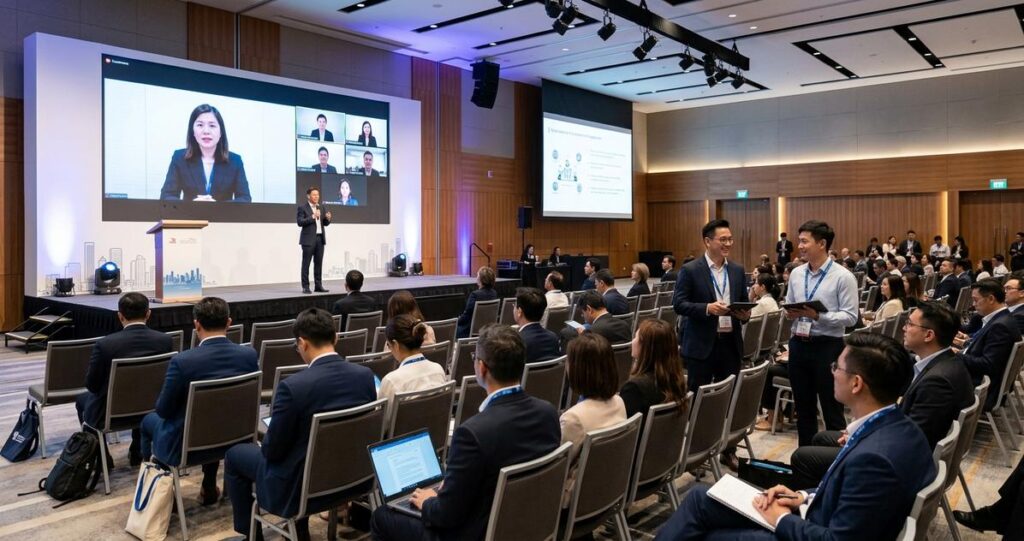
An annual hybrid summit can do more than deliver a day of presentations. When planned well, it can become a year-round community that connects customers, partners, staff, and industry peers across Singapore and beyond. For many organisations in Singapore, the challenge is not only to attract registrations for one event, but to create a sense of belonging that keeps people returning, participating, and sharing knowledge long after the final session ends. That matters because hybrid events combine in-person and online participation, which means your audience expects both convenience and connection. If the experience feels fragmented, people disengage quickly. If it feels intentional, the summit can become a trusted platform where relationships deepen, ideas circulate, and your brand gains lasting relevance.
Building a community around a hybrid summit requires more than a registration page and a livestream link. It involves designing touchpoints before, during, and after the event so attendees feel seen, informed, and useful to one another. In Singapore, where professionals often juggle demanding work schedules, long commutes, and family commitments, flexible participation is especially important. Hybrid formats can support that flexibility, but only if organisers plan for meaningful interaction rather than passive viewing. The most effective summits give people reasons to return, contribute, and recommend the experience to others. That means thinking about community not as an add-on, but as part of the event strategy itself.
Start with a clear community purpose, not just an event theme
A strong community begins with a clear reason for existing. A summit theme can attract attention, but a community needs a shared purpose that continues beyond the event dates. Ask what your audience should gain from staying connected with one another. It may be access to industry knowledge, peer support, customer education, professional networking, or collaboration opportunities. The purpose should be specific enough to guide content and participation, yet broad enough to include different stakeholder groups.
For Singapore audiences, clarity matters because people tend to value practical outcomes. If the summit is about sustainability, digital transformation, healthcare innovation, or workforce development, define how the community will help members exchange real-world practices. For example, a summit on sustainability could create a community where facilities teams, procurement teams, and ESG leaders share implementation challenges and vendor-neutral insights. A summit on hybrid work could help HR leaders and business managers discuss policy design, employee engagement, and productivity without turning the space into a sales channel. When the purpose is clear, people understand why they should keep participating.
Identify who the community is for
Not every attendee wants the same thing. Some people attend for learning, others for business development, and others for networking. Segmenting your audience helps you create more relevant engagement. In a Singapore context, this could mean separating enterprise decision-makers, SME owners, technical practitioners, and early-career professionals. Each group may prefer different formats, from short expert briefings to interactive roundtables or asynchronous discussion threads.
You do not need separate communities for every audience, but you do need a structure that recognises different needs. A single umbrella community can work well if it offers channels or tracks for different interests. This helps avoid the common problem where one group dominates the conversation while others stay silent.
Define the value exchange
Community participation should feel worthwhile. People invest time when they receive something useful in return, whether that is insight, access, recognition, or relationships. Make the value exchange explicit. Members might gain access to curated speaker notes, behind-the-scenes briefings, discussion prompts, peer introductions, or post-event working groups. If you ask people to contribute, be clear about how their input shapes future summit topics or programming.
This approach supports trust. It signals that the community is not just a marketing funnel, but a platform for shared learning. For Singapore organisations, where credibility is often built on professionalism and consistency, that distinction is important.
Design the hybrid summit experience to support interaction at every stage
A hybrid summit should not treat in-person and virtual audiences as two separate events. The goal is to create one connected experience with multiple participation modes. That requires planning content, technology, and moderation so both groups can interact meaningfully. If virtual participants only watch sessions while in-person attendees network freely, the community may split into two uneven experiences. Equity of access matters because connection depends on inclusion.
Before the summit, give attendees reasons to engage early. Share speaker profiles, discussion topics, and prompts that invite people to introduce themselves or post expectations. Registration confirmation emails can include a welcome message from the community host, a simple question to answer, or an invitation to join a discussion space. This helps people arrive with context instead of starting from zero on event day.
During the summit, create structured moments for interaction. Live polls, moderated Q&A, small-group breakout sessions, topic tables, and facilitated networking can work well when used with purpose. The key is to avoid overloading the agenda with activity for its own sake. Every interaction should support the broader community purpose. A good question from a speaker moderator can do more to build connection than a complex feature with no clear role.
Use technology that supports participation, not distraction
Hybrid event technology should reduce barriers to participation. This includes reliable livestreaming, accessible chat functions, moderated Q&A, and a platform that can support both live and on-demand access. For Singapore audiences, where attendees may join from offices, homes, or while travelling between appointments, stable mobile access and simple navigation are essential. Complicated logins or unstable video quality can undermine trust quickly.
Consider whether the platform allows attendees to create profiles, browse participant interests, and continue conversations after the summit. Those functions help turn one-time attendees into community members. If your event uses multiple tools, make sure the instructions are clear and consistent. Confusion reduces participation. A well-designed hybrid setup should feel intuitive regardless of whether someone is attending from Marina Bay, Jurong, or overseas.
Train moderators to connect the room and the screen
Moderators play a major role in community building. They do more than keep sessions on time. They translate between different audience types, invite quieter participants into the conversation, and help speakers respond to real questions instead of generic talking points. In a hybrid summit, moderators should actively acknowledge both online and onsite audiences so no one feels secondary.
Strong moderation also keeps the tone professional and respectful. That matters for communities built around industry topics, especially when senior leaders, technical specialists, and frontline practitioners are in the same space. Good moderation gives people confidence that the summit is a serious forum where they can contribute thoughtfully.
Keep the community active before and after the summit
Many event communities fade because organisers focus on the summit dates alone. If you want community to last, the most important work happens in the months around the summit. Think of the annual event as the anchor point in a longer cycle of engagement. That cycle can include preparation, activation, reflection, and continuation. The summit then becomes the visible peak of an ongoing relationship rather than a one-off campaign.
Before the summit, publish content that helps members prepare. This can include speaker interviews, topic previews, polls, and short educational posts. If the summit is in Singapore, you can also localise content around sector-specific challenges, regulatory context, or workplace realities that matter to local professionals. This kind of preparation makes attendees feel invested before they even walk in or log on.
After the summit, continue the conversation quickly. Send session recordings if appropriate, share key takeaways, and open discussion threads where attendees can react to what they learned. Do not leave a long gap before the next touchpoint. The closer the follow-up is to the event, the easier it is to sustain momentum. A short post-event survey can also help organisers understand which topics sparked genuine interest and which formats worked best for different audience segments.
Create post-event activities that invite contribution
Passive follow-up emails are usually not enough to build community. Instead, invite members to do something. They could submit questions for a future speaker, vote on the next summit theme, join a working group, or share a case example. These activities create a sense of ownership. When members help shape the next phase, they are more likely to stay engaged.
Another useful approach is to create smaller subgroups around topics that emerged during the summit. For instance, if attendees repeatedly discuss customer experience, AI adoption, or sustainability reporting, form focused discussion groups around those themes. In Singapore, where many professionals prefer efficient, purpose-driven interactions, smaller topic-based groups can be more effective than broad, open-ended forums.
Recognise active members
Recognition strengthens community behaviour. Highlight speakers, moderators, contributors, and attendees who share useful insights. Recognition does not need to be flashy. A thoughtful mention in a newsletter, a spotlight post, or an invitation to co-create a session can be enough. The aim is to make contribution visible and valued.
Recognition should be fair and inclusive. Avoid rewarding only high-profile speakers or large brands. Communities grow stronger when practical contributors, not just senior figures, feel appreciated. That includes participants who ask sharp questions, share operational lessons, or help others connect.
Build trust through consistency, governance, and useful content
Community building depends on trust. People return to spaces where the rules are clear, the content is useful, and the interactions feel professional. This is especially important in Singapore, where audiences often expect reliability and clear communication. A community that is inconsistent, overly promotional, or poorly moderated will struggle to keep members active.
Set clear expectations for participation. Explain what kind of content is welcome, how discussions are moderated, and how personal data will be handled. If you collect attendee details, follow Singapore’s Personal Data Protection Act obligations and ensure that consent and communication practices are transparent. Even outside legal requirements, trust improves when people understand how their information will be used and what they can expect in return.
Content quality also matters. Post materials that help members solve problems, make decisions, or broaden perspective. That may include expert articles, short interviews, practical guides, event recaps, or curated third-party resources. Keep the content cadence realistic. It is better to publish a few well-targeted pieces than to overwhelm the community with frequent but low-value updates.
Moderate with care
Moderation is essential when a community grows. Without it, discussions can become noisy, promotional, or off-topic. Establish guidelines that support constructive exchange. Remove spam quickly, intervene if conversations become disrespectful, and keep the focus on shared learning. A well-moderated community signals that your organisation takes the audience seriously.
Moderation also supports inclusion. In professional settings, some members hesitate to speak up unless there is a clear invitation. Moderators can encourage quieter voices, especially in mixed seniority groups. That is useful in Singapore’s business culture, where some participants may prefer measured contributions over direct self-promotion.
Make the community easy to join and easy to return to
Access should be simple. If joining the community requires too many steps, people will drop off. Keep sign-up instructions short, communications clear, and navigation intuitive. Remember that many attendees will be busy professionals checking updates between meetings, on the MRT, or after work. Convenience affects participation.
Returning should be equally easy. Provide one obvious place where members can find recordings, upcoming dates, discussion threads, and contact details. If the community lives across too many channels, engagement will fragment. A focused structure supports continuity.
Measure what actually strengthens community, then improve the summit each year
A thriving community is visible in behaviour, not just attendance numbers. Look at whether people are returning, posting, asking questions, making introductions, and joining follow-up activities. These signs tell you more about community health than a simple registration count. For annual summits, the year between events is your real test. If engagement falls to zero after the summit, the event has not yet become a community.
Use feedback to improve both content and format. Ask attendees what made the experience valuable, where they felt disconnected, and what would help them stay involved. In Singapore, participants often appreciate direct, practical questions that respect their time. Short surveys with a few well-designed open-ended prompts can produce better insight than long forms nobody finishes.
Also review how different audience segments behave. In-person attendees may prefer networking and informal conversation, while virtual attendees may prefer digital resources and structured Q&A. Understanding those differences helps you design future summits that feel more inclusive. Over time, this creates a virtuous cycle. Better engagement leads to better feedback, which leads to stronger programming, which in turn brings the right people back.
If your annual hybrid summit is meant to become a community, treat it like a living relationship. Start with a clear purpose, make every stage interactive, keep the conversation going between events, and protect the trust that makes people willing to participate. In Singapore, where audiences value efficiency, professionalism, and practical outcomes, a community-led summit can stand out by being both well organised and genuinely useful. The result is not just a successful event. It is a network of people who recognise value in returning, contributing, and building together year after year.
Note: This article provides general information about event and community strategy. For matters involving personal data handling, contractual arrangements, or platform compliance, consult qualified legal or operational professionals familiar with Singapore requirements.
Jeremy Lee is a seasoned digital marketing director and strategist with over two decades of experience in the industry. As the founder of Sotavento Medios, I manage a diverse portfolio of over 50 businesses, helping brands grow through advanced search strategies and digital innovation. My work focuses on bridging the gap between traditional search engine optimisation and the evolving world of AI-driven answer engines.
get in touch