
The Criticality of Network Uptime in High-Stakes Corporate Broadcasting
In the context of a live corporate broadcast from a Central Business District (CBD) venue, the single most critical point of failure is not the camera, the microphone, or the presentation content. It is the internet connection. A single packet drop at the wrong moment can compromise a multi-million dollar product launch; a moment of network congestion can render a CEO’s quarterly address unintelligible to global stakeholders. For the enterprise decision-makers, production managers, and IT directors overseeing these events, understanding the profound inadequacy of a single internet line is paramount. This is not about simply having a “backup” connection. It is about architecting a multi-layered, resilient, and intelligent network infrastructure that anticipates and mitigates failure at every level. A professional B2B broadcast strategy treats network connectivity with the same rigor as power redundancy, ensuring the integrity of the stream, the security of the message, and the success of the event.
This technical brief moves beyond the simplistic notion of a secondary internet line and delves into the engineering principles of true network redundancy for mission-critical B2B broadcasts. We will deconstruct the vulnerabilities inherent in typical CBD venue connectivity, architect robust solutions using diverse carriers and advanced protocols, and outline the implementation of intelligent hardware and failover logic required for flawless execution. This is the Spring Forest Studio standard for ensuring that every corporate broadcast is delivered with uncompromising quality and reliability, regardless of external network conditions.
Deconstructing the Single Point of Failure: Network Vulnerabilities in Corporate Venues
The assumption that a premium CBD office building or event space inherently possesses broadcast-ready internet is a frequent and dangerous oversight. Enterprise-grade streaming requires a forensic examination of the network topology, identifying potential weaknesses that would be irrelevant for standard office data traffic but catastrophic for a live video feed.
The Illusion of High-Speed Connectivity in CBDs
A venue’s advertised “1 Gbps Fiber” connection often refers to the building’s aggregate downstream bandwidth, a metric largely irrelevant for live broadcasting. The critical specification is the dedicated, uncontended, and symmetrical upstream bandwidth available from the specific network port used for production. In many multi-tenant commercial buildings, internet services are shared resources. This means the production team’s data packets are competing with thousands of other users, leading to unpredictable performance fluctuations. Furthermore, the “last mile” of connectivity, the physical connection from the street to the building’s data closet, often represents a significant single point of failure. A construction crew accidentally severing a single fiber optic cable can, and often does, take an entire building offline.
Upstream Bandwidth vs. Downstream: A Critical Distinction for Broadcasting
Standard internet usage, such as web browsing or video consumption, is heavily asymmetrical, prioritizing download speed. Live event streaming reverses this dynamic entirely. The production’s primary task is to send a high-bitrate video stream from the venue to a cloud ingest point. This requires substantial and stable upstream bandwidth. A 4K/UHD (2160p) stream encoded with H.265 (High-Efficiency Video Coding) might require a sustained 15-25 Mbps upstream connection. A high-quality 1080p60 stream using H.264 encoding typically demands 6-8 Mbps. For a professional broadcast, the available upstream bandwidth should be at least double the target bitrate of the stream to accommodate overhead and any potential fluctuations, a principle known as network headroom.
Packet Loss, Jitter, and Latency: The Silent Stream Killers
A complete connection loss is an obvious failure. More insidious, however, are network impairments that degrade the stream quality without causing a total disconnect. Latency, the delay for a packet to travel from the encoder to the ingest server, is a factor but less critical than its variability. Jitter is the variation in packet arrival time. High jitter means data packets arrive out of order, forcing the receiving server to work harder to reassemble the stream, which can lead to buffering or artifacts. Packet loss occurs when data packets fail to reach their destination entirely. While protocols like Secure Reliable Transport (SRT) can recover lost packets, high loss rates (even 1-2%) on a standard RTMP stream can cause macroblocking, audio dropouts, and a complete failure of the video feed.
Architecting Network Resilience: Methodologies for Broadcast Redundancy
True network resilience is achieved by creating multiple, independent paths for the video stream data to travel. This requires a strategic approach that considers not just different service providers but also the physical infrastructure and transmission technology used. The goal is to eliminate every conceivable single point of failure between the on-site encoder and the cloud ingest server.
Carrier Diversity: Beyond a Second Line from the Same ISP
The most fundamental step is engaging at least two different Internet Service Providers. Crucially, these must be true B2B-grade services with comprehensive Service Level Agreements (SLAs) that guarantee uptime and provide priority technical support. Simply ordering a second line from the same provider offers little protection against a localized outage affecting that provider’s central office or fiber backbone. The ideal scenario involves sourcing connections from providers who utilize entirely different physical network infrastructure. For instance, pairing a primary fiber optic line from a provider like Lumen with a secondary dedicated coaxial business line from Comcast or a fixed wireless access (FWA) service creates genuine diversity.
Path Diversity: Physical Entry Points and Last-Mile Security
Beyond carrier diversity is physical path diversity. For mission-critical facilities, this means ensuring that the cables from the different ISPs enter the building at physically separate locations. This mitigates the risk of a single incident, such as road work, a fire, or a utility failure in one part of the building, severing all connectivity. During a site survey, our technical team traces the physical cabling from the production space back to the building’s point of presence (POP) rooms to verify that the redundant paths do not converge at a common, vulnerable point within the building’s infrastructure.
Cellular Bonding: Leveraging 4G/5G for Agile Redundancy
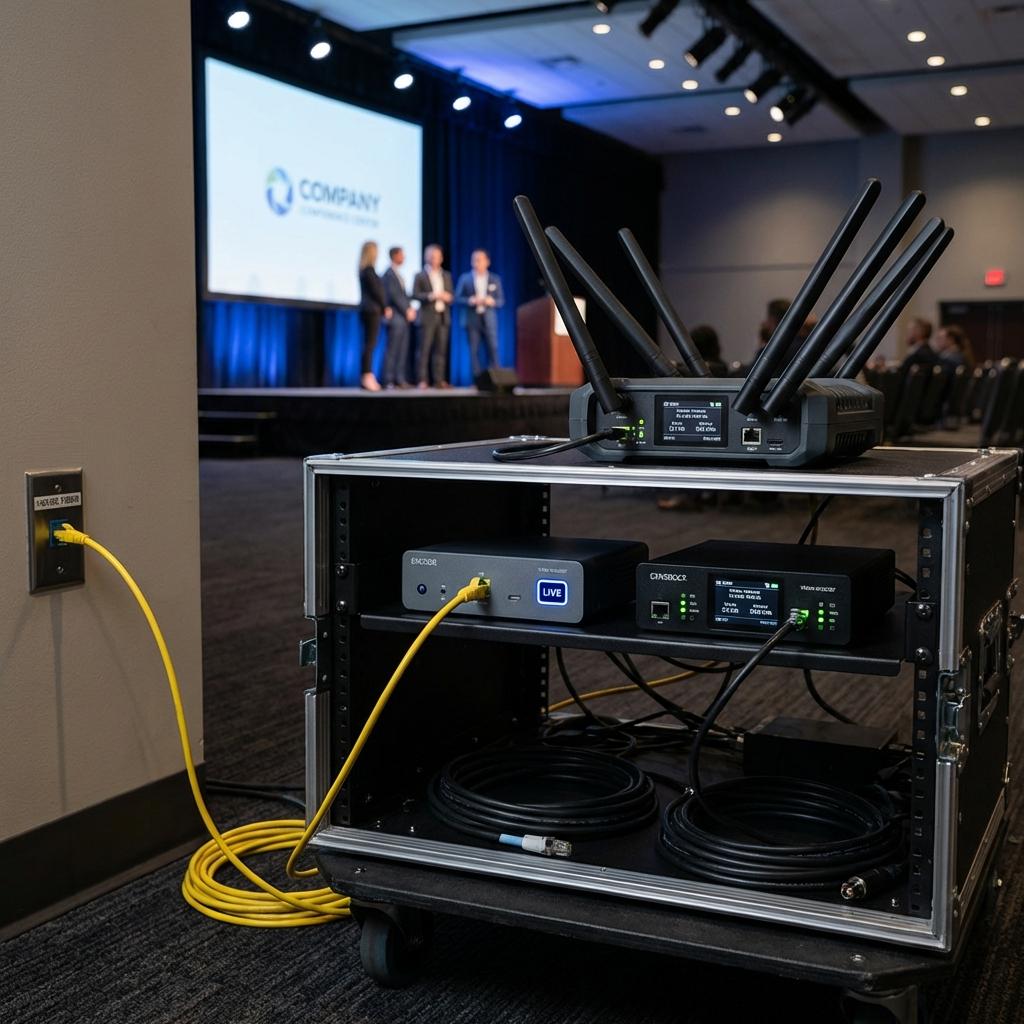
For venues with limited wired infrastructure or as a powerful tertiary failover, bonded cellular technology is an indispensable tool. Devices from manufacturers like LiveU, TVU Networks, and Peplink utilize multiple cellular modems, each with a SIM card from a different carrier (e.g., AT&T, Verizon, T-Mobile). The technology aggregates the available bandwidth from all cellular connections into a single, robust data pipe. This is not simple failover; the system actively sends data packets across all available cellular networks simultaneously. If one carrier’s network becomes congested or loses signal, the system instantly reallocates the data flow to the others, providing seamless, uninterrupted connectivity. In many CBD environments where deploying new wired lines is impossible, a bonded 5G cellular unit can often outperform the venue’s shared wired connection.
Implementation: Hardware, Protocols, and Failover Logic
A redundant network architecture is only as effective as the hardware and software that manage it. Professional implementation requires enterprise-grade equipment and advanced streaming protocols that can intelligently utilize multiple network paths and react to changing conditions in milliseconds.
Intelligent WAN (SD-WAN) and Failover Routers
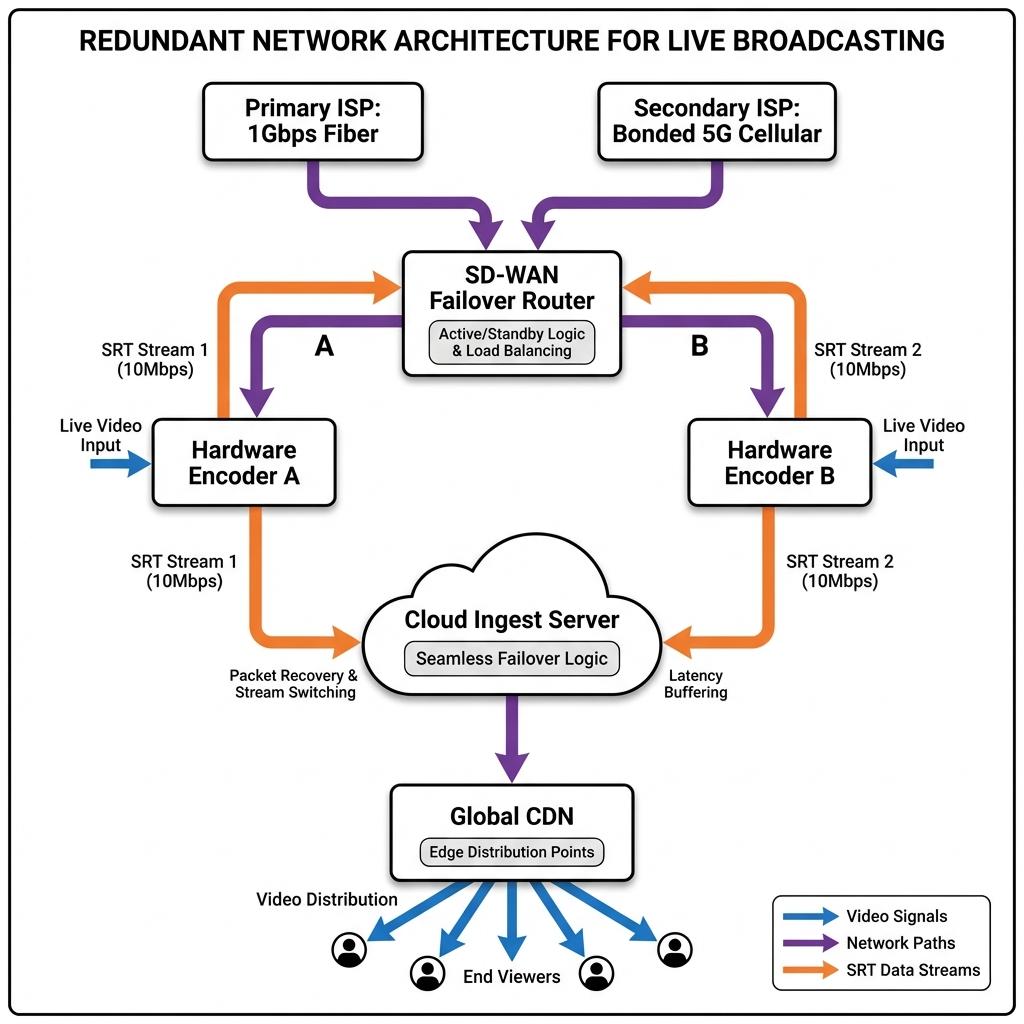
The core of a modern redundant setup is an SD-WAN (Software-Defined Wide Area Network) router. Devices like the Peplink Balance series are purpose-built for this task. These routers can be configured in several modes. In a hot failover configuration, the router continuously monitors the primary WAN connection (e.g., fiber). If it detects high latency, packet loss, or a total disconnect, it automatically and instantaneously reroutes all traffic through the secondary WAN (e.g., bonded cellular) with no interruption to the stream. More advanced configurations use bonding or smoothing technologies, like Peplink’s SpeedFusion, which duplicates packets and sends them across multiple connections simultaneously. The receiving end uses the first packet that arrives and discards the duplicate, eliminating any packet loss and mitigating jitter for an absolutely pristine connection.
The Role of Streaming Protocols: SRT vs. RTMP in Redundant Environments
The choice of streaming protocol is critical. The legacy Real-Time Messaging Protocol (RTMP) is a TCP-based protocol that is highly sensitive to network impairments. It does not gracefully handle packet loss or jitter. The modern, and professionally preferred, protocol is Secure Reliable Transport (SRT). SRT is a UDP-based protocol that incorporates its own advanced error correction mechanism (ARQ – Automatic Repeat reQuest). If a packet is lost, the destination server requests a re-transmission from the source encoder. This allows SRT to maintain a stable, high-quality stream even over imperfect networks with significant latency and up to 10-15% packet loss. For a redundant workflow, sending two identical SRT streams over the two diverse internet paths provides the highest possible level of resilience.
On-Premise Encoders and Cloud Ingest: A Dual-Path Strategy
The end-to-end workflow brings these components together. The program feed from the production video switcher (typically via a 12G-SDI connection) is sent to two separate hardware streaming encoders (e.g., Haivision Makito X4, AJA HELO Plus).
- Encoder A is physically connected to the SD-WAN router’s port for the primary fiber line. It is configured to send a 1080p60 SRT stream at 8 Mbps to the primary cloud ingest URL.
- Encoder B is connected to the router’s port for the secondary connection (e.g., the bonded cellular unit). It sends an identical 8 Mbps SRT stream to a backup cloud ingest URL provided by the video platform.
The cloud platform (like Vimeo Enterprise or DaCast) is configured to treat these as a primary/backup pair. If the primary stream from Encoder A fails, the platform automatically switches to the backup stream from Encoder B, with the transition being seamless to the end viewer.
Real-World Application: A Hybrid Town Hall Broadcast Scenario
Let’s contextualize this with a practical example: a CEO’s hybrid town hall for 10,000 virtual attendees, broadcast from a downtown corporate headquarters.
Pre-Production: The Network Site Survey
Six weeks before the event, the Spring Forest Studio technical team conducts a network site survey. We identify the primary house fiber connection and run multi-hour upstream stress tests using specialized software to confirm it can sustain 20 Mbps of egress traffic with less than 0.1% packet loss. We then bring in a multi-carrier 5G bonded cellular unit and perform RF scans to determine the optimal placement for signal strength, identifying that Verizon and T-Mobile 5G offer the strongest performance in the designated production space. The venue’s IT department provides a dedicated network drop for our primary connection, bypassing the corporate firewall to avoid any potential packet inspection or port blocking issues.
Production Signal Flow with Redundancy
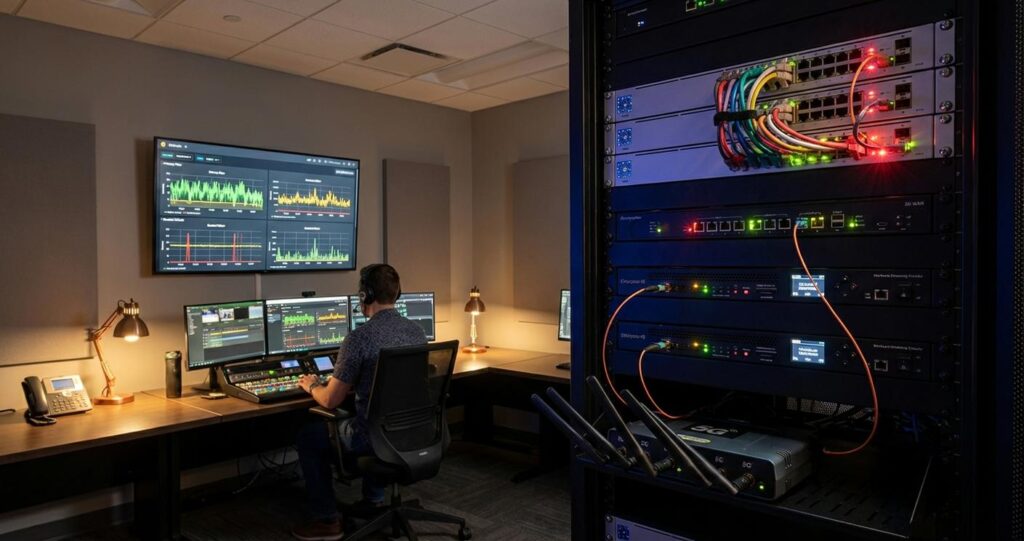
On show day, our setup reflects the dual-path strategy. The production switcher’s program output feeds two AJA Ki Pro Ultra 12G units for ISO recording and simultaneously sends a 12G-SDI signal to our two primary encoders. Encoder A is configured to send a 10 Mbps H.265 SRT stream over the house fiber. Encoder B sends an identical SRT stream over the bonded cellular unit. Both feeds are directed to our cloud video platform. Our on-site broadcast engineer has a monitoring station with a multiviewer showing the program feed, a technical monitoring view from the cloud platform, and a real-time network analytics dashboard from our SD-WAN router. This dashboard displays the real-time bitrate, latency, jitter, and packet loss for both the fiber and cellular connections.
Conclusion: Redundancy as a Professional Standard
For Spring Forest Studio, this level of network redundancy is not an optional add-on; it is the foundational component of our B2B streaming and hybrid production services. The potential financial and reputational cost of a failed corporate broadcast is immense. By architecting resilient systems built on carrier diversity, intelligent hardware, and advanced protocols, we transform the internet from a point of failure into a reliable and robust delivery medium. This engineering-led approach provides our enterprise clients with the confidence and peace of mind that their message will be delivered to their global audience, flawlessly and without compromise.

Jeremy Lee is a seasoned digital marketing director and strategist with over two decades of experience in the industry. As the founder of Sotavento Medios, I manage a diverse portfolio of over 50 businesses, helping brands grow through advanced search strategies and digital innovation. My work focuses on bridging the gap between traditional search engine optimisation and the evolving world of AI-driven answer engines.
get in touch