
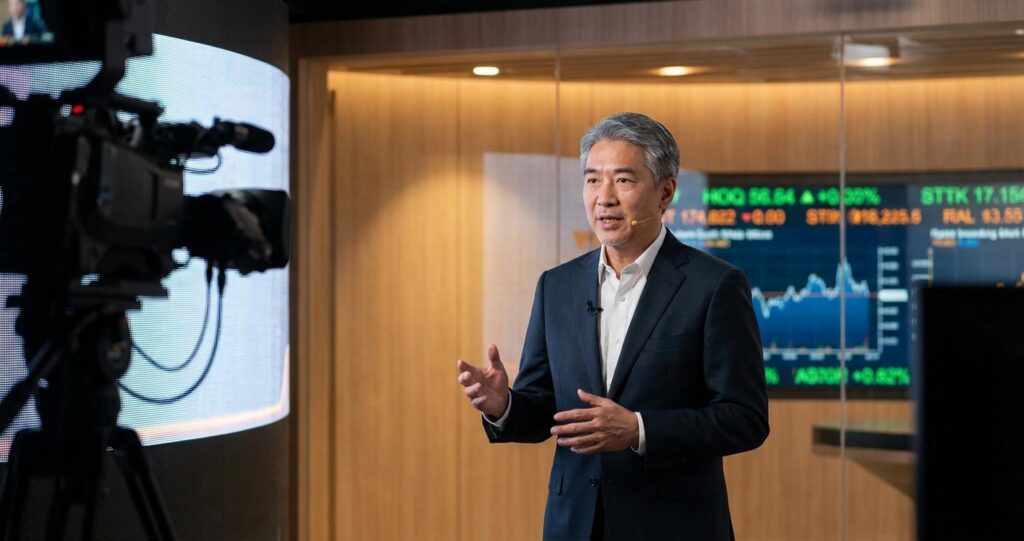
Deconstructing Executive Presence: A Technical Framework for C-Suite Hybrid Event Production
The perceived quality of a C-suite executive’s presentation during a hybrid event is not merely a matter of public speaking skill; it is a direct reflection of the underlying production infrastructure. For corporate event planners and IT directors in Singapore’s competitive business environment, ensuring a flawless on-screen presence for leadership is a mission-critical objective. A presentation undermined by technical failures, such as poor audio intelligibility, unstable video, or high latency, can negatively impact brand perception and shareholder confidence. This article moves beyond superficial discussions of on-screen etiquette to provide a deep technical analysis of the broadcast-grade infrastructure required to engineer a seamless and authoritative virtual presence for high-stakes corporate communications. We will deconstruct the signal chain from camera sensor to the global audience, focusing on the professional production workflows and enterprise-grade protocols essential for modern hybrid events.
Foundational Video Acquisition: Engineering Signal Integrity from Lens to Switcher
The journey to a professional on-screen image begins with pristine video acquisition. The quality of the initial signal dictates the maximum potential quality of the entire downstream workflow. Compromises made at this stage are impossible to fully rectify later in the production chain. A robust acquisition strategy involves careful selection of cameras, lenses, and the signal transport methodology that connects them to the core production system.
Camera and Lens Selection for Corporate Environments
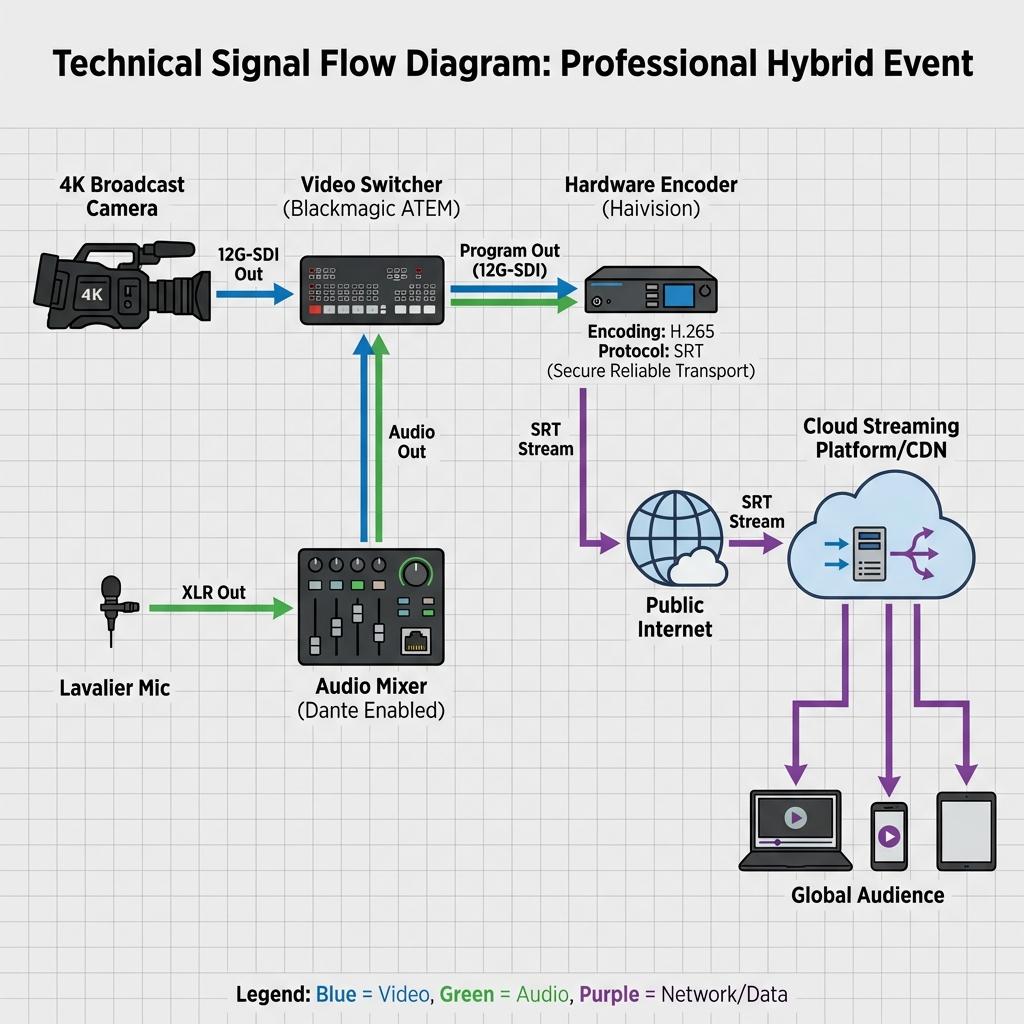
While consumer-grade webcams or DSLR cameras may suffice for internal meetings, they are inadequate for professional B2B events. We specify broadcast-quality cameras, such as the Sony FX series or Blackmagic URSA Broadcast, for several key technical reasons. These systems feature larger Super 35mm or full-frame sensors, which provide superior low-light performance and a shallower depth of field, helping to isolate the speaker from the background. Critically, they offer professional outputs, primarily 12G-SDI (Serial Digital Interface), which allows for the transmission of an uncompressed 4K/UHD video signal up to 60 frames per second over a single coaxial cable. This baseband video connection is paramount for reliability and pixel-perfect quality into the production switcher. Professional broadcast lenses are equally important, providing parfocal performance which maintains focus throughout the zoom range, and a smooth, variable iris for precise exposure control by a remote camera control unit (CCU) operator.
Signal Transport: Comparing SDI and NDI in Enterprise Setups
The method of transporting the video signal from the camera to the production switcher is a crucial architectural decision. For decades, SDI has been the industry standard for its rock-solid reliability and near-zero latency. A 12G-SDI workflow is a point-to-point connection that guarantees signal integrity. However, in modern corporate facilities, Network Device Interface (NDI) has emerged as a powerful IP-based alternative. NDI allows for the transmission of high-quality, low-latency video over a standard Gigabit Ethernet network. This offers immense flexibility in camera placement and system design, reducing complex cable runs. It is vital to differentiate between full-bandwidth NDI, which requires a carefully managed network with sufficient bandwidth (approx. 125 Mbps for a 1080p60 feed), and NDI|HX, a compressed variant that uses less bandwidth but introduces slightly more latency and potential compression artifacts. For a primary C-suite speaker, we recommend a primary 12G-SDI connection for maximum reliability, with NDI utilized for secondary sources or where cabling is impractical.
Advanced Lighting Schematics for Virtual Authority
Professional lighting is non-negotiable for achieving a commanding on-screen presence. Standard office lighting is insufficient and often unflattering. We implement a three-point lighting setup as a baseline. The Key Light is the primary light source, positioned to one side of the camera. The Fill Light is a softer source on the opposite side to soften shadows. The Back Light (or hair light) separates the subject from the background, adding depth. Beyond this basic structure, we focus on technical specifications. All lighting fixtures must have a high Color Rendering Index (CRI) of 95 or above to ensure accurate, natural skin tones. We also standardize color temperature, typically to 5600K for a clean, daylight look, ensuring consistency across all cameras and preventing color balance issues in the final program feed.
Audio Architecture: Guaranteeing Pristine Vocal Clarity and Intelligibility
An audience will tolerate minor video imperfections, but poor audio will cause them to disengage immediately. For a C-suite executive, every word must be heard with absolute clarity. Designing a professional audio workflow involves a multi-layered approach encompassing microphone selection, signal processing, and sophisticated routing for hybrid interactivity.
Professional Microphone Selection and Placement
The internal microphones on cameras or laptops are completely unacceptable for professional use. The industry standard for a single speaker is a high-quality, discrete lavalier microphone, such as a DPA 6060 or Sennheiser MKE 2. These microphones are placed directly on the speaker to ensure a high signal-to-noise ratio, capturing their direct voice while minimizing ambient room noise. For events in Singapore’s dense urban environment, managing wireless frequencies is a critical task. We utilize professional wireless systems from brands like Shure or Sennheiser that operate in managed frequency bands and employ frequency scanning and coordination to avoid interference from other RF sources. A backup hardwired lavalier microphone should always be in place and tested as a primary point of redundancy.
Signal Processing and Digital Audio Mixing
The raw audio signal from the microphone is routed into a professional digital audio mixer (e.g., Behringer X32, Allen & Heath SQ series). Here, an audio engineer applies several key processes. First, a preamplifier boosts the mic-level signal to a usable line-level signal. Second, an equalizer (EQ) is used to shape the tonal quality of the voice, cutting muddy low frequencies and boosting frequencies associated with clarity and presence. Third, a compressor is applied to manage dynamic range, ensuring the audio does not clip or become too quiet. Finally, a noise gate can be used to eliminate background noise when the executive is not speaking. For larger productions, routing audio via Dante (Digital Audio Network Through Ethernet) provides a scalable, IP-based method for transporting hundreds of audio channels across a facility with minimal latency.
Encoding, Transport, and Delivery: The Core Streaming Workflow
Once the audio and video signals are mixed and switched into a final program feed, the next stage is to prepare this feed for internet delivery. This involves encoding the signal into a streamable format and transporting it reliably to the content delivery network (CDN) or streaming platform. This is a highly technical process where protocol and hardware choices have a significant impact on quality and reliability.
On-Premise Hardware vs. Cloud Encoding Strategies
Encoding is the process of compressing the large baseband video signal (e.g., a 12G-SDI signal at 12 Gbps) into a much smaller file suitable for streaming (e.g., 6-8 Mbps for 1080p). This can be done using on-premise hardware encoders or cloud-based services. For high-stakes executive events, we advocate for dedicated hardware encoders like those from Haivision, AJA, or Kiloview. These devices provide a stable, dedicated processing pipeline, minimizing the risk of software or OS-related failures that can occur on a general-purpose computer. The choice of codec is also critical. While H.264 (AVC) remains the most compatible standard, H.265 (HEVC) offers superior compression efficiency, delivering higher quality at a lower bitrate. This can be crucial when dealing with constrained network bandwidth.
Protocol Deep Dive: SRT for Secure, Low-Latency Contribution
The protocol used to transport the encoded stream from the venue to the ingest server is a cornerstone of stream reliability. For years, RTMP (Real-Time Messaging Protocol) was the standard. However, RTMP is a TCP-based protocol that does not handle network packet loss well, leading to buffering and stream failure on less-than-perfect networks. The modern enterprise standard is SRT (Secure Reliable Transport). SRT is an open-source protocol that provides the reliability of TCP with the low latency of UDP. It includes sophisticated packet loss recovery mechanisms (ARQ), AES-256 encryption for security, and stable performance over public internet connections, making it the definitive choice for professional contribution feeds.
Integrating with Enterprise Platforms for Seamless Hybrid Events
A key challenge in hybrid events is bridging the gap between the broadcast-quality production in the room and the consumer-grade enterprise conferencing platforms like Microsoft Teams, Zoom, or Webex used by the remote audience. This requires a specific technical workflow to ensure the high-quality program feed is seen by all participants.
Signal Routing into Conferencing Platforms
Conferencing platforms are not designed to ingest professional video signals directly. A dedicated interface is required to translate the SDI or HDMI program output from the video switcher into a format that the platform recognizes as a simple webcam. Hardware devices like the Blackmagic Design Web Presenter 4K or Magewell USB Capture Gen 2 are excellent for this purpose. They take a professional video signal as input and present it to the host computer as a standard UVC (USB Video Class) device. This ensures that remote participants see the fully produced, multi-camera feed with professional graphics and audio, rather than a low-quality laptop webcam view.
Managing Multiple Feeds for Confidence and Control
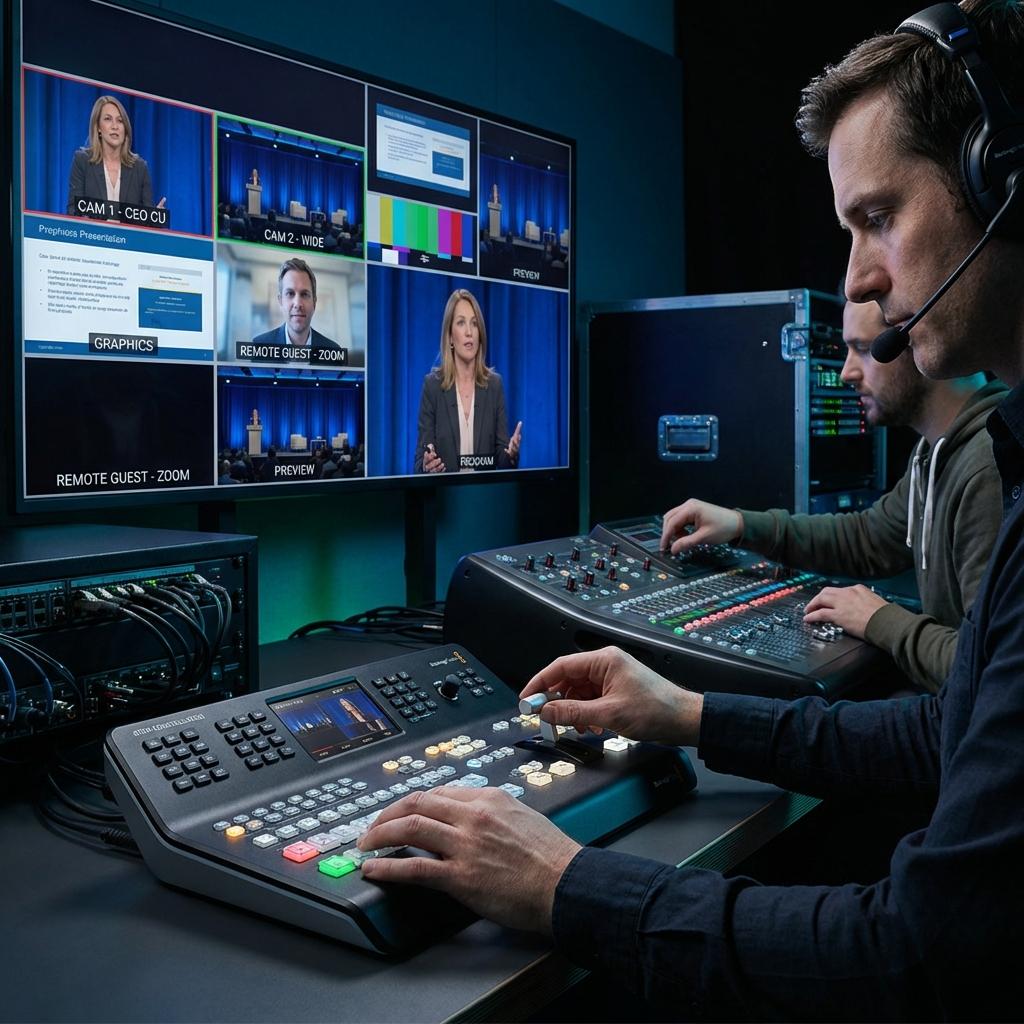
A seamless experience for the on-camera executive requires a carefully managed monitoring environment. They must never be left looking at a confusing interface. We engineer several distinct monitor feeds. A Confidence Monitor, placed discreetly below the camera lens, shows the executive their presentation slides or a live view of the remote participants, allowing for natural engagement. A separate Teleprompter feed provides the script. In the control room, the production team relies on a Multiview Monitor, which displays all camera sources, graphics, preview, and the final program output simultaneously. This comprehensive monitoring architecture is fundamental to executing a smooth, professional broadcast where the C-suite talent can focus solely on their delivery.

Jeremy Lee is a seasoned digital marketing director and strategist with over two decades of experience in the industry. As the founder of Sotavento Medios, I manage a diverse portfolio of over 50 businesses, helping brands grow through advanced search strategies and digital innovation. My work focuses on bridging the gap between traditional search engine optimisation and the evolving world of AI-driven answer engines.
get in touch