
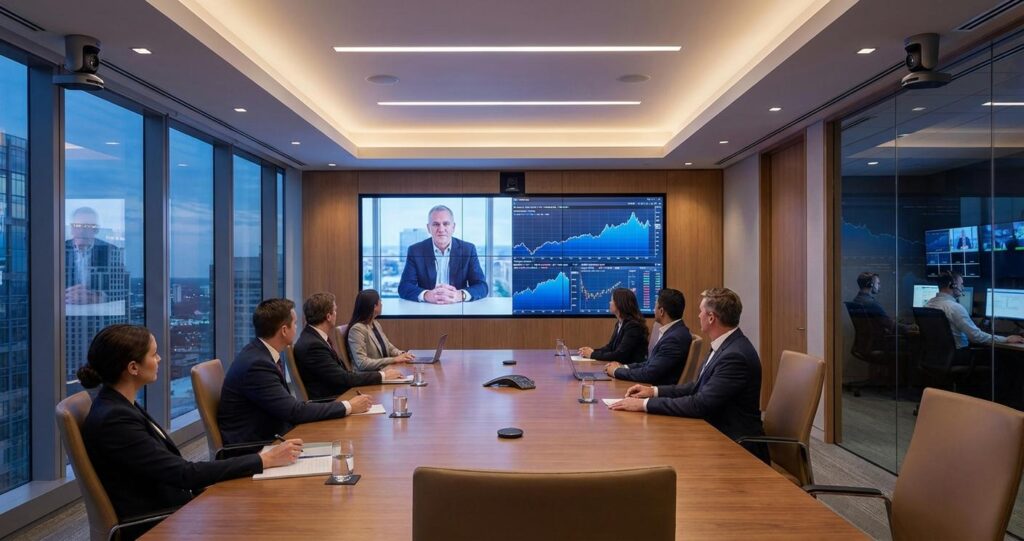
In the enterprise ecosystem, the quarterly business review (QBR) represents a critical alignment point for executive leadership, stakeholders, and key operational teams. However, the logistical and financial overhead of assembling geographically dispersed executives in a single physical location is substantial. The alternative, a purely virtual meeting conducted on standard unified communications (UC) platforms like Teams or Zoom, often fails to command the authority and production value required for high-stakes corporate communication. The technically superior solution is the hybrid quarterly review, a model that merges a physical C-suite nucleus with a professionally integrated remote executive audience. This approach, when architected with broadcast-grade production principles, not only preserves executive time but also enhances communication efficacy through superior technical execution. It requires a deep understanding of signal flow, protocol selection, and redundant infrastructure to ensure a seamless and resilient event that is functionally indistinguishable from a major broadcast production.
Foundational Infrastructure: Architecting the Hybrid Review Environment
The core of a successful hybrid QBR is a meticulously planned technical infrastructure that guarantees signal integrity, low latency, and high availability. The initial architectural decision involves choosing between on-premise, cloud-based, or a hybrid signal routing and processing methodology. This choice dictates network requirements, hardware selection, and operational workflows for the entire production.
On-Premise vs. Cloud-Based Signal Routing
An on-premise architecture leverages local network infrastructure for all primary video and audio routing. The dominant technology for this is NDI (Network Device Interface), which allows for the transport of high-quality, low-latency video over a standard Gigabit Ethernet network. In this model, all cameras, switchers, and graphics systems communicate over a dedicated VLAN (Virtual Local Area Network) to isolate broadcast traffic from general corporate data. The primary advantage is sub-frame latency within the local environment, which is critical for real-time interaction between in-room presenters. However, this requires significant on-site network engineering, including managed switches with sufficient PoE (Power over Ethernet) budget and non-blocking backplane capacity. Conversely, a cloud-based architecture routes sources through a cloud production platform. This is highly effective for integrating numerous remote presenters, as each participant sends their feed to a central cloud server. The protocol of choice here is SRT (Secure Reliable Transport), an open-source protocol that optimizes streaming performance over unpredictable networks by using ARQ (Automatic Repeat reQuest) error correction. While this adds latency (typically 250ms to 2 seconds depending on configuration), it provides immense geographical flexibility and scalability without requiring complex on-premise networking.
Network Configuration and QoS Prioritization
The network is the central nervous system of any hybrid event. For a QBR featuring multiple 4K/UHD sources, robust network capacity is non-negotiable. A dedicated 10GbE network is standard for on-premise NDI workflows to handle multiple uncompressed or lightly compressed video streams. For external transmission using SRT, each high-quality 2160p60 feed requires a sustained, uncontended uplink bandwidth of 30-50 Mbps. To guarantee this, IT and production teams must collaborate to configure Quality of Service (QoS) policies on network switches and firewalls. This involves prioritizing SRT and NDI packet traffic (identified by specific UDP ports) over less critical data, ensuring that video and audio signals are not disrupted by other network activity. Redundancy is also critical; implementing bonded networking solutions, where multiple internet connections (e.g., fiber, 5G cellular) are aggregated, provides a failover path in case of primary carrier failure.
Multi-Camera Production and Signal Integrity for Executive Presence
The production value of a hybrid QBR must reflect the importance of the content and the seniority of the participants. This is achieved through a professional multi-camera setup, redundant signal paths, and broadcast-quality audio engineering, ensuring that both the in-room and remote audiences receive a polished and authoritative presentation.
Camera and Signal Chain Specifications
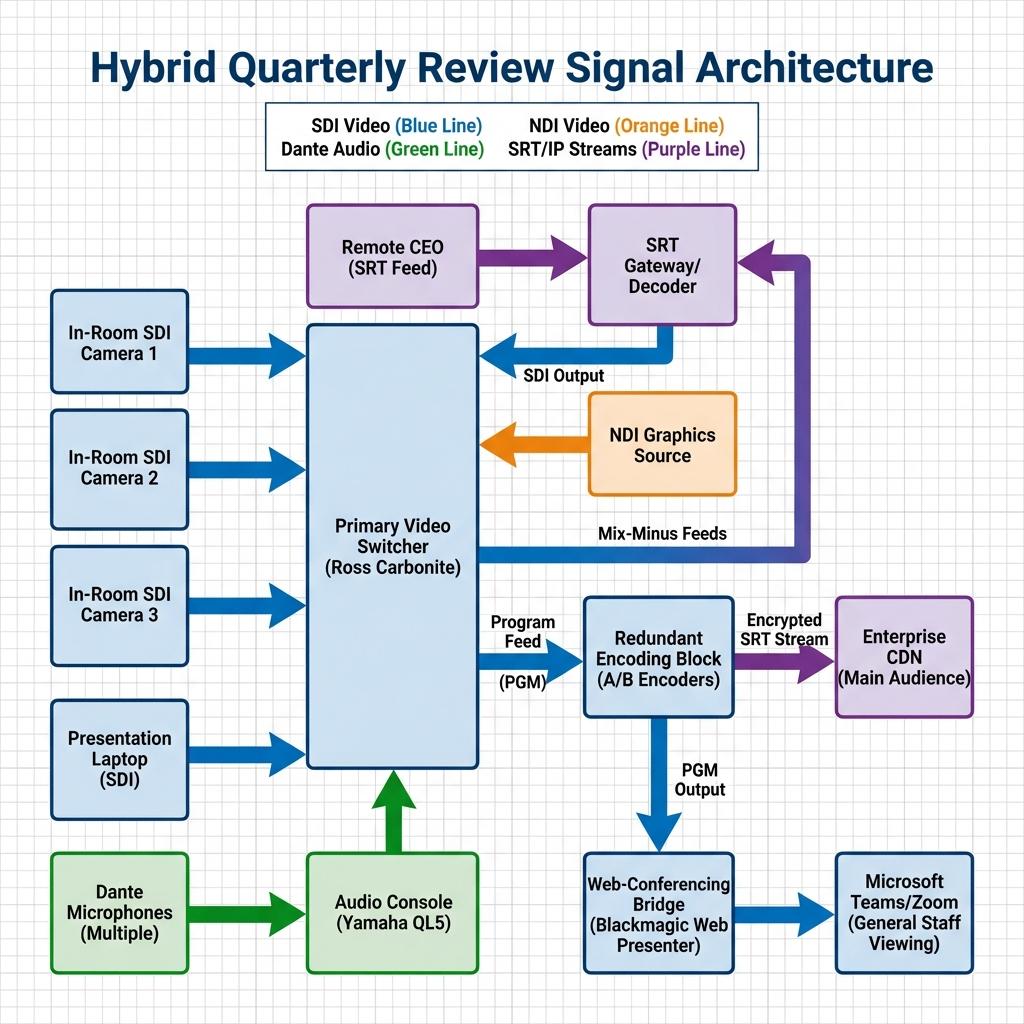
The visual foundation begins with camera selection. For the primary in-room location, broadcast-grade PTZ (Pan-Tilt-Zoom) cameras offering 12G-SDI outputs, such as the Panasonic UE150 or Sony BRC-X1000, provide the flexibility of remote operation with uncompromised 4K image quality. SDI (Serial Digital Interface) is the industry standard for baseband video transport due to its locking connectors and long cable run capabilities, eliminating the signal degradation risks associated with HDMI. Each camera signal path should be standardized to a consistent resolution and frame rate (e.g., 3840×2160 at 59.94p) and synchronized using a master clock generator providing tri-level sync. This genlocking process ensures that all video sources are phase-aligned, preventing frame tearing or glitches when switching between cameras in the production switcher.
Redundant Switching and Encoding Architecture
Single points of failure are unacceptable in executive-level productions. A resilient workflow employs full redundancy in the core production hardware. This means utilizing a primary and a secondary video switcher, such as a Blackmagic ATEM Constellation 8K or Ross Carbonite Ultra, configured for immediate failover. The program feed from the primary switcher is routed to a primary hardware encoder (e.g., an AJA HELO Plus or a Haivision Makito X4). Simultaneously, the same program feed is sent to a secondary, identical encoder connected to a separate network path. This A/B redundant encoding pipeline ensures that if the primary encoder or its network connection fails, the stream to the enterprise CDN (Content Delivery Network) can continue uninterrupted from the secondary unit. This architecture provides the robust fault tolerance expected in enterprise environments.
Professional Audio Integration for Uncompromised Clarity
Audio is arguably more critical than video for comprehension. The audio workflow must be engineered for absolute clarity and to eliminate feedback loops. In the main room, a combination of gooseneck lectern microphones and discreet lapel microphones are fed into a digital audio console like a Yamaha QL series or a Behringer X32. The key to integrating remote participants is creating a mix-minus feed for each remote contributor. A mix-minus is a custom audio mix that contains the full program audio *minus* the contributor’s own voice. Sending this custom mix back to them prevents the echo and feedback that plagues consumer-grade video calls. For signal transport, a Dante (Digital Audio Network Through Ethernet) network is often deployed, allowing for the routing of hundreds of uncompressed audio channels over the same Ethernet network used for NDI video, simplifying cabling and increasing flexibility.
The Remote Participant Experience: Bridging the Gap with Technology
The success of a hybrid event hinges on the quality of the experience for remote participants. It is not enough to simply stream a video feed to them; they must be fully integrated into the event with bidirectional, high-quality audio and video, allowing for seamless interaction with the in-person attendees.
Ingesting Remote Executives via SRT and WebRTC
Bringing remote presenters into the primary production switcher requires a reliable and high-quality contribution link. While platforms like Zoom can be used, their video quality is often heavily compressed. For C-suite presenters, a dedicated SRT stream is the superior method. A small hardware or software SRT encoder can be sent to the executive’s location, providing a broadcast-quality 1080p or 4K feed directly to a corresponding decoder at the production venue. This provides far greater control over bitrate, latency, and image quality than a standard webcam feed through a UC platform. For more interactive Q&A sessions involving a wider group, WebRTC (Web Real-Time Communication) gateways can be used to bring multiple participants into a multiviewer, which is then fed into the production switcher as a single source. This balances scalability with manageable production complexity.
Enterprise Platform Integration for Audience Delivery
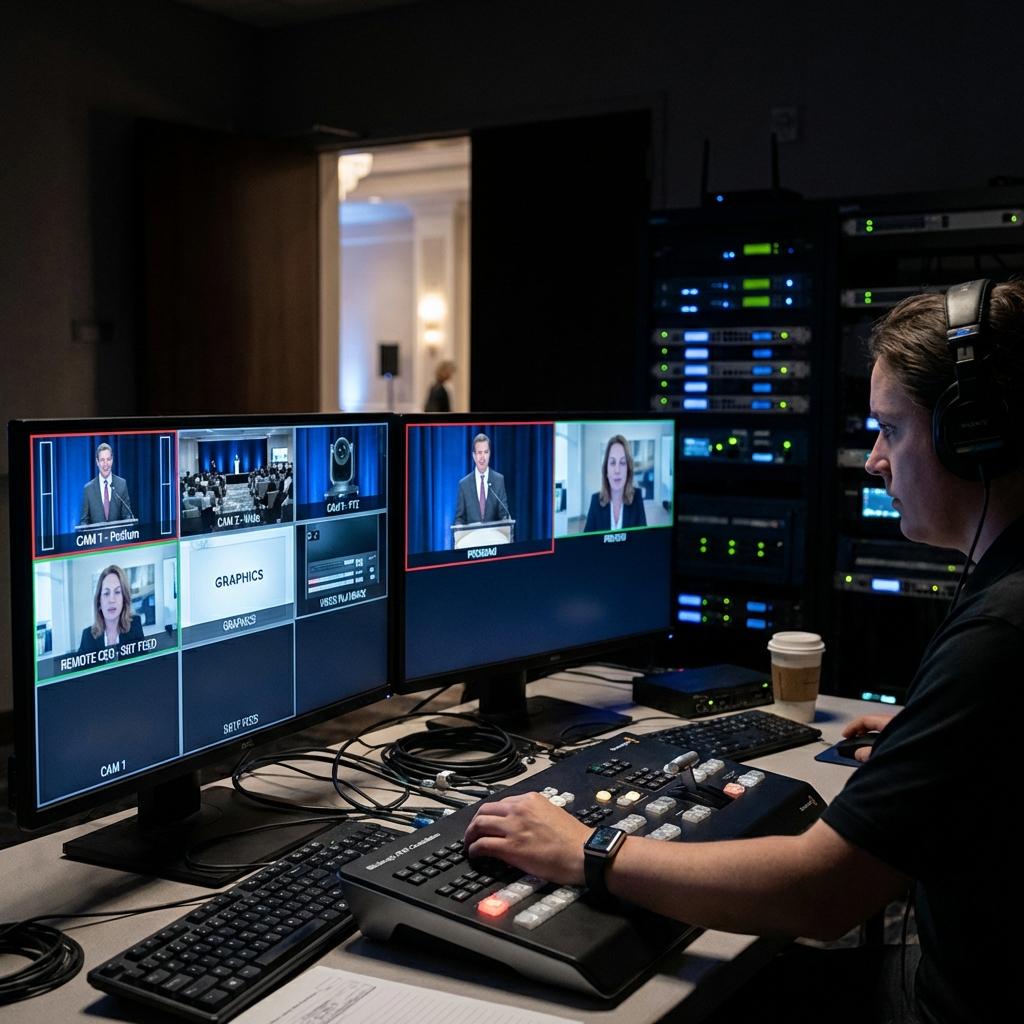
While the primary program feed should be delivered via a high-quality, secure enterprise CDN, many organizations want the QBR to be accessible within their existing communications platforms like Microsoft Teams or Cisco Webex for convenience. The professional approach is not to *produce* the event within these platforms, but to *distribute* to them. The main program output from the video switcher is sent to a dedicated streaming appliance, such as a Blackmagic Web Presenter 4K, which converts the professional SDI video signal into a UVC (USB Video Class) source. The host computer then sees the entire multi-camera production as a simple webcam, allowing it to be the video source for a Teams Live Event or Webex Webinar. This workflow leverages the reliability of the corporate platform for distribution while bypassing its limited production capabilities, ensuring the audience sees the fully polished, broadcast-quality program feed.
Data, Security, and Scalability: Enterprise-Grade Streaming Delivery
For a confidential event like a quarterly review, security and reliable delivery are paramount. The distribution architecture must be designed to protect sensitive information while providing a flawless viewing experience for all authorized personnel, regardless of their location or device.
Secure Streaming Protocols and Access Control
Distributing the final program feed requires robust security measures. RTMPS (Real-Time Messaging Protocol Secure) is a baseline, providing TLS/SSL encryption for the stream in transit. However, for enhanced security, SRT with AES-256 bit encryption is the preferred protocol for point-to-point delivery to the CDN ingest server. From the CDN, delivery to the end-user should be protected by multiple layers of access control. This includes domain restriction, which prevents the video player from being embedded on unauthorized websites, and token-based authentication (or JSON Web Tokens, JWT), which generates a unique, time-limited viewing URL for each authenticated user. This ensures that only verified employees can access the live stream.
ISO Recording and Post-Event Asset Management
The value of the QBR extends beyond the live event. A comprehensive recording strategy is essential for archives, compliance, and post-event analysis. A professional workflow includes ISO (isolated) recording of every camera feed, every remote presenter feed, and the final program output. Hardware recorders like the Blackmagic HyperDeck series or software solutions like vMix Replay can capture these individual feeds in a high-quality codec like Apple ProRes or Avid DNxHD. This provides maximum flexibility for post-production. If a graphic was incorrect or a camera shot needs to be changed, the event can be re-edited from the clean ISO sources without the live-switched errors. These assets become a valuable part of the corporate knowledge base, and having clean, high-resolution recordings is critical for creating executive summaries and highlight reels.
Ultimately, transforming a quarterly review into an efficient, high-impact hybrid event is an exercise in professional broadcast engineering. By architecting a resilient infrastructure, prioritizing signal integrity, and implementing secure distribution protocols, organizations can eliminate geographical barriers and maximize the strategic value of their leadership’s time. This technical investment pays dividends in clarity, engagement, and operational efficiency.
Jeremy Lee is a seasoned digital marketing director and strategist with over two decades of experience in the industry. As the founder of Sotavento Medios, I manage a diverse portfolio of over 50 businesses, helping brands grow through advanced search strategies and digital innovation. My work focuses on bridging the gap between traditional search engine optimisation and the evolving world of AI-driven answer engines.
get in touch