
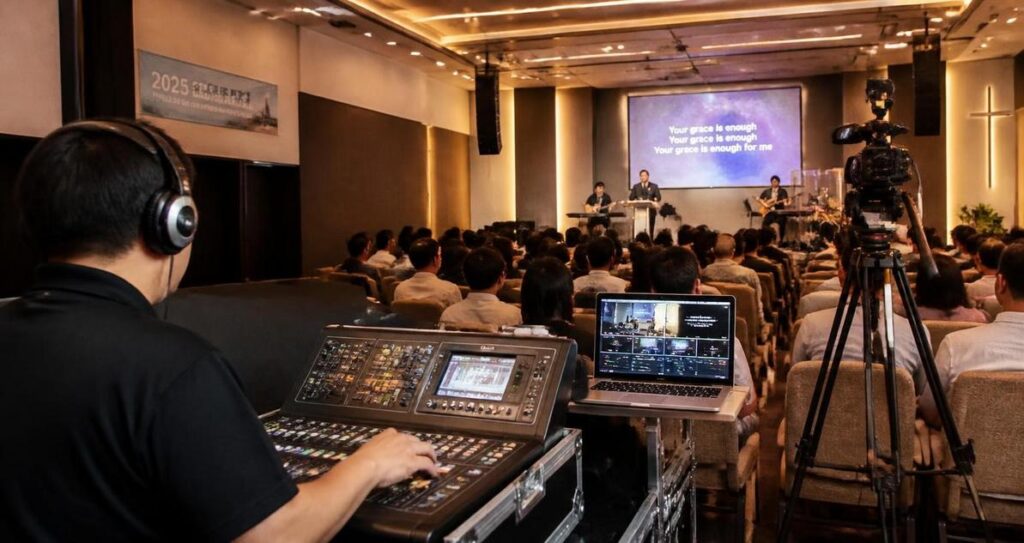
Religious services are often remembered for the spoken word, the music, the prayers, and the quiet moments that carry meaning for the congregation. For many churches, mosques, temples, synagogues, and other places of worship in Singapore, the quality of audio is not a technical detail that sits in the background. It shapes whether a sermon is understood, whether a prayer reaches every corner of the hall, and whether online viewers can stay engaged without strain. In a country where worship spaces may serve multigenerational congregations, multilingual communities, and hybrid audiences joining both in person and remotely, professional audio plays a direct role in whether a service is experienced clearly and respectfully.
Good audio capture is especially important because religious services are not staged like concerts. They often involve spoken segments, singing, group responses, live instruments, ambient congregation sounds, and moments of silence that carry spiritual significance. A microphone setup that is suitable for a conference room may fail in a reverberant sanctuary, while a streaming setup designed only for video may miss the warmth and clarity of the live experience. For Singapore organisations managing services in rented halls, heritage buildings, or multi-purpose venues, the technical challenge is to preserve the integrity of the service without drawing attention to the equipment itself.
Professional audio production does more than make sound louder. It helps maintain intelligibility, balance, and consistency across different parts of a service. It also reduces listener fatigue, which matters for older congregants, children, and viewers who may be listening on phone speakers, headphones, or television soundbars. When handled well, audio supports inclusion, accessibility, and reverence, all of which are important in faith settings.
Why audio quality matters so much in worship settings
Religious services rely heavily on speech. Unlike entertainment programming, where visual spectacle may compensate for weaker sound, a service depends on the congregation hearing prayers, readings, instructions, and reflections clearly. If the voice is muddy, too quiet, distorted, or masked by room echo, meaning is lost. This can affect participation, especially when people need to follow responsive readings, recitations, or sung responses in real time.
Audio quality also affects emotional connection. A sermon or prayer that is clear and natural helps listeners remain present. Poor audio forces people to concentrate on decoding words rather than reflecting on the message. In a live-streamed service, this effect is even stronger because remote viewers have only sound and image to rely on. If audio is inconsistent, they may leave early or struggle to engage with the experience.
In Singapore, many worship communities are linguistically diverse. Services may include English, Mandarin, Malay, Tamil, dialects, or combinations of these languages. Clear audio is essential because accents, tonal differences, and rapid changes between speakers can make comprehension difficult if the sound system is not properly tuned. Professional audio capture ensures each voice remains intelligible without forcing speakers to shout or adopt unnatural pacing.
Speech intelligibility is the primary goal
Speech intelligibility means how easily a listener can understand spoken words. In worship settings, this is the main technical target. It depends on microphone placement, room acoustics, equalisation, speaker coverage, and background noise control. A service may sound acceptable in the front rows, yet remain unclear in the rear seats or in a livestream feed if these elements are not managed carefully.
Professional engineers pay attention to consonant clarity, room reflections, and how different microphones respond to speech. Headset microphones, lapel microphones, handheld microphones, and pulpit microphones each have strengths and limitations. Choosing the right tool depends on the speaker, the movement involved, and the acoustic environment. The aim is not simply amplification, but comprehension.
The technical factors that influence religious service audio
Capturing worship audio well requires more than placing microphones near the stage. Every venue has acoustic properties that influence how sound travels. Hard surfaces such as marble, glass, stone, and tiled floors, which are common in many places of worship and community venues, can create reflections that blur speech. Large open halls can introduce reverberation, while small rooms may produce boxy, cramped sound if the system is not tuned properly.
Professional audio teams begin by understanding the space. They consider ceiling height, wall materials, seating layout, stage position, speaker placement, and crowd density. They also evaluate the likely patterns of use, because a hall that sounds fine during an empty rehearsal may perform very differently when filled with people. Human bodies absorb sound, so the room response changes once the congregation is seated.
Microphone selection and placement
The microphone is the first link in the audio chain, and poor capture cannot be fully corrected later. For sermons and readings, close microphone placement usually offers better clarity than relying on a distant room mic. Lavalier microphones, also known as lapel microphones, can be useful for hands-free speaking, but they must be placed correctly and monitored for clothing noise, breathing noise, and changes in head movement. Headworn microphones often provide more consistent speech pickup because they stay close to the mouth, though they may be more visible and require comfortable fitting.
For group singing, a different strategy is needed. Choirs or worship teams may benefit from a combination of spot microphones and ambient microphones, allowing the richness of the ensemble to be captured without overwhelming the spoken word. Instrument placement matters too. Drums, keyboards, guitars, strings, and traditional instruments all have different volume and frequency profiles, so a one-size-fits-all setup rarely works.
Mixing, equalisation, and dynamic control
Once sound is captured, it must be mixed. Mixing is the process of balancing multiple audio sources so that speech, singing, and instruments sit well together. Equalisation, often called EQ, adjusts different frequency ranges to improve clarity or reduce muddiness. For example, reducing low-frequency rumble can help make speech cleaner, while careful enhancement of midrange frequencies can improve intelligibility.
Dynamic control is equally important. This includes compression and limiting, which help manage differences between soft and loud sounds. Without control, a prayer spoken softly may be hard to hear, while a musical refrain may suddenly become uncomfortably loud. Good dynamic management keeps the listening experience steady and respectful. This matters in worship because volume swings can distract from the spiritual focus of the service.
Acoustic treatment and feedback prevention
Feedback is the sharp, high-pitched sound that happens when a microphone picks up sound from speakers and amplifies it repeatedly. It is one of the most disruptive problems in live audio. Preventing feedback requires correct microphone directionality, speaker positioning, gain staging, and room tuning. Gain staging refers to setting appropriate signal levels at each part of the audio chain so the system remains clean and stable.
Acoustic treatment can also improve performance. This may include panels, curtains, rugs, or other materials that reduce excessive reflections. While not every worship space can undergo major renovation, even modest treatment can improve speech clarity. In Singapore, where venues may be adapted from multi-purpose community spaces, a practical audio plan often matters more than expensive equipment alone.
How professional audio supports livestreams and hybrid worship
Many religious communities in Singapore now serve both onsite and remote audiences. Some members may be overseas, unwell, elderly, or unable to travel, while others simply prefer to join online when schedules are tight. Hybrid worship places extra demands on audio because what sounds acceptable in the room may not translate well to livestream platforms.
Streaming platforms compress audio. That means weak or unbalanced sound becomes even more noticeable after encoding. If the original feed is muddy, too reverberant, or full of background noise, viewers will hear those flaws clearly. Professional audio capture gives the livestream a cleaner source signal, which improves clarity after streaming compression. This is especially important for sermons, scripture readings, announcements, and call-and-response segments.
Hybrid worship also requires consistency. The live congregation hears the room through speakers, while online viewers hear the direct feed through headphones or mobile devices. A skilled audio setup manages both audiences without overcompensating for one at the expense of the other. That may mean using separate mixes, where the in-room sound and the livestream sound are adjusted independently.
Separate mixes for room and stream
A separate livestream mix allows engineers to tailor the online experience without disturbing the live audience. The room mix can include the natural sound of the hall and live speakers, while the stream mix can be shaped for greater clarity and less ambient noise. This is especially useful when there is applause, singing, or congregational response, because online viewers often need a slightly different balance than those seated inside the venue.
In practical terms, this approach helps faith communities avoid common problems such as overly loud music, whispered speech that disappears online, or background chatter that becomes distracting on stream. It also allows the audio team to maintain a respectful and polished presentation for remote participants.
Practical considerations for Singapore congregations and event organisers
Singapore’s worship and event landscape includes heritage buildings, modern auditoriums, hotel ballrooms, rented function rooms, and community facilities. Each venue type presents different audio challenges. Heritage spaces may have acoustic character but limited infrastructure. Ballrooms may offer flexibility but suffer from reflective surfaces. Smaller rooms may need careful microphone and speaker placement to avoid harshness or feedback.
Religious organisations in Singapore often work within practical constraints. Volunteer teams may handle much of the service production, and setup time can be limited. In this setting, clear procedures are essential. A simple pre-service checklist, a soundcheck before doors open, and a backup plan for wireless interference can make a major difference. Professional support is valuable because it reduces the chance of last-minute problems affecting the service.
Wireless audio deserves special attention. In dense urban environments, reliable frequency coordination matters. Interference, battery failure, and poorly matched equipment can interrupt a service at the worst possible moment. Using well-maintained systems, checking batteries, and having spare microphones or cables on hand are practical steps that help protect continuity.
Working with multilingual and multi-speaker services
Many services in Singapore involve multiple speakers, readers, or worship leaders. Some may speak softly, others may move around, and some may transition between languages. Professional audio management helps maintain a consistent experience across all speakers. This may involve standardising microphone types, setting gain levels carefully, and coaching speakers on how to use the microphones correctly.
Speaker training is often overlooked, but it is one of the most effective ways to improve audio. Even the best equipment cannot compensate for a microphone held too far away, covered by clothing, or spoken into from the wrong angle. Brief guidance before the service can prevent many avoidable problems.
When to seek professional audio support
Not every religious organisation needs a full-time technical crew, but services that are regularly streamed, recorded, or held in challenging acoustic spaces benefit from professional involvement. A qualified audio provider can assess the venue, recommend equipment, optimise the signal chain, and design a workflow that suits the community’s service style. This is particularly helpful when the service format includes live music, multiple speakers, ceremonial sequences, or multilingual elements.
Professional support is also important when reliability matters more than experimentation. A service is not the place for unstable equipment choices or improvised setups. Because worship is a meaningful gathering, audio should be treated as a core part of service planning rather than a last-minute add-on. That approach reduces stress for volunteers and helps the congregation focus on the service itself.
If a congregation is considering upgrades, it is useful to review the full audio path, from microphone choice to speaker coverage to livestream output. A modest investment in correct design and setup can improve clarity far more than simply buying more equipment. The most effective system is the one that suits the venue, the users, and the service format.
For Singapore communities that want their religious services to be heard clearly in person and online, professional audio is not just a technical preference. It is part of respectful communication. It supports comprehension, accessibility, and participation, while helping preserve the dignity and atmosphere of worship. Whether the service is intimate or large-scale, a well-planned audio setup allows the message, music, and moments of reflection to reach people as intended.
When reviewing your next service or livestream, start with the simplest question: can every listener understand the voice clearly and comfortably? If the answer is uncertain, the audio system likely needs attention. That is where experienced event and broadcast professionals can make the greatest difference, not by making the service louder, but by making it clearer, steadier, and more faithful to the experience you want to share.

Jeremy Lee is a seasoned digital marketing director and strategist with over two decades of experience in the industry. As the founder of Sotavento Medios, I manage a diverse portfolio of over 50 businesses, helping brands grow through advanced search strategies and digital innovation. My work focuses on bridging the gap between traditional search engine optimisation and the evolving world of AI-driven answer engines.
get in touch