
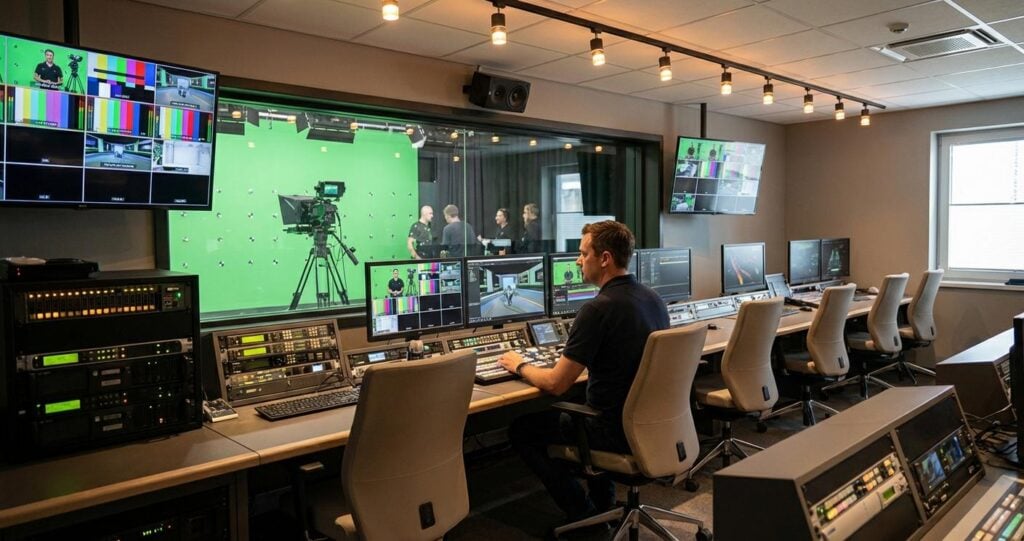
The Role of Motion Tracking in Realistic Virtual Studio Production
In the dynamic realm of B2B event streaming and hybrid production, the pursuit of immersive and engaging visual experiences is paramount. Corporate event planners, AV professionals, and enterprise decision-makers are increasingly seeking solutions that transcend traditional live broadcasts, demanding high-fidelity virtual environments that seamlessly integrate physical presenters with dynamic digital sets. At the core of achieving such photorealistic and interactive virtual studio productions lies advanced motion tracking technology. This technical deep dive from the Spring Forest Studio Technical Team will dissect the intricate mechanisms of motion tracking, its indispensable role in rendering convincing virtual spaces, and its integration within enterprise-grade streaming infrastructure, offering actionable insights for elevating corporate event broadcasting.
Foundations of Virtual Studio Technology and Motion Tracking
Virtual studio production represents a sophisticated convergence of real-time computer graphics, advanced video processing, and precise positional data. Unlike static chroma key compositions, a truly realistic virtual studio allows the camera to move freely within a physical space while its corresponding virtual counterpart moves synchronously within the digital environment. This symbiotic relationship between the physical and virtual camera is facilitated by robust motion tracking systems, which continuously capture and transmit the precise positional and rotational data of the physical camera. Without accurate motion tracking, the virtual set would appear decoupled from the presenter, leading to a jarring and unconvincing viewer experience, severely impacting audience engagement in high-stakes corporate broadcasts.
Camera Tracking Systems: Mechanical, Optical, and Inertial
The methodologies for acquiring camera positional data vary significantly in precision, cost, and complexity. Each system possesses distinct technical characteristics relevant to specific B2B production scenarios:
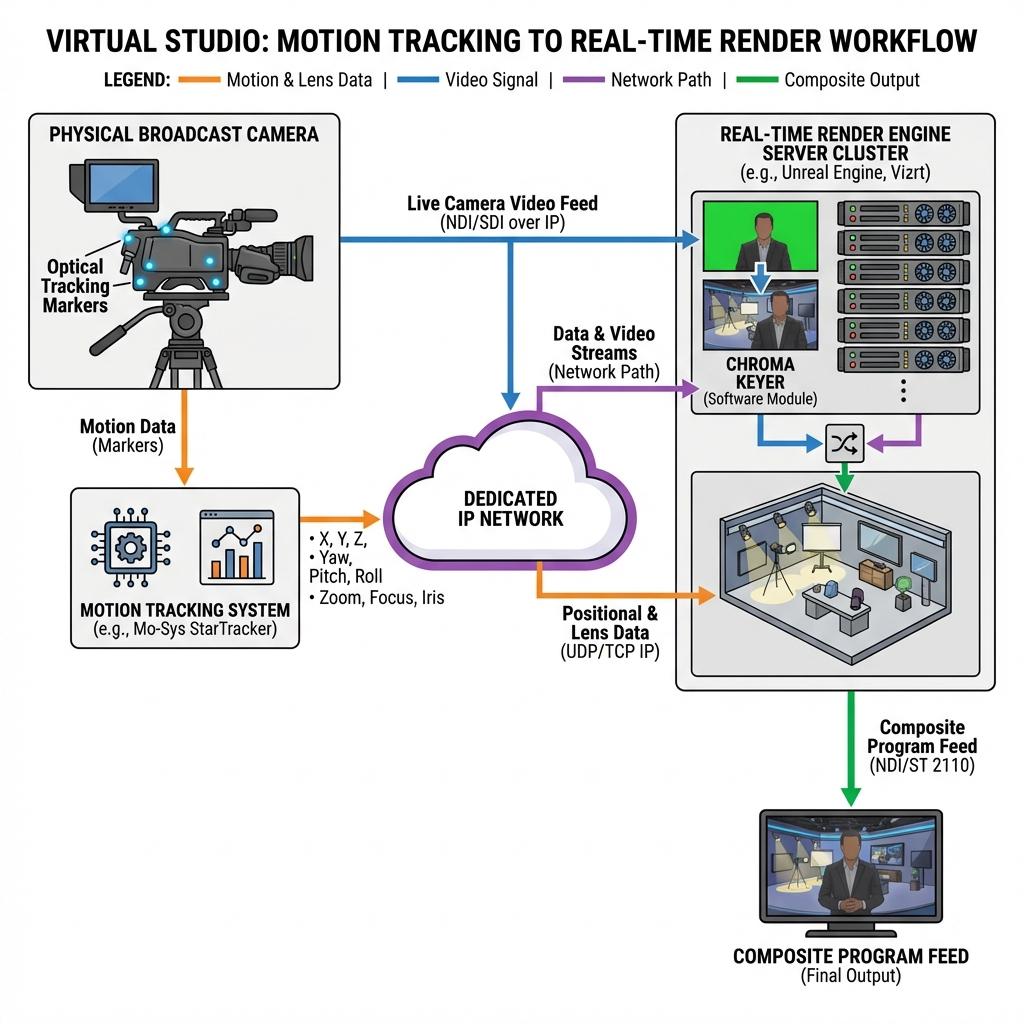
- Mechanical Tracking Systems: These systems, often integrated into professional broadcast pedestals and crane arms, utilize precision encoders attached to the camera’s pan, tilt, zoom, and focus mechanisms. They provide highly accurate, low-latency data streams, typically via serial protocols (e.g., RS-422, RS-485). Their closed-loop nature offers robust positional data, making them a preferred choice for fixed-position or predefined camera movements in high-end studio environments. The data output includes X, Y, Z coordinates for position, and Yaw, Pitch, Roll for rotation, along with zoom and focus values.
- Optical Tracking Systems: Employing either inside-out or outside-in methodologies, optical tracking relies on visual markers or patterns.
- Outside-in Tracking: This common approach uses fixed cameras (often infrared) positioned around the studio space to track active or passive markers affixed to the production camera. The markers are typically retroreflective or emit infrared light, allowing the tracking cameras to triangulate the main camera’s precise location and orientation. Systems like Mo-Sys StarTracker utilize a “star map” of passive reflective dots on the studio ceiling, providing extremely high positional accuracy and resilience to occlusions. Data is typically transmitted over dedicated Ethernet networks.
- Inside-out Tracking: Less common for primary broadcast cameras due to computational demands, this method involves cameras mounted on the main production camera itself, which then analyze the surrounding environment for visual features or markers. While offering greater flexibility for free-roam applications, it requires substantial onboard processing and robust algorithms to maintain stability and accuracy.
- Inertial Tracking Systems (IMU-based): Inertial Measurement Units (IMUs), comprising accelerometers, gyroscopes, and magnetometers, provide rotational data by sensing changes in motion. While excellent for quick, relative movements, IMUs are susceptible to drift over time, necessitating frequent recalibration or fusion with other tracking technologies (e.g., optical or mechanical) for long-duration, absolute positional accuracy in demanding B2B live broadcasts. They are often used as supplementary data streams or for specific applications like handheld virtual cameras where absolute positional data is less critical than rapid responsiveness.
Lens Tracking Data: Zoom, Focus, Iris
Beyond camera body position, lens data is equally critical for photorealistic virtual integration. The focal length (zoom), focus distance, and iris aperture of the physical camera’s lens must be precisely mirrored in the virtual rendering engine. High-end broadcast lenses are equipped with encoders that output these parameters, often via proprietary protocols or industry-standard serial interfaces. This data ensures that the depth of field, field of view, and perspective of the virtual elements match those of the real-world subject, preventing visual discrepancies that could break immersion. Integration involves dedicated lens control units that translate physical adjustments into digital data consumable by the rendering pipeline.
Integration with Real-time Render Engines
The raw motion tracking and lens data must be ingested and processed by a real-time graphics rendering engine. Industry-leading platforms such as Epic Games’ Unreal Engine, Vizrt Viz Artist/Engine, and Brainstorm Infinity are specifically engineered for broadcast virtual production. These engines interpret the incoming data streams to dynamically adjust the perspective of the virtual set, ensuring perfect congruence with the physical camera’s viewpoint. The workflow involves:
- Data Ingestion: Tracking data, often streamed over IP (e.g., UDP, TCP/IP) or serial connections, is received by the render engine.
- Coordinate System Translation: The physical studio’s coordinate system is meticulously mapped to the virtual environment’s coordinate system. This calibration is paramount for accurate placement and scaling of virtual objects.
- Real-time Rendering: The engine renders the virtual set from the calculated camera perspective, compositing it with the live video feed of the presenter. This process demands significant GPU horsepower and optimized rendering pipelines to maintain high frame rates (e.g., 59.94p or 29.97p) and low latency, critical for live event streaming.
Advanced Motion Tracking Techniques for Realistic Virtual Environments
To truly unlock the potential of virtual studios for B2B events, sophisticated tracking techniques move beyond basic camera position, enabling more interactive and dynamic virtual environments.
Free-roam Camera Tracking: Enhancing Dynamic Storytelling
The ability for a camera to move unhindered across a studio floor while maintaining precise tracking data is a significant advancement. This is often achieved through sophisticated optical outside-in systems, where multiple tracking cameras cover the entire studio volume. Such setups require meticulous calibration to create a unified tracking space, allowing operators to execute dynamic, cinematic camera moves that would be impractical or impossible with physical sets. For large-scale corporate keynotes or product launches, free-roam tracking enables a single presenter to interact with multiple virtual elements across a sprawling digital landscape, dramatically enhancing storytelling and visual impact. The complexity escalates with factors like occlusions, requiring robust prediction algorithms and redundant tracking methods to ensure continuous data streams.
Object and Talent Tracking: Interactive Augmented Reality (AR) Overlays
Motion tracking is not limited to cameras; it can also be applied to objects and talent within the studio. By attaching markers to props, presenters, or even remote-controlled drones, augmented reality (AR) graphics can be precisely overlaid onto these elements in real-time. Imagine a CEO interacting with a virtual 3D model of a new product that appears to rest on their hand, or data visualizations dynamically emerging from a panel discussion table. Talent tracking, often achieved with smaller, discreet markers or markerless vision systems, allows virtual elements to follow a presenter as they move, creating highly interactive and personalized experiences. This capability is invaluable for corporate presentations requiring intricate data visualization, interactive product demonstrations, or immersive storytelling that captivates a B2B audience.
Data Synchronization and Latency Management: The Imperative of Precision
In any live production, synchronization is paramount. For virtual studios, the real-time interaction between physical camera movement, virtual set rendering, and the live video feed demands exceptionally tight timing. Latency management is critical; even a few frames of delay between the physical camera’s movement and the virtual set’s update can result in a perceptible “lag” or “swim” of the virtual environment, diminishing realism. Industry standards like SMPTE 2059 (Precision Time Protocol, PTP) are crucial for distributing a highly accurate, synchronized time reference across all connected devices: cameras, tracking systems, render engines, and video switchers. Genlock, or blackburst, provides a common timing pulse for video signals, but PTP extends this synchronization to data networks, ensuring that all components operate on the same precise clock cycle. This minimizes latency and ensures phase alignment, guaranteeing that virtual elements are rendered exactly when and where the physical camera’s data indicates they should be, preserving visual integrity and professionalism for enterprise-grade broadcasts.
Integrating Motion Tracking into Enterprise B2B Streaming Workflows
Deploying motion-tracked virtual studios within an enterprise B2B streaming ecosystem requires a holistic approach, considering robust infrastructure, reliable protocols, and scalable solutions.
Multi-camera Virtual Production Architectures: NDI, SDI over IP
Professional virtual studios typically leverage multiple cameras, each potentially requiring independent motion tracking data. Integrating these feeds into a cohesive virtual environment demands advanced video transport and switching architectures.
- NDI (Network Device Interface): For IP-based workflows, NDI offers a flexible, high-quality, low-latency video over IP solution. NDI|HX (High Efficiency) is suitable for many applications, while full NDI provides higher bitrates and visually lossless compression. NDI streamlines the transport of multiple camera feeds, program feeds, and even alpha channels (for keying) across standard Ethernet networks, simplifying cabling and offering greater scalability for virtual productions in diverse corporate environments.
- SDI over IP (ST 2110, SMPTE 2110): For the most demanding, uncompressed, and ultra-low latency broadcast environments, SMPTE ST 2110 standards separate video, audio, and ancillary data into individual IP streams. This disaggregated approach provides unparalleled flexibility and precision control over each media component. Implementing ST 2110 requires a robust, high-bandwidth network infrastructure (e.g., 10 Gigabit Ethernet or 25 Gigabit Ethernet) and specialized IP gateways and switches, typically found in large-scale broadcast facilities or high-tier enterprise production centers. The benefits for virtual studios include pristine signal quality and the ability to process each component stream independently before compositing, which is crucial for achieving broadcast-grade realism.
These protocols facilitate the efficient routing of live camera feeds, the output of the virtual render engines, and the final composite program feed to vision mixers, encoders, and ultimately, the streaming distribution platforms.
Real-time Compositing and Keying: The Art of Seamless Integration
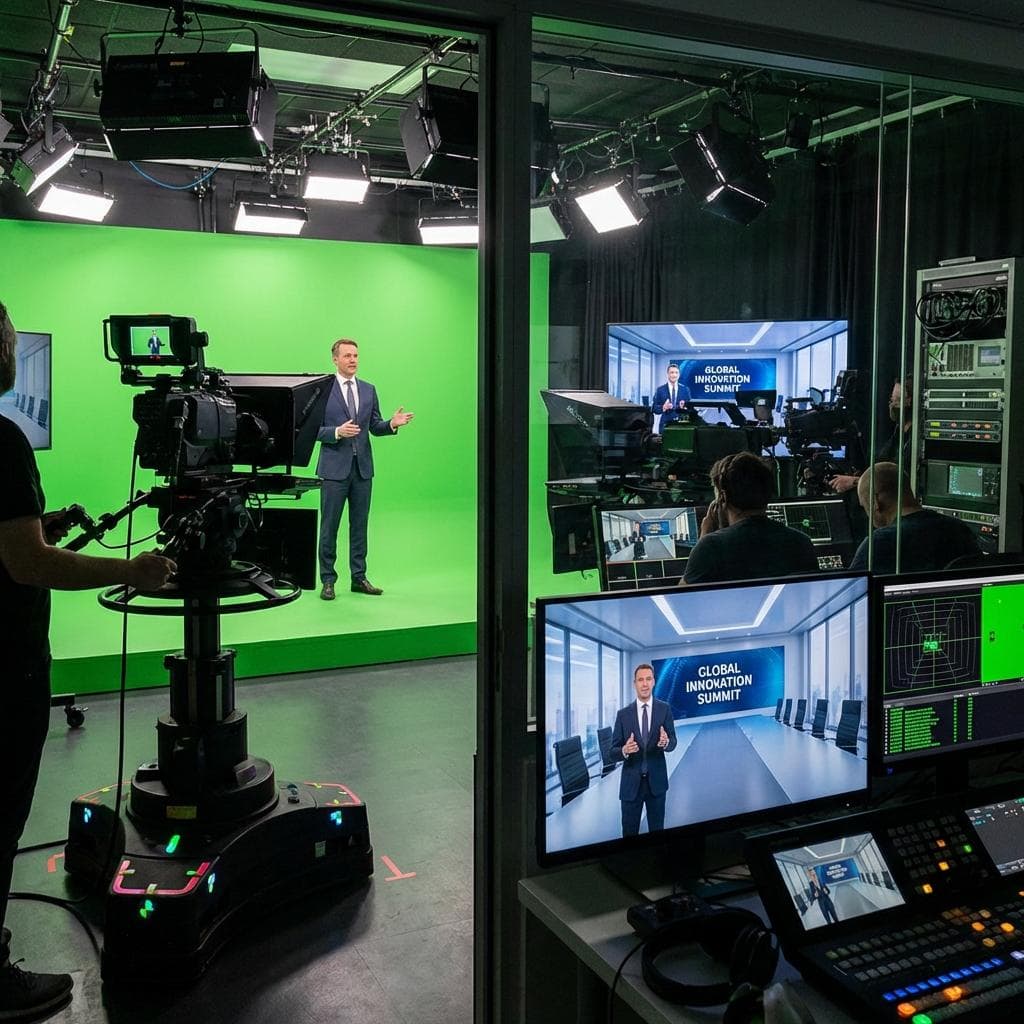
The magic of virtual studio production lies in the real-time compositing of the live presenter with the virtual environment. This process fundamentally relies on precise chroma keying. High-quality chroma keyers, whether hardware-based (e.g., Ross Carbonite, Grass Valley K-Frame) or software-based within the render engine, must accurately extract the presenter from the green or blue screen background, generating a clean alpha channel. Any imperfections in the key, such as spill (color contamination from the background) or poor edge detection, will instantly break the illusion of realism. Advanced keying algorithms, often incorporating sophisticated spill suppression and matte manipulation, are essential for achieving broadcast-grade integration. The render engine then combines the keyed foreground with the dynamically rendered background, creating a single, cohesive program output.
Signal Flow and Infrastructure Considerations: Powering the Virtual Dream
An enterprise-grade virtual studio infrastructure is a complex ecosystem.
- GPU Clusters: Real-time rendering of photorealistic virtual sets, especially in 4K/UHD resolutions and with complex lighting/shadows, demands substantial graphical processing power. This often necessitates dedicated GPU clusters, comprising multiple high-end graphics cards, to handle the rendering load across various render engines and output streams.
- Network Bandwidth: For IP-based workflows (NDI, ST 2110) and the transmission of uncompressed video, significant network bandwidth is non-negotiable. A dedicated, high-speed network fabric (e.g., 10GbE, 25GbE, or even 100GbE for ST 2110 environments) is required to ensure low-latency, high-fidelity signal delivery. This network must be meticulously engineered with appropriate QoS (Quality of Service) settings to prioritize time-sensitive media traffic.
- Dedicated Fiber Optic Connectivity: For long-distance signal runs within a large corporate campus or between a studio and a remote control room, fiber optic cabling (e.g., OM3/OM4 multimode, OS2 singlemode) provides superior bandwidth, immunity to electromagnetic interference, and extended reach compared to copper cabling, making it ideal for the backbone of a professional streaming infrastructure.
- Control Surfaces: Operators require intuitive control surfaces (physical or software-based) to manage camera parameters, virtual set elements, lighting, and compositing layers in real-time.
Overcoming Technical Challenges and Ensuring Broadcast Quality
While the capabilities of motion tracking are immense, its implementation presents specific technical hurdles that must be addressed for reliable, broadcast-quality B2B event streaming.
Calibration and Drift Correction: Maintaining Positional Integrity
The accuracy of any motion tracking system hinges on meticulous calibration. This involves precisely mapping the physical studio space to its virtual counterpart, often using fixed calibration points or known geometric shapes. Environmental factors such as temperature fluctuations, physical vibrations, or even subtle changes in lighting can introduce “drift” over extended periods, causing the virtual set to slowly become misaligned with the physical camera. Professional systems employ automated recalibration routines, often utilizing markerless or fiducial-based systems that continuously monitor the tracking environment for inconsistencies. Manual recalibration checkpoints during rehearsals and live production breaks are also essential best practices to ensure continuous positional integrity and prevent visual discrepancies during a live corporate broadcast.
Lighting Integration and Photorealism: Harmonizing Real and Virtual
Achieving true photorealism requires seamless integration of physical and virtual lighting. The lighting conditions on the physical green screen stage must be meticulously matched in the virtual environment. This involves replicating real-world light sources (e.g., key lights, fill lights, backlights) as virtual lights within the render engine, ensuring that shadows cast by the presenter and reflections on virtual surfaces appear natural and consistent. Real-time global illumination, ambient occlusion, and physically-based rendering (PBR) techniques within the render engine are crucial for producing convincing interactions between the real and virtual elements. Color grading and final post-processing, even in live scenarios, play a significant role in unifying the aesthetic and maintaining a cohesive visual quality across the entire production, delivering a polished, high-end presentation for discerning enterprise audiences.
Scalability, Redundancy, and Failover: Enterprise-Grade Reliability
For B2B event streaming, especially for large-scale corporate events, the infrastructure must be resilient.
- Scalability: As production demands grow, the virtual studio system must scale. This could involve adding more rendering nodes (GPUs), expanding network bandwidth, or integrating additional tracking cameras. Cloud-based rendering solutions are emerging as a scalable option, allowing render processing to be dynamically allocated based on demand, reducing on-premise hardware requirements and offering flexibility for fluctuating production loads.
- Redundancy: Critical components, from tracking sensors and data processors to render engines and video switchers, should have redundant backups. Hot-swappable components and N+1 or 1+1 redundancy configurations for core processing units are essential.
- Failover Strategies: Automated failover mechanisms are paramount. If a primary render engine or tracking system encounters an issue, a backup system must take over instantaneously and seamlessly, ideally without any noticeable disruption to the live stream. This often involves parallel processing, where a duplicate system runs concurrently, ready to become active at a moment’s notice. Implementing redundant power supplies (UPS, generator backups) for all critical infrastructure components is also a non-negotiable aspect of enterprise-grade production.
These considerations ensure uninterrupted, high-quality delivery, safeguarding the reputation and impact of crucial corporate communications.
Technical Recommendations and Implementation Guidelines for Enterprise Clients
For enterprise clients considering or expanding their virtual studio capabilities, Spring Forest Studio offers the following technical recommendations:
- Comprehensive Site Assessment: Prioritize a detailed evaluation of the existing physical studio space, network infrastructure, and power capabilities. This forms the bedrock for selecting appropriate tracking technologies and render engines.
- Invest in Robust Tracking: Opt for high-precision optical tracking systems (e.g., Mo-Sys StarTracker) for fixed or free-roam cameras, potentially augmented with IMU for specific handheld applications, to ensure consistent and accurate positional data.
- Dedicated High-Bandwidth Network: Establish a dedicated network segment for virtual production traffic, utilizing 10GbE or higher, with meticulous QoS configuration to prioritize real-time media streams (NDI, ST 2110 data, tracking data).
- Powerful Real-time Render Engines: Allocate significant GPU resources, potentially in a cluster configuration, to ensure smooth, low-latency rendering of complex virtual sets at target resolutions and frame rates (e.g., 1080p59.94 or 2160p29.97).
- Precision Synchronization: Implement a PTP (SMPTE 2059) timing system across all relevant devices to maintain microsecond-level synchronization between cameras, tracking, render engines, and video switchers.
- Professional Chroma Keying Solutions: Utilize broadcast-grade hardware keyers or integrated software keyers with advanced spill suppression and matte control to achieve pristine foreground extraction.
- Rigorous Calibration Procedures: Develop and adhere to strict calibration schedules and procedures for all tracking systems, including regular drift correction, to maintain positional accuracy throughout production cycles.
- Redundancy and Failover Planning: Design the system with N+1 or 1+1 redundancy for all critical components (tracking servers, render engines, switchers) and implement automated failover protocols to guarantee uninterrupted live streams.
- Skilled Technical Personnel: Ensure that production teams are extensively trained in virtual studio workflows, encompassing tracking system operation, render engine management, and real-time compositing techniques.
By meticulously integrating motion tracking technology into a robust, enterprise-grade production infrastructure, B2B organizations can unlock unparalleled creative possibilities, delivering virtual events that are not only visually stunning but also technically flawless and profoundly engaging. Spring Forest Studio stands ready to partner with enterprise clients to design, implement, and support these advanced virtual production solutions, ensuring every broadcast achieves its maximum impact.

Jeremy Lee is a seasoned digital marketing director and strategist with over two decades of experience in the industry. As the founder of Sotavento Medios, I manage a diverse portfolio of over 50 businesses, helping brands grow through advanced search strategies and digital innovation. My work focuses on bridging the gap between traditional search engine optimisation and the evolving world of AI-driven answer engines.
get in touch