
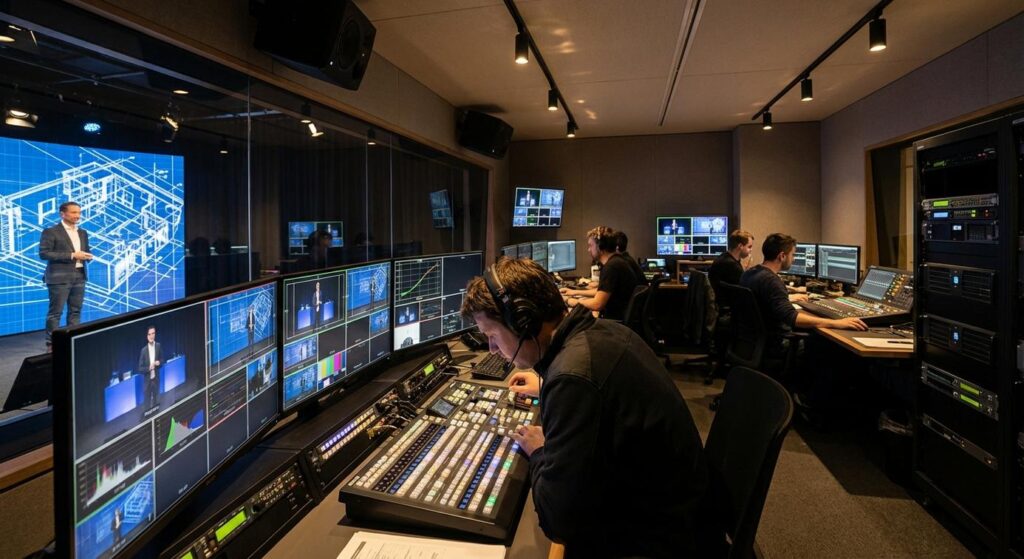
In the evolving landscape of B2B communication and corporate training, the demand for highly engaging and technically precise educational content is paramount. Traditional webinars, while effective for information dissemination, often fall short in conveying complex technical concepts with the clarity and impact required by sophisticated enterprise audiences. Spring Forest Studio understands this critical challenge, positioning immersive 3D technical diagrams as a transformative solution. This advanced approach moves beyond static slides, offering dynamic, interactive visualizations that significantly enhance comprehension, retention, and overall attendee engagement in live B2B streaming and hybrid event environments.
The integration of real-time 3D technical diagrams into live educational webinars represents a significant leap in production complexity and technical sophistication. It necessitates a robust understanding of advanced graphics rendering, high-fidelity signal acquisition, precise synchronization, and enterprise-grade streaming infrastructure. Our expertise focuses on engineering seamless workflows that bridge advanced visualization tools with professional broadcast production standards, ensuring a superior visual and auditory experience for both in-person and remote participants. This article will delve into the intricate technical requirements and strategic implementation protocols essential for deploying such immersive visual aids in a professional B2B context, moving beyond consumer-grade streaming paradigms to deliver truly impactful enterprise solutions.
The Technical Imperatives of Integrating 3D Diagrams into Live Streams
The successful integration of immersive 3D technical diagrams into a live streaming environment begins with a meticulously engineered production pipeline. This process demands stringent technical considerations from content creation through final delivery, ensuring visual fidelity and real-time performance. The foundation involves robust hardware and software capable of handling intensive graphical workloads, coupled with low-latency signal transport mechanisms.
Real-time Rendering and Encoding Architectures
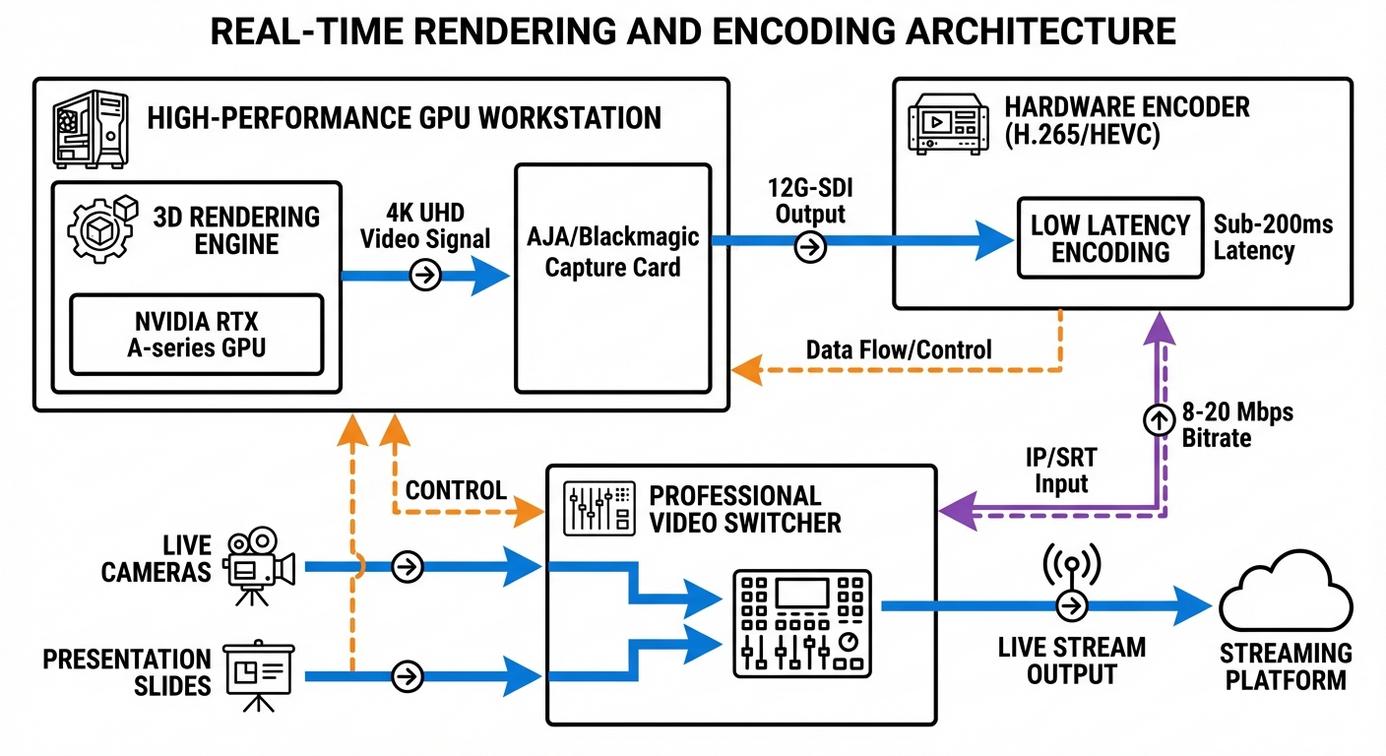
The core of dynamic 3D diagram integration lies in the real-time rendering capabilities. This typically involves high-performance workstations equipped with professional-grade Graphics Processing Units (GPUs) from manufacturers such as NVIDIA (e.g., Quadro or RTX A-series) or AMD (e.g., Radeon Pro W-series). These GPUs are critical for accelerating the computation of complex 3D models, textures, lighting, and animation, ensuring smooth frame rates, often targeting 60 frames per second (fps) for fluid motion. The rendering engine itself, whether it is a dedicated 3D application like Autodesk Maya, SolidWorks, or a real-time engine such as Unity or Unreal Engine, must be optimized for live output. This optimization includes efficient polygon counts, LOD (Level of Detail) management, and pre-baked lighting solutions where possible to reduce computational load. The output from these rendering systems, often a high-resolution feed (e.g., 1080p, 4K/UHD), must then be ingested by the production switcher.
Encoding architectures play an equally vital role. Once the 3D content is rendered, it must be encoded for integration into the broader streaming workflow. This typically involves hardware encoders that support H.264 (AVC) or H.265 (HEVC) codecs, capable of maintaining visual quality at bitrates optimized for enterprise network conditions, commonly ranging from 8 Mbps to 20 Mbps for 1080p and significantly higher for 4K/UHD content. Latency is a critical metric; end-to-end latency, from rendering to display, must be minimized, ideally below 200 milliseconds (ms) for interactive experiences. This is achieved through carefully selected encoding presets, GPU-accelerated encoding, and efficient streaming protocols.
Signal Acquisition and Integration Workflows
Acquiring the rendered 3D content for inclusion in the live program feed necessitates professional-grade signal integration. For local, on-premise production, this involves high-bandwidth digital interfaces such as Serial Digital Interface (SDI) for broadcast environments (e.g., 12G-SDI for 4K UHD at 60p) or HDMI 2.1 for workstation connectivity. Capture cards, such as those from AJA or Blackmagic Design, are utilized to convert these baseband signals into a format usable by the video switching system. These cards often support various color spaces, with Rec. 709 being standard for broadcast and web content, ensuring color accuracy and consistency across all visual elements.
For distributed or hybrid production scenarios, IP-based signal transport protocols become essential. Network Device Interface (NDI) offers a robust, low-latency solution for sending high-quality video, audio, and metadata over standard IP networks. NDI|HX, a lower-bandwidth version, is suitable for environments with more constrained network resources. Secure Reliable Transport (SRT) protocol, an open-source video transport protocol, provides secure, low-latency, and reliable video delivery over unreliable networks, making it ideal for ingesting 3D content rendered on remote machines or from geographically dispersed contributors. Real-Time Messaging Protocol (RTMP) or RTMPS (Secure RTMP) remain workhorses for contribution to streaming platforms, but for internal production signal paths, NDI or SRT offer superior performance and flexibility for multi-source integration. Precise synchronization between these diverse sources and the 3D content output is managed at the production switcher level, often using genlock and frame synchronizers to eliminate artifacts and ensure seamless transitions.
Advanced Production Workflows for Dynamic 3D Content
Beyond signal acquisition, the dynamic integration of 3D diagrams demands sophisticated production workflows that ensure seamless presentation, presenter control, and audience engagement. This involves careful orchestration of multiple video sources, audio elements, and interactive controls within a professional production environment.
Multi-Source Switching and Composition
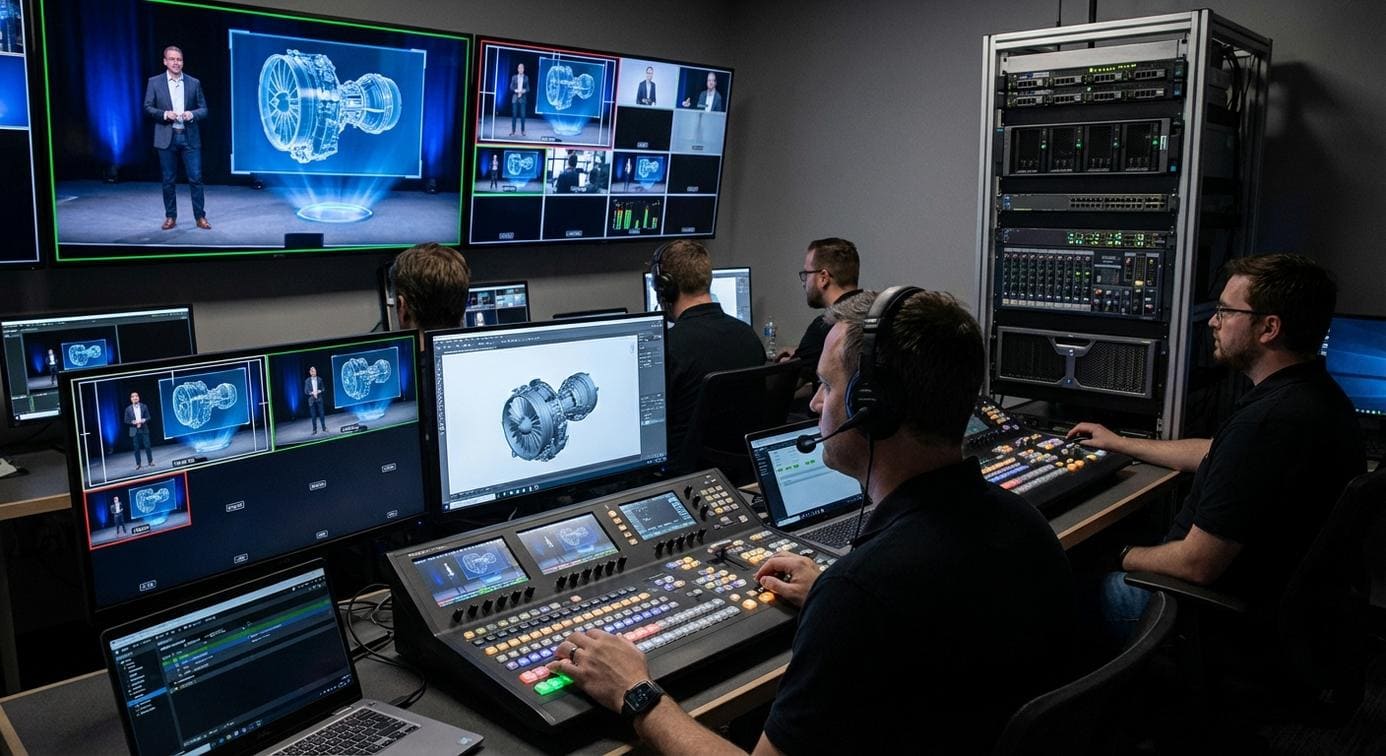
Professional video switchers, whether hardware-based (e.g., Ross Carbonite, Grass Valley K-Frame, Blackmagic ATEM) or software-defined (e.g., vMix, OBS Studio in a professional context, or dedicated broadcast automation systems), are central to composing the final program feed. These systems enable real-time switching between camera feeds, presentation slides, and the live 3D diagram output. Digital Video Effects (DVEs) units within the switcher are crucial for picture-in-picture (PiP) arrangements, allowing the presenter to be visible alongside the 3D model, or for complex multi-layer compositions. Advanced keying techniques, including chroma key (for green screen virtual sets) and luminance key, are employed to seamlessly overlay 3D elements onto other video backgrounds, creating an immersive, integrated visual experience. The switcher operator, often working on a dedicated control surface, executes these transitions with precision, responding to the presenter’s cues and the flow of the educational content. Multiview monitoring is essential for the technical director and production team, displaying all camera inputs, program feed, preview feed, and auxiliary outputs simultaneously on a single or multiple screens, facilitating critical real-time decision-making.
Synchronized Audio and Visual Delivery
Achieving perfect synchronization between the presenter’s narration, any supplementary audio, and the dynamic 3D visuals is paramount for an authoritative and trustworthy presentation. Audio mixing consoles (e.g., Yamaha Rivage, Behringer X32, or Dante/AES67-enabled digital mixers) manage multiple audio inputs, including presenter microphones, audience Q&A mics, and embedded audio from video sources. Audio processing, including equalization, compression, and noise reduction, ensures pristine speech clarity. The program audio feed is then carefully embedded into the video stream, typically via SDI or into the IP stream, maintaining exact lip-sync. This often requires precise audio delay management at the mixing console or through frame synchronizers equipped with audio delay capabilities, measured in milliseconds, to compensate for varying video processing latencies. Talkback systems provide essential communication pathways between the director, technical crew, and presenter, ensuring coordinated execution of cues and dynamic adjustments during the live event.
Interactivity and Presenter Control
To truly elevate educational webinars, presenters must have intuitive control over the 3D diagrams. This moves beyond simple playback to real-time manipulation, such as rotating models, exploding assemblies, highlighting specific components, or toggling layers of information. This interactivity is often achieved through custom-programmed control surfaces, such as Stream Decks or dedicated touchscreen interfaces, which trigger macros or API calls to the 3D rendering application. Integration with presentation software like Microsoft PowerPoint or Google Slides can also facilitate seamless transitions between traditional slide content and live 3D demonstrations, allowing the presenter to drive the narrative flow directly. This level of dynamic control empowers educators to respond spontaneously to audience questions and tailor the visual explanation on the fly, mimicking an in-person, hands-on demonstration and significantly boosting engagement.
Enterprise Streaming Infrastructure for Immersive Experiences
Delivering high-fidelity 3D content globally requires a robust and resilient enterprise streaming infrastructure, meticulously engineered for performance, scalability, and reliability. This is not merely about bandwidth; it involves a holistic approach to network design, encoding strategies, and redundancy protocols.
Network Architecture and Bandwidth Management
Professional B2B streaming necessitates a dedicated, optimized network architecture. This typically involves separating streaming traffic onto its own VLAN (Virtual Local Area Network) within the corporate network to prevent contention with other enterprise data. Quality of Service (QoS) policies are configured on network switches and routers to prioritize video and audio packets, minimizing latency and jitter. For 4K/UHD streams with complex 3D graphics, egress bandwidth requirements can be substantial, often exceeding 50 Mbps per stream for uncompressed or lightly compressed IP video, and 10-25 Mbps for highly optimized H.265 encoded streams delivered via CDN. Network architects must provision sufficient dedicated internet bandwidth and ensure redundant pathways to prevent single points of failure. Technologies like IP multicast can efficiently distribute a single stream to multiple internal recipients, conserving bandwidth within the local area network, while unicast is used for wider internet distribution. Careful bitrate management, adjusting the encoding parameters dynamically based on network conditions and content complexity, is vital to maintaining a consistent, high-quality viewer experience.
Encoding and Transcoding for Multi-Platform Delivery
The final stage of content preparation before distribution involves advanced encoding and transcoding. Enterprise-grade encoders, whether purpose-built hardware appliances (e.g., Elemental Live, Haivision Makito X) or robust software encoders running on powerful servers, convert the program feed into various output formats and bitrates for adaptive bitrate (ABR) streaming. ABR is crucial for delivering content effectively across diverse viewer devices and network conditions, providing multiple renditions (e.g., 360p, 720p, 1080p, 4K) that clients can dynamically switch between. Cloud-based transcoding services offer scalability and flexibility, automatically generating multiple profiles and offloading compute-intensive tasks, while on-premise solutions provide maximum control and often lower latency for mission-critical events. Content Delivery Networks (CDNs) are indispensable for global distribution, caching content at edge locations closer to viewers, significantly reducing latency, improving load times, and ensuring consistent playback quality irrespective of geographic location. This infrastructure is designed to handle thousands, even tens of thousands, of concurrent viewers without degradation of service.
Redundancy and Failover Strategies
For mission-critical B2B educational webinars, an N+1 redundancy strategy is non-negotiable. This involves duplicating every critical component in the streaming chain: cameras, microphones, video switchers, encoders, network pathways, and internet egress points. In the event of a primary system failure, a redundant backup system can take over seamlessly, often within milliseconds, preventing service interruption. This includes redundant power supplies, dual network interface cards, and redundant servers configured for automatic failover. Path diversity, utilizing multiple internet service providers (ISPs) and separate physical network routes, mitigates against widespread network outages. Real-time monitoring of all system parameters, including CPU utilization, network throughput, video quality metrics (e.g., PSNR, SSIM), and error rates, is performed by a dedicated technical operations center (TOC). Automated alerts and pre-configured failover scripts ensure a rapid response to any detected anomalies, maintaining an uninterrupted, high-quality streaming experience for the enterprise audience. Compliance with ISO standards for information security and operational resilience is often a key consideration for enterprise clients.
Elevating Hybrid Event Engagement with 3D Visualizations
The immersive capabilities of 3D technical diagrams are particularly impactful in hybrid event environments, where the challenge is to create an equally engaging experience for both physical and virtual attendees.
Bridging Physical and Virtual Audiences
For in-person audiences, large format LED walls or projection systems display the 3D content with stunning clarity, often integrated into a physical stage set. Simultaneously, the identical high-fidelity feed is distributed to virtual participants. The goal is parity of experience. Integration with leading enterprise communication platforms such as Microsoft Teams, Zoom, and Webex is achieved through dedicated hardware or software virtual camera outputs, ensuring that the enhanced program feed, complete with dynamic 3D diagrams, appears as a high-quality video source within these platforms. This allows for the full functionality of these platforms, including Q&A, chat, and polling, to be leveraged while providing superior visual content. The seamless blending of a physically present speaker with a dynamically rendered 3D diagram, equally visible and controllable for both audiences, significantly enhances the educational value and engagement for all participants.
Scalability and Global Reach
Scaling the delivery of rich, high-resolution 3D content to a global audience demands a robust and intelligently designed streaming architecture. This involves leveraging geographically distributed CDNs, as discussed, and optimizing bitrate ladders for a truly international audience, considering varying internet speeds and infrastructure. Cloud-native streaming platforms provide the elasticity required to handle sudden spikes in viewership, automatically scaling resources to meet demand without manual intervention. Secure token-based authentication and geo-blocking capabilities ensure that content is delivered only to authorized viewers in specified regions, adhering to enterprise security and compliance policies. This ensures that a complex, visually rich educational webinar delivered from a single production facility can reach thousands of engineers, product managers, or sales professionals across continents without compromising quality or performance.
Post-Production and Archiving Considerations
The value of immersive 3D content extends beyond the live event. Professional production workflows include ISO recording (isolated recording) of individual camera feeds and the clean program feed, allowing for meticulous post-production. This enables the creation of refined on-demand versions, where specific segments featuring 3D diagrams can be highlighted, re-edited, or combined with additional voiceovers and graphics. Metadata tagging, often in XML format, is crucial for categorizing and searching archived content, making it easily discoverable in enterprise learning management systems (LMS) or video asset management (VAM) platforms. The ability to repurpose these high-value 3D assets for future training modules, marketing content, or internal documentation amplifies their return on investment, providing a lasting educational resource that maintains its technical fidelity and visual impact long after the live stream concludes.
Conclusion: Spring Forest Studio’s Expertise in Immersive Technical Production
Elevating educational webinars with immersive 3D technical diagrams is no longer a futuristic concept; it is a present-day imperative for enterprises seeking to convey complex technical information with unparalleled clarity and engagement. This advanced production approach demands not just creative vision, but a deep, granular understanding of broadcast-grade equipment, IP networking, advanced encoding, and robust streaming protocols. From high-performance GPU rendering to N+1 redundant streaming infrastructure, every component must be meticulously engineered and expertly managed. Spring Forest Studio stands as your trusted partner in navigating these technical complexities, offering end-to-end B2B event streaming and hybrid production services. Our technical team possesses the expertise to design, implement, and execute immersive webinar solutions that leverage dynamic 3D visualizations, transforming passive viewing into an active, highly educational experience. Partner with us to deliver technical webinars that truly resonate, educate, and empower your enterprise audience with unparalleled visual and informational depth.
Jeremy Lee is a seasoned digital marketing director and strategist with over two decades of experience in the industry. As the founder of Sotavento Medios, I manage a diverse portfolio of over 50 businesses, helping brands grow through advanced search strategies and digital innovation. My work focuses on bridging the gap between traditional search engine optimisation and the evolving world of AI-driven answer engines.
get in touch