
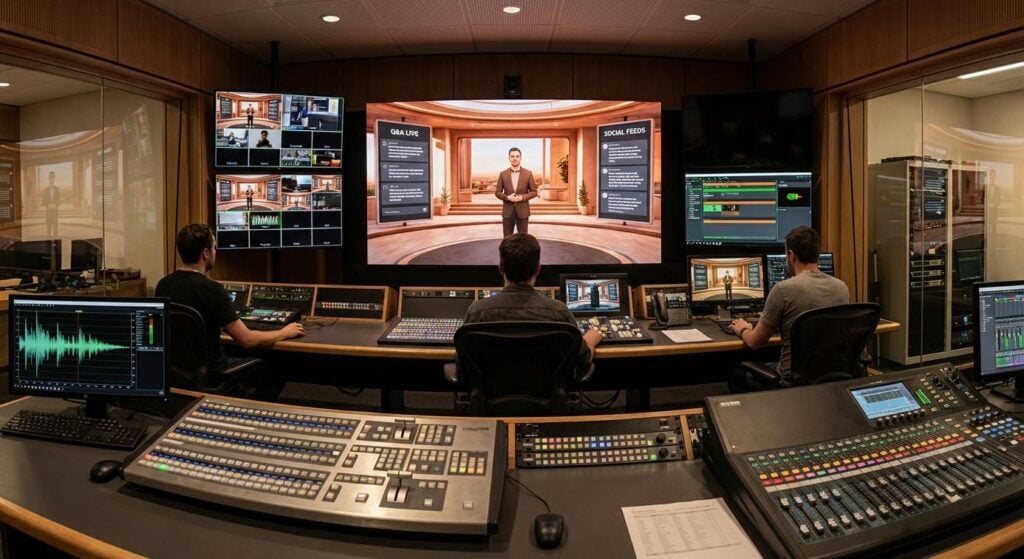
How to Integrate Live Social Feeds into 3D Virtual Studio Environments
In the evolving landscape of high-stakes B2B event streaming and hybrid production, the integration of live social feeds into sophisticated 3D virtual studio environments represents a significant advancement in audience engagement and content dynamism. This intricate process transcends basic graphic overlays, demanding a robust understanding of real-time data acquisition, secure protocol translation, advanced rendering techniques, and broadcast-grade output architectures. For corporate event planners, AV professionals, production managers, and IT directors, mastering this integration is paramount to delivering immersive, interactive, and impactful virtual and hybrid experiences that resonate with enterprise decision-makers.
The technical challenge lies in harmonizing disparate systems: the often asynchronous, distributed nature of social media platforms with the highly synchronized, low-latency demands of live broadcast production within a photorealistic virtual space. This requires meticulous planning across data ingest, processing, rendering, and distribution pipelines, leveraging industry-standard protocols and enterprise-grade infrastructure to maintain stability, security, and superior quality of service (QoS) throughout the event lifecycle.
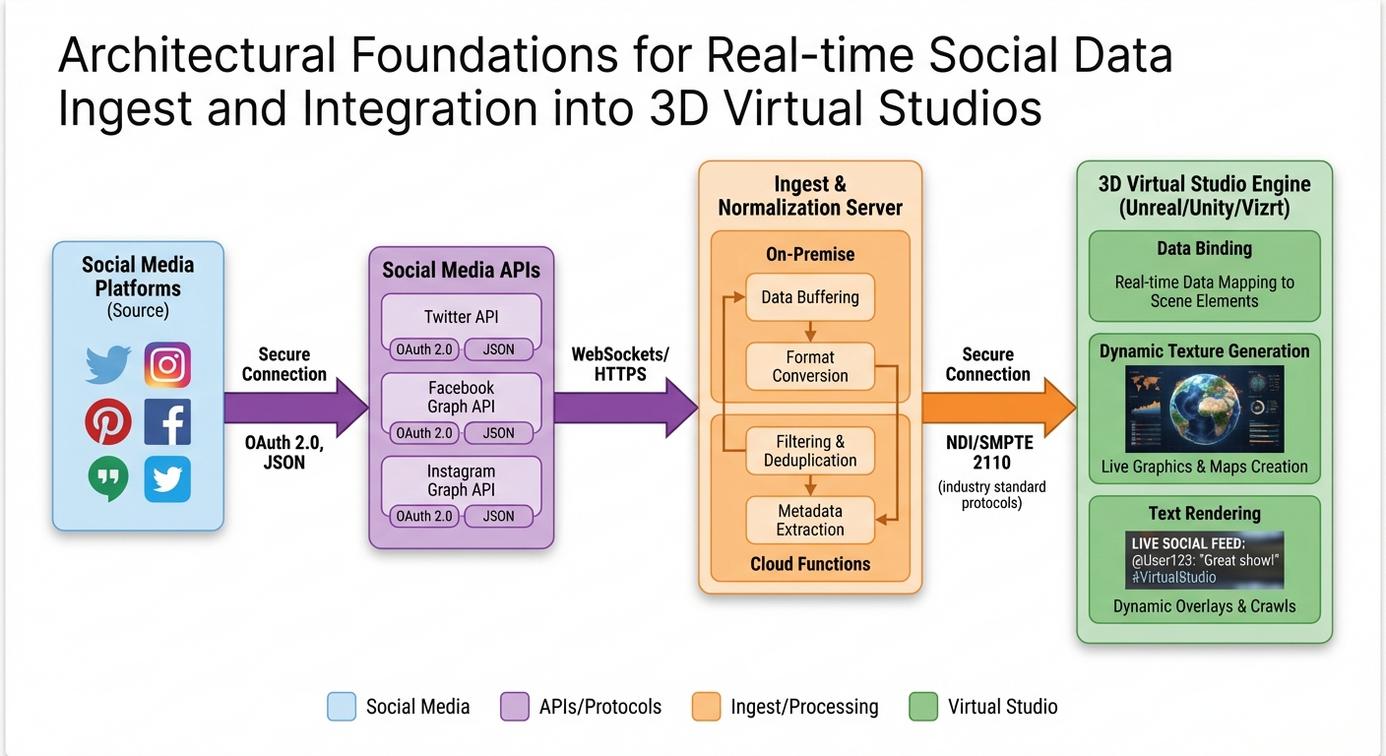
Architectural Foundations for Real-time Social Data Ingest
The initial and critical phase of integrating live social feeds into a 3D virtual studio involves establishing a resilient and low-latency architecture for data acquisition. This foundation dictates the speed, reliability, and security of the social content stream.
Social Media API Integration and Data Normalization
Direct integration with social media platforms necessitates leveraging their respective Application Programming Interfaces (APIs). Each platform, such as Twitter, LinkedIn, or even dedicated event platforms with integrated chat functionalities, exposes distinct API endpoints for accessing real-time data. This process begins with secure authentication, typically via OAuth 2.0, establishing a trusted connection between the ingest system and the social platform. Data retrieved is commonly in JSON (JavaScript Object Notation) format, containing user posts, comments, hashtags, user profiles, and timestamps. A crucial technical step is data normalization: transforming these varied JSON structures into a consistent, standardized schema within the ingest system. This involves parsing specific fields, filtering irrelevant data, and standardizing metadata for uniform processing, regardless of the originating social platform. API rate limits and quotas must be meticulously managed to prevent service interruptions, often requiring robust queuing and retry mechanisms.
Data Transport Protocols for Low Latency Ingest
For real-time social data, traditional HTTP polling can introduce unacceptable latency. Modern solutions prioritize push-based communication. WebSockets are a preferred protocol for maintaining persistent, full-duplex communication channels between the client (ingest server) and the social media API, enabling instantaneous push notifications of new social activity. This significantly reduces latency compared to repeated HTTP requests. For specific event-driven architectures or when integrating with IoT devices that might contribute to a social feed (e.g., audience sentiment sensors), MQTT (Message Queuing Telemetry Transport) can be employed due to its lightweight publish-subscribe model. However, for the primary social feed, WebSockets typically provide the optimal balance of real-time performance and broad platform support. All data transport must employ TLS/SSL encryption to ensure data confidentiality and integrity, aligning with enterprise security standards.
On-Premise vs. Cloud-based Ingest and Processing
The choice between an on-premise dedicated ingest server and a cloud-based solution (e.g., AWS Lambda, Azure Functions, Google Cloud Functions) carries significant implications for scalability, redundancy, and operational expenditure. On-premise solutions offer maximum control over hardware, network infrastructure, and data sovereignty, appealing to organizations with stringent security policies or existing broadcast infrastructure. However, they require careful provisioning for peak load capacity and robust failover strategies. Cloud-based solutions provide inherent scalability, allowing dynamic resource allocation based on event activity, and often integrate seamlessly with global Content Delivery Networks (CDNs). They excel in providing geographical distribution for reduced latency to distributed social APIs and offer built-in redundancy mechanisms. A hybrid approach, using cloud functions for initial ingest and normalization, then relaying processed data to an on-premise virtual studio system via a secure, dedicated link (e.g., VPN over an enterprise-grade fiber optic connection), often presents the most balanced solution for demanding B2B productions.
Bridging the Gap: Integrating Data into 3D Virtual Studio Engines
Once social data is securely ingested and normalized, the next challenge is to bridge the gap between abstract data and its visual representation within the real-time 3D virtual studio environment.
Virtual Studio Platforms and Their Data Interfaces
Leading 3D virtual studio platforms like Unreal Engine and Unity, along with specialized broadcast graphics engines such as Vizrt, Ross XPression, and ChyronHego, serve as the rendering backbone. These platforms offer various methods for external data ingestion. Unreal Engine, for instance, can utilize its nDisplay framework for multi-display setups, Live Link for real-time motion data, or custom C++ plugins to establish direct data conduits. Data can be injected as dynamic textures, text fields, or even drive skeletal animations of virtual characters. Unity, conversely, allows C# scripting to parse incoming data and manipulate scene objects, textures, and UI elements via its Scriptable Render Pipeline. Specialized broadcast graphics engines often feature proprietary data connectors designed for real-time sports statistics, news feeds, and, crucially, social media integration. Understanding the specific data interface capabilities and limitations of the chosen engine is paramount for efficient and scalable integration.
Data-Driven Graphics and Real-time Textures
The transformation of normalized social data into visually compelling, renderable assets is a core technical process. This involves mapping data fields (e.g., `user_name`, `post_text`, `profile_picture_URL`) to specific graphical elements within the virtual studio. Dynamic text objects within the engine can be bound directly to incoming text strings, updating in real time. User avatars or associated images can be downloaded, cached, and rendered as real-time textures, often requiring on-the-fly resizing and format conversion to optimize GPU performance. Complex social feeds, such as continuously scrolling comment sections or interactive polls, necessitate custom UI elements designed within the virtual studio environment, driven by the real-time data stream. This process demands careful consideration of font rendering, anti-aliasing, and resolution independence to ensure legibility and visual fidelity across various display outputs (e.g., 1080p, 4K/UHD). The refresh rate of these data-driven graphics must be synchronized with the virtual studio’s render loop, typically 30 or 60 frames per second (fps), to prevent visual stutter or tearing.
Network Protocols for Internal Studio Communication
Within the local area network (LAN) of a professional virtual studio, specialized protocols are essential for high-bandwidth, low-latency media and metadata transport. NDI (Network Device Interface) is widely adopted for transporting high-quality video (up to 4K/UHD), audio, and ancillary metadata (including social data triggers or graphic updates) over standard Gigabit Ethernet. NDI’s discovery and auto-configuration features simplify integration between NDI-enabled devices, such as virtual studio render engines, graphics workstations, and video switchers. For larger, more complex broadcast facilities, SMPTE 2110 (Society of Motion Picture and Television Engineers ST 2110) provides a robust framework for uncompressed IP-based video, audio, and ancillary data transport. This standard separates media flows, offering granular control over each stream but requiring more sophisticated network infrastructure and PTP (Precision Time Protocol) for synchronization. While RTMP (Real-Time Messaging Protocol) and SRT (Secure Reliable Transport) are primarily used for external contribution and distribution, they can also serve as ingest points for external video feeds that may contain embedded social graphic elements originating from another production segment.
Real-time Rendering, Compositing, and Interaction within the Virtual Space
The integration of social feeds culminates in the real-time rendering and compositing phase, where all elements converge into the final program feed. This phase is critical for maintaining visual consistency and interactivity.
Compositing Techniques for Seamless Integration
Effective integration demands seamless compositing. For live talent interacting with the virtual environment, chroma keying (green screen or blue screen) is fundamental, enabling the virtual studio engine to replace the physical background with the 3D scene. Social graphics, once rendered within the virtual environment, are then composited into the scene. This often involves alpha channel management to ensure transparent overlays, allowing virtual backgrounds or other scene elements to show through the non-text portions of the social feed graphics. Advanced techniques include manipulating depth-of-field effects or virtual lighting to ensure social graphics appear organically placed within the 3D space, rather than simply being flat overlays. Dynamic masking and garbage matting are also employed to isolate specific elements and refine the compositing output.
Interactive Elements and Audience Engagement
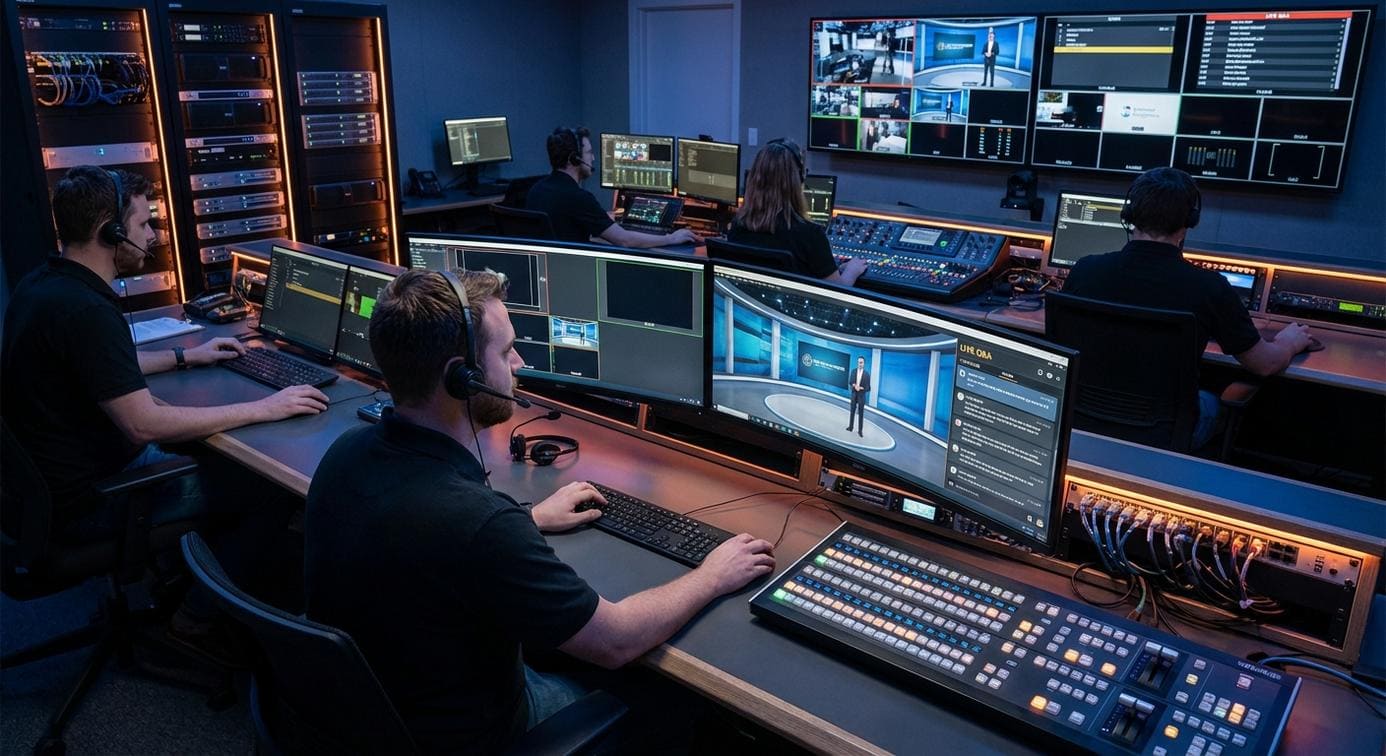
Beyond static display, social feeds can drive dynamic and interactive elements. Live polls, Q&A modules, and moderated chat sessions can be rendered as interactive components within the 3D virtual studio. Producers can interact with these elements via dedicated control surfaces, such as custom-built touch UIs, Stream Deck devices programmed with specific actions, or professional broadcast control panels. These interfaces allow producers to push specific social posts to air, launch polls, display results, or moderate comments in real time. The integration workflow must include a robust mechanism for producer approval, ensuring only appropriate content is displayed to the live audience. This human-in-the-loop moderation is crucial for maintaining brand reputation and content quality in enterprise B2B events.
Latency Management and Synchronization
Minimizing end-to-end latency, from a social post being created to its display within the virtual studio and subsequent distribution, is a paramount technical challenge. Strategies include optimizing network paths, using high-performance hardware for ingest and rendering, and implementing robust clock synchronization protocols. Network Time Protocol (NTP) provides system-wide time synchronization, while Precision Time Protocol (PTP, IEEE 1588) offers sub-microsecond accuracy, critical for frame-accurate timing in demanding broadcast workflows, especially when dealing with SMPTE 2110 IP streams. Buffer management at various stages (ingest, rendering, encoding) must be finely tuned to balance latency against system stability and error resilience. Frame-accurate triggering for social graphic animations and transitions ensures that visual elements appear precisely when intended, maintaining a professional broadcast aesthetic.
Enterprise-Grade Output, Distribution, and Quality Assurance
The final stage involves preparing the integrated program feed for secure, high-quality, and scalable distribution to a global B2B audience.
Encoding and Transcoding for Multi-Platform Delivery
The composited program feed, including the live social graphics, must be encoded efficiently for delivery. H.264/AVC (Advanced Video Coding) remains a widely supported and efficient codec, while H.265/HEVC (High Efficiency Video Coding) offers superior compression efficiency for 4K/UHD content at lower bitrates. Professional hardware encoders (e.g., from Elemental, Haivision, AJA) offer dedicated processing for high-quality, low-latency encoding. Adaptive Bitrate (ABR) ladders are essential for multi-platform delivery, creating multiple renditions of the stream at varying resolutions and bitrates (e.g., 1080p at 6 Mbps, 720p at 3 Mbps, 480p at 1.5 Mbps). This allows the Content Delivery Network (CDN) to dynamically deliver the optimal stream based on the viewer’s network conditions and device capabilities, ensuring a consistent and high-quality experience.
Streaming Protocols for Secure and Reliable Distribution
For contribution from the production facility to the streaming platform, SRT (Secure Reliable Transport) is increasingly preferred due to its ability to maintain high-quality, low-latency video over unpredictable public internet networks, utilizing advanced error correction and encryption. RTMPS (Real-Time Messaging Protocol Secure) offers broad compatibility with many streaming platforms and CDNs, albeit with higher latency characteristics than SRT. For final delivery to end-users, HTTP-based adaptive streaming protocols like HLS (HTTP Live Streaming) and MPEG-DASH (Dynamic Adaptive Streaming over HTTP) are standard. These protocols segment the video into small chunks and deliver them over standard HTTP, leveraging the scalability and caching capabilities of global CDNs. Security is paramount; all protocols must employ robust encryption, and content protection mechanisms like DRM (Digital Rights Management) may be implemented for sensitive corporate content.
Redundancy, Failover, and Monitoring
Enterprise-grade B2B events demand unwavering reliability. Redundancy must be built into every critical path: dual ingest encoders, redundant network paths with automatic failover (e.g., using bond interfaces or BGP routing), and geographically distributed streaming servers. A typical setup includes 1+1 or N+1 redundancy for encoders and streaming infrastructure. Comprehensive monitoring is non-negotiable, employing Simple Network Management Protocol (SNMP) for device health, API polling for cloud services, and specialized video probes to monitor stream integrity, bitrate, and latency at various points in the delivery chain. Alerting systems must be configured to notify technical teams immediately of any deviation from established QoS parameters, enabling proactive intervention and maintaining event continuity.
Integration with Hybrid Event Platforms
The fully composited program feed, enriched with live social interaction, must seamlessly integrate into the chosen hybrid event platform. For platforms like Microsoft Teams Live Events, Zoom Events, or Webex Events, the program feed is typically ingested as an RTMP or SRT stream. Dedicated enterprise event platforms often provide more advanced API integrations for metadata synchronization, enabling features like single sign-on (SSO) and audience analytics aggregation. The goal is to provide a unified, professional experience for both in-person and virtual attendees, where the live social interaction displayed in the virtual studio is consistently presented across all viewing surfaces, from large LED walls at the physical venue to individual screens of remote participants.
The Strategic Advantage: Enhancing B2B Event Engagement and ROI
Integrating live social feeds into 3D virtual studio environments is not merely a technical feat; it is a strategic imperative that elevates audience engagement and demonstrably enhances the return on investment (ROI) for corporate events.
Practical Implementation Scenarios and Workflow Optimization
Consider a global corporate town hall where executive presentations are delivered from a photorealistic virtual set. Integrating a live, moderated Twitter Q&A feed allows remote employees to submit questions and see them displayed dynamically within the virtual studio, directly interacting with presenters. For a product launch, a curated social wall showcasing customer excitement or industry analyst commentary can be rendered as a dynamic element on a virtual LED screen within the studio, fostering community and social proof. Workflow optimization involves establishing clear roles for social media managers, content moderators, and technical directors. Pre-defined graphic templates, automated content filtering (while maintaining human oversight), and robust communication protocols between all production team members are essential for smooth, real-time operation.
Data Analytics and Post-Event Reporting
The real-time data flow from social feeds provides invaluable analytics. By integrating the ingest system with event analytics platforms, organizations can capture metrics such as audience sentiment, popular topics, peak engagement times, and geographic distribution of social interaction. This data can be correlated with other event metrics, such as viewership duration and poll participation, to provide a comprehensive post-event report. This granular insight allows corporate clients to measure the true impact of their content, understand audience reception, and refine future event strategies, ensuring continuous improvement and a maximized ROI on their streaming infrastructure investments.
The integration of live social feeds into 3D virtual studio environments represents the pinnacle of modern B2B event streaming and hybrid production. It demands a deep technical understanding of data pipelines, real-time rendering, and broadcast-grade distribution protocols. Spring Forest Studio stands ready to navigate these complexities, providing the expertise and infrastructure to transform your corporate events into immersive, interactive, and strategically impactful experiences for your global audience.
Jeremy Lee is a seasoned digital marketing director and strategist with over two decades of experience in the industry. As the founder of Sotavento Medios, I manage a diverse portfolio of over 50 businesses, helping brands grow through advanced search strategies and digital innovation. My work focuses on bridging the gap between traditional search engine optimisation and the evolving world of AI-driven answer engines.
get in touch