
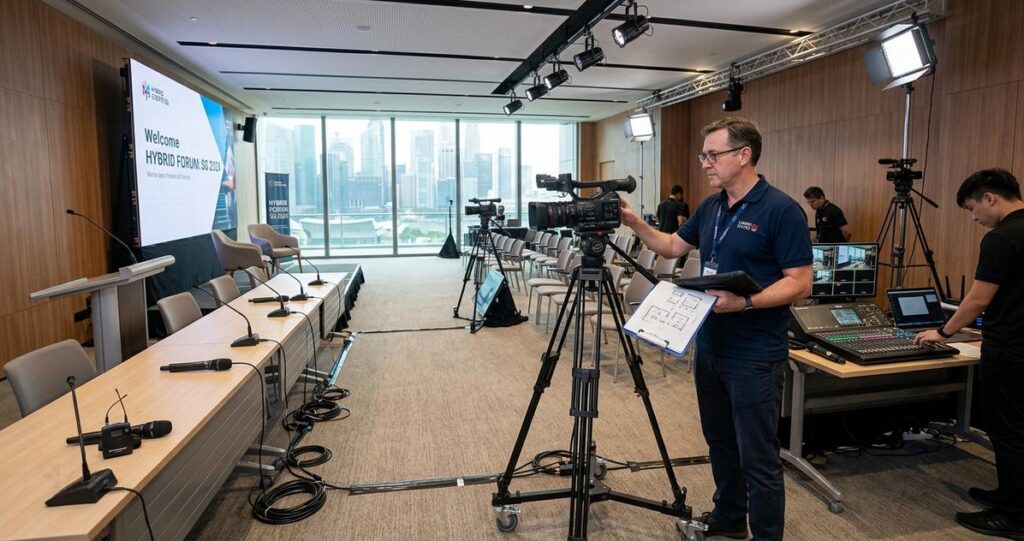
For hybrid events in Singapore, the venue is never just a backdrop. It becomes a live production environment where presenters, audiences, cameras, microphones, laptops, streaming encoders, and venue systems all have to work together without friction. A technical site survey is the process that makes this possible. It is the on-site assessment of the venue’s physical layout, connectivity, power availability, audio-visual infrastructure, access points, safety constraints, and operational workflow before event day. For organisers planning conferences, town halls, product launches, medical forums, AGMs, and government or corporate briefings, the survey is one of the most important steps in reducing technical risk and protecting the audience experience, both in the room and online.
In Singapore, this step matters even more because event spaces vary widely. A hotel ballroom in Marina Bay, a heritage venue in the civic district, a co-working auditorium in the CBD, and a campus hall in one-north each bring different limitations. Some spaces have fixed in-house AV systems. Others may have strict building management rules, loading bay constraints, or limited internet provisioning options. A technical site survey helps the production team understand those realities early, so the event plan is based on what the venue can actually support, not what it appears to support on paper. That is the difference between a smooth hybrid experience and a day spent troubleshooting sound dropouts, camera blind spots, or unstable streaming.
For audiences, hybrid events are judged quickly. In-person attendees expect clear sound, visible screens, and comfortable pacing. Online attendees expect stable video, intelligible speech, and minimal interruptions. A technical site survey helps align both audiences’ needs with the venue’s actual conditions. It is not simply a box-ticking exercise. It is a practical risk assessment and production design step that shapes the entire event workflow from rehearsal to live transmission.
What a technical site survey actually covers
A technical site survey is a structured inspection and planning exercise carried out before the event. Its purpose is to identify the venue’s capabilities, limitations, and operational rules, so the production team can design a workable hybrid setup. The survey usually involves the event organiser, venue representative, AV provider, streaming team, and sometimes the speaker management or ICT support team if the event involves confidential material, government stakeholders, or specialised content.
For hybrid production, the survey should cover more than audio and video. It must also assess power distribution, internet redundancy, camera placement, audience sightlines, stage dimensions, rigging points, lighting conditions, and the practical movement of crew and equipment. If any part of that chain fails, the live stream can be affected, even if the venue appears visually suitable. Good planning depends on understanding the whole system, not just the stage.
Venue layout and physical access
The first layer of the survey is physical. The team measures the room dimensions, ceiling height, stage size, seating arrangement, and available floor space for cameras, tripods, screens, and control areas. They also examine access routes for equipment loading, lift size, delivery timing, and any building restrictions that affect set-up and dismantling. In Singapore, where venue access may be tightly controlled in shopping complexes, commercial towers, or government-linked buildings, these details can directly affect setup time and crew allocation.
Physical access also includes emergency exits, fire safety clearances, and cable routing. Cables cannot simply be placed wherever they fit. They must avoid trip hazards and not obstruct walkways or safety routes. If the venue has carpeted floors, elevated platforms, glass partitions, or fixed furniture, these features influence where equipment can safely go. A survey helps the team solve these issues before the event, instead of improvising under pressure.
Audio, video, and lighting conditions
Hybrid event quality depends heavily on audio. In many cases, poor sound is more damaging than imperfect video because online audiences can tolerate lower image quality for a short period, but they struggle to understand speech when there is echo, feedback, or low microphone gain. During the survey, the team checks the venue acoustics, microphone options, loudspeaker placement, and whether the room has reflective surfaces that may create reverberation. Reverberation means sound persists in the room longer than desired, which can make speech less clear.
The video side focuses on camera positions, screen visibility, projector compatibility, and line of sight. The team determines where presenters will stand, whether they will move, and how many camera angles are needed to capture the stage effectively. Lighting is equally important. A venue may look bright to the human eye but still produce uneven exposure on camera, especially if the stage lighting and room lighting are not balanced. The survey allows the team to anticipate these issues and decide whether additional lighting, a different camera sensor setup, or a revised stage orientation is needed.
Connectivity and power resilience
Hybrid events need reliable internet connectivity. The survey should identify whether the venue can provide wired internet, what bandwidth is available, where network ports are located, and whether there are any restrictions on live streaming traffic. A wired connection is generally preferred for live production because it is more stable than public Wi-Fi. If the primary connection is unsuitable, the team may need to arrange a dedicated line, bonded connectivity, or a backup mobile solution.
Power is equally important. The survey checks the number and location of power points, circuit loading, and whether equipment can be distributed across separate power sources. This matters because cameras, encoders, monitors, lighting, and laptops all draw power. If too many devices share a single circuit, the risk of overload increases. The team also assesses whether the venue provides uninterrupted power supply support for critical systems. Even brief disruptions can interrupt a live stream, so power planning must be detailed and conservative.
Why the site survey is critical for hybrid event success
Many event problems are not caused by equipment failure alone. They happen when equipment is suitable in theory but unsuitable for that specific venue. A technical site survey prevents this mismatch. It turns assumptions into verified facts. That is especially valuable in hybrid events, where the production team has to serve both a physical room and a virtual audience at the same time.
Without a survey, teams may discover too late that the stage is too narrow for the planned camera positions, that the projector cannot display the correct aspect ratio, or that the venue’s wireless network is blocked by security settings. These are not minor inconveniences. They can affect speaker confidence, audience engagement, recording quality, and the professionalism of the entire event.
For Singapore-based organisers, where events often involve senior leadership, multinational participants, or public-facing communications, consistency matters. A technical site survey helps create a predictable production environment. It supports punctuality, compliance with venue rules, and smoother coordination among suppliers. It also helps teams make better decisions about whether a venue is suitable for a hybrid format at all.
Reducing avoidable production risk
Hybrid events involve multiple points of failure. A presenter microphone may work in rehearsals but become unclear once the room fills with people. A streaming laptop may run fine until it shares a crowded power strip with lighting and monitors. A camera may have a great angle, but its view may be blocked once the audience seating is rearranged. A technical site survey reveals these risks before they become live incidents.
It also allows the production team to plan contingencies. If the venue internet is uncertain, a backup route can be prepared. If the stage lighting is insufficient, portable lighting can be added. If ceiling height limits camera placement, alternative framing can be designed. The survey does not remove all risk, but it reduces uncertainty and increases the number of workable options.
Improving the audience experience
In hybrid formats, audience experience is not only about content. It is about delivery. In-person attendees need to hear speakers clearly and see shared content without strain. Remote attendees need audio that is clean and a visual feed that reflects the event professionally. If the venue is not surveyed properly, the online audience is often the first to notice the problem, because streaming platforms make technical flaws immediately obvious.
When the survey is done well, it supports a more polished event flow. Camera shots can be planned to avoid awkward angles. Slides can be tested for readability on stream. Speaker rostrums can be positioned to reduce microphone handling noise. The result is a more coherent experience across both formats.
How a technical site survey is conducted in practice
A proper survey is systematic. It usually begins with a pre-visit briefing where the organiser shares the event format, audience size, session types, speaker requirements, run-of-show draft, and any confidential or regulatory considerations. The venue then confirms available facilities and house rules. During the on-site visit, the production team documents the space, takes measurements, checks access, and identifies technical dependencies.
Photographs, floor plans, annotated diagrams, and checklists are often used to capture the findings. These documents help the team translate the physical venue into a production plan. They also improve communication between teams, especially when the event involves multiple suppliers. In Singapore, where events are commonly scheduled tightly and turnaround times can be short, having clear survey records reduces misunderstandings and helps everyone work from the same information.
Questions the survey should answer
The survey should give clear answers to practical questions such as:
- Where will cameras be placed, and will those positions obstruct attendees or presenters?
- Where can the control area or streaming desk be set up safely and discreetly?
- What audio inputs are available, and are they compatible with the production equipment?
- Is the internet connection wired, secured, and stable enough for streaming?
- Are there enough power outlets for the planned load, and where are they located?
- Can the venue support rehearsal, setup, and live operations within the allocated time?
- Are there venue-specific restrictions on drilling, rigging, adhesive use, or cable runs?
These questions are basic, but missing even one of them can create an operational bottleneck. The goal of the survey is to eliminate surprises that affect the live event.
How Singapore venue realities affect planning
Singapore’s venue landscape is efficient, but it is also diverse and highly managed. Many buildings have strict loading and access procedures. Some venues require advance approval for technical equipment, especially if it affects fire safety or building infrastructure. Others may have fixed house systems that need to be integrated with external production gear. In commercial venues, operational hours may be limited by tenant management or shared-use schedules. In institutional venues, approvals and IT access may take additional time.
These conditions make early surveying especially valuable. A venue that is aesthetically ideal may still be technically impractical if network access, power, or access timing cannot support the event design. A survey helps organisers choose the right venue, right-size the production scope, and plan realistic setup timelines. That is often the difference between a smooth event and an expensive last-minute redesign.
Best practices for organisers and production teams
To make a technical site survey useful, the organiser should treat it as a working session, not a passive tour. The team should arrive with the draft agenda, speaker format, branding requirements, and a clear view of the hybrid deliverables. That may include live streaming, recorded archives, breakout sessions, simultaneous presentation displays, or remote speaker integration. The more detailed the brief, the more accurate the production plan will be.
It also helps to involve the right stakeholders early. Venue staff understand local infrastructure and house rules. AV specialists understand signal flow, encoder requirements, and camera needs. The organiser understands the event objectives and stakeholder sensitivities. When these groups speak early, they can identify conflicts before they become expensive.
Rehearsal planning should also follow the survey findings. For instance, if the stage is wide and the presenter moves frequently, camera operators need that information in advance. If the room has strong echo, speakers may need to be coached on microphone use. If remote presenters are joining, the team should test their audio and video integration before the live date. A survey is only useful if the findings are translated into production decisions.
Common mistakes to avoid
One common mistake is assuming that a familiar venue will automatically work for a hybrid event. A venue may be excellent for in-person conferences but still unsuitable for streaming without additional support. Another mistake is leaving the survey too late. If the team discovers problems close to the event date, there may not be enough time to change equipment, book backups, or adjust the format.
It is also a mistake to focus only on the stage. Hybrid success depends on the entire signal path, from microphone to mixer to encoder to platform. If any part is weak, the stream quality suffers. Finally, organisers should avoid treating internet and power as afterthoughts. These are core production utilities, not optional extras.
For events that involve health, legal, financial, or public policy content, the communication standard should be even higher. Clear sightlines, intelligible audio, and stable streaming are not cosmetic preferences. They support comprehension, transparency, and professional delivery. If the event involves regulated or sensitive material, the production team should coordinate closely with the organiser’s compliance or communications lead to make sure the technical setup supports the intended message.
A technical site survey is one of the most practical ways to raise the quality and reliability of a hybrid event. It allows organisers to verify the venue, identify constraints, plan contingencies, and align the technical setup with the event’s goals. In Singapore, where venues are diverse and expectations are high, this step should be treated as essential rather than optional. The best hybrid events rarely look complicated to the audience, but they are usually the result of careful preparation, measured decisions, and a site survey that surfaced problems long before the first microphone was switched on. For organisers, the key takeaway is simple. If the event must work for people in the room and people online, the survey is where that reliability begins.

Jeremy Lee is a seasoned digital marketing director and strategist with over two decades of experience in the industry. As the founder of Sotavento Medios, I manage a diverse portfolio of over 50 businesses, helping brands grow through advanced search strategies and digital innovation. My work focuses on bridging the gap between traditional search engine optimisation and the evolving world of AI-driven answer engines.
get in touch