
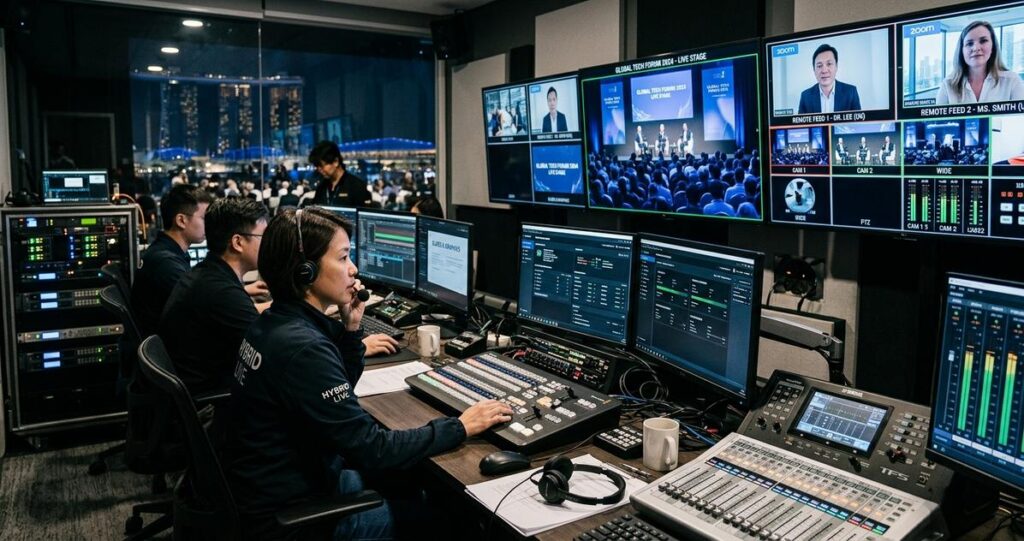
Hybrid events have become a practical choice for many organisations in Singapore because they allow people to join both in person and online. They are especially useful when teams are spread across offices, when speakers travel from overseas, or when attendees need flexibility around work, family, and commuting. Yet the same format that makes hybrid events so effective can also make them more vulnerable to disruption. A speaker may be delayed at Changi Airport, a panellist may lose audio from a remote location, a venue may run longer than planned, or a livestream segment may need to be shortened to fit a changing programme. When those changes happen close to start time, the pressure rises quickly, and the way the event team responds can determine whether the experience feels professional or chaotic.
For Singapore audiences, the expectation for efficiency is especially high. Corporate meetings, government-related forums, healthcare briefings, association conferences, and product launches often run on tightly managed schedules, and participants usually expect clear timing, reliable communication, and minimal confusion. The good news is that last-minute change does not have to mean disorder. With a clear decision process, disciplined communication, and a hybrid-specific runbook, most schedule changes can be handled without losing control of the event. The key is to prepare for flexibility before the event begins, then respond in a structured way when reality changes on the day.
Why hybrid event schedules change at the last minute
Hybrid events combine live onsite operations with digital delivery, so there are more moving parts than in a purely physical or fully virtual programme. A schedule change may affect stage management, speaker coordination, streaming crews, audience engagement, and technical support at the same time. In Singapore, this can happen because of traffic congestion, weather disruptions, venue access issues, travel delays, corporate approval changes, or technical problems with remote speakers joining from another time zone. Even a simple delay in one segment can have knock-on effects on the rest of the programme if the production team does not react quickly.
The most common reason a hybrid schedule becomes unstable is that one dependency changes. If a keynote speaker is late, the opening sequence may need to be rearranged. If a remote presenter cannot connect from home or office, the session may need to be replaced by a panel discussion or a pre-recorded segment. If the moderator arrives early but the interpreter does not, the event may need a brief pause. Hybrid events are sensitive to such changes because both audiences, those physically present and those watching online, must receive a coherent experience even when the original running order shifts.
Common triggers in a Singapore setting
Singapore’s event environment is highly organised, but that does not eliminate risk. Heavy rainfall can affect arrival timing, especially for delegates moving between MRT stations, taxis, and sheltered walkways. Peak-hour traffic can delay speakers travelling across the island. Multi-country teams may also face different time zones, which makes remote attendance coordination more complex. In corporate and public sector events, changes may also arise from senior stakeholder availability, security checks, or last-minute content edits that require the production team to adjust cueing and slides.
For planners, the practical lesson is simple. The schedule should be treated as a live operating document, not a fixed script. That mindset allows the team to adapt without panic.
Build a schedule that can absorb change
The best time to manage last-minute change is before it happens. A hybrid event schedule should be built with enough structure to keep the programme on track, but enough flexibility to absorb small delays. This means planning buffer time, grouping content in logical blocks, and identifying which segments can move, shorten, or be swapped if needed. It also means knowing which items are non-negotiable, such as welcome remarks from a senior leader, a legally required disclosure, or a time-bound live demonstration.
A strong schedule includes both the public agenda and an internal production run sheet. The public agenda shows attendees the overall programme, while the internal run sheet includes exact cue times, audio checks, camera transitions, slide changes, remote speaker links, break timings, and contingency notes. When a change occurs, the production manager should be able to see immediately what can be delayed, what must continue, and which team member is responsible for each adjustment.
Use buffer time strategically
Buffer time is not wasted time. It is a risk-management tool. In hybrid events, buffers are most useful after opening remarks, before high-profile speaker segments, around technical handovers, and before audience Q and A. These are moments where a short delay can usually be absorbed without harming the structure of the event. If a schedule is packed too tightly, even a five-minute disruption can create a chain reaction that affects the stream, live audience engagement, and venue logistics.
For Singapore event teams, buffer time is particularly useful when the event involves external stakeholders who may not share the same level of control over arrival time or remote setup. A speaker coming from another building in the Central Business District, for example, may be affected by lift congestion, security screening, or transport delays. A buffer provides breathing room without making the programme feel under-managed.
Identify what can be swapped
Before event day, define which items can be moved into a different order if needed. This might include a sponsor video, a panel discussion, a networking segment, or a short recorded presentation. If the hybrid event includes both live and pre-recorded content, those assets can often act as stabilisers during a delay. The goal is to create an event structure with interchangeable parts, so the team can keep the programme moving while solving the problem in the background.
Make decisions fast, but not impulsively
When a schedule changes at the last minute, the biggest risk is making a rushed decision without checking how it affects the full event. A good response is fast, but it is also coordinated. One person should have clear authority to approve changes, usually the event producer or stage manager in close consultation with the client lead. That person should gather the minimum information needed to decide: what changed, how long the delay is likely to last, which segments are affected, and whether the live and online audiences can still follow the programme smoothly.
Decision-making becomes easier when the team has already defined priority levels. Some changes need immediate action because they affect guest experience or technical continuity. Others can wait a few minutes while the speaker arrives or the connection stabilises. What should be avoided is parallel decision-making by multiple people without coordination, because that often leads to conflicting instructions for the emcee, AV crew, and moderation team.
Use a simple prioritisation framework
In a hybrid environment, ask three questions before changing the order of the agenda. First, does the change affect safety, compliance, or essential delivery? Second, does it affect the technical sequence of the stream or onsite presentation? Third, will the audience understand what is happening if the plan changes now? If the answer to the first question is yes, the change should usually be handled immediately. If the main issue is timing, the team may be able to absorb it by moving a session, shortening an introduction, or filling the gap with a backup item.
For example, if a remote panellist loses internet access, it may be better to move to the next speaker while the technical team restores the connection. If the keynote speaker is delayed by only a few minutes, the emcee can extend the introduction, show a short sponsor film, or bring forward a prepared housekeeping segment. The aim is to preserve momentum rather than expose uncertainty to the audience.
Keep the change small and controlled
The more a schedule changes, the more likely it is that the event will feel unstable. Whenever possible, make the smallest adjustment that solves the problem. Avoid rewriting the entire programme unless it is truly necessary. Small, contained changes are easier for the emcee to explain, easier for the streaming team to cue, and easier for attendees to follow. This is especially important in hybrid events, where one audience is in the room and another may be watching on a delayed stream or through an event platform.
Communicate clearly with every stakeholder
Communication is the heart of managing a last-minute schedule change. If people do not know what has changed, they will fill the gap with assumptions. A hybrid event needs coordinated communication across three groups at minimum: the internal event team, the speakers and hosts, and the audience. In some cases, there may also be sponsors, interpreters, security teams, venue staff, and client stakeholders who need immediate updates.
Use short, direct messages. State what has changed, what the new instruction is, and who is responsible for the next step. Avoid long explanations in the middle of live production, because the team needs actionable information, not discussion. A production lead might tell the emcee, for example, that the keynote will begin in ten minutes, the remote speaker will follow after the break, and the livestream should remain on standby with a holding slide. That kind of instruction is specific, calm, and useful.
Brief the onsite and online audiences differently
Onsite attendees can usually be guided through a delay with a verbal explanation from the emcee, updated signage on screens, or a short filler segment. Online attendees need the same clarity, but it must be delivered through the event platform, livestream graphics, or a moderator message. If the session order changes, the digital audience should not be left staring at a static screen without context. A simple holding slide with a revised programme message can prevent confusion and reduce drop-off.
In Singapore, where many corporate audiences are accustomed to efficient service standards, clarity matters as much as speed. A short, transparent update often feels more professional than silence. If a change affects the timing of a lunch break, keynote, or panel discussion, tell attendees what they need to know and when the next meaningful update will arrive. That keeps expectations realistic.
Use a communications chain, not ad hoc messages
Every hybrid event should have a communication chain. This means one person updates the client, one person briefs the emcee, one person informs the technical crew, and one person updates the online audience or moderation team. If the event is large, the chain may include room hosts, stage managers, interpreters, and venue operations staff. The benefit of a defined chain is consistency. Everyone receives the same direction at the same time, which reduces the risk of contradictory messaging.
Protect the audience experience while the team resets
The audience should feel that the event is still under control, even if the internal team is working hard behind the scenes. This is true for both the live room and the virtual stream. When a change happens, the audience judges the event not only by whether the problem occurred, but by how smoothly it was handled. A calm emcee, a visible production plan, and a useful filler activity can make a delay feel minor instead of disruptive.
Audience experience also depends on pacing. If a session runs late, do not compress every remaining segment too aggressively, because that can make the event feel rushed and difficult to follow. It is often better to keep a single, coherent adjustment and preserve the quality of the rest of the programme. In hybrid events, consistency matters more than trying to force the original schedule back into place at all costs.
Have ready-to-use filler options
Useful filler content may include a brief welcome message, a sponsor video, a housekeeping reminder, a polling question, a networking prompt, or a recorded segment that is already approved for use. These items should be pre-cleared in advance, because improvising content during a live event can create brand, legal, or technical issues. In Singapore, where many events involve formal corporate communication or regulated sectors, the filler content should also be appropriate for the audience and aligned with the event’s purpose.
Backup content should not feel like an emergency patch. It should feel like part of the event design. When done well, it gives the production team time to resolve the issue while keeping attendees engaged and informed.
Plan for accessibility and inclusivity
Last-minute changes can disproportionately affect attendees who rely on captions, interpretation, or clear timing cues. If the event includes accessibility support, the production team must update those services when the schedule shifts. For example, if a session is moved earlier, the captioner, interpreter, and moderator need to know immediately. If slides are being updated, the accessible version must be distributed as well. In hybrid formats, accessibility is not a separate layer. It is part of event continuity.
After the event, capture what the change taught you
Once the event is over, the team should review what happened while the details are still fresh. A short debrief is often enough to identify where the process worked and where it broke down. Ask which change triggered the disruption, how quickly the team responded, whether communication was clear, and whether the audience experience remained coherent. Record those findings in the event notes so the next hybrid programme benefits from the lessons learned.
This review is especially useful in Singapore, where organisations often run multiple events across the year and expect each one to improve operationally. A well-run debrief can lead to better buffer planning, stronger speaker instructions, tighter cue sheets, and more realistic contingency design. Over time, that creates a more resilient event operation.
Document the actual sequence of adjustments, not just the final outcome. If a keynote was delayed, note what the team did in those ten minutes. If the livestream had to switch to a holding slide, record who approved it and how the online audience was updated. These notes become practical reference material for future events, especially for recurring conferences, seminars, and product launches.
For organisations planning hybrid events in Singapore, the central lesson is straightforward. Last-minute changes are not a sign that planning has failed. They are a normal part of live production, and they can be managed professionally when the team is prepared, the schedule has room to flex, and communication is disciplined. A calm, structured response protects both the experience and the credibility of the event.
If you are responsible for a hybrid event, build your next schedule with clear priorities, realistic buffers, backup content, and an internal communication chain that can activate instantly. That preparation is what turns a disruptive change into a manageable adjustment, and it is what helps both onsite and online audiences stay engaged from the first cue to the last.
General information only: This article is intended for event planning and production awareness, not medical advice. If a schedule change involves health, safety, or emergency concerns at an event, follow venue procedures and seek assistance from qualified professionals immediately.

Jeremy Lee is a seasoned digital marketing director and strategist with over two decades of experience in the industry. As the founder of Sotavento Medios, I manage a diverse portfolio of over 50 businesses, helping brands grow through advanced search strategies and digital innovation. My work focuses on bridging the gap between traditional search engine optimisation and the evolving world of AI-driven answer engines.
get in touch