
Beyond the Webcam: The Critical Function of a Vision Mixer in Enterprise Streaming
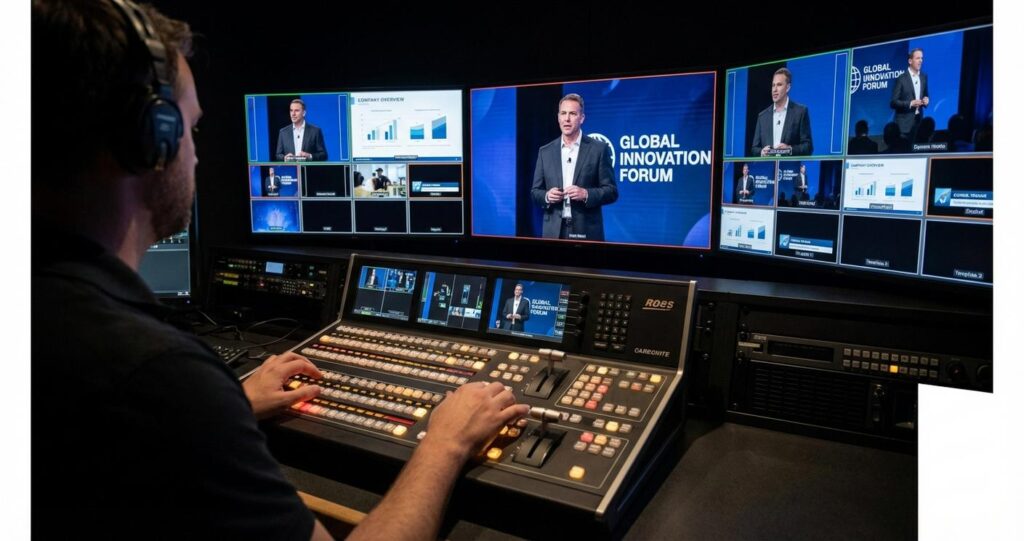
In the world of B2B executive communication, perception is paramount. A simple single-camera stream from a laptop may convey a message, but it fails to command authority or reflect the premium nature of an enterprise brand. The difference between an amateur broadcast and a polished, professional production lies in the deliberate, real-time control over the visual narrative. This control is the domain of the professional vision mixer, also known as a technical director. A vision mixer is the human-to-hardware interface that transforms a collection of disparate video and audio sources into a single, cohesive, and impactful program feed. For corporate event planners and IT directors tasked with delivering flawless town halls, product launches, and hybrid keynotes, understanding the vision mixer’s role is fundamental to elevating production value from standard to exceptional. This is not about simple software switching; it is about leveraging broadcast-grade infrastructure and expertise to ensure the message is delivered with maximum clarity and professionalism.
Architecting the Signal Flow: From Source Ingest to Global Distribution
The vision mixer operates at the heart of the production’s signal flow. Their primary responsibility is to manage every video source, ensuring technical consistency and seamless integration into the live program. This process begins long before the first button is pressed, with the meticulous design of the signal acquisition and routing architecture. The complexity of this architecture directly impacts the stream’s stability, quality, and creative potential.
Multi-Source Integration: SDI, NDI, and Synchronized Signals
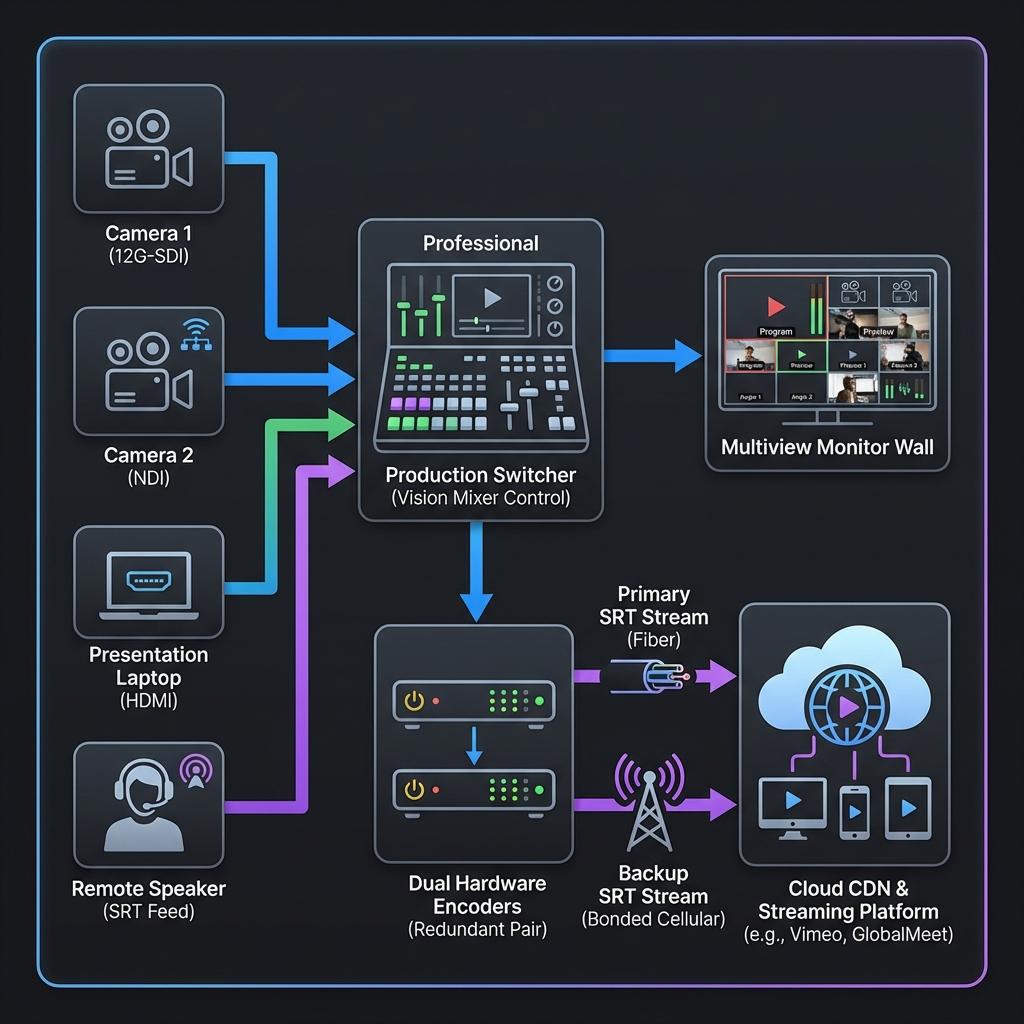
A professional executive stream typically involves multiple camera sources to provide varied angles, such as a wide shot, a medium shot, and a tight shot on the speaker. It also includes content sources like presentation slides, video playback, and remote participant feeds. The vision mixer must ingest these diverse formats flawlessly.
- Baseband Video (SDI): The industry standard for broadcast is the Serial Digital Interface (SDI). For high-end productions, this often means 6G-SDI or 12G-SDI, capable of carrying uncompressed 4K UHD video signals at 60 frames per second over a single coaxial cable. The vision mixer’s production switcher must have the appropriate SDI inputs and processing power to handle these high-bandwidth signals without introducing latency. A critical component in a multi-camera SDI workflow is ensuring all sources are synchronized via genlock, which prevents frame tearing or glitches when switching between cameras.
- IP Video (NDI): Network Device Interface (NDI) has become a powerful tool in corporate environments. It allows high-quality, low-latency video to be transmitted over a standard Gigabit Ethernet network. A vision mixer can integrate NDI sources from cameras, computers running presentation software, or even other production systems. This offers immense flexibility, reducing cable runs and simplifying setup in venues like hotel ballrooms or corporate headquarters. The mixer must operate on a network configured with sufficient bandwidth and Quality of Service (QoS) protocols to prioritize video traffic.
- Remote Sources (SRT): For hybrid events, bringing in remote speakers is a common requirement. The Secure Reliable Transport (SRT) protocol is the professional solution for this. A vision mixer integrates an SRT feed, delivered from a remote location over the public internet, as another input source on their switcher. This requires a dedicated SRT decoder that converts the incoming stream back into a baseband (SDI) or IP (NDI) signal for the switcher. The mixer monitors this feed for packet loss and jitter, ready to switch away if the connection degrades.
Signal Routing and Processing: The Production Switcher Core
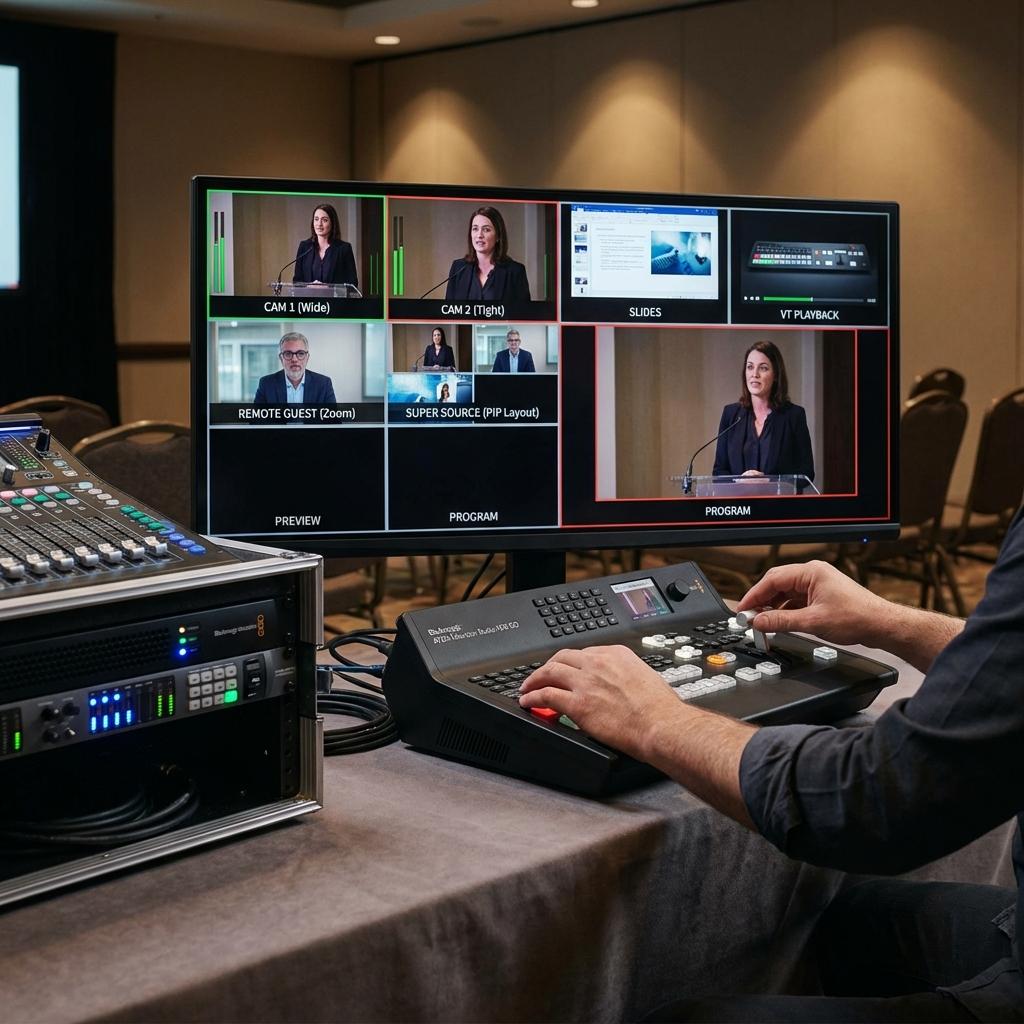
The production switcher is the vision mixer’s console. This hardware is a specialized computer designed for real-time video processing with near-zero latency. The mixer uses Program and Preview buses to prepare and execute switches. The Preview bus allows them to cue up the next shot, check its framing and color, and apply effects before taking it live to the Program bus, which is the feed being broadcast. Advanced switchers contain multiple Mix/Effects (M/E) buses, enabling the mixer to build complex layered compositions, such as a picture-in-picture (PiP) effect with a speaker alongside their slides, without tying up the main program output.
Executing the Live Cut: Weaving a Cohesive Visual Narrative
With the infrastructure in place, the vision mixer’s role shifts from architectural to operational. During the live event, they are responsible for every visual transition, graphic overlay, and video playback, effectively directing the audience’s focus and pacing the flow of information. This is a high-pressure role that blends technical precision with creative instinct.
Real-Time Switching and Composition
The most fundamental task is cutting between camera angles. A skilled vision mixer does this with purpose. They follow the speaker’s cadence, cutting to a wide shot to establish context, a medium shot for discussion, and a tight shot for emphasis. They use a variety of transitions, from a direct cut for energy, to a soft dissolve for a smoother change in topic, to a wipe for stylistic effect. Beyond simple cuts, the mixer uses the switcher’s keyers to create sophisticated compositions. A Downstream Keyer (DSK) is used to overlay graphics like lower-third titles, logos, or call-to-action banners. An upstream keyer is used for more complex effects, such as placing a speaker into a virtual set using a chroma key (greenscreen) or creating multi-box layouts for panel discussions.
Managing Media and Graphics Integration
Professional production switchers have built-in media stores for holding still graphics and video clips. The vision mixer is responsible for loading pre-approved assets, such as intro animations, sponsor loops, and pre-recorded video packages (known as VTs), into these stores. During the show, they will trigger the playback of these assets at the precise moment required by the run-of-show document. This requires perfect timing and coordination with the show caller or director. Integrating these elements smoothly, without black frames or audio mismatches, is a hallmark of a professional production.
Ensuring Broadcast-Grade Reliability and Quality Control
For any B2B executive stream, technical failure is not an option. The brand’s reputation is on the line. The vision mixer plays a crucial role in the implementation and management of redundancy systems and performs constant quality control to ensure the outgoing stream meets professional broadcast standards.
Redundancy, Failover, and Transmission
A professional workflow always includes redundancy. This means a primary and a backup production switcher, or at least redundant power supplies. The program feed from the switcher is sent to a hardware encoder. Here, the uncompressed SDI signal is converted into a compressed format like H.264 or H.265 (HEVC) and packaged into a streaming protocol like RTMPS or SRT. Best practice dictates using two separate encoders fed by two different power circuits and two independent network paths (e.g., primary fiber internet and a bonded cellular backup). The vision mixer must know the failover procedure instantly, capable of re-routing the program feed to the backup encoder with zero disruption to the viewer if the primary path fails. They are the last line of defense before the signal leaves the venue.
Comprehensive Monitoring and Communication
A vision mixer does not simply watch the program output. They monitor a large multiview display showing every single source, preview and program outputs, and key technical parameters. They use waveform monitors and vectorscopes to ensure video signals are broadcast-safe, with correct luminance and chrominance levels, preventing issues like clipped whites or illegal colors. They are also the central hub for production communication, using a hard-wired intercom system to talk to the director, producer, audio engineer, and camera operators. They direct camera movements, confirm readiness for graphic cues, and ensure the entire production team is synchronized. This constant loop of communication and verification is essential for a smooth, error-free production.
The Vision Mixer: Your Ultimate Quality Gatekeeper
Ultimately, the role of a professional vision mixer transcends that of a mere operator. They are the technical director, the quality gatekeeper, and the real-time storyteller who ensures the executive message is framed with the highest possible production value. They architect the complex signal flows, manage the sophisticated hardware, and execute flawless live cuts that engage the audience and reinforce the brand’s commitment to quality. For any enterprise considering a hybrid or virtual event, investing in a professional production team with an experienced vision mixer at the helm is not a luxury; it is a strategic necessity to protect brand integrity and ensure the successful delivery of high-stakes communication.

Jeremy Lee is a seasoned digital marketing director and strategist with over two decades of experience in the industry. As the founder of Sotavento Medios, I manage a diverse portfolio of over 50 businesses, helping brands grow through advanced search strategies and digital innovation. My work focuses on bridging the gap between traditional search engine optimisation and the evolving world of AI-driven answer engines.
get in touch