
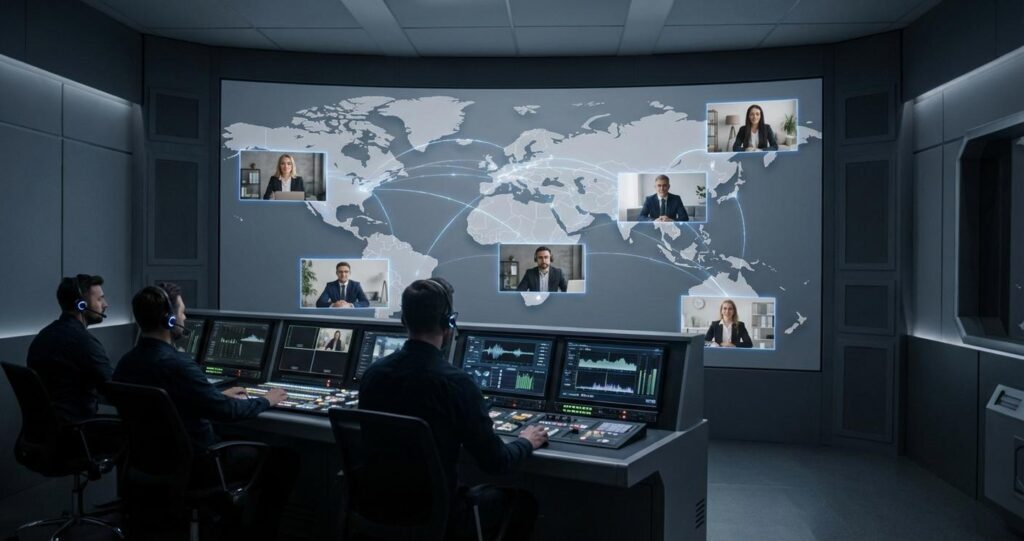
The proliferation of decentralised corporate structures presents a significant technical challenge for enterprise event production. When C-suite executives, key stakeholders, and product managers are distributed across multiple continents, delivering a cohesive, broadcast-quality all-hands meeting or global town hall becomes an exercise in complex systems integration. The primary obstacle is maintaining consistent production value and technical stability. Ad-hoc solutions relying on consumer-grade video conferencing platforms introduce unacceptable variables in video quality, audio intelligibility, and latency, undermining the professionalism of high-stakes corporate communication. Achieving a uniform standard of quality requires a shift from reactive problem-solving to a proactive, engineering-led framework. This framework is built upon three pillars: the standardisation of contribution signals from remote locations, the implementation of a centralised production hub, and the enforcement of rigorous quality control and redundancy protocols. This is not a matter of simple IT configuration; it is an application of broadcast engineering principles to the enterprise environment, ensuring every remote participant is presented with the same clarity and impact as if they were on a physical stage.
The Foundation: Standardising Contribution Signals
The signal chain for any live production begins at the source. In a decentralised model, each remote presenter is a source, and variability at this stage multiplies downstream. To mitigate this, we must move beyond laptop webcams and unstable software clients, establishing a baseline of technical quality for every incoming feed. This process involves mandating professional contribution protocols and deploying standardised hardware kits to all remote participants, effectively turning any home office into a controlled remote studio environment.
Moving Beyond Consumer-Grade Protocols
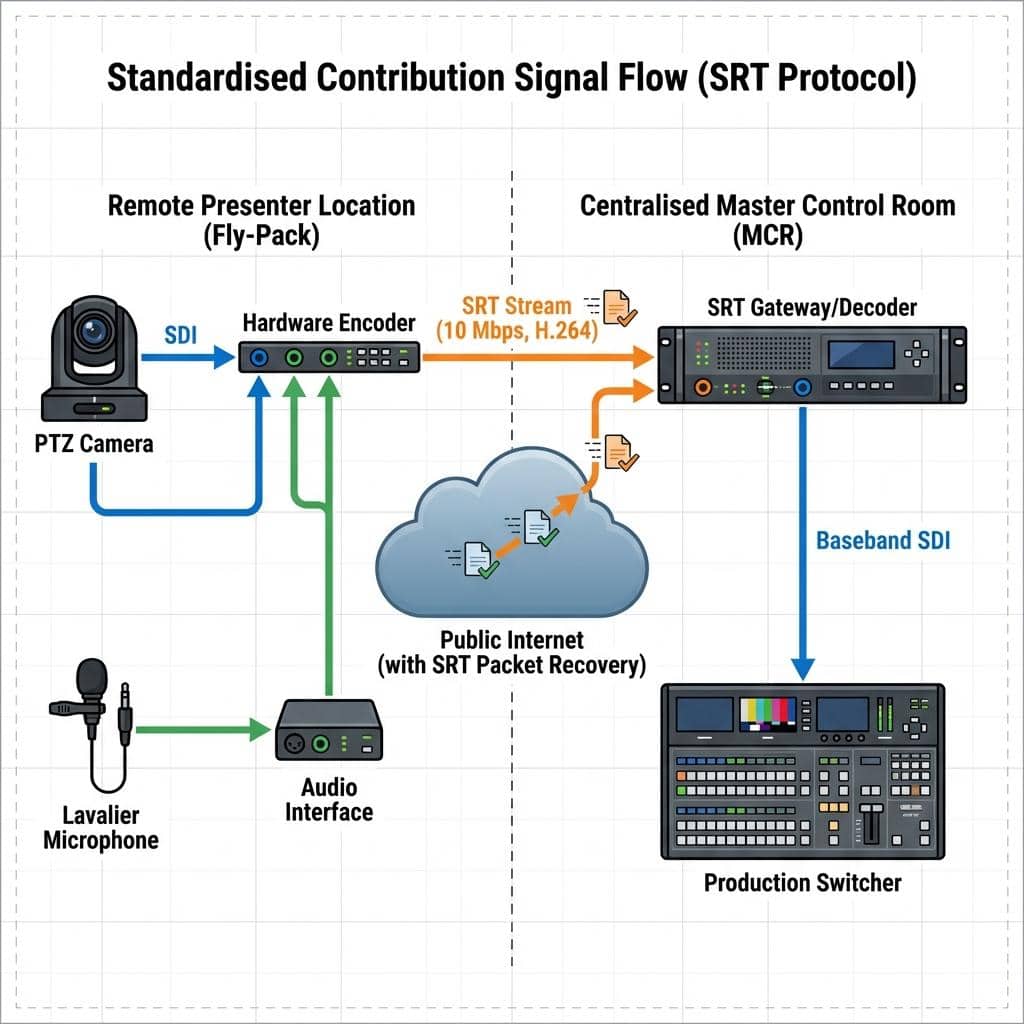
The default for many organisations is to leverage existing unified communications platforms like Microsoft Teams or Zoom as contribution sources. While convenient, these platforms are engineered for conversation, not broadcast contribution. They employ aggressive, variable bitrate encoding (VBR) that prioritises connection stability over visual fidelity, resulting in frequent resolution drops, compression artifacts, and audio gating. For professional production, we require protocols that grant us granular control. The industry standards are RTMP (Real-Time Messaging Protocol) and, more critically, SRT (Secure Reliable Transport). RTMP and its encrypted variant, RTMPS, function over TCP (Transmission Control Protocol), which guarantees packet delivery but can introduce significant latency as it re-transmits lost packets, leading to buffering during periods of network congestion. It remains a viable standard for final delivery to a Content Delivery Network (CDN) but is less than ideal for contribution over unreliable networks. SRT, conversely, is the superior choice for contribution. Built on UDP (User Datagram Protocol), it features a sophisticated ARQ (Automatic Repeat reQuest) mechanism that intelligently re-transmits only the specific packets that are lost. This results in significantly lower latency, higher resilience to network jitter, and robust security through AES-128 or AES-256 encryption. Standardising on SRT for all incoming feeds is the first and most critical step in building a reliable decentralised production.
Defining the Contribution Kit: A Standardised Fly-Pack
A robust protocol is only as good as the signal it carries. To ensure every remote presenter delivers a high-quality audio and video signal, a standardised “fly-pack” or contribution kit must be deployed. This removes the guesswork and variability of personal equipment. A professional-grade kit includes:
- Acquisition Hardware: A professional camera, such as a PTZ (Pan-Tilt-Zoom) unit or a mirrorless camera with a clean, uncompressed HDMI or SDI (Serial Digital Interface) output. This allows the central production team to have remote control over camera parameters like pan, tilt, zoom, and, crucially, manual control over exposure, focus, and white balance to ensure visual consistency between presenters.
- Professional Audio: A high-quality lavalier or shotgun microphone connected to a dedicated audio interface or small-format mixer. This bypasses the noisy preamps in laptops and cameras, providing a clean, intelligible audio signal with consistent levels, typically targeted between -12dBFS and -18dBFS to provide adequate headroom.
- Dedicated Encoder: A hardware or software encoder is the core of the kit. A hardware encoder like a Haivision Makito or AJA HELO Plus provides a reliable, single-purpose device for converting the SDI or HDMI signal into an SRT stream. For more flexibility, a pre-configured laptop running software like vMix or OBS can serve the same purpose. The key is that it is configured by a technical team with a standardised profile: H.264 or H.265 (HEVC) codec, a constant bitrate (CBR) of 8-10 Mbps for 1080p60 video, and the correct SRT connection parameters.
- Controlled Lighting and Connectivity: A 3-point LED lighting kit (key, fill, and backlight) ensures the subject is properly illuminated, creating depth and separation from the background. Critically, the kit must include instructions and an ethernet cable to mandate a hard-wired internet connection, bypassing unstable Wi-Fi. A minimum of 20 Mbps upstream bandwidth should be verified via a network speed test during the technical setup call.
Centralised Production Hubs: Cloud and On-Premise Architectures
With standardised signals being reliably transmitted via SRT, the next step is to receive, manage, and produce the final program feed from a central location. This Master Control Room (MCR) can be a physical facility, a virtualised environment in the cloud, or a hybrid of both. The choice of architecture depends on the production team’s location, budget, and specific requirements for latency and control.
The Cloud-Based Master Control Room
A cloud-based MCR leverages virtualised production software, such as vMix on an AWS EC2 instance or platforms like Grass Valley AMPP, running on powerful cloud servers. This architecture is ideal for a distributed production team. Multiple SRT feeds from global presenters are ingested directly into the cloud instance. The technical director can operate the switcher from their location, a graphics operator can push lower thirds from another, and the show director can monitor all feeds on a cloud-hosted multiviewer. This model offers immense scalability, as server resources can be increased as needed, and it removes the dependency on the internet connectivity of a single physical building. All source feeds can be recorded in isolation (ISO recording) directly to cloud storage, providing a complete record for post-production or backup purposes.
On-Premise and Hybrid MCR Models
The traditional broadcast model utilizes a physical, on-premise MCR. Here, incoming SRT streams are received by dedicated hardware decoders or SRT gateways, which convert the signals back to baseband video, typically SDI. These SDI signals are then fed into a physical video router and a production switcher like a Ross Carbonite or Blackmagic ATEM Constellation. This approach provides the lowest possible processing latency and the highest degree of reliability, as it is a closed system not subject to the variables of public cloud infrastructure. A hybrid model combines the best of both worlds, using an on-premise MCR for the primary program production while leveraging the cloud for ingesting specific remote feeds or for running a fully redundant backup system.
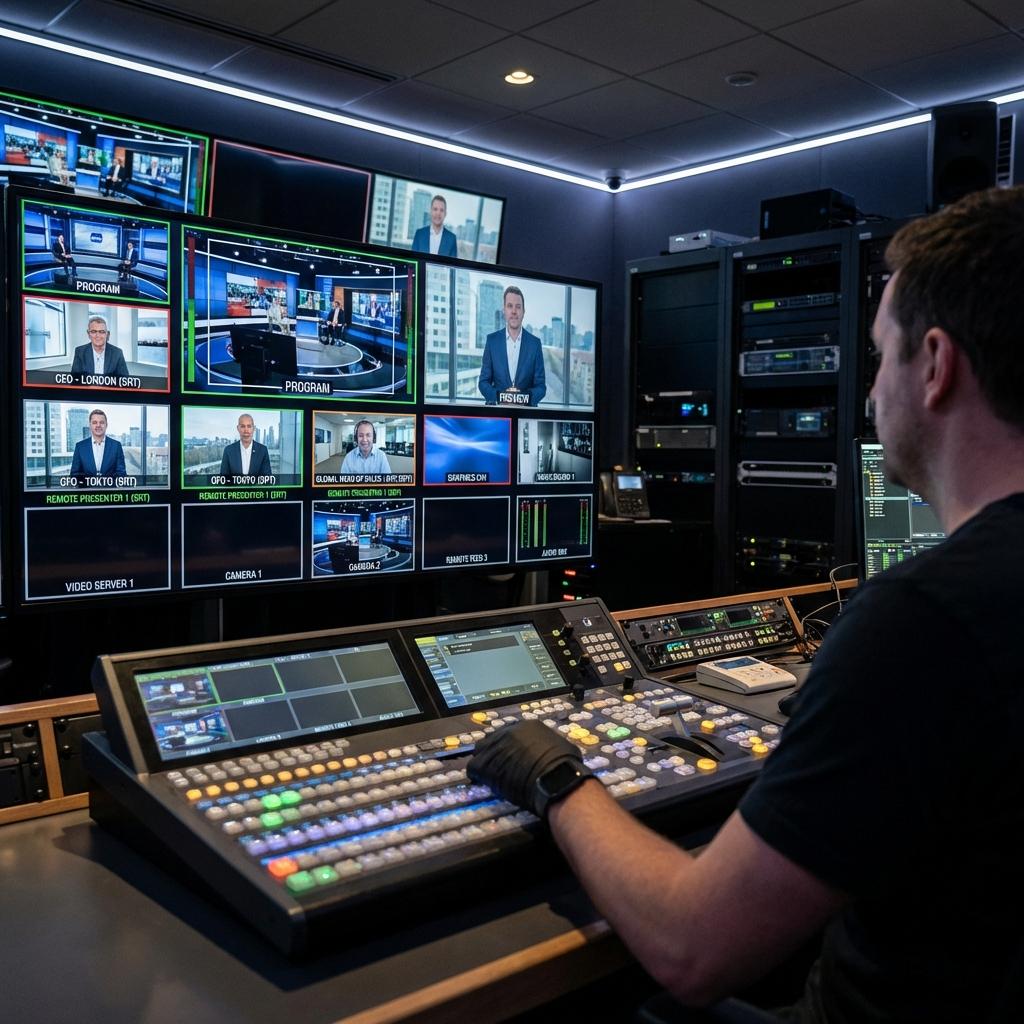
This allows for a robust core infrastructure while maintaining flexibility for remote contributions.
Signal Routing and Communication Infrastructure
Regardless of the MCR architecture, the internal signal flow and communication systems are critical. In an on-premise facility, a central SDI router is the backbone, allowing any source to be sent to any destination. For audio, an Audio-over-IP (AoIP) protocol like Dante is essential for managing dozens of audio channels from various sources. The most critical system, however, is communications. A professional talkback and intercom system, such as Clear-Com or Riedel, is non-negotiable. It connects the director, producers, graphics, and technical crew. For remote presenters, this system must be extended to provide an IFB (Interruptible Foldback) feed, allowing the director to speak directly into their earpiece. This can be accomplished using dedicated audio channels within the SRT return feed or via separate dedicated audio applications.
Ensuring Consistency: Quality Control, Monitoring, and Redundancy
A standardised framework is incomplete without rigorous processes for quality control, real-time monitoring, and comprehensive redundancy. These systems ensure that the final output maintains a broadcast-grade standard from the first second to the last, with contingency plans for any potential point of failure.
Technical Quality Control Protocols
Consistency is achieved through meticulous preparation. A mandatory technical rehearsal with each remote presenter is paramount. During this session, an engineer verifies the entire signal chain. This includes confirming SRT connection stability, measuring latency and jitter, setting precise audio levels using audio meters, and critically, white-balancing every camera to a consistent color temperature. To ensure visual continuity, a video engineer or shader should have remote access to the camera’s control panel or, at a minimum, apply real-time color correction within the MCR to match skin tones and background colors across all participants. This prevents a jarring visual experience where one presenter appears warm and another cool.
Real-Time Monitoring and Analytics
During the live event, the technical team relies on a suite of professional monitoring tools. The primary tool is the multiviewer, which displays all incoming sources, preview, and the final program output on a single large monitor array. Alongside this, waveform monitors and vectorscopes are used to objectively measure video signals. The waveform monitor displays the luminance (brightness) levels, ensuring they remain within the legal limits (typically 0-100 IRE for broadcast). The vectorscope displays the chrominance (color) information, which is essential for accurate color grading and matching sources. For SRT streams, dedicated monitoring dashboards provide real-time analytics on network performance, including latency in milliseconds, packet loss percentage, and bandwidth utilization, allowing engineers to anticipate and diagnose issues before they affect the viewer.
Building in Redundancy and Failover
For any high-stakes corporate event, a single stream or single point of failure is an unacceptable risk. A multi-layered redundancy strategy is required. At the contribution level, critical presenters should be equipped with dual encoders connected to diverse network paths, such as a primary fiber connection and a secondary bonded cellular connection. SRT’s seamless protection switching feature can automatically switch between these paths with no visible disruption. The MCR itself should be redundant. In a cloud architecture, this means running a second, identical production instance in a different availability zone. For an on-premise facility, a complete “B” string of core equipment (switcher, router, encoders) should be ready for immediate failover. This comprehensive approach to redundancy ensures the production remains on-air even in the face of network outages or hardware failure.
From Decentralised Chaos to Standardised Excellence
Effectively managing a global, decentralised production is a complex technical undertaking that demands an engineering-first mindset. Success is not found in hoping for the best with consumer tools, but in building a robust and predictable system. By standardising the entire signal chain, from the remote presenter’s lens to the final program output, we eliminate variables and create a controlled production environment. The strategic implementation of professional contribution kits using the SRT protocol, coupled with a centralised MCR architecture and fortified with uncompromising quality control and redundancy plans, transforms decentralised chaos into standardised excellence. This broadcast-level framework ensures that a company’s message is delivered with the technical quality and professionalism it deserves, regardless of geographical boundaries. Spring Forest Studio specializes in designing and executing these sophisticated global streaming solutions, providing the technical expertise required to connect your teams with clarity and confidence.
Jeremy Lee is a seasoned digital marketing director and strategist with over two decades of experience in the industry. As the founder of Sotavento Medios, I manage a diverse portfolio of over 50 businesses, helping brands grow through advanced search strategies and digital innovation. My work focuses on bridging the gap between traditional search engine optimisation and the evolving world of AI-driven answer engines.
get in touch