
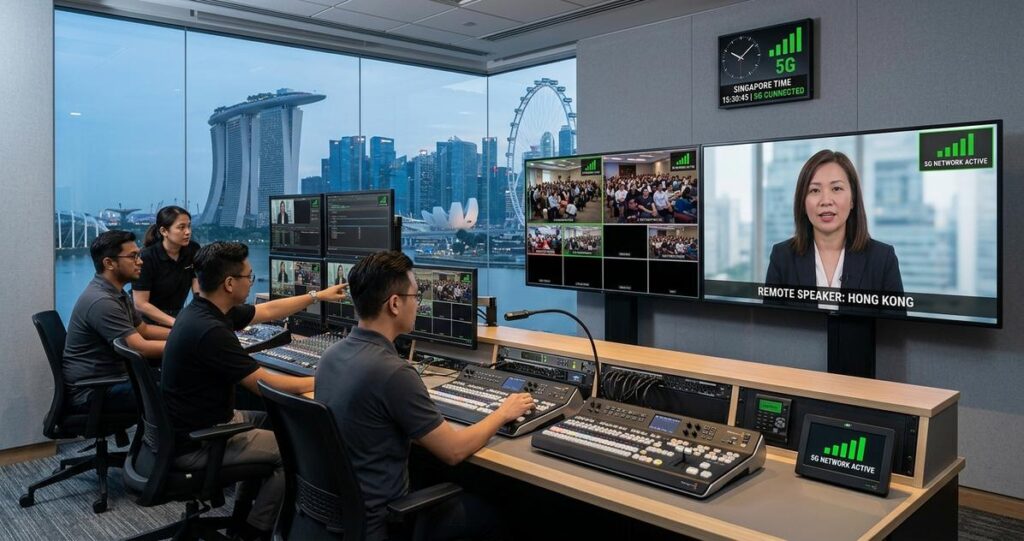
Hybrid regional events have become a practical format for businesses, associations, and public organisations that need to connect people across multiple locations without losing the value of in-person interaction. In Singapore, where event spaces are often tightly scheduled, audiences are highly mobile, and regional collaboration is a core part of business life, the pressure on event technology is real. Organisers are expected to deliver smooth live streaming, stable audio and video, interactive participation, and reliable backup plans, often from venues that were never designed as full broadcast studios. This is where 5G has begun to matter. It is not a magic solution, and it does not replace careful production planning, but it can significantly strengthen the backbone of remote hubs, especially when hybrid regional events need flexibility, rapid deployment, and dependable connectivity across different sites.
For Singapore readers, the question is not whether hybrid events are useful, but how to make them work reliably at scale. A remote hub is a location that supports part of an event production workflow from a separate site, often outside the main venue. It may handle speaker contributions, video switching, commentary, audience interaction, or regional breakout communication. When these hubs rely on fixed broadband alone, organisers can face constraints if network capacity is shared with other users, if the site has limited cabling, or if there is no practical way to install a full temporary infrastructure. 5G, particularly when used with proper redundancy and professional-grade equipment, can help event teams build more resilient remote hubs for regional delivery.
What a remote hub does in a hybrid regional event
A remote hub is best understood as a production node that supports an event from a separate physical location. Instead of placing every participant, camera feed, moderator, and control function in one venue, the organiser distributes some of the workflow across locations. This is useful for regional events involving speakers from Singapore, Malaysia, Indonesia, or other markets, because it can reduce travel demands, simplify satellite participation, and allow localised content to be created closer to each audience.
In practical terms, a remote hub may host a presenter who joins via live contribution, a small technical team managing graphics or subtitles, or a satellite studio connected back to the main venue. For trade conferences, corporate town halls, and government-linked forums, this model can improve accessibility and reduce the logistical burden on both organisers and attendees. The challenge is that a hybrid event depends on low-latency communication, stable upload performance, and clean audio-video synchronisation. If the connection drops or suffers severe delay, the audience experience can quickly deteriorate.
Why connectivity quality matters more than raw speed
Many people think the most important network metric is download speed, but for event production, upload consistency, latency, and jitter are often more important. Latency is the time it takes data to travel between two points. Jitter is variation in that travel time. Packet loss occurs when data never reaches its destination. In a live event, these issues can affect real-time conversation, video switching, and remote speaker interactions even when the headline speed looks impressive.
That is why a remote hub needs more than a fast connection on paper. It needs a connection that behaves predictably under load. 5G can help because it offers high-capacity wireless access, but results depend on coverage quality, signal conditions, network design, and how many devices are competing for bandwidth. In dense Singapore environments, these factors matter especially in high-rise offices, hotels, convention spaces, and temporary event sites.
How 5G strengthens event production workflows
5G is the fifth generation of mobile network technology. Compared with earlier mobile generations, it is designed to support more connected devices, higher throughput, and lower latency under the right conditions. For event teams, the most useful feature is not simply faster internet. It is the ability to create flexible connectivity for production workflows that may be mobile, temporary, or distributed.
For hybrid regional events, 5G can support remote hubs in several ways. It can provide primary connectivity in locations where wired access is limited or unavailable. It can function as a backup path if fixed broadband fails. It can help teams connect cameras, encoders, laptops, and communication tools without laying extensive cabling. It can also reduce setup time, which matters when organisers are working within short venue access windows common in Singapore event operations.
Lower latency supports more natural interaction
Latency is critical when an event involves live discussion between locations. Even a short delay can create awkward interruptions when a moderator in Singapore is speaking with a panelist in another country. 5G networks are designed with lower latency potential than previous mobile generations, which can improve the responsiveness of live interactions. That said, the actual latency experienced in an event setup depends on many variables, including the device, local radio conditions, network route, and platform architecture. Organisers should therefore test end-to-end performance, not just assume that a 5G logo guarantees seamless live delivery.
In a remote hub setting, lower latency can make back-and-forth conversation feel more natural. It can also help technical teams communicate more efficiently during a show, especially when they are coordinating live cues, switching feeds, or responding to unexpected changes.
Wireless flexibility supports temporary and distributed hubs
Event production often happens in spaces that were not built as permanent studios. A ballroom, museum, co-working space, or branded experiential venue may need to be turned into a temporary broadcast point for one day only. Installing a full fibre setup can be expensive or impractical in such cases. 5G can give organisers a practical alternative, particularly for short-term deployments where flexibility matters more than permanent infrastructure.
This is especially relevant in Singapore, where event teams may need to move quickly between venues and where space constraints are common. A well-planned 5G setup can support compact remote hubs with fewer cables, faster rigging, and easier repositioning. For teams managing multiple regional contributors, that flexibility can make the difference between a workable event design and an overly rigid one.
Why 5G is especially useful in Singapore’s event environment
Singapore is a strong environment for hybrid regional events because it has advanced digital infrastructure, a concentrated business ecosystem, and frequent cross-border collaboration. At the same time, event professionals here work in a highly competitive setting where expectations for quality are high. Audiences are used to polished streaming, reliable audio, and professional moderation. A remote hub that fails to connect cleanly can quickly undermine the credibility of the entire event.
5G fits well into this environment because it can supplement the strong connectivity ecosystem already available in Singapore. It is useful for productions that need mobility, redundancy, or rapid deployment across business districts, hotels, convention centres, and satellite offices. For regional events, the ability to coordinate contributions from different countries can also make content more relevant. A Singapore-based main stage can be supported by regional breakout hubs in other cities, allowing organisers to localise discussions while keeping a unified production standard.
Supporting multi-site collaboration across Southeast Asia
Hybrid regional events often need to balance local relevance with central coordination. A Singapore-based organiser may be running a conference for audiences across Southeast Asia, with speakers joining from different markets and a content team in Singapore managing the main programme. A remote hub supported by 5G can help create a more distributed production model, making it easier to bring in regional voices without requiring every contributor to travel to the main venue.
This can be valuable for businesses with offices across ASEAN, trade associations with regional chapters, and public sector programmes that aim to connect stakeholders in multiple locations. If the technology is implemented properly, the event can feel more inclusive and less centralised, while still maintaining editorial control and technical consistency.
Improving resilience with network diversity
One of the strongest reasons to consider 5G is resilience. Even strong fixed networks can experience congestion, local faults, or site-specific limitations. By adding 5G to the production design, organisers create network diversity, which means they are not relying on a single failure point. This does not eliminate risk, but it reduces vulnerability.
In event operations, resilience is not optional. A live session is only as strong as its weakest critical connection. For a remote hub, a 5G link can serve as a backup line for streaming encoders, a communications channel for the production team, or a failover pathway if primary internet service becomes unstable. This layered approach aligns with professional broadcast and IT practice, where redundancy is used to reduce operational risk.
What event teams should plan before relying on 5G
Although 5G can be a powerful tool, it should never be assumed to work perfectly in every venue or use case. Professional event teams need to plan the deployment carefully, test it in advance, and build fallback options into the production design. The best results come when 5G is treated as part of a broader connectivity strategy, not as a standalone fix.
Perform site surveys and live tests
Every venue is different. Indoor signal strength can vary due to building materials, room position, crowd density, and local interference. A site survey helps identify whether 5G coverage is strong enough for the intended use. More importantly, live tests should be conducted with the actual devices and workflows that will be used during the event. A test with a laptop alone is not enough if the real production setup involves bonded connectivity, encoding hardware, remote camera feeds, and interactive platforms.
Organisers should test under realistic load, ideally at the same time of day as the event, because network conditions can vary. The goal is to understand real performance, not just ideal performance.
Use professional encoding and backup pathways
5G connectivity works best when paired with professional-grade encoding equipment and proper backup planning. An encoder converts video and audio into a format suitable for transmission. If the encoder is poorly configured, even a strong 5G signal may not produce a clean stream. Event teams should also consider bonded connectivity, where multiple connections are combined to improve stability, as well as backup power for critical devices.
For high-stakes events, a single network should not carry all critical functions. Separate paths for programme delivery, team communication, and contingency access can reduce the chance that one issue disrupts the entire event.
Protect sensitive data and access points
Any networked event environment carries cyber and privacy considerations. Remote hubs may transmit speaker feeds, internal briefings, registration data, or business-sensitive content. Organisers should work with secure equipment, strong access controls, and approved platforms. Use of 5G does not remove the need for cyber hygiene. Authentication, device management, and careful handling of event data remain essential, especially for corporate and government-related programmes.
What good 5G deployment looks like in a hybrid event strategy
Effective 5G deployment starts with clarity about the event objective. Is the remote hub being used for backup connectivity, for a satellite studio, for live regional participation, or for a mobile production unit? Each use case requires a different technical design. A corporate AGM, a regional leadership forum, and a public conference will not have identical needs.
For Singapore-based organisers, a sensible strategy is to design the event around reliability first, then add flexibility. That means identifying the must-have functions, such as keynote transmission, speaker communication, audience questions, or translation support. It also means defining what happens if a network slows down or drops. Good event teams prepare alternate layouts, backup communication channels, and clear escalation procedures so the production keeps moving even when conditions change.
5G is most valuable when it helps teams do three things well. First, it expands the range of possible event locations. Second, it improves redundancy when combined with wired connections. Third, it makes distributed collaboration more practical for regional audiences. When these benefits are matched with proper planning, remote hubs can become a stable part of hybrid event delivery rather than a risky experiment.
For Singapore, where regional business links are strong and event standards are high, the role of 5G is likely to keep growing. It enables more agile production models, supports satellite participation, and helps organisers serve geographically spread audiences without sacrificing technical discipline. The key is to use it deliberately, with realistic expectations and thorough preparation. When event teams treat 5G as one component of a robust production system, it can meaningfully improve how hybrid regional events are created, connected, and delivered.
For organisations planning a hybrid event in Singapore or across the region, the practical takeaway is simple. Build connectivity resilience into the concept from the start, test every critical path before show day, and choose production partners who understand both live streaming and operational risk. That approach gives remote hubs their best chance to perform consistently, even in demanding live conditions.
Jeremy Lee is a seasoned digital marketing director and strategist with over two decades of experience in the industry. As the founder of Sotavento Medios, I manage a diverse portfolio of over 50 businesses, helping brands grow through advanced search strategies and digital innovation. My work focuses on bridging the gap between traditional search engine optimisation and the evolving world of AI-driven answer engines.
get in touch