
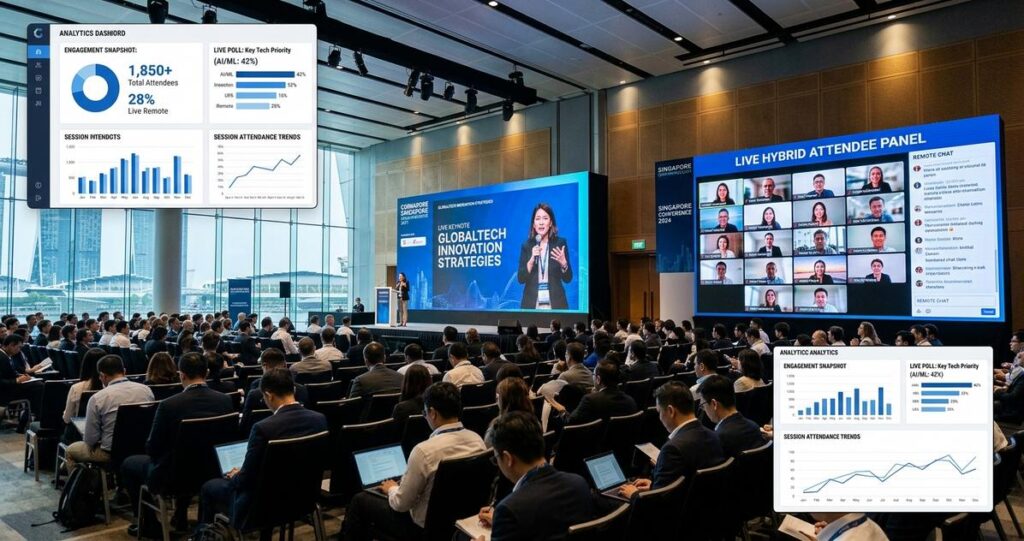
For Singapore organisations planning conferences, seminars, and corporate forums, the question is no longer whether an event should be in person, online, or both. The more practical question is how to know whether the event actually worked. Hybrid conferences offer a useful answer because they generate measurable engagement data across both physical and digital touchpoints. For businesses, associations, healthcare groups, universities, and government-related organisations in Singapore, this matters because event success is often judged not only by attendance, but by attention, interaction, lead quality, and post-event action.
A hybrid conference combines a live audience with a remote audience, usually through streaming platforms, virtual meeting tools, or event apps. That format gives organisers a broader reach, but the real advantage is data. Unlike a traditional room-only event where feedback may depend on observation, hybrid events can capture structured information such as registration behaviour, session attendance duration, poll participation, chat activity, question volume, content downloads, and follow-up conversions. When used properly, these data points help organisers understand what audiences actually engaged with, rather than what they assumed was effective.
In Singapore, where event budgets are often tightly managed and audiences are diverse in age, language preference, and digital comfort, this level of insight is especially valuable. A hybrid format can support delegates who are in the office, travelling between meetings, caring for family members, or joining from overseas. It can also help organisers improve future planning by showing which speakers held attention, which sessions were skipped, and which content formats encouraged action. The result is not just a more accessible event, but a more accountable one.
Why engagement data matters more than attendance alone
Attendance tells you how many people showed up. Engagement data tells you what they did after they arrived. That distinction is important because high registration numbers do not necessarily mean the message landed, and a packed room does not always mean the audience was attentive. In a hybrid conference, organisers can move beyond headcount and measure actual participation across multiple channels.
This is especially relevant for events that serve professional or technical audiences in Singapore, such as medical briefings, financial sector forums, education conferences, trade seminars, and public-sector stakeholder events. In those settings, the quality of attention is often more important than the size of the audience. A smaller but highly engaged audience may be more valuable than a large audience that passively logs in and leaves early.
What engagement means in a hybrid setting
In event analytics, engagement refers to observable actions that indicate attention, interest, or interaction. These may include:
- Session check-in and watch time
- Participation in polls or surveys
- Questions asked through Q and A tools or chat
- Downloads of slides, brochures, or white papers
- Clicks on links shared during the session
- Networking activity in event platforms
- Post-event registrations for follow-up meetings, demos, or consultations
These indicators are not medical terms, but the same logic applies in information-heavy events, where the organiser wants to understand whether participants processed and acted on the material presented. Engagement should be interpreted as a pattern, not a single metric. A participant who stays for 80 percent of a session and submits a question may be more engaged than someone who logs in briefly but never interacts.
Why this matters for Singapore audiences
Singapore participants often attend conferences with limited time between work commitments, commuting, and family responsibilities. Many also value efficiency and direct relevance. This makes engagement tracking particularly useful, because it helps organisers identify content that respects audience time. If a 45-minute session loses most viewers after 15 minutes, the issue may be timing, content depth, presenter delivery, or technical friction. Data can help separate these factors.
For organisations operating in Singapore’s competitive business environment, engagement data also supports better decision-making. It can justify event spend, refine content strategy, and help leadership teams evaluate whether a conference produced meaningful business outcomes. In sectors where trust and professionalism matter, such as healthcare, finance, education, and B2B services, that evidence-based approach is an important advantage.
The main data points that hybrid conferences can capture
Hybrid conferences generate a wider range of data than many organisers realise. The value comes not just from collecting numbers, but from choosing the right ones and interpreting them in context. When data is aligned with event goals, it becomes a practical tool for improving content, audience experience, and return on effort.
Registration and attendance patterns
Registration data shows who intended to attend, while attendance data shows who actually participated. In hybrid events, organisers can compare in-person and virtual turnout, analyse peak registration periods, and identify whether certain groups prefer one format over the other. This can help with planning future outreach, especially for Singapore-based audiences who may prefer lunchtime sessions, after-work timings, or weekend formats depending on the event type.
It is also useful to track drop-off between registration and attendance. A high registration count with low attendance may suggest reminder emails were ineffective, the time slot was inconvenient, or the topic was too broad. This type of insight is much harder to obtain from a purely physical event.
Session duration and audience retention
Watch time and retention show how long participants stayed in a session before leaving. These metrics are important because they help organisers understand the strength of the content and the pacing of delivery. If viewers consistently leave at the same point, the material may need restructuring. If retention remains high throughout, the session may be well matched to the audience’s needs.
For hybrid conferences in Singapore, where audiences often expect concise and relevant content, retention data can be especially revealing. It can show whether keynote speeches, panel discussions, or product demonstrations hold attention better than long slide presentations. It can also help planners decide whether to shorten sessions, add breaks, or split topics into more digestible segments.
Interaction data from polls, chat, and questions
Interactive features give organisers direct evidence of participation. Polls can measure opinion trends, knowledge checks, or preference patterns. Chat messages and live questions show whether the audience is following the discussion closely enough to respond. These actions often reflect stronger engagement than passive viewing alone.
For example, a Singapore professional association hosting a hybrid panel on workplace transformation may use live polls to compare opinions between in-room and remote attendees. If remote participants answer more actively, the organiser may need to rethink how the in-person audience is being prompted. If certain questions keep recurring in chat, that may indicate the presentation was not clear enough or that the topic needs deeper explanation.
Lead quality and post-event conversion
For B2B events, engagement data becomes especially valuable when linked to conversion outcomes. A person who attended a product demo, downloaded a technical guide, and booked a follow-up meeting is a stronger lead than someone who simply registered. In this sense, hybrid conference data can support sales and business development by showing which content attracted serious interest.
This is one reason many Singapore organisations view hybrid events as more than a broadcast format. They are a measurable marketing and relationship-building channel. When event data is properly connected to customer relationship management systems, organisers can see which sessions led to further action and which audience segments responded most strongly.
How hybrid conference analytics improve event strategy
The best use of engagement data is not to create more reports. It is to improve decisions. Organisers can use hybrid analytics to refine event design, sharpen content, and allocate resources more effectively. This is particularly important in Singapore, where event quality is often judged by professionalism, precision, and the ability to deliver clear business value.
Content planning becomes more evidence-based
Data can reveal which topics generate the most interest, which speakers sustain attention, and which formats encourage interaction. If panel discussions consistently outperform long presentations, the next event may need more moderated discussion and fewer lecture-style segments. If a technical workshop gets strong post-event downloads but weak live chat, the content may be highly useful but too dense for live interaction.
Over time, these insights help organisers build a stronger content strategy. Instead of guessing what the audience wants, they can observe patterns across multiple events. That is particularly useful for recurring conferences, annual forums, and professional development programmes in Singapore.
Audience segmentation becomes clearer
Hybrid platforms can show how different audience groups behave. For instance, first-time attendees may stay longer in introductory sessions, while repeat delegates may prefer deeper technical content. Local participants may engage differently from regional attendees joining from abroad. Senior executives may register but interact less, while practitioners may ask more questions.
Understanding these segments helps organisers tailor content, marketing messages, and session formats. It can also support more inclusive planning. In Singapore, where audiences may include English-speaking professionals alongside participants more comfortable with concise visual content, segmentation helps ensure the event serves a wider range of needs without losing clarity.
Event operations become easier to optimise
Analytics can also improve logistical planning. If virtual attendance peaks during a specific time window, organisers can schedule important sessions accordingly. If technical drop-offs happen when switching between platforms or speakers, the production workflow may need tightening. If in-person and online participation differ significantly, the format balance may need adjustment.
These operational insights are valuable because event quality depends not only on content, but on delivery. A well-produced hybrid event reduces friction, supports attention, and makes it easier for participants to participate meaningfully, regardless of location.
Important limits and responsible interpretation of event data
While hybrid conferences offer more data, not every metric should be treated as a perfect measure of success. Data is useful only when interpreted carefully. Organisers should avoid overreading superficial numbers or making claims that the numbers do not support.
High interaction does not always mean high understanding
A session may receive many chat messages or poll responses, but that does not automatically mean participants understood the material. Some audiences interact because the format encourages it, not necessarily because the content was clear. Likewise, low interaction does not always mean poor quality. A highly technical or executive-level session may be more reflective than chat-heavy.
That is why engagement data should be read alongside qualitative feedback, speaker notes, and post-event surveys. Numbers show behaviour, but comments and open-text responses often explain why that behaviour happened.
Privacy and consent must be handled properly
Event analytics should be collected and used in a way that respects privacy expectations and applicable data protection obligations. In Singapore, this means organisers should pay careful attention to the Personal Data Protection Act, especially when collecting identifiable attendee information, tracking behaviour across platforms, or linking event activity to marketing follow-up.
Participants should understand what data is being collected and how it will be used. This is important for trust. If the event involves registration, recording, or lead capture, organisers should provide clear notices and use the data only for legitimate event-related purposes. Good data practice is not just a legal issue, it also strengthens credibility.
Accessibility and digital comfort matter
Not every participant engages in the same way. Some audiences are comfortable using chat, polls, or app-based networking tools. Others may prefer to listen quietly and absorb information. In Singapore, where hybrid events may serve a wide age range from early-career professionals to senior decision-makers, organisers should avoid assuming that less visible participation means less value.
Accessibility also matters for people joining from different environments, including offices, homes, or while commuting. Clear instructions, stable streaming, readable slides, accurate captions where available, and simple navigation all improve the likelihood of meaningful engagement. A hybrid event should make participation easier, not more complicated.
Practical ways Singapore organisers can use engagement data well
The strongest hybrid event strategies are the ones that turn data into action. That requires planning before the event, monitoring during the event, and reviewing the data afterwards. For Singapore organisers, a disciplined approach helps ensure each event builds on the last.
Set clear goals before the event starts
Before choosing metrics, define what success means. Is the main goal to educate, generate leads, support professional networking, or demonstrate thought leadership? The answer affects which data matters most. A training event may focus on retention and quiz scores. A business conference may focus on lead quality and follow-up meetings. A policy forum may focus on attendance diversity and question quality.
Without clear goals, data becomes noisy and difficult to use. With goals in place, the team can focus on the indicators that actually support decision-making.
Use a mix of quantitative and qualitative feedback
Numbers are important, but they work best when paired with participant comments, speaker observations, and operational notes. A drop in watch time may be explained by a technical issue, a confusing topic transition, or audience fatigue. A strong poll response may be supported by open comments that reveal the audience wanted more practical examples.
This combined approach gives organisers a more complete picture and reduces the risk of misinterpreting one metric in isolation.
Review data quickly after the event
The most useful insights often fade if they are not reviewed soon after the conference. A post-event debrief should include event production, content, marketing, and business development teams where relevant. Review registration sources, retention curves, interaction peaks, and follow-up actions while the event is still fresh in everyone’s mind.
For organisations in Singapore that run multiple events each year, this process creates a feedback loop. Each conference becomes a source of evidence for the next one, which gradually improves planning quality and audience experience.
Hybrid conferences are not only about reaching people in more than one place. They are about understanding how people engage, what holds their attention, and what moves them to act. That is the real data advantage. For Singapore organisations, especially those that value measurable outcomes, the hybrid format offers a practical way to make events more accountable, more inclusive, and more effective.
When event teams define the right metrics, interpret them responsibly, and respect privacy obligations, engagement data becomes a strategic asset. It can sharpen content, improve delivery, and support stronger business results. For companies and institutions that want a clearer picture of audience behaviour, hybrid conferences provide something that traditional formats often cannot, a detailed, usable view of participation that helps every future event perform better.

Jeremy Lee is a seasoned digital marketing director and strategist with over two decades of experience in the industry. As the founder of Sotavento Medios, I manage a diverse portfolio of over 50 businesses, helping brands grow through advanced search strategies and digital innovation. My work focuses on bridging the gap between traditional search engine optimisation and the evolving world of AI-driven answer engines.
get in touch