
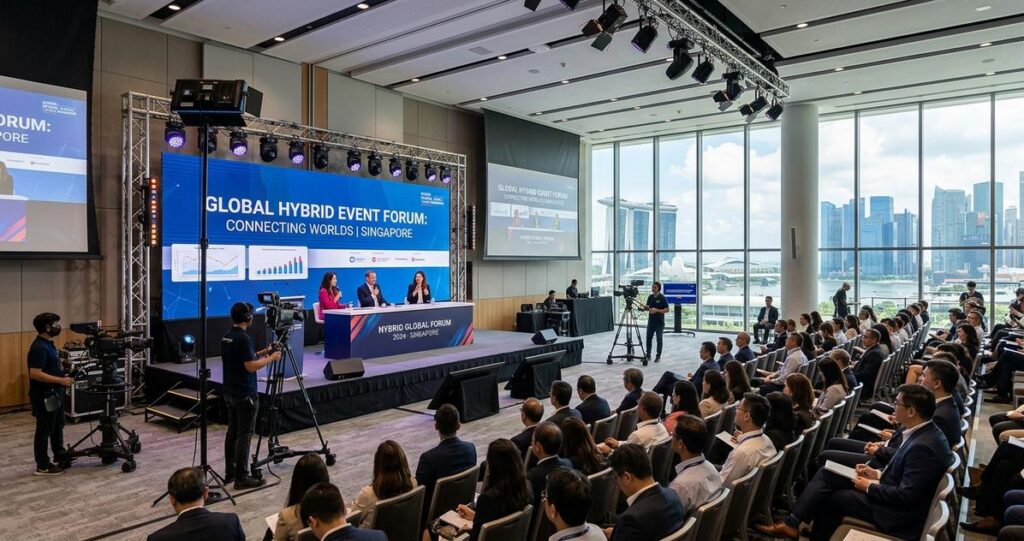
Choosing the right venue is one of the most important decisions in any professional hybrid event. For Singapore-based organisers, the venue is not just a location, it is the physical foundation that affects audio quality, camera placement, internet reliability, lighting consistency, audience comfort, and the overall experience for both in-person and remote participants. A beautifully designed ballroom or meeting room can still perform poorly on stream if it has reflective surfaces, weak network infrastructure, or limited space for production equipment. Likewise, a smaller venue can perform exceptionally well when the technical environment supports clean sound, stable connectivity, and clear sightlines. For hybrid streaming, the venue should be assessed as a broadcast environment first, and an event space second.
In Singapore, this matters even more because many events are hosted in hotels, co-working spaces, convention centres, offices, and heritage venues that were not originally designed for live broadcast workflows. Organisers often need to balance premium presentation with practical realities such as building access, loading constraints, and rules around cabling or rigging. When the venue supports the production team properly, the event feels seamless to both audiences. When it does not, even a strong programme and experienced speakers can be undermined by echo, unstable video, or interruptions in connectivity.
To optimise venue choice for professional hybrid streaming, it helps to think in terms of system design. The venue must support capture, transmission, control, and audience experience in one integrated setup. That means evaluating acoustics, power, internet, lighting, layout, accessibility, and operational logistics before any booking is confirmed. This article explains the practical criteria that matter most, with Singapore-specific considerations that event planners, corporate teams, and agencies can apply when selecting a venue.
Start with the venue’s technical suitability, not just its visual appeal
The first instinct when choosing an event venue is often to look at how impressive it appears in photos. That matters for brand perception, but for hybrid streaming, technical suitability should carry equal or greater weight. A venue may look elegant in person but still be a difficult environment for professional live production if it has excessive reverberation, poor access to power, or limited control over ambient noise.
A hybrid event usually requires multiple production elements working together, including cameras, microphones, lighting, monitors, encoding hardware, and a stable uplink for transmission. If the venue cannot support these elements without compromise, the stream quality will suffer. The production team then has to spend more time compensating for environmental limitations, which increases complexity and risk.
Acoustics should be assessed early
Acoustics refers to how sound behaves in a space. In simple terms, it determines whether speech is clear or whether it bounces around the room and becomes difficult to understand. Venues with hard surfaces such as glass, marble, concrete, polished walls, and high ceilings often create echo and reverberation. That can make microphones pick up unwanted room sound, which is especially noticeable for remote viewers.
For professional hybrid streaming, speech intelligibility is critical. Even a visually polished event can feel unprofessional if the audience struggles to hear speakers clearly. During site visits, listen for echo by speaking normally, clapping once, or checking how sound carries from one side of the room to the other. If the venue sounds live and reflective, the production team may need more directional microphones, acoustic treatment, or careful speaker positioning.
Singapore venues vary widely in acoustic quality. Hotel ballrooms, function rooms, office boardrooms, and cultural venues all have different sound characteristics. Do not assume that a premium venue automatically has better sound. A smaller carpeted room with soft furnishings may perform better on stream than a visually grand hall with many reflective surfaces.
Check line of sight and camera placement options
Hybrid streaming depends on clear visual framing. The venue should allow cameras to capture presenters, panels, and audience reactions without awkward obstructions. Columns, low ceilings, fixed furniture, decorative screens, and stage edges can all interfere with camera angles. A venue that is suitable for live audiences may still be challenging if there is no practical space for tripods, side cameras, roaming cameras, or a wide master shot.
The ideal venue gives the production team enough flexibility to place cameras at different distances and heights. It should also allow a clean view of the stage or speaking area from the main camera positions. If the event includes a panel discussion, make sure there is enough room for multiple seated speakers without crowding the frame. If the event includes product demonstrations or audience participation, the space should support movement without losing sightlines.
Prioritise connectivity, power, and production infrastructure
Reliable connectivity is one of the most important requirements for professional hybrid streaming. Even the best content cannot reach remote viewers smoothly if the venue’s network is unstable. Singapore has strong digital infrastructure overall, but event venues still vary in the quality, capacity, and accessibility of their internet services. A venue should be assessed for both wired and wireless connectivity, and the production team should never rely on unverified assumptions.
For live streaming, wired internet is generally preferred because it is more stable than standard public Wi-Fi. The team should ask whether the venue can provide dedicated bandwidth, whether there are any restrictions on external streaming equipment, and whether network access can be tested in advance. If the event is mission-critical, it is wise to have a backup connectivity plan such as a bonded mobile solution or a separate internet line, subject to venue rules and production requirements.
Test upload stability, not only advertised speed
Many organisers focus on internet speed figures, but for streaming, upload stability is often more important than a single speed number. The stream depends on consistent upstream performance, because video must be sent from the venue to the remote platform without dropouts. A connection that looks adequate on paper can still fail under real-world load, especially if the venue network is shared with guests, exhibitors, or other event operations.
A proper site survey should include testing from the exact production position, not just at the venue reception or management office. Network conditions can differ significantly from one room to another. If possible, the production team should test at the planned operating time, because network congestion can vary throughout the day. For larger events, a dedicated line or VLAN may be worth discussing with venue management and the technical provider.
Confirm power distribution and load capacity
Hybrid production equipment uses multiple power sources, including cameras, switchers, encoders, monitors, lights, audio gear, laptops, and charging stations. Venue power must be planned carefully to avoid overloaded circuits, unsafe cable runs, or inconvenient extension arrangements. Ask about the number and location of power outlets, the available circuit capacity, and whether the venue can support separate power feeds for production and event operations.
It is also important to consider cable management. Safe routing matters for staff, speakers, and attendees, especially in busy Singapore venues where movement through compact spaces can be frequent. The venue should allow cable runs that do not create trip hazards or interfere with emergency exits. Professional production teams will usually bring cable covers and safety materials, but the venue layout must still support a clean setup.
Design the venue around the audience, both onsite and online
Hybrid streaming is not just about broadcasting to remote viewers. It is about designing an event where the in-person audience and the online audience both receive a coherent, high-quality experience. The best venue choice supports both groups without making either feel like an afterthought. This means evaluating seating, stage visibility, sound distribution, screen placement, and audience movement patterns.
For onsite attendees, comfort and sightlines matter. For remote attendees, the event must be framed in a way that makes the content easy to follow. If the venue is too large for the expected audience size, the room may feel empty and the energy may drop. If it is too small, the room may feel cramped, and camera shots may look cluttered. Venue size should therefore match the event format, not just the guest count.
Stage design and speaker positioning affect both experiences
The stage or presentation area should be positioned so that speakers can face the live audience while remaining camera-friendly. Some venues place stages in corners or against heavily patterned backdrops, which can create visual distractions on stream. A cleaner background often works better, especially for corporate events, webinars with live studio elements, leadership talks, and panel sessions.
Speaker placement should also support natural communication. If presenters need to face multiple cameras, confidence monitors, or teleprompter systems, the venue should allow enough space for those tools without making the stage look crowded. In Singapore’s business environment, where hybrid town halls, product launches, and panel conversations are common, the layout must support both professionalism and clarity.
Think about audience flow and room transitions
Hybrid events often involve registration, networking, live presentation, Q and A, and sometimes breakout sessions. The venue should support smooth movement between these phases. Narrow entrances, awkward registration points, or congested foyers can slow down the event and create noise that affects the stream. If a venue has multiple uses at once, the production area should be separated from guest circulation wherever possible.
For events that include remote speakers or interactive audience participation, the venue should also have a quiet area for pre-event checks, speaker makeup or touch-up if needed, and technical troubleshooting. A good venue makes the event feel organised, which reduces stress for speakers and helps the production team focus on quality.
Assess lighting, reflections, and environmental control
Lighting is one of the most visible factors in hybrid streaming quality. Poor lighting can make even expensive cameras produce flat, noisy, or unflattering footage. Many venues have general ambient lighting that is acceptable for in-person use but not ideal for broadcast. For professional streaming, the venue should allow the production team to shape the light on speakers, minimise harsh shadows, and maintain consistent brightness throughout the session.
Windows, glass walls, mirrors, glossy floors, and bright LED signs can all affect camera exposure. Daylight changes can also be an issue for venues with large windows, especially for afternoon events in Singapore when sunlight can shift during the programme. If natural light is part of the venue’s appeal, it should be controllable with blinds, curtains, or scheduling decisions that keep lighting consistent.
Temperature and noise control matter more than many organisers expect
Climate control affects comfort, but it also affects production stability. Equipment generates heat, and a crowded room can become warm quickly. Speakers may become less comfortable, and cameras or encoding gear may overheat if ventilation is poor. A venue should maintain a stable indoor environment and allow the production team enough time for setup without rushing.
Noise control is equally important. Air-conditioning systems, kitchen operations, elevators, traffic noise, and nearby event spaces can all create background sound that microphones may capture. This is particularly relevant in multi-use buildings and hotels, which are common in Singapore’s event scene. During venue assessment, listen for hums, rattles, or intermittent noise. If noise is unavoidable, the production team may need to adjust microphone types, placement, or recording strategy.
Work with the venue’s operational realities, not against them
Even the best technical plan can fail if the venue’s operations do not support the production workflow. Loading access, equipment handling, on-site contacts, and setup windows all affect the feasibility of a professional hybrid stream. In Singapore, where venue schedules can be tightly managed and event turnover may be fast, it is essential to confirm logistical details early.
Ask how equipment can be delivered, where it can be stored, and how much setup and teardown time is available. Confirm whether lifts, loading bays, and service entrances are accessible for production gear. If the venue requires vendor registration, insurance documents, or specific safety procedures, these should be handled well before event day.
Understand the venue’s rules on rigging, cabling, and external vendors
Some venues limit the use of truss, lighting stands, floor tape, or overhead rigging. Others may require approved contractors or in-house technical support. These rules are not necessarily obstacles, but they must be known in advance so the event design remains realistic. A production team cannot promise a particular camera angle or lighting effect if the venue forbids the necessary equipment placement.
External vendor coordination is especially important for corporate events with multiple stakeholders. The venue, event organiser, AV provider, internet provider, and content team should all understand the same technical requirements. Clear communication reduces last-minute changes and prevents avoidable compromise. In hybrid production, small misunderstandings can become visible on camera very quickly.
Plan for rehearsal and contingency
A reliable venue should support rehearsal time. This is where the team can test camera framing, sound levels, slides, speaker movement, and remote connection flow. Rehearsal is not a luxury, it is part of professional quality control. It allows problems to be solved before the audience arrives.
Contingency planning is also part of venue selection. Ask what happens if the primary room becomes unavailable, if network access fails, or if a key technical area is unexpectedly restricted. A strong venue partner will work with the organiser to reduce risk and provide alternatives where possible. That level of preparedness is especially important for board meetings, leadership broadcasts, investor presentations, product announcements, and other high-stakes events.
For Singapore organisers, optimising venue choice for professional hybrid streaming means balancing aesthetics, acoustics, connectivity, and logistics in one decision. The most impressive venue is not always the most effective venue. The right choice is the one that lets the production team deliver a clear, stable, and polished experience to both live and remote audiences without unnecessary technical compromise. Before confirming a venue, walk through the room as if you are the camera, the microphone, and the network. If the space supports those three fundamentals well, it is far more likely to support a successful hybrid event.
If you are planning a hybrid conference, town hall, panel discussion, or brand event in Singapore, treat the venue as part of the production system from the start. Evaluate acoustics, connectivity, power, lighting, sightlines, access, and operational policies together. That approach gives your audience a better experience, reduces technical risk, and helps your event achieve a professional standard that reflects well on your organisation.

Jeremy Lee is a seasoned digital marketing director and strategist with over two decades of experience in the industry. As the founder of Sotavento Medios, I manage a diverse portfolio of over 50 businesses, helping brands grow through advanced search strategies and digital innovation. My work focuses on bridging the gap between traditional search engine optimisation and the evolving world of AI-driven answer engines.
get in touch