
Quantifying the ROI: Beyond Simple Travel Cost Reduction
The initial calculation for justifying an investment in professional streaming infrastructure often begins and ends with a direct comparison to travel expenses. While the savings on airfare, accommodations, and per diems for executives and key personnel are substantial and easily quantifiable, they represent only a fraction of the total return on investment. A more sophisticated analysis, appropriate for enterprise-level decision making, must account for indirect costs and strategic benefits that deliver compounding value.
Direct Cost Analysis: Hard Numbers on Logistical Overhead
A C-suite executive traveling for a single-day, multi-location roadshow or a critical quarterly update incurs significant direct costs. These include business-class airfare, ground transportation, hotel stays, and meals. For a team of five executives, this can rapidly escalate into tens of thousands of dollars per event. A centralized, broadcast-quality streaming studio amortizes its capital expenditure over each event it replaces. An initial investment in a permanent or semi-permanent production facility can achieve payback in as few as two to three fiscal quarters, based solely on the elimination of these recurring logistical expenditures. The financial modeling is straightforward: calculate the average annual executive travel cost for internal events and compare it to the one-time CapEx and minimal ongoing OpEx of a dedicated streaming solution.
Indirect Cost Savings: Opportunity Cost and Productivity Gains
The most significant, yet often overlooked, component of ROI is the reclamation of executive time. An executive’s time is the organization’s most valuable and finite resource. A two-day trip for a four-hour meeting equates to a massive productivity loss. High-quality streaming eliminates travel time, jet lag, and the associated physical and mental fatigue. This recovered time is directly reallocated to high-value strategic activities such as product development, competitive analysis, and team leadership. This is not simply downtime; it is a direct injection of top-tier intellectual capital back into core business operations. Furthermore, the risk of travel disruptions, including flight cancellations and security delays, is entirely mitigated, ensuring that critical communications happen on schedule, every time.
The Intangible ROI: Enhanced Communication Cadence and Inclusivity
A professionally engineered streaming capability transforms executive communication from a high-cost, infrequent event into a low-friction, high-impact, and regular occurrence. Leadership can address the entire global workforce with greater frequency, fostering a more connected and aligned corporate culture. This increased cadence is a strategic advantage, enabling rapid dissemination of information during market shifts, mergers, or crisis situations. Moreover, it democratizes access. Employees in satellite offices or remote locations receive the same high-quality, front-row experience as those at headquarters. This sense of inclusivity and direct access to leadership is a powerful driver of employee engagement and retention, an intangible but potent long-term financial benefit.
Architecting the Broadcast-Grade Executive Streaming Environment
Achieving a return on investment is wholly dependent on the quality and reliability of the technical execution. A consumer-grade webcam and USB microphone setup not only fails to command executive presence but also introduces unacceptable points of failure. The architecture must be approached with the same rigor as a professional broadcast facility, prioritizing signal integrity, production control, and audio clarity from acquisition to distribution.
The Signal Chain Foundation: From Sensor to Screen
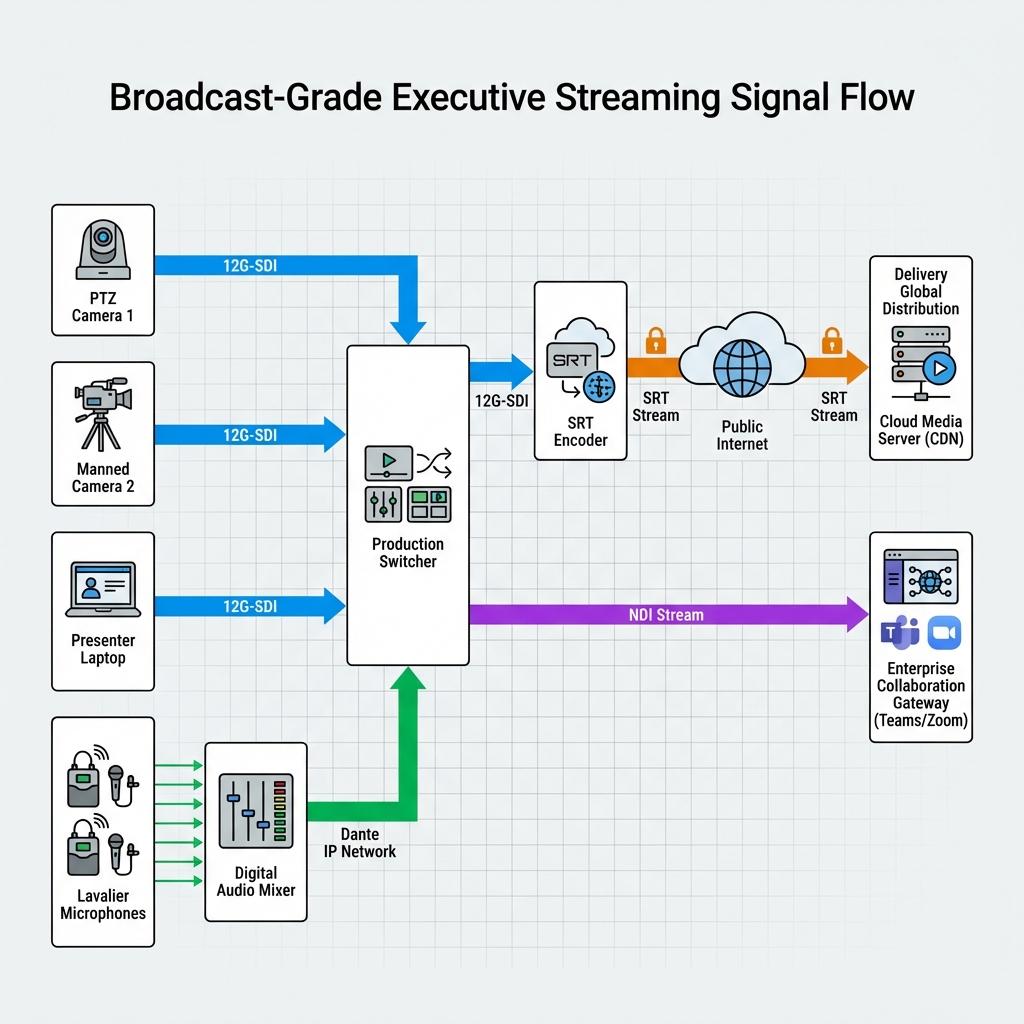
The foundation of any professional video production is an uncompromised signal chain. This begins with camera selection. Professional pan-tilt-zoom (PTZ) cameras with 1-inch sensors or manned studio cameras with broadcast lenses provide superior optical quality, depth of field, and low-light performance compared to webcams. The signal from these cameras should be transported via Serial Digital Interface (SDI), the industry standard for professional video. A 12G-SDI infrastructure supports uncompressed 4K UHD signals at 60 frames per second over a single coaxial cable, offering a robust and high-bandwidth connection that is far more reliable for the long cable runs typical in a studio or event space than HDMI. This ensures a pristine, full-raster video signal arrives at the production switcher without compression artifacts or signal degradation.
Production Control and Switching Infrastructure
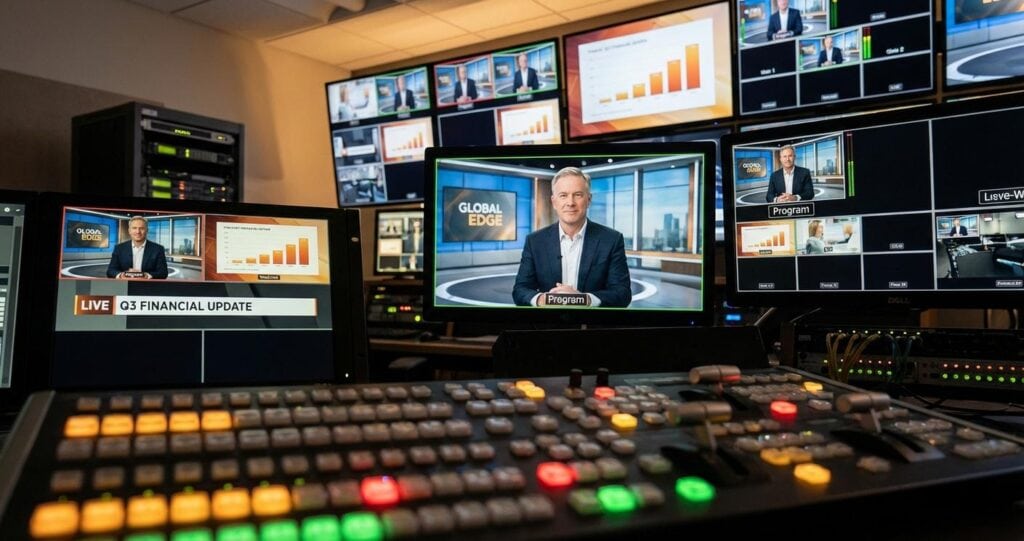
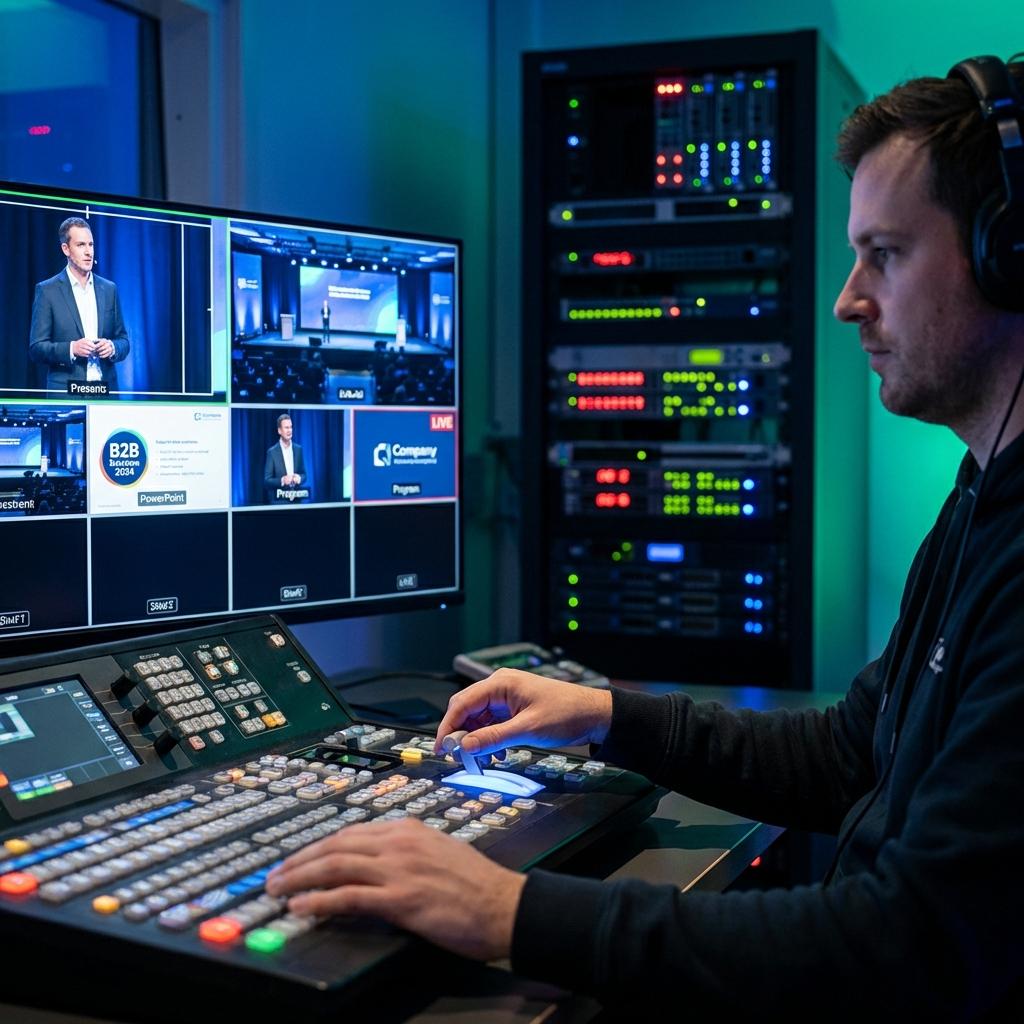
Central to the operation is a production switcher, which serves as the hub for all video and audio sources. Hardware-based switchers like a Blackmagic Design ATEM Constellation or Ross Video Carbonite provide the reliability and low-latency performance required for live events. These systems allow a technical director to seamlessly switch between multiple camera angles, pre-produced video roll-ins, and data sources like presentation slides. A critical component of this hub is multiview monitoring, which provides the production team with a real-time view of all sources, as well as preview and program outputs, on a single display. This allows for precise, broadcast-style direction. Professional graphics systems are integrated to provide lower-third titles for speakers, corporate branding, and real-time data visualization, elevating the production value far beyond a simple video call.
Audio Integrity: The Most Critical Component
Poor audio quality will undermine even the most pristine video. The audio workflow must be meticulously engineered for clarity and intelligibility. This involves using professional microphones, such as wireless lavalier systems for presenters and shotgun microphones for directional pickup, to ensure clean source audio. These signals are fed into a digital audio mixing console, which allows an audio engineer to manage levels, apply equalization (EQ) to enhance vocal presence, and use dynamics processing to prevent clipping and manage noise. For IP-based workflows, protocols like Dante enable the routing of hundreds of uncompressed, low-latency audio channels over a standard gigabit Ethernet network, providing immense flexibility and scalability in routing audio from microphones, video playback sources, and remote participants to the main program mix.
Protocol Deep Dive: Ensuring Secure and Resilient Delivery
The most sophisticated in-room production is worthless if the signal cannot be delivered reliably and securely to its intended audience. The choice of streaming protocol and encoding parameters is a critical engineering decision that directly impacts the viewer’s quality of experience (QoE) and the security of the communication. This is where enterprise-grade solutions diverge sharply from consumer-level streaming.
Beyond RTMP: The Case for SRT (Secure Reliable Transport)
For years, Real-Time Messaging Protocol (RTMP) was the de facto standard for contribution. However, it is a TCP-based protocol that does not gracefully handle network packet loss or jitter, which are common on public internet connections. For high-stakes executive communications, Secure Reliable Transport (SRT) is the superior choice. SRT is an open-source protocol that provides the reliability of TCP with the low latency of UDP. It utilizes an intelligent ARQ (Automatic Repeat reQuest) mechanism to retransmit lost packets, effectively smoothing out network congestion to prevent video stuttering or freezing. It also includes AES 128/256-bit encryption, ensuring the stream is secure end-to-end, a non-negotiable requirement for sensitive internal communications.
NDI for On-Premise IP-Based Workflows
Within the local area network (LAN) of a corporate campus or production facility, Network Device Interface (NDI) has become the standard for flexible, high-quality video-over-IP. Full NDI provides visually lossless video at extremely low latency (typically a single frame), making it ideal for routing video signals from cameras, graphics systems, and computers to the production switcher without the need for physical SDI cabling. This significantly simplifies setup and allows for immense scalability. For bandwidth-constrained environments, NDI|HX offers a compressed alternative that can be transmitted over standard Wi-Fi or 1-gigabit Ethernet networks, providing a balance between quality and bandwidth efficiency. An NDI-based infrastructure creates a flexible and powerful production ecosystem entirely on the network.
Encoding and Transcoding: H.264 vs. H.265 (HEVC)
The final step before distribution is encoding. This is the process of compressing the raw video signal into a manageable bitrate for streaming. The H.264 (Advanced Video Coding, or AVC) codec offers broad compatibility across virtually all devices. For 4K/UHD streaming, however, H.265 (High Efficiency Video Coding, or HEVC) is technically superior, offering up to 50% greater compression efficiency. This means a 4K stream can be delivered at a lower bitrate with HEVC than with H.264, reducing bandwidth requirements for the viewer without sacrificing visual quality. The choice of bitrate strategy is also critical. Constant Bitrate (CBR) is often preferred for live streaming to ensure a stable connection, while Variable Bitrate (VBR) can provide higher quality for a given average bitrate but may be more susceptible to network fluctuations.
Enterprise Integration and Scalable Distribution
A successful executive streaming solution must seamlessly integrate with existing corporate IT infrastructure and be capable of scaling from a small group of stakeholders to a global all-hands audience of thousands. This requires a robust distribution strategy that prioritizes security, accessibility, and reliability.
On-Premise vs. Cloud-Based Distribution
The distribution architecture can be on-premise, cloud-based, or a hybrid of the two. An on-premise media server, such as a Wowza Streaming Engine instance, provides maximum security and control, as the entire workflow remains within the corporate firewall. This is ideal for highly confidential communications. Cloud-based distribution, using services like AWS Elemental MediaLive or Microsoft Azure Media Services, offers unparalleled scalability and global reach. These platforms can dynamically scale to accommodate any audience size and use Content Delivery Networks (CDNs) to cache content at edge locations around the world, ensuring a low-latency, high-quality viewing experience for all employees, regardless of their location.
Bridging Broadcast and Collaboration Platforms
A key requirement is the ability to feed the high-quality program output into standard collaboration platforms. This bridges the gap between a broadcast-quality presentation and the interactive tools employees use daily. This is achieved by taking the SDI or NDI program output from the production switcher and feeding it into the collaboration tool via a professional capture card (e.g., from Magewell or AJA). In Microsoft Teams, this appears as a high-quality video source. For Zoom, Zoom Rooms can be configured with hardware kits that accept HDMI or SDI inputs. This workflow ensures that when an executive speaks, their video and audio feed within the collaboration platform is the professionally produced, multi-camera program, not a low-resolution webcam feed.
Redundancy and Failover Strategy
For mission-critical events, there is no tolerance for failure. A comprehensive redundancy plan is essential. This starts with the contribution path. Using bonded cellular technology (e.g., LiveU, TVU Networks) combines multiple cellular connections (4G/5G) and Wi-Fi into a single, highly resilient internet connection for the primary stream. A secondary, geographically diverse fiber line can serve as a backup. A dual-encoder setup, running in parallel, allows for instantaneous failover if the primary encoder fails. At the distribution level, a multi-CDN strategy can be employed, where traffic is automatically routed to a secondary CDN if the primary provider experiences an outage. This multi-layered approach to redundancy ensures the stream remains live even in the face of hardware or network failures. By investing in this level of technical production and resilient infrastructure, organizations can confidently replace executive travel, knowing their communications will be delivered securely, reliably, and with maximum impact, generating a powerful and multifaceted return on investment.

Jeremy Lee is a seasoned digital marketing director and strategist with over two decades of experience in the industry. As the founder of Sotavento Medios, I manage a diverse portfolio of over 50 businesses, helping brands grow through advanced search strategies and digital innovation. My work focuses on bridging the gap between traditional search engine optimisation and the evolving world of AI-driven answer engines.
get in touch