

Evaluating the Security of Peer-to-Peer Streaming for Internal Corporate Communications
The successful delivery of an all-hands meeting, CEO town hall, or critical training seminar to a geographically dispersed workforce is no longer a luxury; it is a fundamental requirement of enterprise operations. As production professionals, our focus is on delivering a flawless signal from our multi-camera production switcher to every employee, regardless of their location. However, the primary technical obstacle is often not the production itself, but the immense strain that high-quality video places on corporate Wide Area Networks (WAN) and VPN infrastructure. A single 1080p stream, encoded at a modest 4 Mbps, can quickly overwhelm network links when multiplied by thousands of employees. This challenge has driven the adoption of Enterprise Content Delivery Networks (eCDNs), with peer-to-peer (P2P) technology emerging as a popular solution. While P2P offers compelling bandwidth savings, it introduces a complex security paradigm that must be rigorously evaluated by IT, security, and production teams. This analysis will provide a technical deep-dive into the security architecture of P2P streaming systems for internal B2B communications, moving beyond the marketing claims to focus on the engineering realities of secure implementation.
Understanding P2P Streaming in an Enterprise Context
Before dissecting the security implications, it is crucial to establish a clear technical understanding of how P2P eCDN technology functions within a corporate network, as it differs fundamentally from other content delivery architectures. Its primary purpose is to minimize external internet traffic by intelligently sharing video data between viewers on the same local network.
Distinguishing P2P from Traditional Unicast and Multicast
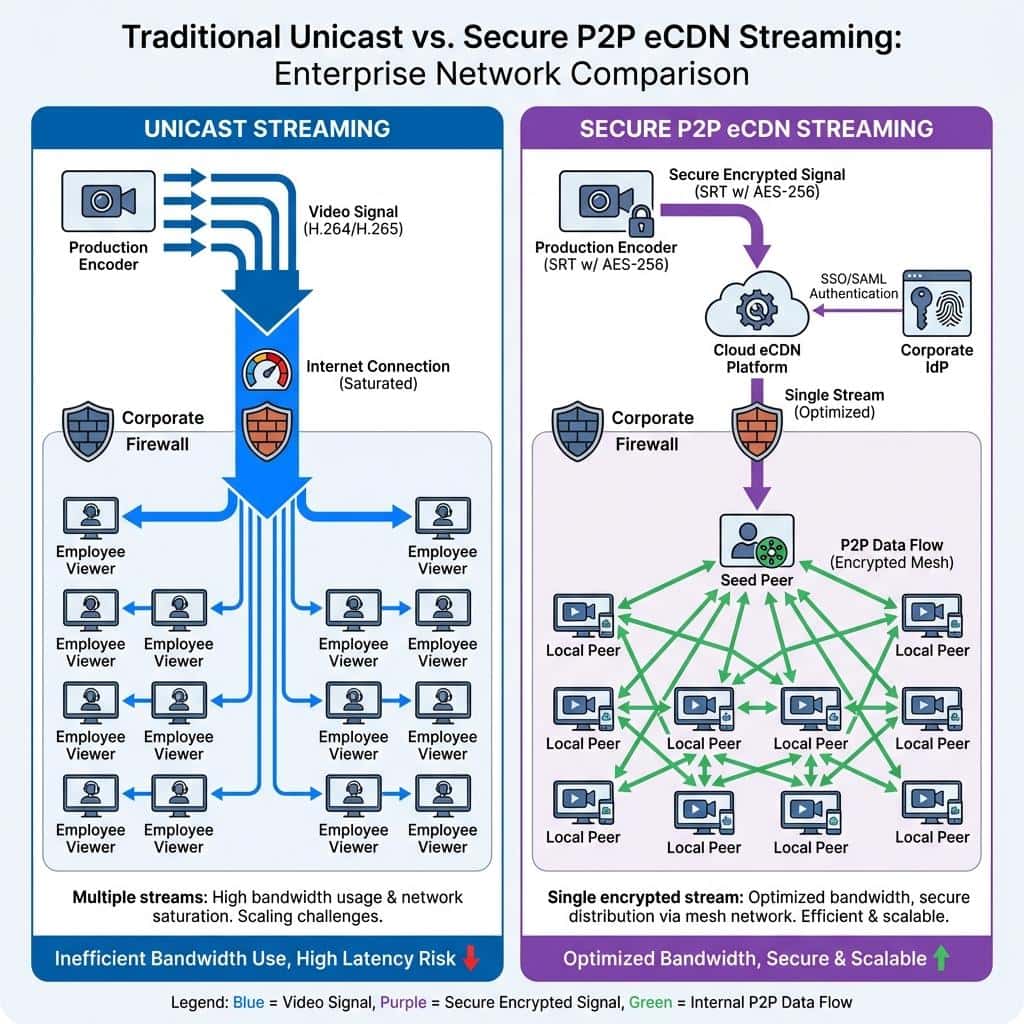
In a traditional Unicast delivery model, every single employee viewing a stream establishes a direct, one-to-one connection with the source video server. If 5,000 employees watch a 4 Mbps stream, this results in 20,000 Mbps (20 Gbps) of traffic being pulled through the corporate internet gateway. This is unsustainable for most enterprise networks. Multicast offers a more efficient solution, where a single stream is placed on the network and routers manage its delivery to multiple subscribed endpoints. While highly efficient, Multicast requires specific network hardware (IGMP snooping, PIM) and complex configuration, making it difficult to implement across diverse or non-managed networks, especially for remote VPN users. Peer-to-Peer (P2P) architecture offers a hybrid approach. The video stream enters the corporate network a limited number of times. The first few viewers, or “peers,” pull the stream directly from the source. Subsequent viewers on the same Local Area Network (LAN) then pull segments of the video stream from these initial peers, creating a mesh of data sharing that drastically reduces external bandwidth consumption. All of this is managed by a cloud-based signaling server or tracker, which coordinates the connections between peers.
The P2P Signal Flow for Corporate Communications
The signal flow begins in the production environment. A production switcher like a Ross Carbonite or a software-based system like vMix generates the final program feed. This feed is sent to a hardware or software encoder, which compresses the video using a codec like H.264 or H.265. The encoded stream is then sent via a transport protocol to the P2P provider’s cloud ingest point. While RTMP (Real-Time Messaging Protocol) is a legacy option, modern professional workflows mandate the use of SRT (Secure Reliable Transport) for its superior reliability and built-in AES-256 encryption. Once ingested, the P2P platform’s signaling server takes over. When an authenticated employee clicks play, their client communicates with the signaling server, which directs them to either the source stream or, more likely, to other peers on their local subnet who already possess the required video segments. This intricate dance of peer discovery and data exchange is the core of the eCDN’s function and also the source of its primary security considerations.
Core Security Vectors in Peer-to-Peer eCDN Deployments
A P2P eCDN is not a single product but a complex system of interconnected components, each presenting a potential attack surface. A comprehensive security evaluation must scrutinize data encryption, user authentication, and the integrity of the network traffic itself. Failure to address any of these vectors can expose sensitive internal communications and create vulnerabilities in the corporate network.
Data Encryption: From Ingest to Playback
End-to-end encryption is non-negotiable for internal corporate video. This requires securing the data at three critical stages: in-transit from production to the eCDN provider, at-rest on the provider’s servers (if caching is used), and in-transit between peers on the local network.
1. Ingest Encryption: Using RTMPS (RTMP over a TLS connection) is a baseline, but the industry standard is SRT. The SRT protocol provides a robust wrapper around the video stream, using pre-shared keys and AES-128 or AES-256 bit encryption to secure the content from the production encoder to the ingest server. This prevents any man-in-the-middle attacks on the primary contribution feed.
2. Inter-Peer Encryption: This is the most critical and often misunderstood part of P2P security. Most commercial P2P eCDNs are built upon WebRTC (Web Real-Time Communication) standards. WebRTC mandates that all data streams between peers are encrypted using DTLS (Datagram Transport Layer Security), which is based on the same security foundation as standard HTTPS web traffic. It is imperative to confirm with a vendor that all peer-to-peer traffic is encrypted by default and cannot be disabled. An unencrypted P2P mesh on a corporate LAN would allow any connected device on that network to potentially sniff and reconstruct the video content.
Authentication and Access Control Mechanisms
Ensuring only authorized employees can view the stream is paramount. Relying on obscure URLs is not a security strategy. A robust enterprise-grade P2P solution must integrate directly with the company’s existing identity management systems.
Single Sign-On (SSO): The platform must support standards like SAML 2.0 or OIDC (OpenID Connect) to integrate with an Identity Provider (IdP) such as Microsoft Azure Active Directory, Okta, or Ping Identity. When an employee attempts to view the stream, they are redirected to their standard corporate login page for authentication. Upon success, the IdP passes a secure assertion back to the eCDN platform, granting access. This ensures that all access is governed by existing corporate security policies, including multi-factor authentication (MFA).
Tokenization and Authorization: Beyond the initial login, the system should use short-lived, encrypted tokens to authorize session playback. This prevents a user from copying a stream URL and sharing it with an unauthorized individual. Additional controls such as IP whitelisting, which restricts access to known corporate IP ranges, and geo-fencing can provide further layers of security to prevent access from outside designated regions.

Network Integrity and Firewall Traversal
For peers to communicate, they must be able to discover each other and exchange data, which can be challenging on a secured corporate network with Network Address Translation (NAT). P2P systems use STUN (Session Traversal Utilities for NAT) and TURN (Traversal Using Relays around NAT) servers to facilitate this. A STUN server helps a peer discover its public IP address, while a TURN server acts as a relay when a direct peer-to-peer connection cannot be established. From a security perspective, this means the P2P client software will attempt to make outbound connections. IT teams must be fully aware of the destination IP addresses and UDP port ranges the system requires. A full audit of the P2P provider’s network infrastructure is necessary to ensure their STUN/TURN servers are secure and that the required firewall rules are narrowly defined to minimize any new attack vectors.
Auditing and Mitigating P2P Security Risks
A secure deployment is not just about technology; it’s about process. Proactive auditing, diligent vendor evaluation, and strategic architectural choices are essential to mitigate the inherent risks of a P2P system.
Evaluating Vendor Security Posture and Compliance
When selecting a P2P eCDN provider, the client’s IT security team must conduct thorough due diligence. This goes beyond marketing materials and requires a formal security review. Key artifacts to demand include:
- SOC 2 Type II Report: This report, audited by a third party, details the provider’s controls related to security, availability, processing integrity, confidentiality, and privacy.
- ISO 27001 Certification: This international standard specifies the requirements for an information security management system (ISMS).
- Penetration Testing Results: Reputable vendors will conduct regular third-party penetration tests and should be willing to share executive summaries or attestations of these tests.
- Data Processing Agreements: For regulations like GDPR and CCPA, a clear DPA is required to understand how employee data (like IP addresses and user IDs) is handled, processed, and stored.
Monitoring and Analytics for Security Audits
A secure system is a visible system. The eCDN platform must provide granular, real-time analytics and exportable logs that are accessible to the client’s security team. These logs should detail every playback session, including the user’s ID (via SSO), their IP address, geographic location, device type, and the amount of data they received from the source versus from other peers. This data is invaluable for troubleshooting playback issues and for conducting security audits. In the event of a suspected breach, these logs provide a critical forensic trail to identify unauthorized access attempts.
Spring Forest Studio’s Recommended Implementation Workflow
Deploying a P2P eCDN solution securely requires a collaborative, multi-disciplinary approach. At Spring Forest Studio, we manage this process by integrating our production expertise with the client’s IT and security infrastructure requirements from day one, ensuring a seamless and secure result.
The Discovery and Architecture Phase
The first step is a joint meeting between our production engineers, the client’s internal comms team, and their IT security and network architects. We review the existing network topology, the IdP used for SSO, and any specific security constraints. We collaboratively define the access control policies, map out the signal flow from our on-site production setup to the cloud, and provide the IT team with a comprehensive list of all network endpoints and port requirements for the chosen eCDN platform. This proactive alignment prevents last-minute security objections that could derail a major event.
Secure Ingest and Redundancy Planning
We engineer our contribution signal for maximum security and resilience. Our standard procedure is to establish two fully independent SRT streams from the production site to the eCDN’s primary and backup ingest points. Each stream is configured with its own AES-256 encryption key. These streams originate from separate encoders and are routed over diverse network paths (e.g., primary fiber internet and a cellular bonded backup). This ensures that even a complete failure of one network path or one encoder does not interrupt the secure delivery of the program feed to the eCDN platform, maintaining continuity for the internal audience.
Pre-Event Testing and Validation
Approximately one week before any major internal event, we conduct a full-scale load test and security validation. This involves running a test stream and having a representative group of employees from different offices and network segments attempt to access it. We work directly with the IT security team to monitor firewall logs in real-time, confirming that traffic is flowing as expected and that no anomalous connections are being attempted. We validate the SSO login process for different user roles and test failover between the primary and backup ingest streams. This rigorous, hands-on validation process moves the deployment from a theoretical architecture to a proven, secure, and production-ready system.
Ultimately, peer-to-peer technology is a powerful tool that can enable broadcast-quality video experiences for internal corporate communications without requiring costly network upgrades. However, its efficiency cannot come at the expense of security. By treating a P2P eCDN deployment as a critical piece of IT infrastructure and applying the same level of scrutiny and process rigor as any other enterprise application, organizations can successfully leverage its benefits. Partnering with a technically proficient production team that understands these security complexities is the critical first step in ensuring your internal messages are delivered not only clearly, but also confidentially.

Jeremy Lee is a seasoned digital marketing director and strategist with over two decades of experience in the industry. As the founder of Sotavento Medios, I manage a diverse portfolio of over 50 businesses, helping brands grow through advanced search strategies and digital innovation. My work focuses on bridging the gap between traditional search engine optimisation and the evolving world of AI-driven answer engines.
get in touch