
The Unseen Engine of Executive Composure: A Technical Breakdown of Professional Teleprompter Integration
In the high-stakes environment of corporate B2B event streaming, every element of the production chain is scrutinized for its contribution to a flawless broadcast. While encoding bitrates, camera sensor technology, and low-latency protocols often dominate technical discussions, the teleprompter system remains a critically underestimated component. For enterprise clients, a town hall, annual general meeting, or product launch is not merely a presentation; it is a direct reflection of leadership competence and brand stability. A poorly delivered message due to a technical failure or an unnatural presentation style can have significant repercussions. This article provides a deep technical analysis of professional teleprompter services, examining their integration into complex live and hybrid event production workflows, signal chain architecture, and the network infrastructure required to ensure absolute reliability. We will move beyond the superficial concept of scrolling text and detail the broadcast-grade engineering that elevates a simple script into a powerful tool for executive communication.
Teleprompter System Architecture: Signal Flow and Core Components
A professional teleprompter setup is a multi-component subsystem that must integrate seamlessly with the master production environment. Its architecture involves specialized software, dedicated hardware for control and display, and a robust signal distribution methodology. The reliability of this entire chain is paramount, as any single point of failure directly impacts the on-air talent.
Operator Control Software and Hardware Interfaces
The core of the system is the teleprompter software, such as industry-standard solutions like WinPlus-IP or Autocue QPro. This software runs on a dedicated operator workstation, typically a high-performance laptop or small form factor PC. The operator, a skilled technician, controls the scroll speed in real-time to match the presenter’s natural cadence using specialized hardware controllers. These are not simple keyboard inputs; they are typically either a wired hand-held scroll control with a rotary encoder for precise speed adjustments or a foot pedal for presenters who need their hands free, such as for product demonstrations. Real-time script edits are a common requirement during live events. The software must allow the operator to make on-the-fly changes, insert markers, or jump between sections of the script without any visible disruption on the display screens. This capability is critical for responding to live Q&A sessions or unexpected event developments.
Video Signal Generation and Distribution
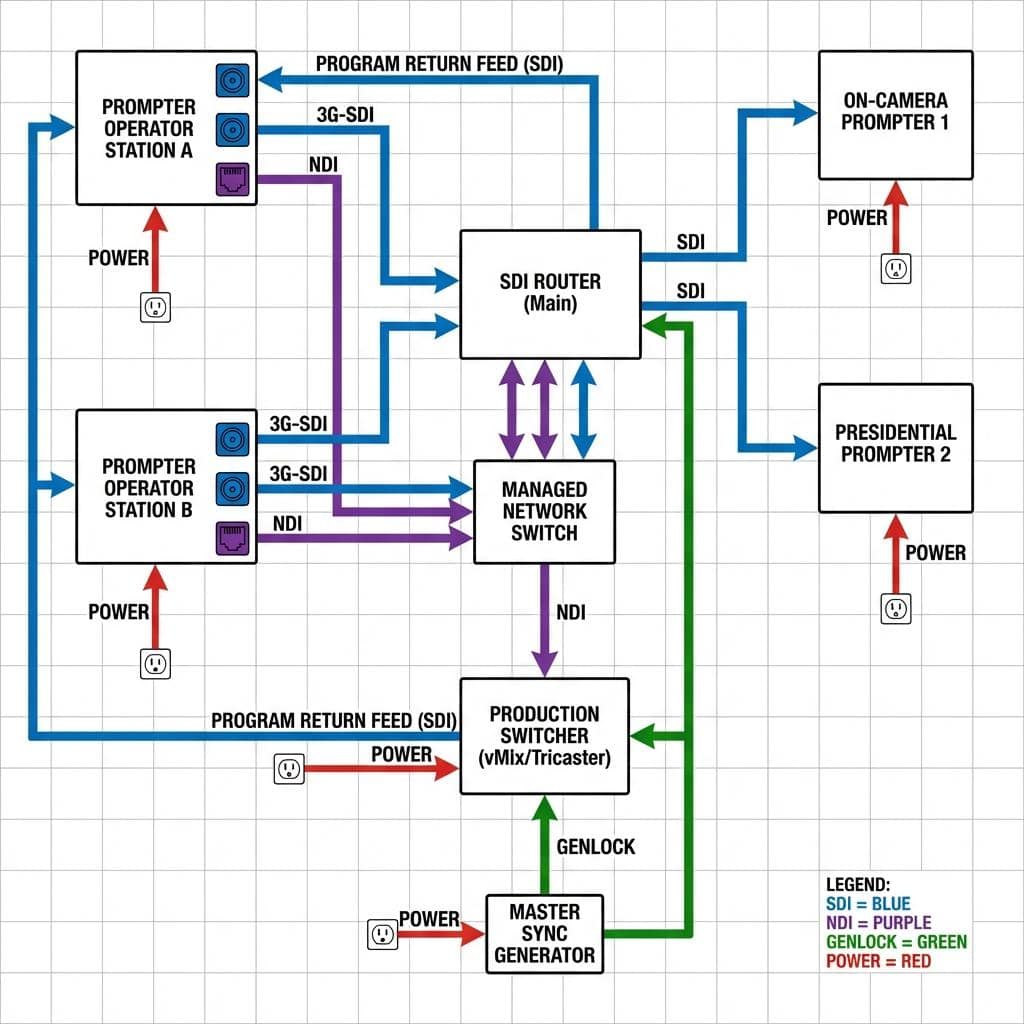
The operator’s workstation generates a video signal of the scrolling text. Traditionally, this output was an analog composite signal, but modern broadcast workflows demand high-definition digital signals. The two primary transport streams used today are Serial Digital Interface (SDI) and Network Device Interface (NDI). An SDI output, typically 3G-SDI for 1080p50/60 resolutions, provides a dedicated, point-to-point connection known for its low latency and reliability. The signal is sent from a video output card on the operator’s machine to a distribution amplifier or a video router, which then feeds the various on-stage displays. For IP-based workflows, NDI has become the prevailing standard. The software generates an NDI stream directly from the workstation, making the prompter feed available as a source to any NDI-enabled device on the same gigabit Ethernet network. This drastically simplifies cabling, especially in large venues or complex multi-room setups.
On-Camera and Off-Camera Display Hardware
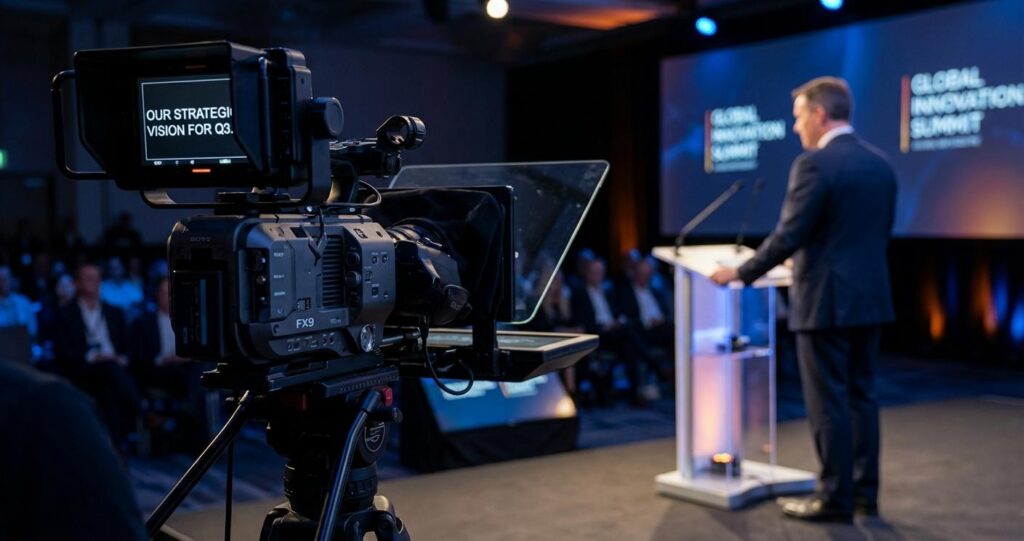
The final output destination is the display hardware. For direct-to-camera presentations, this involves an on-camera teleprompter unit. This device consists of a high-brightness monitor (typically >1000 nits to be visible in bright stage lighting) and a specially coated beam-splitter glass positioned at a 45-degree angle in front of the camera lens. This glass reflects the text from the monitor for the presenter to read while remaining transparent to the camera, ensuring the presenter’s eye-line is perfectly aligned with the lens. For keynote speeches or panel discussions, large-format presidential prompters are used. These are essentially freestanding beam-splitter panels positioned on either side of the lectern, allowing the presenter to look out at the audience while referencing the script.
Integrating Teleprompters into Multi-Camera Production Workflows
In a professional multi-camera production, the teleprompter system cannot operate in isolation. It must be perfectly synchronized with the vision switcher, monitoring systems, and communication infrastructure. This integration ensures the teleprompter operator, the technical director, and the presenter are all working from the same operational reality.
Signal Routing, Monitoring, and Synchronization
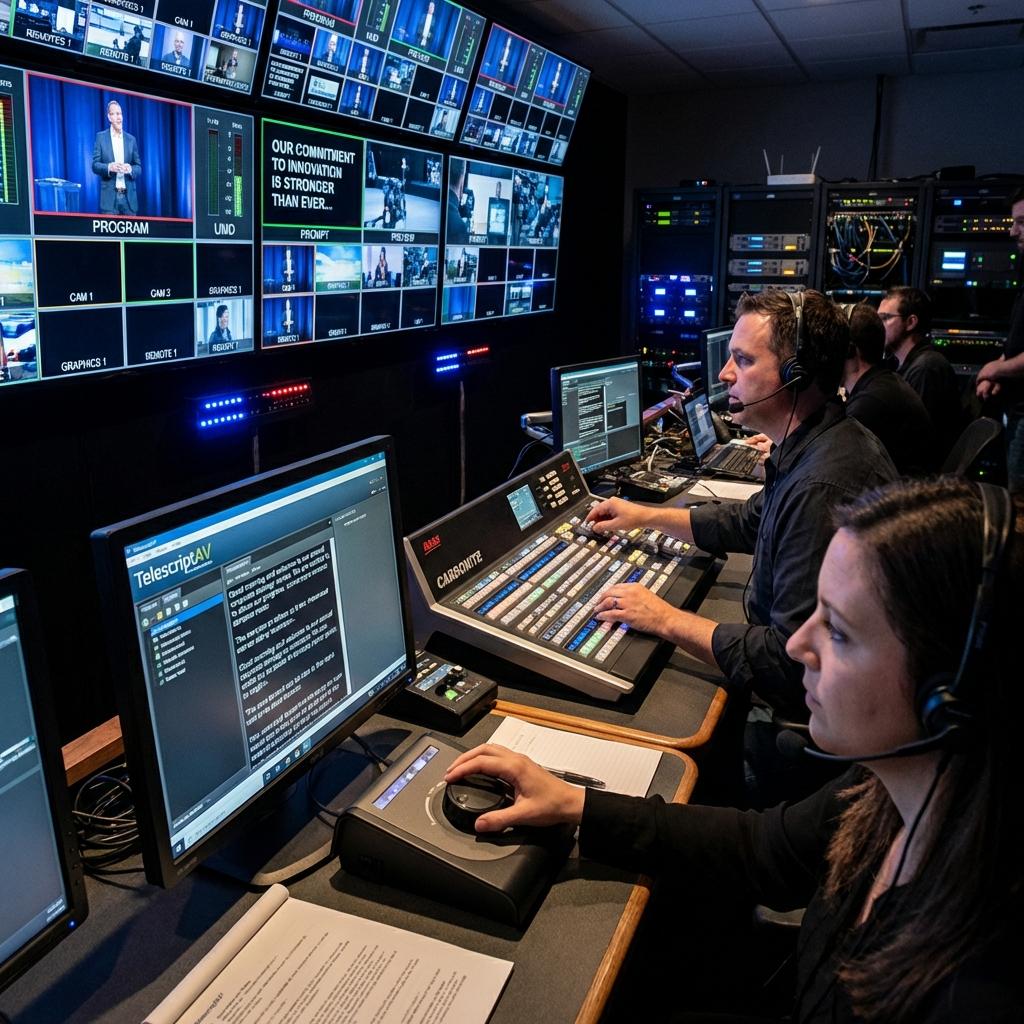
The teleprompter output signal, whether SDI or NDI, is ingested as a source by the main production switcher (e.g., a Ross Carbonite or Blackmagic Design ATEM Constellation). While this feed is not typically broadcasted, its presence on the switcher is crucial for monitoring. The technical director can see the prompter feed on their multiviewer, allowing them to anticipate cues and camera switches. Crucially, a return program feed (the final switched video output) must be sent back to the teleprompter operator’s station. This allows the operator to see which camera is live, ensuring they are feeding the correct script prompts relevant to that specific camera angle or segment. All video sources in a broadcast environment must be synchronized to a common reference signal, known as genlock, to prevent frame tearing or glitches when switching. The prompter operator’s workstation, if outputting SDI, must be connected to this master sync generator to ensure its video signal is perfectly timed with the cameras and other video sources.
IP-Based Integration with NDI
Network Device Interface (NDI), a protocol developed by NewTek, has fundamentally changed production signal flow. By enabling high-quality, low-latency video transmission over standard gigabit Ethernet, NDI eliminates the need for extensive SDI cabling. A prompter workstation running NDI-enabled software can be connected to the production network switch. The production switcher, if it is NDI-aware, will automatically discover the prompter stream as an available input source. This is incredibly efficient, especially for hybrid events with multiple breakout rooms or remote production scenarios. For example, a single prompter operator in a master control room can send different NDI feeds to multiple stages or virtual breakout rooms simultaneously over the network. It’s also important to consider the network infrastructure; a managed switch with Quality of Service (QoS) settings is necessary to prioritize NDI video packets and ensure a stable, glitch-free stream.
Redundancy and Failover Protocols for Mission-Critical Events
For any enterprise-level event, failure is not an option. Professional teleprompter services must be built with comprehensive redundancy. This starts with a fully redundant “B” system: a second operator workstation running in parallel, with an identical script and connected to a separate power circuit. In an SDI workflow, both the “A” and “B” systems are connected to a routing switcher. If the primary machine fails, the operator can instantly switch to the backup system with no visible disruption. In an IP workflow using NDI, redundancy can be achieved using protocols like SMPTE 22-7, which sends identical packet streams over two separate network paths. The receiving device can seamlessly reconstruct the stream from both paths, providing hitless protection against network hardware failure. Furthermore, all critical components, from the workstation to the on-camera monitors, should be powered via an Uninterruptible Power Supply (UPS) to guard against power fluctuations or outages.
Advanced Teleprompter Solutions for Hybrid and Remote Productions
The rise of hybrid events and the need for remote executive participation have introduced new complexities that advanced teleprompter solutions are engineered to solve. The challenge is to extend the same level of confidence and direct-to-camera delivery to presenters who are not physically present in the main studio.
Low-Latency Streaming to Remote Presenters using SRT
When an executive is presenting from their office or home, they still require a confidence monitor. Simply screen-sharing the script is not a professional solution due to latency and control issues. A broadcast-grade solution involves encoding the prompter output feed from the master control room and sending it to the remote presenter using a reliable, low-latency protocol. Secure Reliable Transport (SRT) is the industry standard for this application. SRT is an open-source video transport protocol that optimizes streaming performance across unpredictable networks like the public internet. It provides the security of encryption and robust packet loss recovery. An SRT encoder in the studio sends the prompter feed to an SRT decoder (a small hardware device or software) at the remote presenter’s location, which then outputs the video to a monitor placed near their camera. This ensures the remote presenter has a fluid, real-time script feed controlled by the central operator.
Integration with Enterprise Video Platforms
Many hybrid events leverage enterprise platforms like Microsoft Teams, Zoom, or Webex to connect remote participants. Providing a teleprompter feed within these ecosystems requires careful signal routing. A common workflow involves using a hardware or software production system (like vMix or a Tricaster) to manage the event. The teleprompter’s NDI or SDI output is brought into this system. The system then sends a customized video return feed to the remote presenter via the platform’s ‘spotlight’ or direct return video feature. This return feed is a composite of the program video and a picture-in-picture window containing the scrolling prompter text. This allows the remote presenter to see both the live program and their script within a single interface, maintaining engagement and ensuring accurate delivery.
In conclusion, professional teleprompter services are a deeply technical and integral part of modern B2B event production. The system is far more than a text display; it is a broadcast-critical subsystem requiring robust signal management, network integration, and strategic redundancy planning. From on-camera SDI units synchronized via genlock to low-latency SRT streams for remote executives, the underlying technology is designed to provide absolute reliability and seamless integration. For corporate event planners and production managers, investing in a professional teleprompter solution managed by a skilled operator is a direct investment in the clarity, confidence, and overall impact of their executive messaging.

Jeremy Lee is a seasoned digital marketing director and strategist with over two decades of experience in the industry. As the founder of Sotavento Medios, I manage a diverse portfolio of over 50 businesses, helping brands grow through advanced search strategies and digital innovation. My work focuses on bridging the gap between traditional search engine optimisation and the evolving world of AI-driven answer engines.
get in touch