
The ROI of Creating a Reusable 3D Brand Asset Library for Streaming
In the evolving landscape of B2B event streaming and hybrid production, maintaining a cohesive and impactful brand presence across all digital touchpoints is paramount. Corporate event planners, AV professionals, and IT directors face the ongoing challenge of delivering high-quality, visually consistent, and technically robust live streams that resonate with discerning enterprise audiences. Beyond mere content delivery, the visual fidelity and brand integration within virtual and hybrid environments directly influence audience engagement, brand perception, and ultimately, the perceived professionalism of an organization. This article provides a comprehensive technical analysis of the return on investment (ROI) derived from establishing a reusable 3D brand asset library for streaming, dissecting the engineering efficiencies, cost reductions, and enhanced production capabilities that such an infrastructure offers to enterprise clients.
The Technical Imperative of Visual Consistency in B2B Streaming
The proliferation of hybrid events necessitates a seamless convergence of physical and virtual experiences. Brand identity, typically managed through static graphic guidelines, must now extend into dynamic, real-time 3D environments. Achieving visual consistency across disparate streaming platforms, multi-camera feeds, and augmented reality (AR) overlays is a significant technical undertaking. Without a standardized, reusable library, each event or production often requires bespoke design and integration of elements such as lower thirds, animated intros, virtual set extensions, and product showcases. This ad-hoc approach leads to inconsistent brand representation, extended pre-production cycles, and increased technical overhead.
A 3D brand asset library serves as a central repository for pre-optimized, production-ready graphical elements. These assets are not merely flat images; they are three-dimensional models, textures, animations, and lighting setups meticulously crafted to represent a brand’s visual identity in a spatial context. For live production, these assets are critical for rendering virtual sets, animating on-screen graphics, and deploying AR elements that interact with the physical stage. The technical challenge lies in ensuring these assets are consistent in terms of polygonal count, texture resolution, material properties, and animation kinematics, allowing for seamless integration across various real-time render engines and broadcast graphics systems, such as Vizrt, Ross XPression, and Unreal Engine.
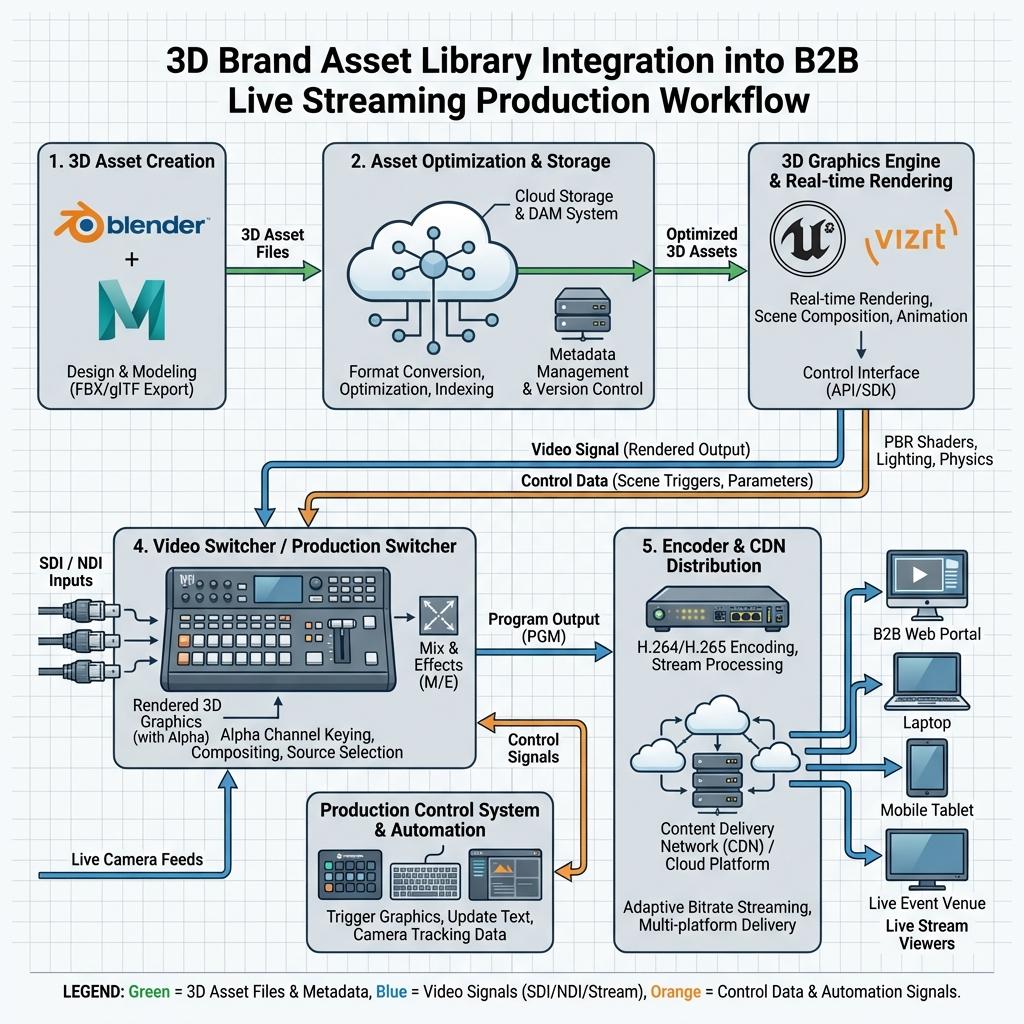
Consider a typical B2B hybrid event. A keynote speaker might be on a physical stage, while remote panelists appear on a virtual screen. The visual elements framing both the live and virtual participants, from branded lecterns to animated information panels, must be uniform. A 3D asset library ensures that every iteration of a logo, every specific brand color, and every approved animation sequence is readily available and technically compliant, eliminating visual discrepancies that can undermine brand authority. The integration process involves data deserialization from the asset repository into the graphics engine, real-time manipulation via a control surface, and subsequent composition into the program feed, often over Network Device Interface (NDI) or Serial Digital Interface (SDI) with alpha keying.
Engineering Efficiency and Workflow Optimization through 3D Assets
Streamlining Pre-Production and Design Cycles
One of the most immediate technical benefits of a reusable 3D asset library is the dramatic reduction in pre-production and design cycle times. In traditional workflows, graphic designers and 3D artists often create new assets from scratch or heavily modify existing ones for each event. This process is resource-intensive, requiring significant person-hours from skilled professionals, and is prone to inconsistencies. With a curated library, pre-approved and technically optimized assets can be rapidly deployed.
For example, a standard virtual set element, such as a branded background wall or a virtual podium, can be designed once in a software suite like Autodesk Maya or Blender, exported in universal formats such as FBX or glTF, and then optimized for real-time rendering in Unreal Engine. This asset then becomes available for any future event, reducing the iterative design-and-approval process from weeks to mere hours. Furthermore, the standardization of assets ensures compatibility with various live production software and hardware, minimizing the need for format conversions or re-rendering. This applies to complex assets like volumetric video backdrops or simpler elements such as animated lower thirds adhering to SMPTE (Society of Motion Picture and Television Engineers) standards for broadcast graphics.
Enhancing Real-time Production Capabilities
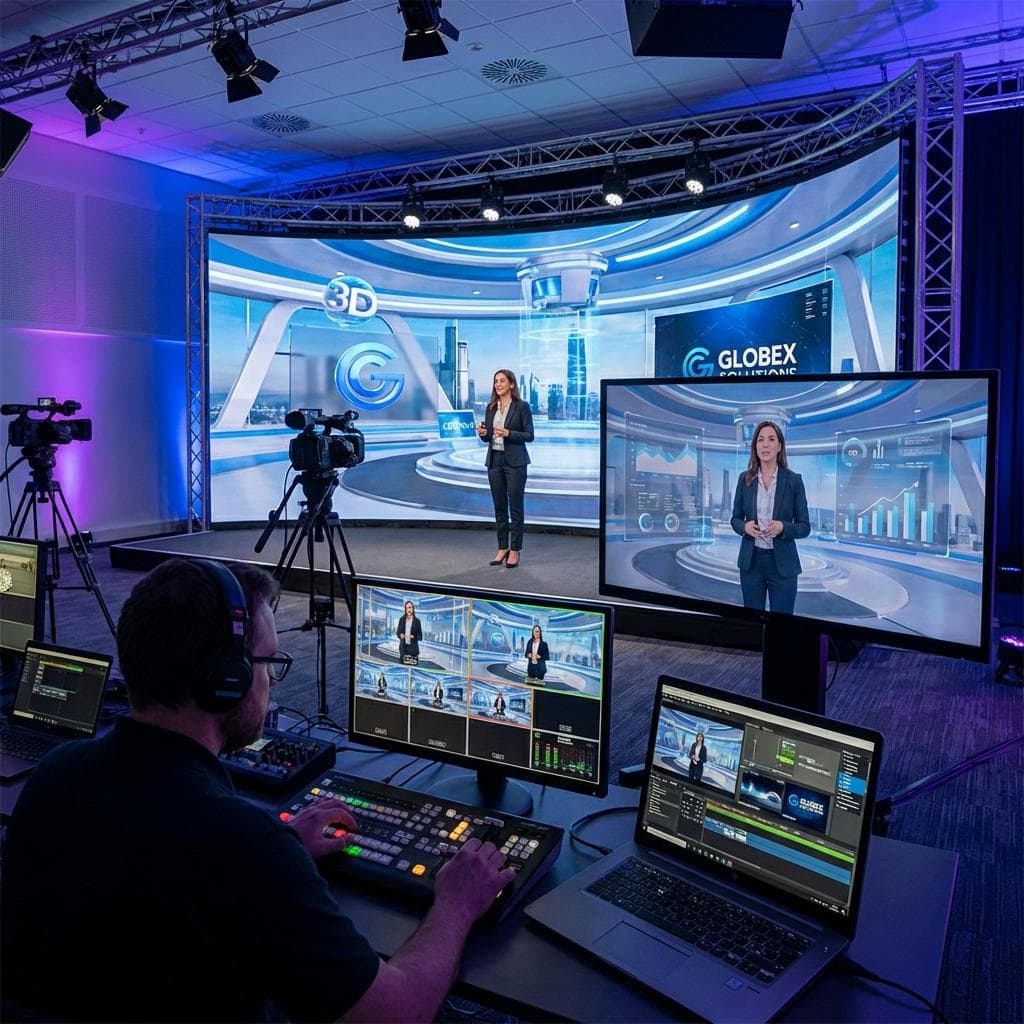
The impact of a 3D asset library extends directly into the live production environment. During a broadcast, production teams can dynamically access and manipulate pre-loaded 3D assets with confidence, knowing they adhere to brand guidelines and technical specifications. This is crucial for real-time augmented reality (AR) overlays, where virtual objects are seamlessly integrated into the live camera feed. Imagine a product reveal during a keynote, where a 3D model of a new device materializes on stage; with a pre-existing asset, this can be executed flawlessly and repeatedly across multiple events.
Integration with multi-camera production setups and video switching systems, such as the Ross Carbonite, Grass Valley Kahuna, or Blackmagic ATEM series, is enhanced by the predictability of asset behavior. These systems can receive rendered 3D graphics, often with alpha channels, via NDI, SDI, or even HDMI 2.1, facilitating complex compositions. Media servers like disguise or Resolume Arena can be pre-programmed with sequences leveraging these assets, enabling precise cueing and real-time adjustments. The standardization of assets reduces the processing load on graphics engines, allowing for lower latency and higher frame rates, critical for maintaining a 4K/UHD (Ultra-High Definition) program feed at 50p or 60p, and avoiding dropped frames which compromise visual quality and audience experience. This technical foundation supports complex signal routing and video switching architectures, ensuring a robust and reliable program output.
The Financial and Operational ROI: A Technical Deep Dive
Cost Reduction in Technical Staffing and Software Licenses
The most tangible financial benefit of a reusable 3D brand asset library is the significant reduction in operational expenditure (OpEx) related to technical staffing and specialized software licenses. By standardizing and centralizing 3D assets, organizations can decrease their reliance on external motion graphics studios or dedicated in-house 3D artists for every event. Instead, existing production teams, with training on asset management systems, can deploy and integrate these elements. This leads to a more efficient allocation of human resources, allowing highly specialized personnel to focus on advanced technical challenges rather than repetitive asset creation.
Furthermore, reduced development cycles translate to fewer software license-hours for high-end 3D modeling and animation suites. While initial investment in creation and system integration is required, the long-term savings from optimizing workflows and minimizing per-project design costs are substantial. For enterprise clients producing multiple events annually, these cumulative savings quickly justify the initial capital expenditure (CapEx) for building the library and associated digital asset management (DAM) infrastructure.
Scalability and Multi-Platform Deployment
A well-architected 3D asset library significantly enhances the scalability of an organization’s streaming operations. A single, high-quality 3D asset can be adapted for various output formats, resolutions, and aspect ratios (e.g., 16:9 for widescreen, 9:16 for vertical social media stories) without extensive re-rendering or redesign. This is crucial for multi-platform deployment, where a single event might be streamed simultaneously to an internal corporate CDN (Content Delivery Network), Microsoft Teams, Zoom, Webex, and public social media channels, each with potentially different technical specifications and branding requirements.
The library ensures that branded elements maintain visual integrity across all these endpoints. Efficient asset management, often integrated with cloud-based object storage like AWS S3 or Azure Blob Storage, allows for rapid distribution and retrieval, supporting global event productions. This reduces bandwidth consumption during asset transfer, as only the final rendered output, optimized with H.264 or H.265 encoding at targeted bitrates (e.g., 8-15 Mbps for 1080p, 20-50 Mbps for 4K), needs to be streamed. The consistent application of branding via these assets, even with adaptive bitrate (ABR) streaming, reinforces brand identity regardless of audience network conditions. This systematic approach also simplifies compliance with various streaming protocols, including the low-latency, high-reliability Secure Reliable Transport (SRT) and the widely adopted Real-Time Messaging Protocol (RTMP/RTMPS).
Implementing an Enterprise-Grade 3D Asset Management System
Technical Considerations for Library Architecture
Building an enterprise-grade 3D brand asset library requires meticulous technical planning for its architecture. At its core, it necessitates a robust Digital Asset Management (DAM) system capable of handling large 3D file formats, associated textures, animations, and metadata. This DAM system must support version control, allowing for iteration tracking and rollbacks, crucial for managing evolving brand guidelines. Metadata management is equally vital, enabling efficient search, categorization, and retrieval of assets based on project, event type, or usage rights. For complex 3D models, metadata might include polygonal count, texture resolution, rigging data, and real-time render engine compatibility flags.
Storage solutions must be scalable, secure, and offer high availability. Cloud-based object storage services (e.g., AWS S3, Azure Blob Storage) provide elastic scalability, global accessibility, and integrated redundancy, critical for disaster recovery. For on-premise solutions, Network Attached Storage (NAS) or Storage Area Network (SAN) systems with RAID configurations and robust backup strategies are essential. Network infrastructure requirements for asset transfer, especially for large 3D scenes or textures, must account for gigabit Ethernet or even 10-gigabit Ethernet connectivity to ensure efficient data egress during live production preparation. Integration with existing enterprise identity management systems (e.g., Active Directory) is also necessary for secure access control and user authentication.
Integration with Live Production Workflows and Encoding
The effectiveness of a 3D brand asset library hinges on its seamless integration into live production workflows. This involves establishing pipelines that allow 3D assets to be ingested, optimized, and rendered in real-time by broadcast graphics systems and virtual set engines. For instance, a common workflow involves creating assets in software like Cinema 4D or Maya, exporting them to Unreal Engine for real-time rendering within a virtual production environment, and then compositing the rendered output with live camera feeds using a video switcher. This composite program feed is then routed to hardware or software encoders for distribution.
Encoding standards are critical. Assets must be designed with encoding efficiency in mind, minimizing gradients or complex transparency effects that can introduce artifacts during H.264/H.265 compression, especially at lower bitrates. Proper color space management (e.g., Rec. 709, Rec. 2020 for HDR) must be maintained throughout the asset pipeline to prevent color shifts in the final streamed output. Quality of service (QoS) and redundancy strategies are also enhanced. With pre-approved assets, production teams can focus on optimizing network infrastructure for latency and jitter, implementing failover systems (e.g., redundant encoders, secondary streaming paths via SRT bonding) rather than debugging last-minute graphic issues. The predictable nature of a standardized asset library contributes significantly to a more resilient and professional streaming operation.
Conclusion
The strategic development and implementation of a reusable 3D brand asset library for streaming represents a significant, long-term investment with substantial technical and financial returns for enterprise organizations engaged in B2B event production. From streamlining pre-production and enhancing real-time graphics capabilities to reducing operational costs and improving scalability for multi-platform delivery, the advantages are multifaceted. This sophisticated approach to visual asset management ensures brand consistency, elevates production quality, and empowers technical teams to deliver flawless, enterprise-grade streaming experiences. For corporate event planners, AV professionals, and IT directors seeking to optimize their B2B event infrastructure, Spring Forest Studio offers the expertise to architect, implement, and manage such advanced streaming solutions, ensuring maximum ROI and unparalleled broadcast professionalism for every virtual and hybrid event.

Jeremy Lee is a seasoned digital marketing director and strategist with over two decades of experience in the industry. As the founder of Sotavento Medios, I manage a diverse portfolio of over 50 businesses, helping brands grow through advanced search strategies and digital innovation. My work focuses on bridging the gap between traditional search engine optimisation and the evolving world of AI-driven answer engines.
get in touch