
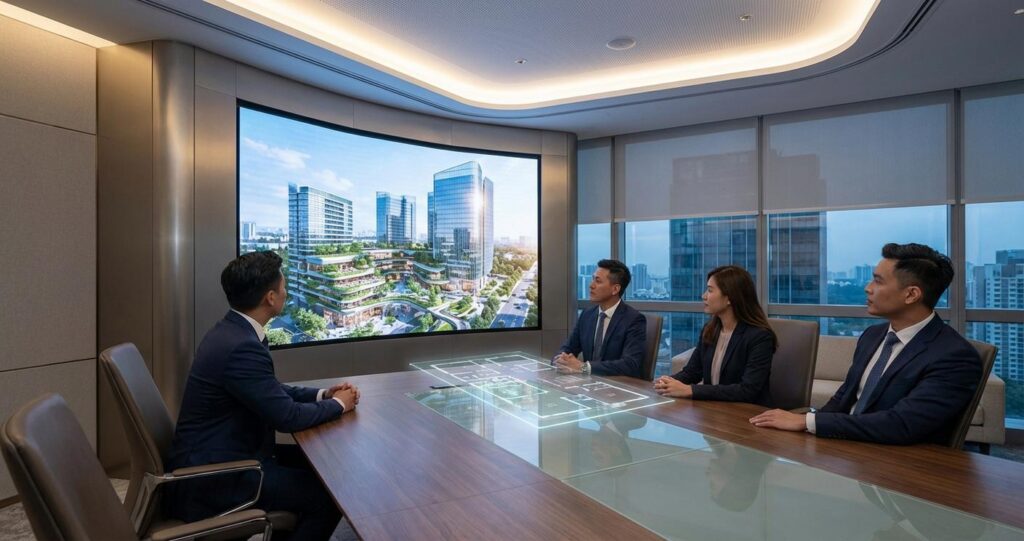
The global real estate market has undergone a profound transformation, driven by technological advancements that transcend traditional physical boundaries. For Singaporean real estate firms, a strategic imperative exists to reach an international clientele, often necessitating virtual engagement that mirrors or even surpasses in-person experiences. Extended Reality (XR), encompassing Virtual Reality (VR), Augmented Reality (AR), and Mixed Reality (MR), has emerged as a cornerstone technology for delivering highly immersive and interactive property tours. However, translating high-fidelity XR experiences into a globally accessible, enterprise-grade B2B streaming solution presents complex technical challenges that demand robust live event production, hybrid infrastructure, and sophisticated streaming protocols.
This article provides an in-depth technical analysis of how Singaporean real estate entities can leverage professional-grade XR integration for global property showcases, focusing on the critical streaming and production infrastructure required to deliver these advanced experiences reliably and securely to a discerning B2B audience. We will delineate the architectural components, streaming methodologies, and operational workflows essential for such high-stakes corporate presentations.
Architecting the Immersive XR Content Pipeline for Global Reach
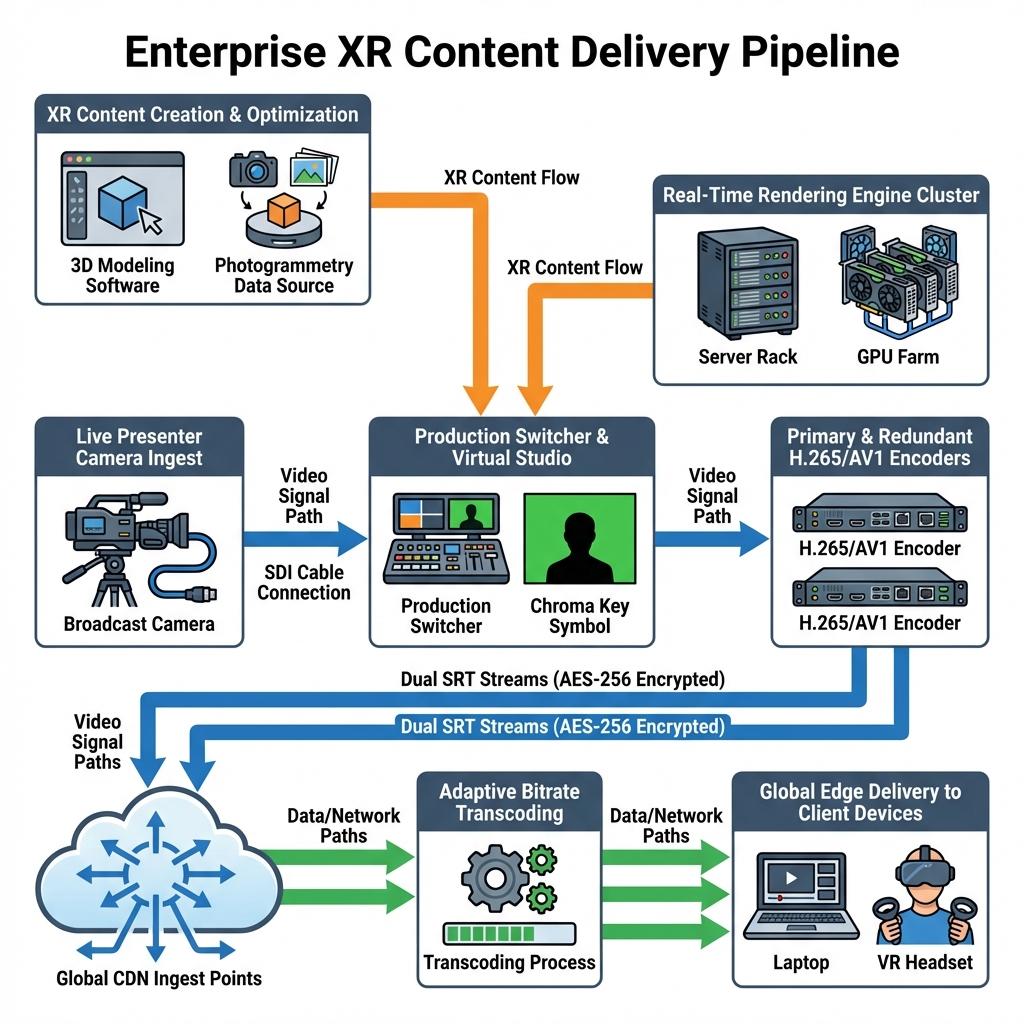
The foundation of any successful XR-driven property tour lies in the meticulous creation and preparation of the immersive content itself. For real estate, this typically involves 3D architectural models, high-resolution photogrammetry of existing properties, or volumetric video captures. These assets must be optimized for real-time rendering and streaming. Data formats such as glTF (Graphics Language Transmission Format) or USD (Universal Scene Description) are increasingly prevalent for their interoperability and efficiency in representing 3D scenes across various platforms. The computational demands for rendering these environments in real-time for an interactive XR experience are substantial, often requiring high-performance computing clusters, either on-premise or cloud-based, equipped with professional-grade GPUs.
For pre-rendered, linear XR tours, content is often encoded into high-bitrate video formats, leveraging codecs such as H.265 (HEVC) or even AV1, which offer superior compression efficiency while preserving intricate visual details crucial for architectural fidelity. Resolutions typically range from 4K (3840×2160) to 8K (7680×4320) at frame rates of 30p or 60p to ensure smooth motion and clarity. The output from these rendering pipelines then becomes the source material for the live streaming infrastructure.
Integrating live elements, such as a real estate agent presenting within a virtual environment, necessitates advanced chroma keying and virtual studio technologies. Multi-camera production setups utilizing professional broadcast cameras (e.g., those with 3G-SDI or 12G-SDI outputs for 1080p60 or 4K60 respectively) are essential. These camera feeds are ingested into a video switcher, such as a Ross Carbonite or Blackmagic ATEM Constellation, capable of handling multiple SDI inputs, keying operations, and sophisticated graphics overlays. The synchronized composite feed, combining the live presenter with the XR environment, becomes the program output for encoding and distribution.
Enterprise-Grade Streaming Protocols and Infrastructure for XR Delivery
Delivering high-fidelity, interactive XR content to a global B2B audience demands an enterprise-grade streaming infrastructure that prioritizes low latency, reliability, and security. Traditional protocols like RTMP (Real-Time Messaging Protocol) often suffer from inherent latency issues (typically 5-10 seconds) and lack robust error correction over unreliable networks, making them less ideal for interactive XR experiences or time-sensitive B2B presentations where immediate feedback is critical. Instead, modern B2B streaming leverages more advanced protocols:
- SRT (Secure Reliable Transport): An open-source protocol developed by Haivision, SRT is paramount for delivering high-quality, low-latency video over unpredictable networks, including the public internet. It utilizes UDP (User Datagram Protocol) for speed but adds robust error recovery mechanisms, including Automatic Repeat Request (ARQ) and forward error correction (FEC), to mitigate packet loss and jitter. For XR tours, SRT ensures that the visual fidelity and responsiveness of the streamed experience remain intact, even when connecting to remote clients across continents. Typical latency can be reduced to under 500ms, critical for any semblance of real-time interaction or Q&A.
- NDI (Network Device Interface): Within the local production network, NDI|HX or full NDI is invaluable for transporting video, audio, and metadata between various production devices over standard IP networks. This simplifies cabling and enhances workflow flexibility, enabling seamless integration of XR rendering engines, virtual camera systems, and video switchers within the production studio before content is encoded for global distribution. Full NDI supports visually lossless 4K60 video with very low latency (typically less than a single frame).
- WebRTC (Web Real-Time Communication): For truly interactive XR experiences where remote viewers might manipulate virtual objects or navigate environments, WebRTC provides peer-to-peer, low-latency communication capabilities. While more complex to implement at scale for broadcast, it is critical for specific interactive modules within an XR tour, offering sub-100ms latency. For B2B applications, WebRTC often integrates with an SFU (Selective Forwarding Unit) architecture to manage multiple peer connections efficiently.
The streaming infrastructure extends to Content Delivery Networks (CDNs) strategically positioned worldwide. For Singaporean firms targeting global markets, selecting a CDN with extensive PoPs (Points of Presence) in key regions (e.g., North America, Europe, MENA, APAC) is crucial. Cloud-based encoding platforms, such as AWS Elemental MediaLive or Google Cloud Media CDN, offer scalable solutions for transcoding high-bitrate XR streams into various adaptive bitrate (ABR) renditions (e.g., 1080p, 720p, 480p) to accommodate diverse client network conditions and device capabilities. This ensures a consistent Quality of Experience (QoE) for all viewers, regardless of their bandwidth.
Hybrid Production Workflows for Interactive Global Property Showcases
A truly compelling global XR property tour for B2B clients often involves a hybrid production approach, blending live presenters, pre-rendered XR content, interactive elements, and Q&A sessions. The production control room becomes the nerve center, requiring sophisticated signal flow management and routing architectures.
- Multi-Camera and Presenter Integration: Live camera feeds (e.g., Sony HDC series or Panasonic AK-UC series) are connected via SDI to a central video router (e.g., Grass Valley Densité or EVS Cerebrum) which then routes signals to the main production switcher. Audio from presenter microphones (e.g., Sennheiser wireless systems) is fed into a professional audio mixer (e.g., Yamaha Rivage PM series or Behringer X32) where it is mixed with embedded audio from the XR rendering engine and other playback sources. Dante or AES67 protocols are increasingly used for networked audio distribution within the facility, providing high channel counts and low latency.
- XR Environment Integration: The XR rendering engine outputs its visual feed, often via SDI or NDI, to the production switcher. This feed can be treated as a foreground layer, a background layer, or integrated via advanced keying for virtual set applications. Real-time data synchronization between the live video feed and the XR environment is paramount to prevent visual artifacts or lag. Timecode synchronization via SMPTE LTC or VITC ensures all elements remain perfectly aligned.
- Interactive Elements and Audience Engagement: For interactive property tours, custom web applications leveraging WebRTC can be deployed, allowing remote clients to control camera angles within the XR environment or click on specific areas for more information. Integration with enterprise communication platforms like Microsoft Teams, Zoom Events, or Cisco Webex for moderated Q&A sessions is standard. This requires bridging the streaming platform with these collaboration tools, often using dedicated hardware codecs (e.g., Cisco Codec Pro) or software gateways that can ingest and output video/audio feeds in compatible formats.
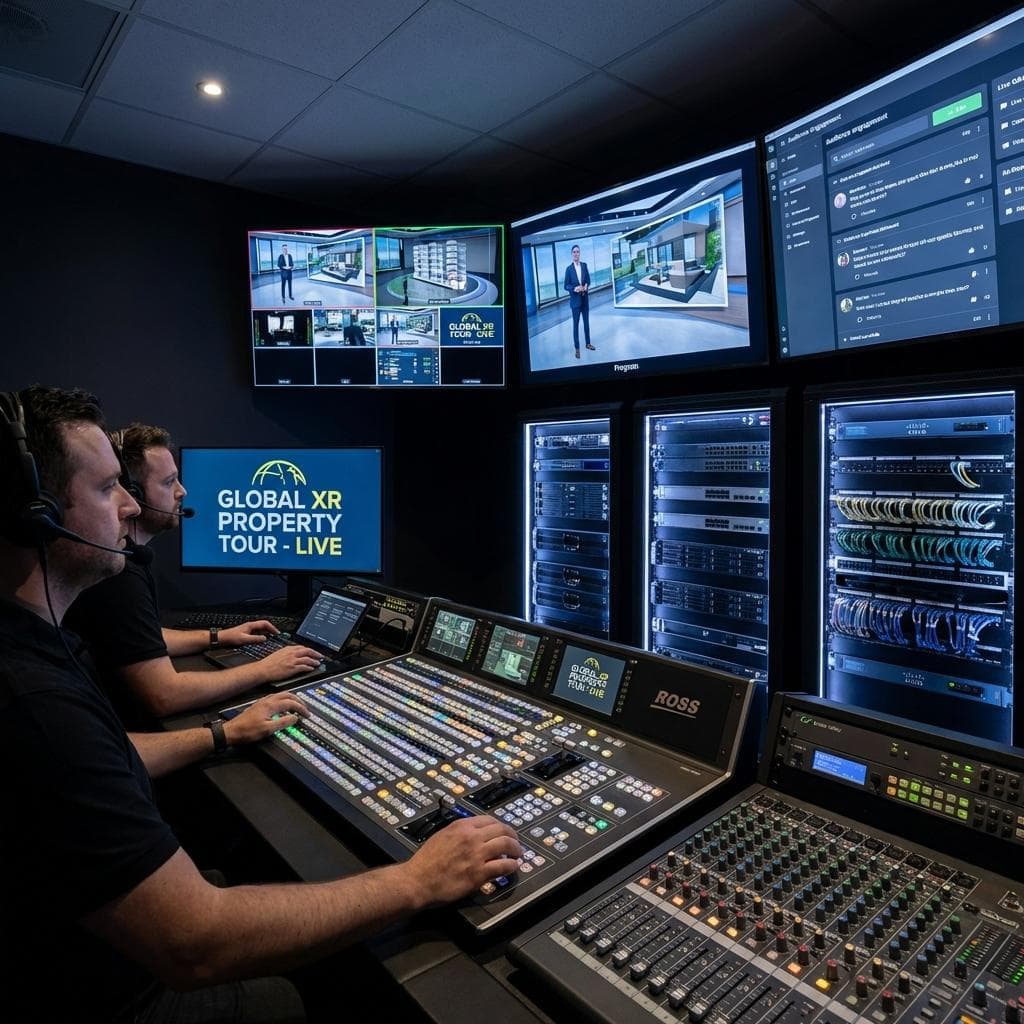
The control room setup must include multiview monitoring systems (e.g., Decimator MD-QUAD or custom software multiviewers) displaying all camera feeds, program out, preview out, graphics, and the XR environment feed, allowing the technical director and vision mixer to maintain precise control. Dedicated talkback systems (e.g., Clear-Com or Riedel) are essential for real-time communication between the director, camera operators, audio engineers, and XR technicians.
Network Infrastructure, Scalability, and Redundancy for Global XR Streams
The success of global XR property tours hinges on a robust and resilient network infrastructure. High-bandwidth, low-latency connectivity is non-negotiable from the production facility to the ingest points of the CDN.
- Network Connectivity: A dedicated fiber optic connection with symmetric bandwidth, typically 1 Gbps to 10 Gbps, is recommended for the primary internet egress from the production studio. This dedicated capacity mitigates congestion and ensures sufficient throughput for high-bitrate source streams. Quality of Service (QoS) mechanisms on network routers must be configured to prioritize streaming traffic, minimizing packet loss and jitter.
- Cloud vs. On-Premise Solutions: While some aspects of XR rendering can occur on-premise, leveraging cloud-based platforms for encoding, transcoding, and content distribution offers unparalleled scalability and redundancy. Cloud providers (AWS, Azure, GCP) offer global infrastructure that can automatically scale resources based on viewer demand, eliminating concerns about exceeding on-premise hardware capacity during peak events. Redundancy is built into these platforms with geo-redundant storage and processing.
- Failover Strategies: For mission-critical B2B events, comprehensive failover strategies are essential. This includes redundant encoding paths (primary and backup encoders), diverse internet service providers (ISPs) with automatic failover, and multi-CDN distribution. For instance, an encoder might simultaneously push two SRT streams to separate ingest points on different CDNs via distinct network paths. In the event of a primary encoder failure or network outage, the redundant path ensures uninterrupted service, with detection and switchover typically occurring within milliseconds. ISO recording of all camera feeds and the program output is also vital for post-event editing and archival, ensuring a pristine master copy.
- Security Protocols: Protecting sensitive corporate information and proprietary XR content is paramount. All streaming protocols should utilize encryption (e.g., SRT with AES-128/256, RTMPS for legacy compatibility, HTTPS for WebRTC signaling). DRM (Digital Rights Management) solutions can be integrated with streaming platforms to control access and prevent unauthorized distribution. Network security measures, including firewalls, intrusion detection systems (IDS), and DDoS (Distributed Denial of Service) protection from cloud providers, are essential to safeguard the streaming infrastructure.
Actionable Technical Recommendations for Enterprise Clients
For Singaporean real estate firms seeking to implement advanced XR-driven global property tours, Spring Forest Studio provides the following technical recommendations:
- Conduct a Comprehensive Network Assessment: Prioritize an in-depth analysis of your existing network infrastructure. Ensure sufficient symmetric bandwidth, low latency, and robust QoS configuration from your production facility to your chosen CDN ingest points. Consider dedicated enterprise-grade fiber optic links.
- Invest in Professional-Grade Production Equipment: Utilize broadcast-standard cameras (e.g., 3G-SDI, 12G-SDI), video switchers capable of advanced keying and multi-layer composition, and professional audio mixing consoles. For XR rendering, deploy high-performance workstations or cloud GPU instances.
- Standardize on SRT for Ingest and Contribution: Leverage Secure Reliable Transport (SRT) for all primary stream ingest into your CDN or cloud encoder. This ensures high-quality, low-latency, and reliable video transport over the public internet, critical for global reach.
- Implement a Multi-CDN Strategy with Adaptive Bitrate (ABR) Streaming: Distribute your XR content across multiple CDNs to enhance redundancy, improve global reach, and optimize viewer QoE. Utilize ABR encoding to dynamically adjust stream quality based on client network conditions, supporting resolutions up to 4K or 8K.
- Integrate Enterprise Collaboration Platforms Thoughtfully: Seamlessly connect your live XR stream with platforms like Microsoft Teams, Zoom, or Webex for interactive Q&A. This often requires professional hardware gateways or certified software integrations to maintain video and audio fidelity.
- Prioritize Redundancy and Failover Across the Entire Workflow: Design every component of your streaming architecture with N+1 redundancy, from cameras and encoders to network paths and power supplies. Implement automatic failover mechanisms to guarantee business continuity for critical presentations.
- Enforce Strict Security Protocols: Implement end-to-end encryption for all streams, secure access control for viewing platforms, and robust network security measures, including DDoS protection and firewalls, to protect proprietary content and maintain client trust.
By meticulously planning and executing these technical considerations, Singaporean real estate firms can not only overcome the geographical limitations of traditional property viewings but also deliver unparalleled, interactive, and high-fidelity XR experiences that captivate a global B2B audience, solidifying their position as innovators in the international market.

Jeremy Lee is a seasoned digital marketing director and strategist with over two decades of experience in the industry. As the founder of Sotavento Medios, I manage a diverse portfolio of over 50 businesses, helping brands grow through advanced search strategies and digital innovation. My work focuses on bridging the gap between traditional search engine optimisation and the evolving world of AI-driven answer engines.
get in touch