
The Technical Foundation of Corporate Messaging and Its Impact on Employee Perception
In enterprise communication, the technical delivery of a message is inseparable from the message itself. For corporate event planners, IT directors, and production managers, the decision to invest in professional-grade streaming and hybrid event production extends far beyond achieving a stable video feed. It is a strategic investment in corporate culture, directly influencing employee pride and their perception of the organization’s stability, competence, and respect for its workforce. A C-suite address delivered via a poorly lit webcam with fluctuating audio and an unstable connection sends an unintentional message of unpreparedness. Conversely, a multi-camera production with broadcast-quality audio, dynamic graphics, and resilient streaming architecture communicates authority, precision, and value. This article provides a deep technical analysis of the production and infrastructure elements that transform a standard corporate webcast into an experience that reinforces employee pride and validates their role within a high-performing organization. We will examine the specific signal chains, protocols, and workflows that underpin this psychological impact, providing actionable insights for enterprise decision-makers.
High-Fidelity Video and Audio: The Signal Chain of Perceived Value
The immediate and most discernible difference between amateur and professional internal communications lies in the quality of the image and sound. These elements are not mere aesthetics; they are the primary carriers of perceived value and professionalism. The human brain makes instantaneous judgments based on sensory input, and a technically flawless audiovisual presentation creates a halo effect, lending credibility and weight to the content being delivered.
From Webcam Sensor to 12G-SDI: The Video Signal of Respect
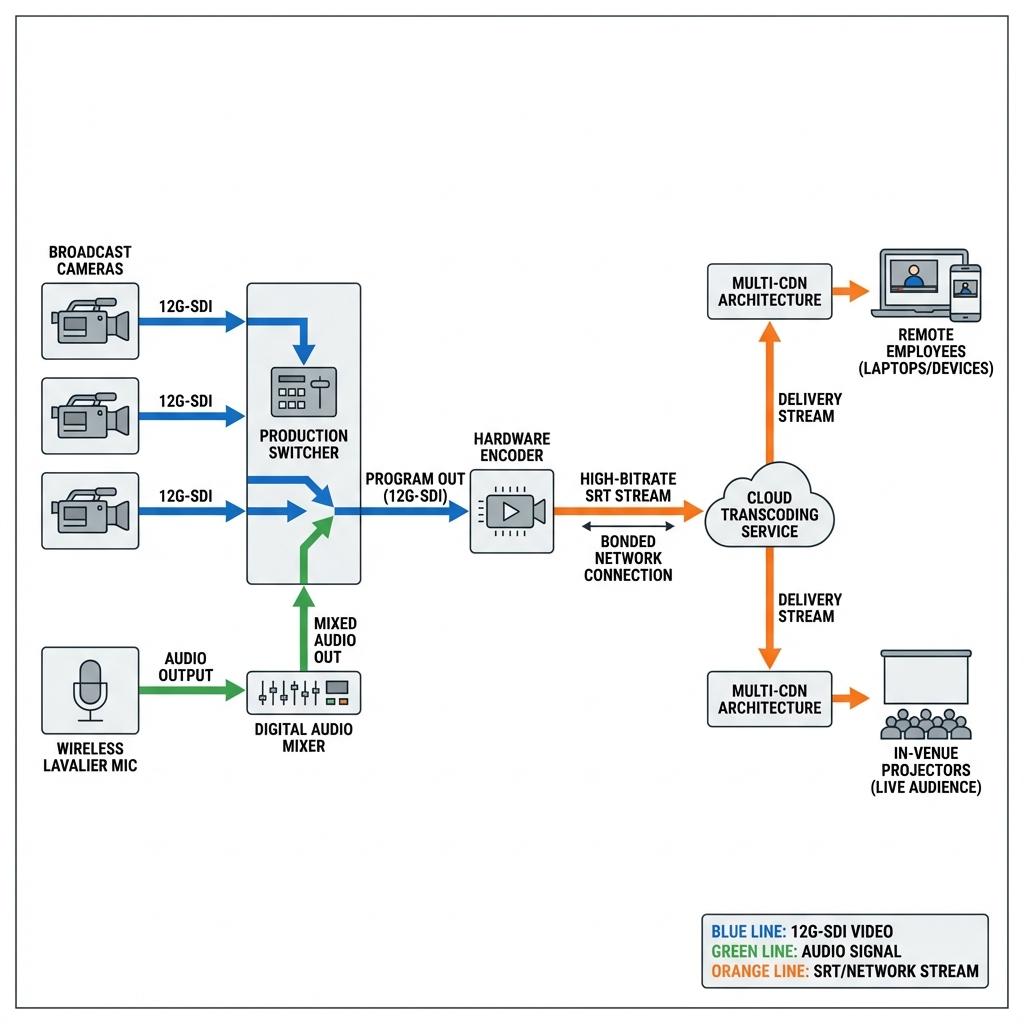
A standard integrated laptop webcam utilizes a small sensor and aggressive compression, resulting in a flat, noisy image with poor dynamic range. This is technically adequate for a peer-to-peer call but inadequate for authoritative corporate messaging. A professional production workflow begins with a fundamentally superior source. This involves using cinema or broadcast cameras, such as a Sony FX6 or Canon C300, equipped with large Super 35mm or full-frame sensors. The larger sensor size allows for a shallower depth of field, which naturally draws the viewer’s focus to the speaker and lends a cinematic, premium quality to the image. The signal is captured in a high-bitrate codec like ProRes or XAVC and transported uncompressed via a 12G-SDI (Serial Digital Interface) cable, capable of carrying a 4K UHD signal at 60 frames per second. This SDI feed maintains maximum signal integrity from the camera to the production switcher, eliminating the compression artifacts and latency inherent in IP-based camera sources like webcams. Professional lighting, utilizing a three-point lighting setup (key, fill, and back light), further sculpts the subject, conveying a sense of importance and authority that is psychologically impossible to achieve with ambient office lighting.
Encoding and Bitrate Allocation: The Unseen Language of Quality
Once the pristine video signal reaches the production switcher, it is routed to a hardware encoder for distribution. This is another critical juncture where technical decisions directly impact perception. Enterprise-grade encoders, such as those from Haivision or AJA, utilize advanced H.264 or H.265 (High-Efficiency Video Coding, or HEVC) codecs that offer superior compression efficiency. While a typical consumer-grade platform may allocate a variable bitrate of 1.5 to 3 Mbps for a 1080p stream, a professional production for a critical all-hands meeting will provision a constant bitrate of 8 to 10 Mbps. This substantial increase in data allocation ensures the preservation of fine detail, accurate color reproduction, and fluid motion, even during moments of high activity. This meticulous management of the encoding profile is an unseen but deeply felt aspect of quality. It prevents the distracting blockiness and artifacting that plague lower-bitrate streams, allowing the employee audience to remain fully immersed in the message without being subconsciously distracted by technical flaws. The choice to dedicate significant bandwidth and processing power to the video stream is a technical manifestation of the company’s commitment to clear, high-value communication.
Audio Architecture as an Instrument of Authority and Clarity
While video quality often receives the most attention, audio architecture is arguably more critical to the success of a corporate broadcast. Poor audio quality, characterized by background noise, inconsistent levels, or echo, increases the cognitive load on the audience, forcing them to strain to understand the message. This cognitive friction undermines the speaker’s authority and can lead to message abandonment. Professional audio design eliminates these barriers, ensuring effortless intelligibility and reinforcing the speaker’s command.
The Intelligibility Imperative: From Lavalier to Digital Mixer
Professional audio capture begins with selecting the right microphone and placing it correctly. For a corporate presenter, this typically involves a discreet lavalier microphone, such as a Shure ULX-D or Sennheiser EW-DP series wireless system. These systems operate in clean UHF frequency bands and utilize digital transmission to eliminate noise and interference. The audio signal is then routed to a digital audio mixing console, like a Behringer X32 or Yamaha QL1. Here, a dedicated audio engineer performs critical gain staging to optimize the signal-to-noise ratio. They apply subtle equalization (EQ) to enhance vocal clarity, use a compressor to manage dynamic range and ensure consistent volume, and implement a noise gate to eliminate ambient room tone when the speaker pauses. For hybrid events with remote participants, the engineer creates a mix-minus feed, which sends all program audio to the remote presenter *except* their own voice, preventing distracting echo and feedback. This level of audio treatment is impossible with automated software solutions and ensures the final output is clean, clear, and easy to listen to for extended periods.
Dynamic Production: Crafting an Engaging and Professional Narrative
A static, single-camera shot of a speaker at a podium is monotonous and fails to hold audience attention. Professional production employs multi-camera techniques and dynamic visuals to create a narrative structure, transforming a simple presentation into an engaging broadcast that mirrors the quality employees see in professional media. This dynamism conveys a sense of eventfulness and importance.
Beyond the Static Shot: The Grammar of Multi-Camera Production
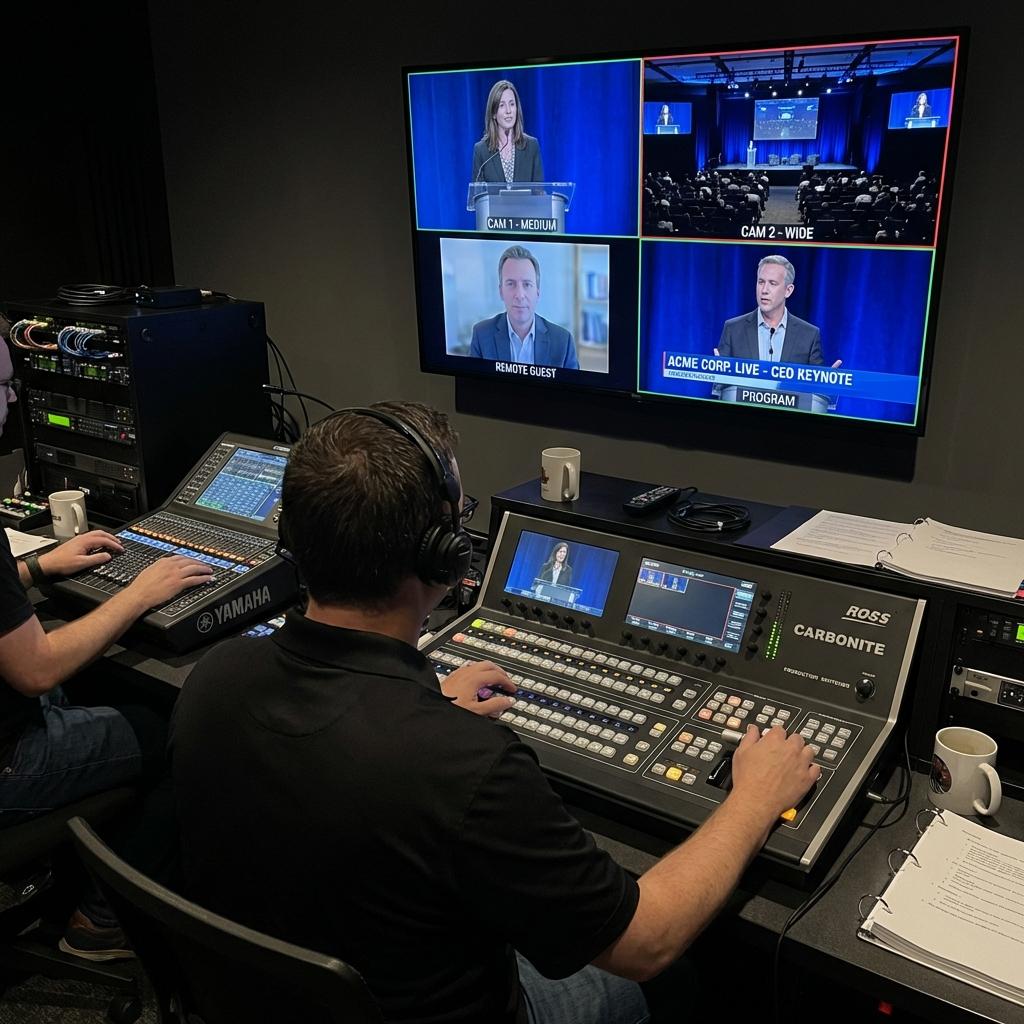
A typical corporate town hall setup involves at least three cameras: a wide shot to establish the scene, a medium shot of the primary speaker, and a tight shot for emphasis or to capture facial expressions during key moments. These camera feeds, typically connected via SDI, are fed into a production switcher like a Ross Video Carbonite or Blackmagic Design ATEM Constellation. A technical director (TD) uses the switcher to cut, dissolve, or wipe between these camera angles, creating a viewing experience that is visually interesting and directs the audience’s focus. The TD follows the rhythm of the presentation, switching to the wide shot for audience reactions, cutting to the tight shot for a powerful statement, and transitioning to a picture-in-picture displaying the speaker alongside their presentation slides. The multiview monitor output from the switcher allows the production crew to see all sources, the preview bus, and the final program feed, enabling precise, broadcast-level execution. This active direction makes the event feel deliberate and professionally crafted.
Seamless Integration of Graphics and Remote Feeds
Professional production value is significantly enhanced by the integration of broadcast graphics and remote presenters. Using character generators or the graphics capabilities within the production switcher, lower-third titles are keyed over the video to identify speakers. Branded opening sequences, transitions, and animated backgrounds reinforce the corporate identity and create a cohesive visual experience. For hybrid events, bringing in remote employees or speakers with equal audiovisual quality is paramount. Instead of relying on consumer video chat software, a professional workflow uses the Secure Reliable Transport (SRT) protocol. A remote contributor can send a high-quality, low-latency video feed from their location to the main production switcher via an SRT hardware or software encoder. The SRT protocol’s advanced error correction ensures a stable feed even over public internet connections. This allows the remote participant to be integrated into the program seamlessly, appearing as a full-screen source or in a multi-box with other presenters, making them feel like a first-class participant, not a low-resolution afterthought. This technical integration capability is crucial for fostering a sense of unity and pride in a geographically dispersed workforce.
Resilient Delivery: The Network Infrastructure of Trust
All the efforts in production are wasted if the final stream fails to reach the audience reliably. The underlying network architecture and content delivery strategy are the foundation of trust in corporate communications. A stream that buffers, drops, or fails entirely erodes confidence and can turn a well-planned event into a source of frustration and embarrassment.
From RTMP to Multi-CDN: A Strategy for Global Reach and Stability
The legacy Real-Time Messaging Protocol (RTMP) is still common but is susceptible to packet loss and has diminishing support. Modern professional workflows have largely transitioned to SRT for contribution and a combination of HLS (HTTP Live Streaming) and DASH (Dynamic Adaptive Streaming over HTTP) for delivery. After encoding, the primary stream is often sent via SRT to a cloud-based media server or directly to an enterprise content delivery network (eCDN). To ensure maximum resilience, a strategy of network bonding can be employed at the venue, combining multiple internet sources (e.g., dedicated fiber, business cable, 5G cellular) into a single, robust connection. For global organizations, a multi-CDN strategy is critical. This involves contracting with multiple Content Delivery Network providers (like Akamai, Cloudflare, or AWS CloudFront) to distribute the stream. A load-balancing service can then intelligently route viewers to the best-performing CDN based on their geographic location and real-time network conditions. This redundancy and intelligent routing guarantee a high-quality viewing experience for all employees, regardless of where they are located, demonstrating the company’s technical competence and commitment to inclusive communication.
Conclusion: The ROI of Technical Excellence in Employee Engagement
Investing in professional production and streaming infrastructure for internal corporate events is not a superfluous expense; it is a direct investment in the company’s most valuable asset: its people. The technical decisions made, from the choice of camera sensor and microphone to the implementation of a multi-CDN strategy, culminate in a final product that conveys respect, competence, and value. When employees see their leaders and colleagues presented in a broadcast-quality production, it subconsciously elevates the importance of the message and reinforces their pride in being part of a professional, high-achieving organization. This meticulously engineered experience fosters engagement, builds trust in leadership, and contributes to a corporate culture where every communication is treated with the seriousness and excellence it deserves. For the modern enterprise, the signal chain is a direct line to employee sentiment.

Jeremy Lee is a seasoned digital marketing director and strategist with over two decades of experience in the industry. As the founder of Sotavento Medios, I manage a diverse portfolio of over 50 businesses, helping brands grow through advanced search strategies and digital innovation. My work focuses on bridging the gap between traditional search engine optimisation and the evolving world of AI-driven answer engines.
get in touch