
Foundational Infrastructure Assessment: Aligning Technical Capabilities with Comms Objectives
Integrating live video is not merely a content decision; it is an infrastructure commitment. Before a single event is scheduled, a comprehensive audit of your organization’s technical capabilities is essential to prevent catastrophic failures during high-stakes broadcasts. This process moves beyond a simple internet speed test and requires a granular analysis of network architecture, production hardware, and protocol standards. The goal is to create a reliable technical foundation that supports a full calendar of events, from internal all-hands meetings to global, public-facing product launches.
Auditing Network Architecture for High-Bitrate Streaming
The corporate network is the primary point of failure for most enterprise streaming initiatives. A successful video strategy depends on robust network infrastructure capable of handling sustained, high-bitrate data streams without impacting other critical business operations. We begin by evaluating bandwidth availability, but more importantly, we analyze network policies. For a 4K UHD stream encoded using H.265 (HEVC) at 30 frames per second, a stable egress bandwidth of 25-35 Mbps per stream is a baseline requirement for quality. For full redundancy, this capacity must be doubled. We strongly recommend implementing Quality of Service (QoS) policies that prioritize streaming traffic. This is often achieved by creating a dedicated VLAN (Virtual Local Area Network) for all production hardware, isolating video data packets from general office traffic and ensuring they are not deprioritized by network switches. Furthermore, firewall and proxy configurations must be meticulously examined. Protocols like Secure Reliable Transport (SRT), which are critical for low-latency, secure contribution from remote locations, require specific UDP ports to be opened. A standard corporate firewall will often block this traffic by default, necessitating close collaboration with IT security teams to create specific, secure rules for production endpoints.
Evaluating On-Premise vs. Cloud-Based Production Infrastructure
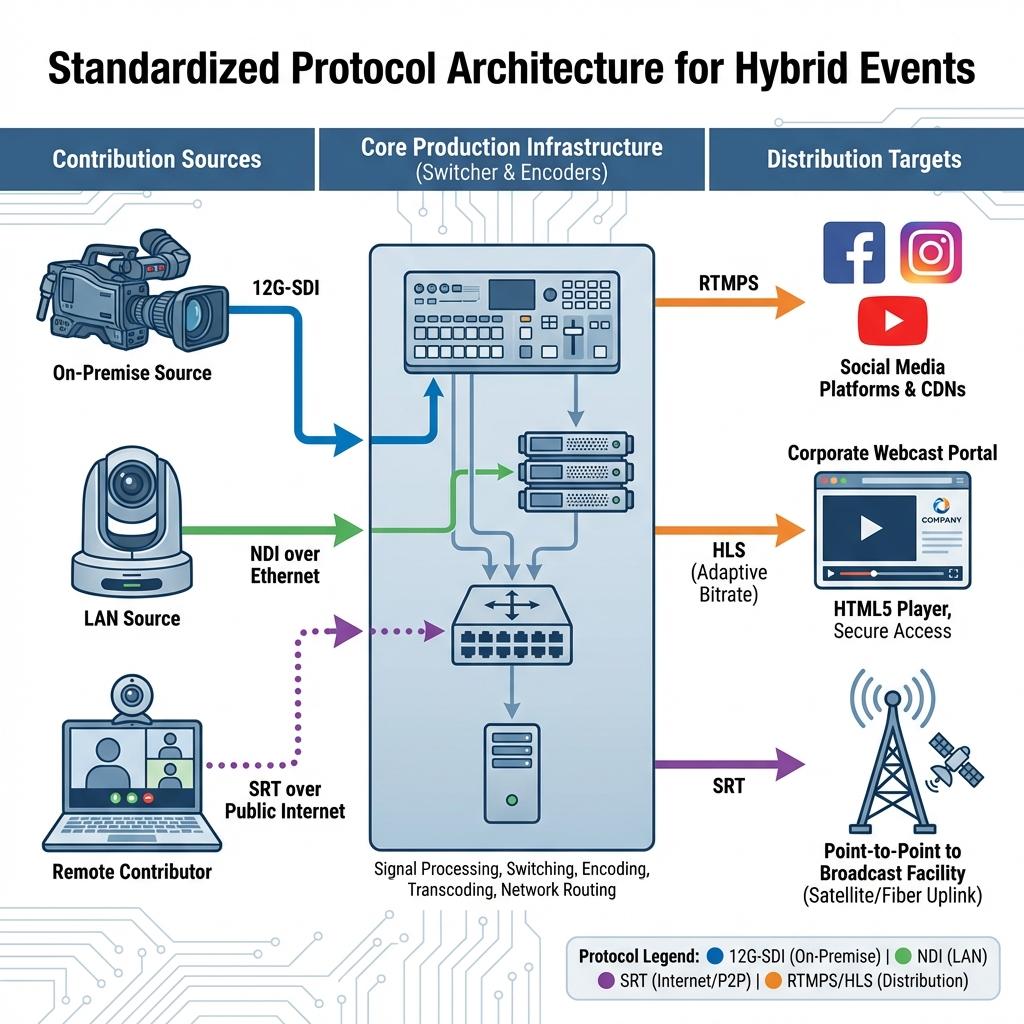
The choice between on-premise (on-prem) and cloud-based production infrastructure is a strategic one, balancing capital expenditure, latency, and control. An on-premise solution, built around a hardware video switcher like a Blackmagic Design ATEM Constellation or a Ross Video Carbonite, provides sub-frame latency and unparalleled reliability for in-venue productions. Signal acquisition and routing are managed via Serial Digital Interface (SDI) cabling, a broadcast standard that guarantees signal integrity. This setup is ideal for dedicated broadcast studios or large event spaces. Conversely, a fully cloud-based workflow leverages virtualized production software like vMix or OBS running on cloud computing instances. This approach offers immense scalability and remote collaboration capabilities, allowing technical directors and graphics operators to control a production from anywhere with a stable internet connection. However, it introduces latency and is entirely dependent on network connectivity. A hybrid model often presents the optimal solution for enterprises. This involves on-premise acquisition using SDI cameras and audio equipment, with the program feed sent via SRT to a cloud-based transcoder and distributor. This retains the reliability of a local production environment while leveraging the scalability and reach of cloud distribution networks.
Standardizing Contribution and Distribution Protocols
A communications calendar will inevitably include a diverse range of event types, each with unique technical requirements for getting video signals into the production system (contribution) and out to the audience (distribution). Standardization is key to efficiency and reliability. For contribution, SDI remains the gold standard for on-site sources due to its reliability and lack of compression. For IP-based workflows within a local area network, NDI (Network Device Interface) offers a powerful and flexible solution, allowing video, audio, and metadata to be shared over a standard Ethernet network. For remote presenters or off-site contributions, SRT has become the industry benchmark, providing low-latency, encrypted video transport over unpredictable networks. For distribution, the choice of protocol is dictated by the viewing platform. Real-Time Messaging Protocol (RTMP) and its secure variant, RTMPS, are still the standard for ingesting into most social media platforms and CDNs. However, for direct-to-viewer web playback, HTTP Live Streaming (HLS) is the dominant protocol, offering adaptive bitrate streaming for optimal viewer experience across different devices and network conditions.
Developing Scalable Production Workflows for Diverse Event Tiers
A one-size-fits-all approach to production is inefficient and cost-prohibitive. An effective annual video strategy categorizes events into tiers, each with a corresponding technical workflow, equipment package, and staffing plan. This ensures that resources are allocated appropriately, with the highest level of production value and redundancy reserved for the most critical communications. By defining these tiers in advance, technical teams can build standardized, repeatable processes that reduce setup time and minimize the potential for error.
Tier 1: High-Stakes Hybrid Events (Annual Conferences, Investor Relations)
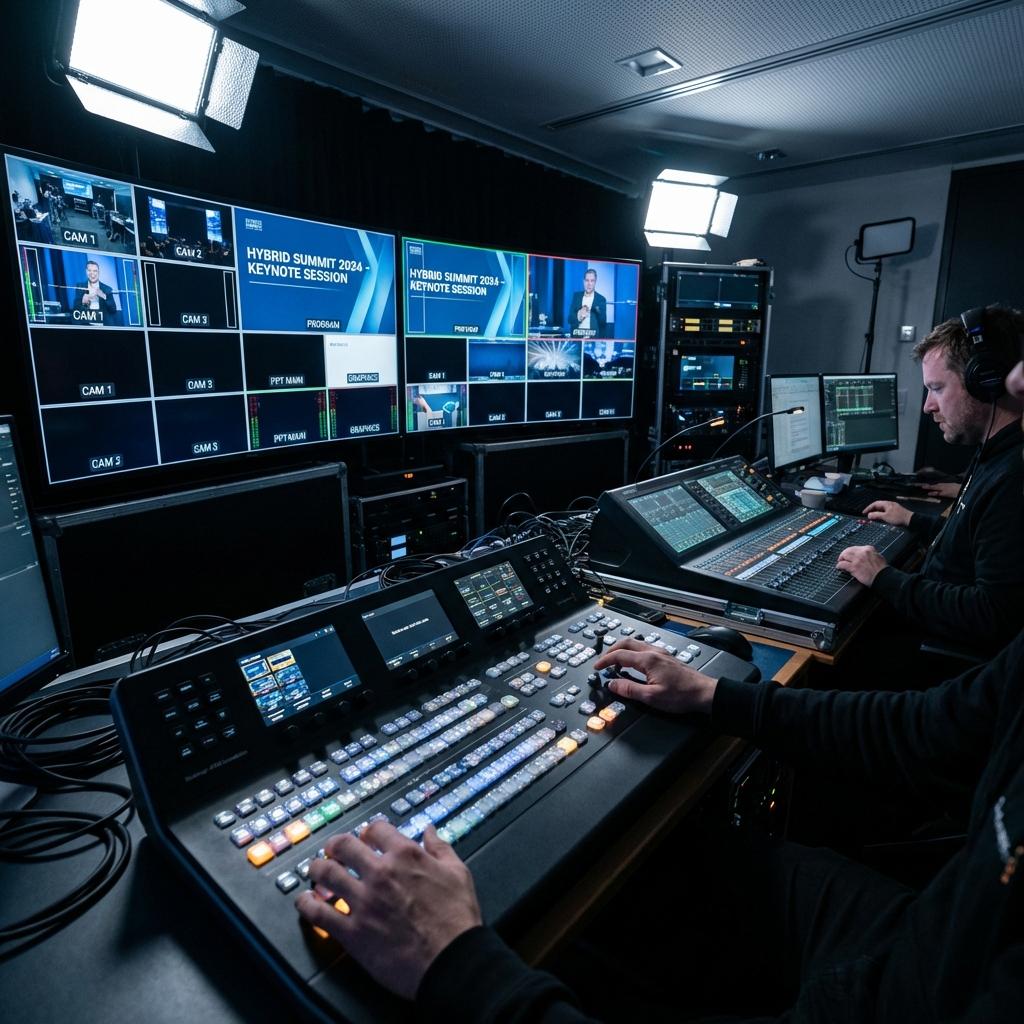
Tier 1 events represent the pinnacle of corporate communication and demand broadcast-level production standards. The technical workflow for these hybrid events must serve both a live, in-person audience and a remote virtual audience without compromise. The foundation is a multi-camera setup using 4K/UHD broadcast cameras connected via 12G-SDI for maximum signal fidelity. In the Production Control Room (PCR), a hardware video switcher and a dedicated audio mixing console, often connected via a Dante or AES67 audio-over-IP network, form the core of the operation. Redundancy is paramount. This includes A/B redundant signal paths for all primary sources, dual hardware encoders running in parallel, and bonded cellular network solutions (e.g., LiveU, TVU Networks) to provide a failover for the primary internet connection. ISO (isolated) recording of every camera feed and the primary program output onto separate recorders is standard practice, providing maximum flexibility for post-production and a backup in case of encoder failure. The audio setup is equally critical, with separate mixes engineered for in-room sound reinforcement and the online broadcast to ensure clarity for both audiences.
Tier 2: Internal All-Hands and Departmental Town Halls
For recurring internal events like all-hands meetings, the focus shifts from broadcast complexity to efficiency, reliability, and seamless integration with enterprise collaboration platforms. The workflow is often built around NDI-enabled PTZ (Pan-Tilt-Zoom) cameras, which can be controlled remotely by a single operator. A software-based production solution like vMix or a compact hardware unit like a NewTek TriCaster provides an all-in-one platform for video switching, graphics insertion, and encoding. A key technical challenge in this tier is the integration of remote participants from platforms like Microsoft Teams or Zoom. Professional workflows avoid screen-capturing a participant gallery. Instead, we use dedicated hardware I/O devices (from brands like Magewell or AJA) or NDI-enabled features within the platforms themselves (like Teams NDI out) to bring individual remote speakers into the production switcher as clean, distinct video sources. This allows them to be treated like any other camera source, ensuring high-quality video and audio for the final broadcast.
Tier 3: Ad-Hoc Webinars and Training Sessions
The most frequent type of video communication often falls into Tier 3. These events require a workflow that is simple enough for a non-technical user to operate but robust enough to maintain professional quality standards. The setup typically involves a high-quality webcam or a mirrorless camera connected via a capture card to provide a clean HDMI output. Audio is managed with a professional USB microphone or a lavalier microphone connected to a simple audio interface. Production is handled through user-friendly software like OBS Studio or directly within a dedicated webinar platform’s production tools. While simpler, technical best practices still apply. This includes ensuring proper lighting, using a wired ethernet connection instead of Wi-Fi, and managing audio levels to prevent clipping or distortion. The goal of this tier is to empower internal teams to create high-quality content independently, following a pre-defined technical and brand guide.
Resource Allocation: Technical Staffing and Equipment Lifecycle Management
A successful video strategy extends beyond the live event and requires careful planning of human resources and technology management. Building an internal team or partnering with a production company involves defining specific technical roles and responsibilities. Simultaneously, managing a fleet of complex broadcast equipment necessitates a structured approach to acquisition, maintenance, and lifecycle planning. This foresight ensures that every production is properly supported and that technology investments deliver long-term value.
Defining Technical Roles and Responsibilities
Flawless execution of a professional live stream depends on a specialized crew where each member has a distinct role. For a Tier 1 production, key roles include the Technical Director (TD), who operates the video switcher and executes the show’s visual flow; the A1 (Audio Engineer), who manages all microphones and audio sources to create a clean broadcast mix; the V1 (Video Engineer), who is responsible for shading the cameras to ensure color and exposure are perfectly matched; and the Streaming Engineer, who configures and monitors the encoders and manages the delivery to the Content Delivery Network (CDN). For smaller productions, these roles may be combined, but understanding the distinct skill sets required for each function is critical for proper staffing. Creating clear documentation, including signal flow diagrams and comms plans, is essential for coordinating the team effectively during a live production.
Implementing a Production Equipment Management Strategy
The decision to purchase equipment versus renting on a per-event basis is a fundamental financial and operational choice. This involves a Capital Expenditure (CapEx) vs. Operational Expenditure (OpEx) analysis. Owning core equipment for Tier 2 and Tier 3 events can be cost-effective long-term, but it also requires a budget for maintenance, storage, and eventual replacement. For highly specialized Tier 1 equipment, renting provides access to the latest technology without the large upfront investment. An effective management strategy includes a rigorous schedule for performing firmware and software updates on all equipment. This is a critical security measure and also ensures interoperability between different pieces of hardware. An asset tracking system should be used to log equipment usage, maintenance history, and known issues, which informs future purchasing decisions and helps preempt equipment failure.
Pre-Production and Post-Production Technical Planning
The work of a technical team begins long before the event and continues well after. The pre-production process must include a detailed technical site survey to assess network infrastructure, power availability and distribution, lighting conditions, and potential sources of RF interference. This information informs the equipment list and logistical plan. The post-production workflow must also be defined in advance. This includes deciding on the recording formats for archival and editing purposes, such as Apple ProRes or Avid DNxHD, and ensuring sufficient high-speed storage is available to handle large multi-camera recording files. A clear plan for managing, editing, and distributing the on-demand version of the event is a crucial part of maximizing the value of the initial live production. This includes multi-track audio recording to allow for a clean-up of the audio mix in post-production. By treating the pre and post-production phases with the same technical rigor as the live event, you create a comprehensive and resilient video communications program.

Jeremy Lee is a seasoned digital marketing director and strategist with over two decades of experience in the industry. As the founder of Sotavento Medios, I manage a diverse portfolio of over 50 businesses, helping brands grow through advanced search strategies and digital innovation. My work focuses on bridging the gap between traditional search engine optimisation and the evolving world of AI-driven answer engines.
get in touch