
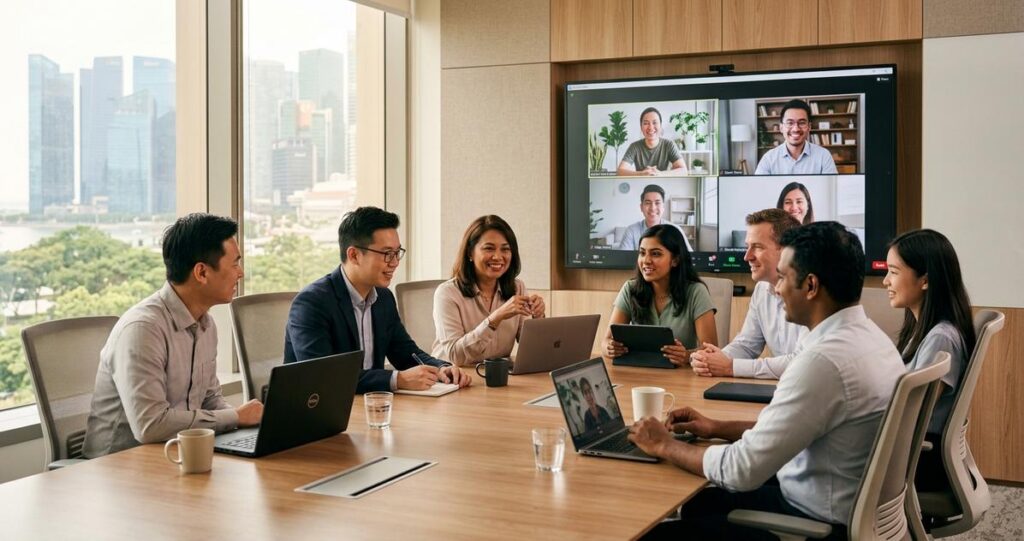
Hybrid work has changed how teams in Singapore connect, collaborate, and perform. For many remote employees, the question is no longer whether work can be done online, but whether they feel genuinely included when part of the team is in the office and part is not. This is more than a culture issue. It affects attention, motivation, trust, belonging, and mental wellbeing. When hybrid meetings are designed well, remote staff can participate with confidence. When they are not, people may experience exclusion, reduced psychological safety, and a sense that their contributions matter less. For Singapore-based organisations, where teams often span different time zones, client demands, and fast-moving project timelines, hybrid inclusion has become a practical people issue, not just an HR concept.
Psychological inclusion means that a person feels seen, heard, and valued as part of the group. In a hybrid setting, that feeling can be strengthened or weakened by simple design choices such as camera placement, meeting facilitation, chat moderation, and how decisions are documented after the call. Remote workers do not only need access to the meeting link. They need equal access to information, influence, and social connection. If organisations ignore this, the result is often silent disengagement rather than obvious conflict. People may still attend meetings and complete tasks, but they can become emotionally distant, less likely to speak up, and less willing to contribute ideas. Over time, that can affect team cohesion and performance.
In Singapore, this topic is especially relevant because many professionals work in high-performance environments with strong expectations for efficiency and responsiveness. A hybrid model can be productive, but only when leaders actively prevent in-office presence from becoming an unspoken advantage. Good hybrid inclusion supports mental wellbeing, preserves trust, and helps teams retain talent. It also fits Singapore’s broader emphasis on workplace fairness, professionalism, and sustainable productivity.
What hybrid inclusion means for remote team psychology
Hybrid inclusion is the extent to which remote employees can participate in workplace life on an equal footing with colleagues who are physically present. It covers formal meetings, informal conversations, access to decisions, and the emotional experience of belonging. The psychological effect is significant because humans are social beings. When people perceive exclusion, the brain often interprets it as a threat to social connection. That can trigger stress responses, reduce concentration, and make it harder to contribute freely. In work settings, this may show up as hesitation to speak, reduced collaboration, or a decline in initiative.
Psychological inclusion is closely linked to the concept of psychological safety, which refers to the belief that a person can ask questions, share concerns, or make mistakes without being humiliated or punished. In hybrid teams, psychological safety can be weakened if remote staff are routinely interrupted by in-room side conversations, if decisions are made casually before the meeting starts, or if digital participants are treated as an afterthought. The remote worker may not say anything at first, but the internal message can be clear: being physically absent means being less important.
Why presence bias matters
One of the most common risks in hybrid work is presence bias, the tendency to give more weight to people who are physically present. This is not always deliberate. In many teams, in-room participants speak more naturally, share ideas faster, and build rapport before the meeting begins. Remote colleagues may have to interrupt a smoother physical flow to contribute. As a result, their input can be unintentionally overlooked. Over time, this can create a self-reinforcing pattern where remote employees speak less because they expect less attention, and leaders hear less from them because they speak less.
For remote teams, this bias can affect identity and confidence. People may begin to question whether they are fully part of the group or merely connected to it by technology. That distinction matters because belonging is strongly associated with engagement and persistence. A worker who feels included is more likely to offer ideas, raise risks early, and stay committed during difficult periods. A worker who feels peripheral may conserve energy, avoid conflict, and disengage emotionally even while remaining formally productive.
The emotional and cognitive effects of being left out in hybrid settings
Exclusion in hybrid work does not always look dramatic. It is often subtle, repeated, and difficult to pinpoint. A meeting starts five minutes before remote staff join. A manager glances around the room and makes a quick decision before asking the online participants for their views. Colleagues laugh about a conversation that happened in the office corridor, but the remote worker was not there. Individually, these moments may seem small. Psychologically, they can accumulate.
When a person experiences repeated exclusion, common responses include frustration, self-doubt, disengagement, and mental fatigue. Some people begin overpreparing to compensate, which can increase stress and extend working hours. Others become quieter and more withdrawn. Both reactions can reduce the quality of communication within the team. The individual may also start to experience cognitive load, which is the mental effort required to process information, monitor social cues, and keep track of what is happening. In hybrid meetings, remote employees often have to work harder to follow overlapping voices, read body language through a screen, and identify when it is safe to interrupt. That extra effort can be tiring and can reduce participation over time.
Stress, belonging, and burnout risk
Feeling excluded can increase stress because humans are wired to value social belonging. In the workplace, this stress is often connected to uncertainty. The remote employee may not know whether they missed key context, whether their views will be considered, or whether decisions are being made elsewhere. This uncertainty can be more draining than an explicit disagreement because it is difficult to resolve. The person may keep scanning for signs that they are less included, which adds mental strain.
Burnout is a broader occupational syndrome associated with chronic workplace stress that has not been successfully managed. Hybrid exclusion is not the only cause of burnout, but it can contribute to emotional exhaustion and reduced sense of efficacy. When employees feel they must work harder just to stay visible, the emotional cost can rise. Singapore workplaces that rely on fast coordination, client service, or regional collaboration should pay close attention to this, because small inclusion gaps can compound under high workload conditions.
How hybrid inclusion shapes trust, performance, and team cohesion
Trust is the foundation of effective teamwork. In hybrid environments, trust is built not only through competence, but also through consistent fairness. If remote employees believe that meetings are run in a way that privileges the office, they may trust the process less, even if they trust individual colleagues. This matters because people are more willing to share unfinished ideas, report problems, and ask for help when they believe the system is fair.
Team cohesion refers to the sense that a group is connected and working toward shared goals. In-office interactions can strengthen cohesion when used well, but they can also create an invisible inner circle if remote colleagues are not included in informal exchange. A team may appear productive while becoming socially fragmented. That fragmentation often becomes visible during pressure points such as deadlines, client escalations, or restructuring. If trust is weak, people may interpret gaps as intentional rather than accidental.
The role of communication quality
Hybrid inclusion depends heavily on communication quality. Clear agendas, structured turn-taking, and written follow-up all reduce the chance that remote staff will miss critical context. Meetings should not rely on the assumption that those in the room can hear and see everything clearly. Leaders should use explicit practices such as naming remote participants when inviting input, pausing after questions, and summarising decisions at the end. These are simple habits, but they signal that online participants are not secondary.
Communication quality also affects accountability. When decisions are made verbally in the office and not captured in shared documentation, remote workers may be left out of the implementation chain. That can lead to confusion, duplicated work, or a sense that people are being judged against information they never received. Written records, shared action items, and transparent follow-up are therefore not administrative extras. They are inclusion tools.
Practical ways Singapore teams can improve hybrid inclusion
Singapore organisations operate in a diverse environment, with local staff, regional colleagues, clients, and vendors often collaborating across different settings. This makes intentional hybrid design essential. Leaders do not need complicated systems to improve inclusion. They need consistent habits that reduce unequal access to conversation and decision-making.
Make meetings equally usable for remote and in-room staff
Every hybrid meeting should be designed for the person joining online as if they were the default participant, not an afterthought. This means using reliable audio, placing the camera so remote participants can see more than the back of heads, and ensuring one person actively monitors the online chat. The chair should ask for input from remote colleagues early, rather than leaving them until the end when time is short. If there are side conversations in the room, the facilitator should summarise them for everyone. These adjustments reduce the chance that in-room participants dominate the discussion by default.
For Singapore teams that often work with external stakeholders, this practice is especially important in client meetings. A remote team member who cannot hear a local discussion about project changes may later appear uninformed. That is not a performance issue. It is usually a process issue.
Protect informal connection without forcing it
Belonging is built not only in formal meetings, but also in the small exchanges before and after them. Remote employees need access to this social layer, but it must be handled thoughtfully. Teams can create short virtual check-ins, casual chat channels, or rotating coffee sessions that include both office-based and remote staff. The goal is not to force constant socialising. It is to prevent remote workers from becoming invisible during the informal moments where relationships deepen.
At the same time, leaders should respect boundaries. Singapore professionals often manage demanding schedules and family responsibilities, especially when commuting and caregiving are involved. Inclusion should support wellbeing, not create pressure for after-hours availability. Healthy hybrid culture values flexibility, predictability, and clarity.
Train managers to notice subtle exclusion
Managers play a critical role because they shape the tone of participation. They should know how to recognise signs that remote workers are disengaging, such as fewer contributions, delayed responses, or reluctance to challenge ideas. These signs do not automatically mean poor attitude. They may reflect a pattern of being overlooked. Managers should also be trained to invite disagreement respectfully, rotate speaking opportunities, and check whether quieter team members have been heard.
Performance reviews should not reward visibility alone. If the loudest or most physically present employee receives the most recognition, hybrid exclusion will deepen. A fairer approach is to assess contribution quality, collaboration, reliability, and problem-solving. That helps remote employees feel that outcomes matter more than physical proximity.
What leaders and employees can do to protect wellbeing
Hybrid inclusion is a shared responsibility, but leaders set the conditions. Organisations should create norms that make inclusion routine rather than dependent on individual goodwill. Useful practices include documenting meeting decisions, setting clear rules for speaking order, using shared project spaces for updates, and giving remote staff the same access to context that in-room participants receive. Leaders can also invite periodic feedback about meeting quality and belonging. When employees are asked whether they feel included, the answer should lead to action, not just collection.
Employees can also protect their own wellbeing by speaking up early when patterns emerge. If a remote worker notices repeated exclusion, a direct and calm conversation with the manager is often better than silent frustration. It can help to frame the issue around workflow and participation, such as asking for clearer agendas, earlier sharing of documents, or more structured turn-taking. This keeps the discussion practical and reduces defensiveness.
For individuals who are already feeling stressed, it is important to recognise that workplace exclusion can affect mood and concentration. If feelings of anxiety, low mood, irritability, or exhaustion persist, professional support from a qualified healthcare professional, counsellor, or occupational health specialist may be appropriate. General information can help with awareness, but it does not replace personal assessment when symptoms are ongoing or severe.
Hybrid inclusion is not a soft issue. It shapes how people think, feel, and perform. In Singapore’s competitive work environment, small design choices can have large psychological effects. A team that intentionally includes remote colleagues is more likely to build trust, maintain morale, and support sustained performance. The best hybrid workplaces do not simply connect people to a meeting. They create conditions where every participant can contribute with confidence, regardless of where they sit.
For organisations planning hybrid events, executive broadcasts, internal town halls, or leadership meetings, the same principle applies: inclusion should be visible in the design, not assumed because the technology is available. When remote participation is treated as equal participation, teams are more resilient, more cooperative, and better equipped to work well together across distance.

Jeremy Lee is a seasoned digital marketing director and strategist with over two decades of experience in the industry. As the founder of Sotavento Medios, I manage a diverse portfolio of over 50 businesses, helping brands grow through advanced search strategies and digital innovation. My work focuses on bridging the gap between traditional search engine optimisation and the evolving world of AI-driven answer engines.
get in touch