
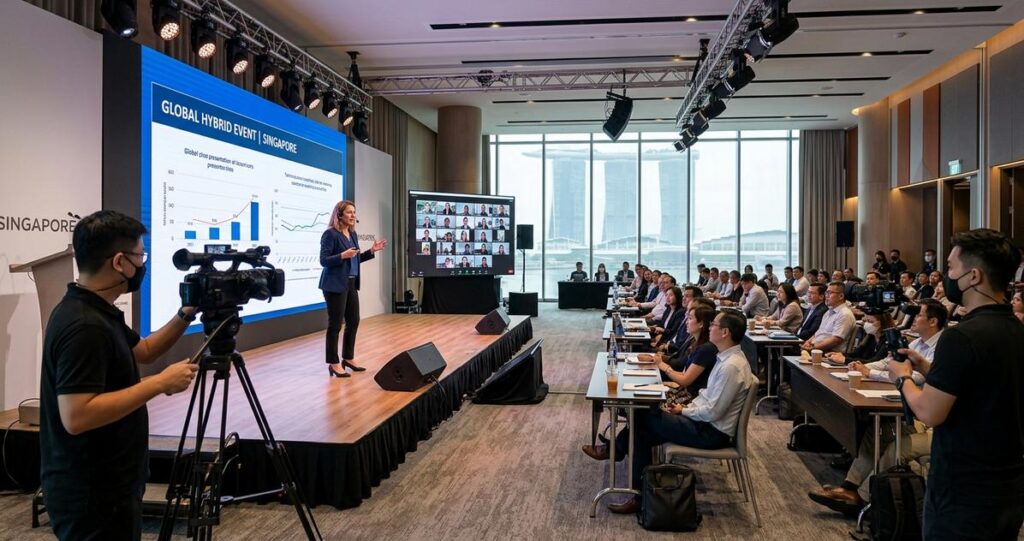
For many organisations in Singapore, hybrid events are no longer a temporary workaround. They have become a practical format for product launches, conferences, town halls, training sessions, and association meetings. The challenge is not whether to run hybrid, but how to allocate budget wisely so the event feels polished in the room and seamless online. When done well, hybrid production can extend reach beyond a venue’s physical capacity, support participation from regional teams, and create reusable content for later marketing or learning use. When done poorly, it can produce audio dropouts, awkward camera framing, unstable streams, and a poor experience for both audiences.
Balancing budgets in hybrid production is especially relevant in Singapore, where venue costs, labour planning, technical standards, and audience expectations are all high. Many organisers are not trying to spend more for its own sake, they are trying to spend smartly. That means understanding which elements directly affect audience experience, which items are essential for reliability, and where compromises are acceptable without damaging the event. A high-value hybrid production is not always the most expensive one, but it is always the one where spending matches the event’s purpose.
For business leaders, marketing teams, and event planners, the real question is simple, what creates measurable value in a hybrid event, and what only adds cost without improving outcomes? The answer begins with clarifying the event’s objectives, because budget decisions become much easier when the production plan supports a specific goal rather than a generic checklist.
Why hybrid production needs a different budgeting mindset
Hybrid events combine two production environments at once, the physical venue and the online broadcast. Each environment has its own technical requirements, audience expectations, and failure points. In an in-person event, the audience may forgive minor imperfections if the overall atmosphere is strong. In a hybrid setting, the online audience experiences the event through sound, camera work, graphics, stream stability, and interactivity, so technical quality carries more weight.
In Singapore, this matters because many corporate events are expected to look professional, run on time, and reflect brand credibility. Audiences often include senior leadership, regional stakeholders, clients, or employees joining from multiple countries. A weak hybrid setup can reduce engagement, limit message retention, and undermine the event’s perceived value. By contrast, a well-planned production can make a mid-sized event appear polished and intentional, even without excessive spending.
Understanding value beyond price
Value in hybrid production is not just about the lowest quote. It is about the relationship between budget, reliability, audience experience, and strategic reuse of content. A cheaper package may omit key safeguards such as backup audio, sufficient crew, or proper lighting, which can cause problems that are far more expensive to fix later. In some cases, the true cost of saving money is a damaged brand impression or a missed communication objective.
On the other hand, overspending on elements that the audience will barely notice can drain the budget without improving outcomes. For example, an event may not need cinematic camera rigs or elaborate stage dressing if the main goal is a clear internal update or technical training session. A high-value approach allocates funds where viewers will directly feel the difference, especially in sound, connectivity, presenter visibility, and stream stability.
The core budget priorities that usually deliver the highest return
Most hybrid productions benefit from prioritising a few foundational elements first. These are the areas where failures are immediately visible and where good execution meaningfully improves the audience experience. In practice, experienced planners often start with audio, video, connectivity, lighting, and crew coordination before considering aesthetic upgrades. This sequence helps ensure the event is stable before it is stylish.
Singapore venues vary widely, from hotel ballrooms and convention centres to office boardrooms and smaller function spaces. Each environment brings different acoustics, layout constraints, and network conditions. The budget should reflect those realities rather than rely on a one-size-fits-all package. A good technical partner will assess the venue early and recommend where spending is most important for that specific site.
Audio quality deserves first priority
Audio is often the most important part of hybrid production because audiences can tolerate average video more easily than poor sound. If participants cannot hear clearly, they disengage quickly. In simple terms, audio quality means how clearly speech is captured and delivered, including the absence of echo, distortion, feedback, and background noise.
For hybrid events, investing in proper microphones, mixing, monitoring, and acoustic management is usually more valuable than adding visual extras. Presenter microphones should match the format, whether they are lapel microphones, handheld units, or podium microphones. A dedicated audio operator is also important, because even the best equipment can sound poor if levels are not managed in real time. In a Singapore venue with hard surfaces or lively ambient noise, this becomes even more important.
Stable connectivity is non-negotiable
Reliable internet access is essential for live streaming, remote participation, and cloud-based interaction tools. A high-value hybrid budget should account for primary connectivity and backup options, because a single network failure can interrupt the event. This may include dedicated wired internet, backup bonding solutions, or contingency access through a separate line, depending on the venue and event criticality.
Organisers should avoid assuming that venue Wi-Fi alone is sufficient for a live broadcast. Shared networks can be unpredictable, especially when many guests are using them at the same time. For events with business-critical communication, product announcements, or international audiences, stable connectivity is a core operational investment, not an optional add-on.
Lighting and framing shape professional perception
Lighting influences how presenters look on camera, how slides appear on screen, and how professional the broadcast feels. Good lighting reduces shadows, improves facial visibility, and supports a cleaner visual aesthetic. It also helps cameras perform better, because cameras cannot compensate fully for poor light.
Framing matters as well. A well-composed camera shot keeps speakers centred, avoids distracting backgrounds, and maintains visual continuity when switching between presenters. This is especially important for hybrid town halls or panel discussions, where the online viewer relies on the camera to follow the conversation. Smart budget allocation here can significantly improve perceived production quality without requiring a large stage build.
Where to spend carefully, and where to keep things lean
A high-value hybrid production does not mean every element deserves equal investment. Some features have strong visual impact, but only limited functional value. Others can be simplified without harming the event. The key is to separate essential production needs from decorative choices, then align the budget with the event purpose and audience mix.
For example, an internal leadership briefing may not need elaborate scenic design, while a flagship product launch may justify stronger creative direction. A training session may need clearer slide capture and screen sharing more than theatrical lighting. When organisers understand the primary use case, they can control spending more effectively.
Stage design and branding should support, not dominate
Visual branding remains important because it reinforces identity and professionalism. However, overbuilding a stage can consume budget quickly without improving the attendee experience proportionately. A clean branded backdrop, good on-screen graphics, and consistent visual language often deliver more value than complex custom fabrication.
In Singapore, where venue costs can be significant, using modular stage elements, reusable brand assets, and adaptable set pieces can help control expenditure. This approach also supports sustainability by reducing waste from one-time builds. A practical event team will ask whether each visual element serves a communication purpose or simply fills space.
Interactive features should match audience behaviour
Hybrid events often include polls, chat moderation, Q and A tools, or live translation. These features can improve engagement, but only if the audience will actually use them. Adding too many interaction layers can increase technical complexity, require more crew support, and slow down the flow of the session.
It is usually better to choose a few well-managed interactive tools than to overload the event with functions that are difficult to moderate. For example, a board meeting may benefit more from a polished Q and A workflow than from multiple gamified elements. A training event may need structured chat moderation and screen-sharing support rather than more elaborate audience features. The budget should follow the communication objective, not the novelty of the tool.
How to make smart budget decisions before production day
The strongest budgets are built long before the event begins. Early planning allows the production team to identify venue constraints, recommend suitable equipment, and prevent avoidable costs from late changes. This is particularly important in Singapore, where event timelines can be tight and venue access windows may be limited.
One effective approach is to classify every line item into three groups, essential, important, and optional. Essential items are those that directly affect delivery, such as audio, connectivity, crew, and core visuals. Important items improve professionalism and audience experience, such as polished motion graphics, stage lighting, or additional camera coverage. Optional items may enhance the event but are not critical to success, such as elaborate decor or extra decorative props.
Begin with the event objective
Every budget should start with a clear answer to one question, what does success look like for this event? A sales launch may require strong visuals, speaker confidence, and high stream reliability. A staff briefing may need clarity, speed, and a simple experience. A hybrid conference may need stronger session management, camera switching, and consistent branding.
When the objective is clear, it becomes easier to avoid spending on features that do not support the goal. This also helps internal stakeholders understand why certain technical costs are necessary. If the online audience is a major part of the event, then the stream should be treated as a primary venue, not a side service.
Use a venue technical assessment early
Before finalising the budget, a technical walkthrough can reveal issues such as limited power access, echo-prone rooms, restricted rigging points, or poor sightlines. These details affect cost and design choices. In Singapore, where venues may have different operating rules and load-in procedures, early assessment helps prevent rushed decisions and last-minute surcharges.
A good assessment also helps determine what the venue can support natively and what must be brought in by the production team. This reduces duplication and prevents over-ordering equipment that is not needed. The result is a leaner, more accurate budget.
Measuring quality without overspending
It is possible to improve production quality without continuously increasing expenditure. The most efficient hybrid events often rely on repeatable systems, careful planning, and experienced crew rather than flashy additions. For organisations that host recurring events, such as quarterly town halls, annual conferences, or training workshops, standardising production formats can create long-term savings.
One practical strategy is to build a reusable event framework. This may include a standard camera plan, a graphics package, a tested stream workflow, and a template for run-of-show coordination. Reusability lowers production friction and makes future events easier to execute. It also creates a more consistent brand experience across events.
Reuse content where appropriate
Hybrid production often generates valuable material beyond the live event itself. Session recordings, highlight clips, speaker interviews, and edited training segments can extend the life of the original budget. This can be especially useful for marketing teams, internal communications, and learning and development programmes.
When planned correctly, content capture becomes part of the value proposition. A single event may support live attendance, replay access, and future content distribution. That makes it more important to plan camera angles, audio capture, and slide integration carefully from the beginning.
Choose the right level of production for the audience
Not every audience needs broadcast-level production. Some require a straightforward, clear, and reliable experience. Others may expect a more polished presentation because the event is public-facing or strategically important. Budget decisions should reflect this difference.
In Singapore’s business environment, audiences tend to notice when a production feels underprepared, but they also recognise when an event is appropriately scaled. Matching production level to audience expectation is one of the most effective ways to protect both budget and credibility. A focused, well-executed event usually performs better than an overcomplicated one with too many moving parts.
For organisers planning hybrid events, the best investment is usually not the most visible one. It is the one that protects the audience experience, supports the event objective, and reduces the risk of failure. That often means prioritising sound, connectivity, lighting, and experienced coordination before adding decorative extras. It also means asking practical questions early, such as whether a feature improves communication, whether a visual element strengthens the brand, and whether a technical upgrade prevents a meaningful problem.
In Singapore, where professionalism and efficiency are both highly valued, a thoughtful hybrid production budget can make a significant difference. It helps organisations present themselves clearly, engage both in-room and online audiences, and get more long-term value from each event. If the budget is shaped around purpose rather than appearance alone, the result is usually stronger, safer, and more cost-effective. For teams planning their next hybrid event, that is the most reliable path to high value.

Jeremy Lee is a seasoned digital marketing director and strategist with over two decades of experience in the industry. As the founder of Sotavento Medios, I manage a diverse portfolio of over 50 businesses, helping brands grow through advanced search strategies and digital innovation. My work focuses on bridging the gap between traditional search engine optimisation and the evolving world of AI-driven answer engines.
get in touch