
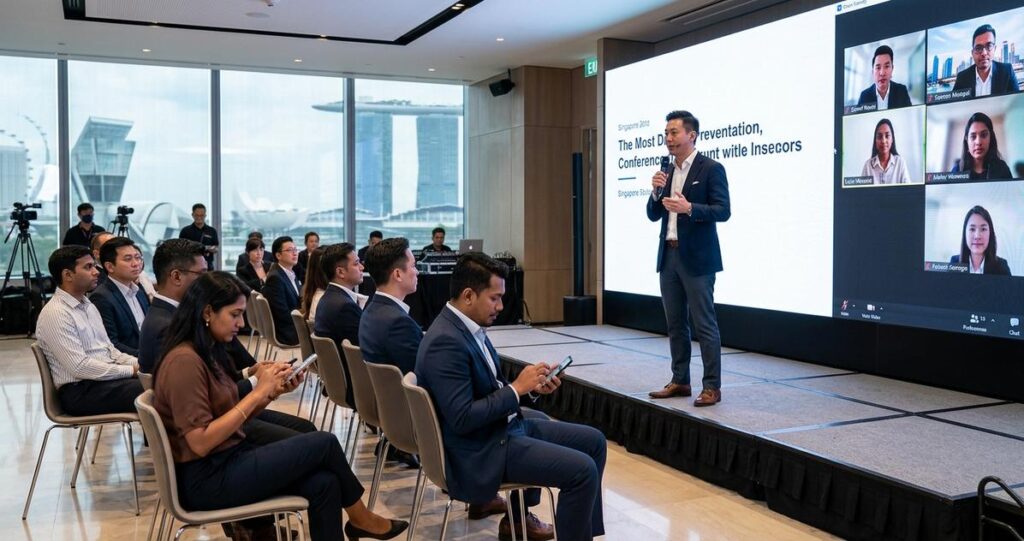
Hybrid events bring together people who are physically present and those joining remotely, and that creates a simple but persistent challenge: how do you make both groups feel equally involved? In Singapore, where business conferences, town halls, product launches, and professional training sessions often serve a mixed audience across offices, homes, and overseas locations, participation cannot depend on chance. If the experience is designed only for the room, remote attendees become observers. If it is designed only for the screen, the in-person audience can feel disengaged. Gamification gives organisers a practical way to close that gap by using game-like mechanics to support attention, interaction, and motivation without turning a serious event into a gimmick.
For Singapore-based businesses, this matters because hybrid participation is not just a technology issue, it is an experience design issue. Audience members are more likely to contribute when the format is clear, the actions are easy to understand, and the rewards feel meaningful. Well-planned gamification can help people ask questions earlier, stay attentive for longer, and move from passive viewing to active involvement. The key is to use it with purpose, so it supports the event objective rather than distracting from it. That means choosing the right mechanics, setting expectations carefully, and making sure the system works for both in-room and remote participants in a fair, accessible way.
What gamification means in a hybrid event setting
Gamification is the use of game design elements in non-game environments. In events, this usually means points, badges, leaderboards, timed challenges, quizzes, polls, progress bars, or mission-based tasks that encourage participation. The aim is not to “play a game” for its own sake. The aim is to create clear incentives and feedback loops that make it easier for people to engage. In a hybrid format, these tools can help unify two different participation channels into one shared experience.
It is useful to distinguish gamification from entertainment. Entertainment can keep attention for a short time, but it does not always lead to meaningful participation. Gamification is more structured. It works best when the behaviour you want is specific, such as submitting a question, responding to a poll, visiting a sponsor booth, completing a training checkpoint, or networking with another attendee. The mechanism should support the event goal. For example, a leadership forum in Singapore may use live polls to collect audience opinion before a panel discussion, while a staff conference may use team-based challenges to encourage cross-department interaction.
Why hybrid audiences respond differently
Hybrid audiences experience the event differently because their environment is different. People in a ballroom are influenced by the energy of the room, the visibility of the stage, and informal cues from nearby attendees. Remote participants depend more on interface design, camera quality, audio clarity, and prompt instructions. A gamified interaction helps create shared moments across both settings, which reduces the sense that one group is secondary.
In Singapore, this matters especially in corporate and professional settings where audience time is limited and expectations are high. Busy professionals are unlikely to engage if the interaction appears confusing or low value. Gamification works when it removes friction. If someone can scan a QR code, answer a poll in a few seconds, or see immediate feedback from the session, engagement rises because the action is simple and the benefit is visible.
Designing gamification that actually increases participation
The most effective gamification strategies are built around behaviour, not decoration. Before choosing mechanics, define the exact participation outcome you want. Do you want questions during the keynote, faster response to audience polls, more time spent in breakout sessions, or stronger sponsor interaction? Once that is clear, you can choose the game element that best supports the behaviour. The event should feel seamless, not like attendees are being pushed through a separate app experience with no connection to the main programme.
Strong gamification also depends on simplicity. Hybrid events already require attention from multiple directions, including video feeds, chat windows, speaker slides, and live instructions. If the participation task is too complex, people disengage. If the system uses too many rules, it can frustrate both in-room and remote attendees. The best systems are easy to enter, easy to understand, and easy to complete in the time available.
Choose mechanics that match the event objective
Different mechanics suit different goals. Live polling is useful for opinion gathering and checking understanding in real time. Quizzes work well when the goal is learning reinforcement or product knowledge. Points and leaderboards can motivate repeated participation, though they should be used carefully in professional settings where fairness matters. Team-based missions can work well for networking events, internal town halls, and offsite conferences because they create shared purpose rather than individual competition alone.
For example, a Singapore financial services conference might use a session-based quiz after each keynote segment to reinforce key compliance messages. A hotel or venue-based corporate retreat might use a digital scavenger hunt that encourages attendees to visit networking zones, sponsor spaces, and workshop stations. A hybrid training seminar may assign points for asking questions, completing a knowledge check, and participating in a case discussion. In each case, the mechanic supports the event objective and gives both audiences a clear role.
Keep the reward system meaningful and fair
Rewards do not have to be expensive to work. In many professional events, recognition is more effective than physical prizes. Digital badges, public acknowledgement, access to exclusive content, or a chance to submit questions to the speaker can all provide motivation. What matters is that the reward feels relevant to the audience. A prize that is unrelated to the event may attract attention, but not necessarily the right kind of participation.
Fairness is especially important in hybrid events. Remote attendees should not be disadvantaged because they cannot physically visit a venue booth or speak into a microphone. Likewise, in-person attendees should not be forced to compete with remote participants in ways that are technically unequal. The system should account for both attendance modes. A practical approach is to make participation opportunities identical in principle, even if the delivery channel differs. For instance, both groups can answer the same question, submit the same type of response, or complete the same challenge within a defined time window.
How to implement gamification across hybrid touchpoints
Gamification only works when the touchpoints are integrated into the event journey. That means the invitation stage, event app, live session, networking segments, and post-event follow-up should work together. If participants have to repeatedly learn new tools or switch between unrelated platforms, engagement drops. In Singapore, where many attendees are highly time-conscious and expect efficient digital experiences, integration is essential.
Start by identifying where attention is strongest and where it tends to drop. Registration, opening sessions, mid-afternoon panels, and networking breaks are often useful moments for interaction. Then introduce a gamified action that feels timely. A short poll at the start of a panel can prime attention. A leaderboard update after a session can maintain momentum. A challenge during a break can bring people back into the experience. The timing matters as much as the mechanic.
Use QR codes, event apps, and live screens carefully
QR codes remain practical in Singapore because many attendees are already comfortable using mobile devices for digital interaction. A QR code can direct users to a poll, a quiz, a check-in page, or a networking task without requiring a separate login process if the system is designed well. Event apps can store progress, show rankings, and provide session-specific tasks. Live screens in the venue can display real-time results, which helps the in-room audience feel connected to remote participants.
However, technology should support the experience, not dominate it. If too much attention goes to the screen, the speaker loses momentum. If too many prompts appear, people may tune out. A good rule is to keep the interaction short, clearly labelled, and visibly relevant to what is happening on stage. The audience should never wonder why they are being asked to do something.
Blend competition with collaboration
Competition can be motivating, but it is not the only effective form of gamification. In some settings, especially internal corporate events, collaboration produces better participation because it lowers anxiety and encourages broader involvement. Team goals, shared milestones, and collective progress bars can involve more people than a strict leaderboard. This is useful when the audience includes different levels of seniority, different departments, or mixed familiarity with digital tools.
For instance, a Singapore company running a hybrid employee engagement event may divide participants into cross-functional teams and award points for attending sessions, submitting questions, and completing learning checkpoints. The winning team could be recognised at the end, but the main value is that everyone participates in a structured way. Collaboration also reduces the risk that only a small number of highly competitive participants dominate the experience.
Managing accessibility, inclusion, and trust
Any gamified hybrid event should be accessible to the widest possible audience. Accessibility means more than compliance, it means making sure that people with different technical skills, language preferences, and physical needs can participate comfortably. In Singapore, where audiences can be multilingual and diverse in age, this is especially important. A system that assumes everyone is equally comfortable with mobile apps, fast typing, or constant screen interaction will leave some people behind.
Instructions should be clear and concise. If an event uses multiple languages or serves participants with different language strengths, use simple language and visual cues. Keep the number of required steps low. Avoid mechanics that require precise timing unless they are necessary and suitable for the audience. Make sure any live screen content is readable from a distance, and ensure remote participants can complete the same tasks without unnecessary technical barriers.
Protect privacy and avoid manipulative design
Gamification should encourage participation, not pressure people into oversharing. Collect only the data that is needed for the event function, and be transparent about how it will be used. This is particularly important in corporate contexts where audience responses may be linked to internal feedback, training completion, or networking data. Clear communication builds trust and reduces resistance.
It is also important to avoid manipulative mechanics. Excessive urgency, hidden rules, or rewards that encourage constant checking can create fatigue rather than engagement. Professional audiences respond better when they feel respected. A well-designed experience gives participants a choice to engage, explains the purpose clearly, and never penalises them unfairly for attending in a different mode.
Make participation comfortable for different age groups
Singapore events often bring together participants across a wide age range. Younger professionals may be comfortable with app-based interaction, while older participants may prefer simpler interfaces and clearer instructions. Good gamification accommodates both. Use familiar actions such as tapping to vote, scanning a QR code, or selecting from a small number of options. Avoid requiring fast reflexes, complex navigation, or multiple account setups. The easier it is to start, the more likely people are to continue.
For some audiences, a visible sense of progress matters more than competition. A session checklist, participation tracker, or “complete three interactions to unlock the next bonus question” format can be more inclusive than a public leaderboard. This makes it easier for quieter attendees to participate without feeling exposed.
Measuring whether gamification is working
To use gamification effectively, organisers should evaluate both participation and quality. A high number of clicks does not automatically mean the event worked well. The better question is whether the interaction improved the event experience and supported the intended outcome. For example, did more people ask relevant questions? Did attendees stay engaged through the session? Did remote participants feel included in the same live moments as the in-person audience?
Useful measures can include poll response rates, quiz completion, number of questions submitted, participation spread across audience segments, and qualitative feedback from attendees and speakers. If one group is participating far less than the other, the design may need adjustment. If participation spikes only at the start but drops later, the event may need stronger pacing or more varied mechanics.
Review the experience after the event
Post-event review is essential. Ask what encouraged participation, what created friction, and where the audience lost momentum. In Singapore’s business environment, where events are often expected to produce clear outcomes, this review helps organisers improve both content and delivery. The most useful lessons are often practical, such as whether the instructions were clear enough, whether the app loaded quickly, or whether the rewards were meaningful.
A hybrid event should feel like one unified programme, not two separate experiences. Gamification can help achieve that, but only when it is designed with the audience in mind. That means testing the interaction flow before the event, rehearsing the live prompts, and making sure the moderator, speaker, and technical crew know how to support the participation moments without awkward pauses.
For Singapore organisations planning webinars, conferences, town halls, or product launches, the strongest approach is to start with one clear behaviour, select a simple gamified mechanic, and ensure the same opportunity exists for both in-room and remote attendees. Keep the design practical, keep the rules transparent, and keep the reward aligned with the purpose of the event. When gamification is handled well, it does more than create excitement. It gives every participant a reason to stay present, contribute, and feel included in the shared experience.
General information only: This article is for educational and event-planning purposes. For legal, privacy, accessibility, or technical implementation decisions, consult qualified professionals familiar with the specific event requirements and Singapore regulations that may apply.

Jeremy Lee is a seasoned digital marketing director and strategist with over two decades of experience in the industry. As the founder of Sotavento Medios, I manage a diverse portfolio of over 50 businesses, helping brands grow through advanced search strategies and digital innovation. My work focuses on bridging the gap between traditional search engine optimisation and the evolving world of AI-driven answer engines.
get in touch