
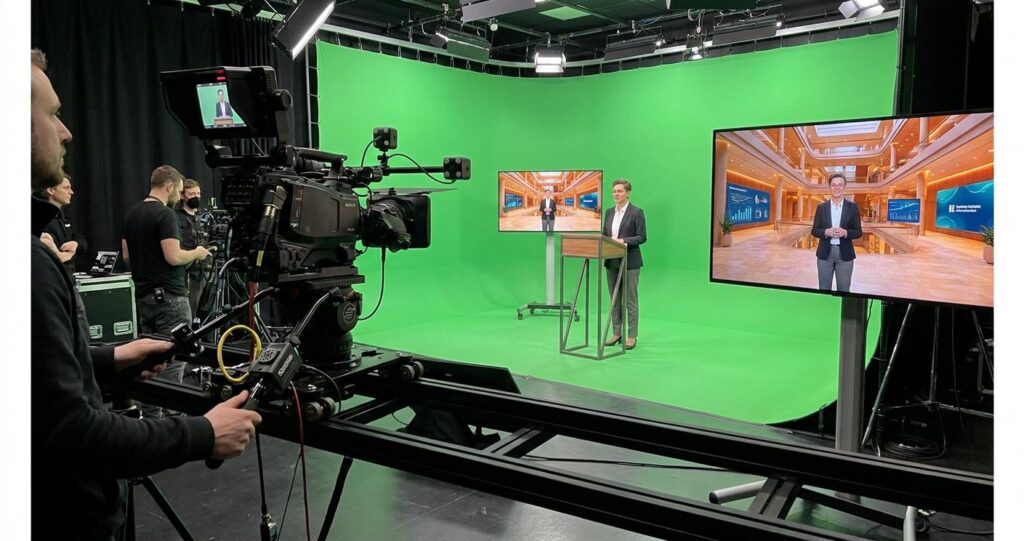
The landscape of B2B event production has undergone a profound transformation, moving beyond static stages to dynamic, immersive hybrid experiences. Central to this evolution is the sophisticated integration of physical props and presenters within meticulously crafted 3D virtual set environments. This advanced production methodology enables corporate event planners and AV professionals to deliver unparalleled visual fidelity and interactive engagement, bridging the divide between on-site and remote audiences. Achieving this seamless blend demands a deep understanding of complex technical workflows, precise signal synchronization, and enterprise-grade streaming infrastructure.
Spring Forest Studio’s technical team is at the forefront of this convergence, leveraging cutting-edge broadcast technologies to create compelling virtual and hybrid event productions. This article delves into the intricate technical considerations and implementation strategies required to flawlessly merge tangible elements with digitally rendered realities, ensuring every B2B event maintains its professional gravitas and technical excellence.
Technical Foundations of Hybrid Set Integration
The successful amalgamation of physical and virtual elements hinges on several foundational technologies that enable real-time compositing and spatial synchronization. These core components include advanced chroma keying, high-precision camera tracking, and robust real-time 3D render engines.
Chroma Keying Architectures for Immersive Compositing
Chroma keying, commonly known as green screen or blue screen technology, serves as the bedrock for isolating a subject or physical prop from its background to replace it with a virtual environment. In B2B event streaming, the demands for pristine keying are exceptionally high to maintain visual integrity. This necessitates professional-grade chroma keying architectures, which can be hardware-based or software-integrated:
- Hardware Keyers: Dedicated broadcast-grade hardware keyers, such as those found in vision mixers (e.g., Grass Valley K-Frame, Ross Carbonite) or standalone units, offer superior processing power, lower latency, and advanced algorithms for spill suppression and edge refinement. These systems typically accept SDI (Serial Digital Interface) inputs, supporting resolutions up to 12G-SDI for 4K/UHD productions.
- Software-Integrated Keyers: Platforms like NewTek TriCaster or production suites incorporating real-time render engines often feature integrated keying capabilities. While powerful, their performance is contingent on the host system’s CPU/GPU resources.
Achieving a clean key demands meticulous attention to lighting design. The green or blue screen must be evenly illuminated, typically between 60-80 IRE (Institute of Radio Engineers) on a waveform monitor, without hotspots or shadows, to ensure uniform color saturation. Furthermore, the subject should be positioned sufficiently far from the screen to prevent color spill, which occurs when the background color reflects onto the subject. Advanced keying parameters include luminance keying, color difference keying, and sophisticated matte generation to extract the most precise subject outline, critical for seamless integration with complex virtual scenes.
Advanced Camera Tracking Systems for Virtual Parallax
The illusion of depth and spatial accuracy in a blended environment relies entirely on the precise synchronization of physical camera movements with their virtual counterparts. Advanced camera tracking systems provide the necessary positional (XYZ) and rotational (pan, tilt, roll) data in real time, communicating this metadata to the 3D render engine. Key tracking methodologies include:
- Optical Tracking: Utilizes infrared cameras and passive or active markers placed on the physical camera and/or the stage. Systems like Stype or Ncam employ sophisticated algorithms to triangulate marker positions and calculate camera parameters. This method offers high accuracy but requires careful calibration and an unobstructed line of sight.
- Mechanical Tracking: Encoder-based systems integrated into professional pan-tilt heads (e.g., Vinten, Shotoku) provide highly accurate, repeatable data derived directly from the physical camera’s movements. These systems are robust and less susceptible to environmental interference but are often tethered to specific camera support equipment.
- Inertial Tracking (IMU-based): Inertial Measurement Units (IMUs) affixed to cameras can provide relative movement data. While useful for handheld or more dynamic scenarios, they often require drift correction or hybrid approaches with optical systems for absolute positioning over extended periods.
The tracking data, often transmitted over dedicated Ethernet networks, must be precisely time-aligned with the video signal to avoid visual artifacts such as “slippage” or “jitter” between the physical and virtual elements. Latency management in this data pipeline is paramount, typically targeting sub-frame delays, often in the range of 16-33 milliseconds (ms).
Real-time 3D Render Engines and Virtual Set Platforms
The real-time 3D render engine is the computational heart of any virtual set production, responsible for compositing the keyed live video feed with dynamically rendered 3D graphics. Professional-grade engines such as Unreal Engine, Zero Density Reality, and Vizrt Viz Engine are purpose-built for broadcast and live event applications:
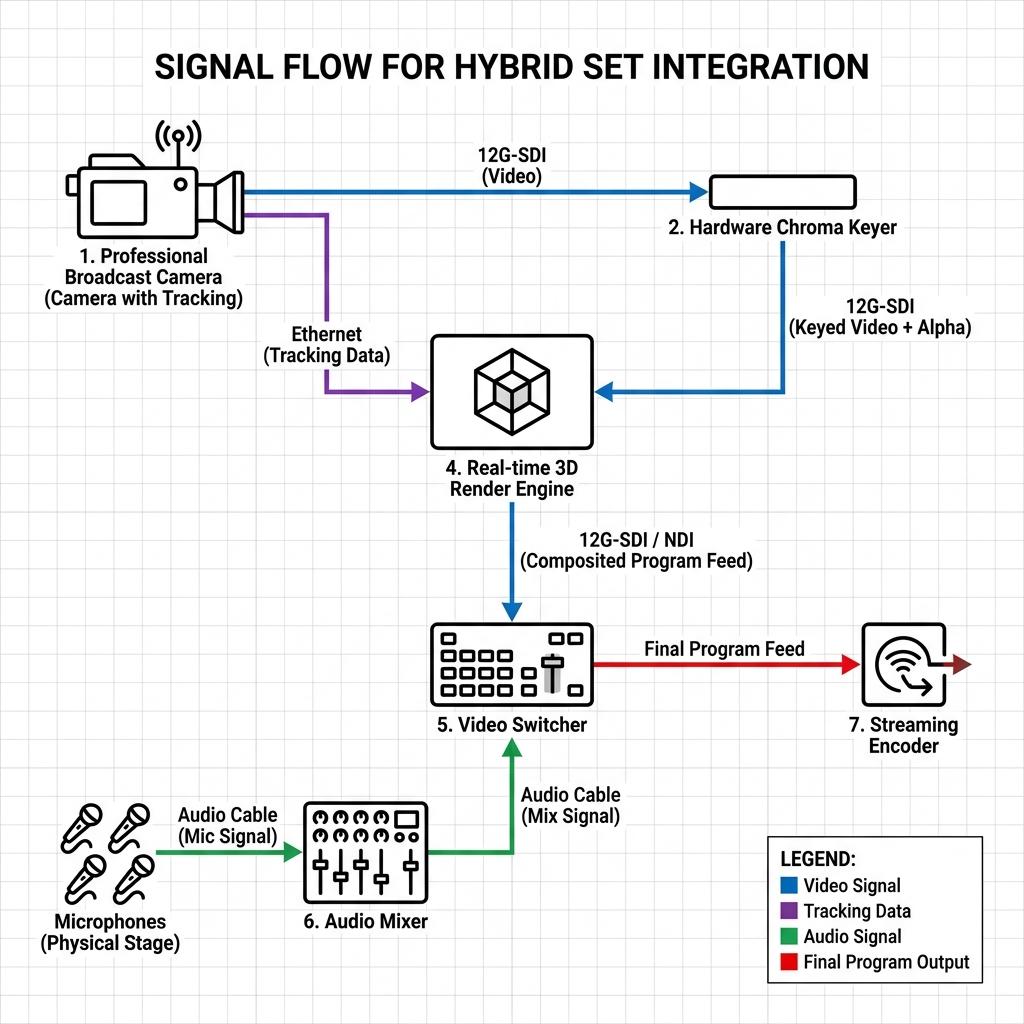
- Core Functionality: These engines ingest the clean video feed (often with an alpha channel from the keyer), the camera tracking data, and the pre-designed 3D virtual environment. They then render the virtual scene from the exact perspective of the physical camera, merging it with the live video to produce a final, composited program feed.
- Physically Based Rendering (PBR): Modern engines utilize PBR workflows, ensuring that virtual materials react to virtual lighting in a physically accurate manner, closely matching the properties of real-world materials. This is crucial for achieving photorealism and seamless integration with physical props.
- System Requirements: These engines demand substantial computing resources, including high-end GPUs (e.g., NVIDIA Quadro RTX series) with ample VRAM (e.g., 24GB or more), powerful multi-core CPUs, and high-speed NVMe storage for rapid asset loading. Distributed rendering across multiple GPU nodes can be employed for extremely complex scenes or multiple simultaneous outputs.
Signal Flow and Infrastructure for Blended Environments
Designing the robust signal flow and underlying network infrastructure for hybrid set integration is a critical engineering challenge. It requires careful consideration of video acquisition, audio synchronization, and high-bandwidth network requirements.
Video Acquisition, Transport, and Synchronization
A multi-camera production setup is standard for blended environments, allowing for dynamic camera angles and compositions. Professional broadcast and cinema cameras (e.g., Sony VENICE, ARRI ALEXA Mini LF, Blackmagic URSA Broadcast G2) are employed for their image quality, genlock capabilities, and robust output options.
- Signal Interfaces:
- SDI: The industry workhorse, SDI (Serial Digital Interface), is typically used for uncompressed video transport within the production facility. 3G-SDI supports 1080p60, while 12G-SDI is essential for single-cable 4K/UHD (2160p60) transmission from cameras to switchers and render engines.
- NDI (Network Device Interface): NDI|HX (High Efficiency) and full-bandwidth NDI are increasingly prevalent for IP-based video transport, offering flexibility and simplified cabling over standard Ethernet networks. NDI can carry video, audio, and metadata, simplifying integration.
- Fiber Optic: For longer cable runs or multi-channel high-bandwidth transmission, SMPTE ST 2110 compliant fiber optic transport solutions provide uncompressed video, audio, and data over IP networks, offering superior scalability and resilience in large-scale enterprise deployments.
- Genlock and Synchronization: All video sources, including cameras, graphics generators, and the real-time render engine output, must be precisely genlocked to a common house sync generator (e.g., Blackmagic HyperDeck Studio, AJA Gen10) to ensure frame-accurate timing. This prevents tearing, jitter, and other visual artifacts in the final composite.
- Routing Architectures: SDI routers or IP-based video routing matrices manage the distribution of raw camera feeds to the chroma keyers, render engines, and ultimately to the program switcher. In an IP environment, multicast group management and network configuration are crucial for efficient bandwidth utilization and reliable signal delivery.
Audio Integration and Synchronization
Audio is as critical as video for a convincing immersive experience. Integration of presenter microphones, playback audio, and talkback systems must be meticulously managed and synchronized:
- Embedding and De-embedding: Audio signals are often embedded within SDI video streams using standards like SMPTE ST 299M for 3G-SDI or SMPTE ST 2082-1 for 12G-SDI. This simplifies cabling but requires careful routing of specific audio channels. Conversely, audio de-embedding is necessary to feed signals into dedicated audio mixing consoles.
- Professional Audio Mixing: Dedicated digital audio consoles (e.g., Yamaha Rivage PM series, Avid S6L, Behringer X32) are used to manage multiple microphone inputs, integrate with playback systems, and mix the final program audio. These consoles offer advanced DSP (Digital Signal Processing) capabilities for equalization, compression, and noise gating.
- Networked Audio Protocols: For distributed audio systems, protocols like Dante, AES67, or AVB (Audio Video Bridging) enable low-latency, high-channel-count audio transport over standard Ethernet networks. This significantly reduces cabling complexity and enhances flexibility in complex setups.
- Lip-Sync Delay Management: Audio latency can differ from video latency due to processing paths. Professional audio delays or video frame synchronizers with adjustable audio delays are crucial for maintaining lip-sync, typically targeting a discrepancy of less than 40ms.
Network Infrastructure for Professional Streaming
The backbone of any modern B2B streaming production is a robust, high-performance network. For blended environments, this network must handle significant data loads from video, audio, tracking, and control signals:
- Bandwidth Requirements: Full-bandwidth NDI streams can consume hundreds of Mbps per stream. Uncompressed video over IP (SMPTE ST 2110) requires multiple Gbps per stream. A dedicated production network, typically operating at 10 Gigabit Ethernet (10GbE), 25GbE, or even 100GbE, is essential.
- Latency Optimization: Low latency is critical for real-time interaction and a natural presenter experience. Network switches must support minimal forwarding delays, and network topology should be optimized to reduce hops between critical components.
- VLAN Segmentation and QoS: Implementing Virtual Local Area Networks (VLANs) isolates different types of traffic (e.g., video, audio, control, general IT) to prevent congestion and enhance security. Quality of Service (QoS) mechanisms are configured on network switches to prioritize real-time A/V packets, ensuring consistent delivery even under heavy load.
- Redundancy and Resilience: Network infrastructure must incorporate redundancy protocols such as Spanning Tree Protocol (STP) or Rapid Spanning Tree Protocol (RSTP), Link Aggregation Control Protocol (LACP) for link redundancy, and redundant power supplies for critical switches to ensure uninterrupted operation.
Production Workflows and Creative Implementation
Beyond the technical infrastructure, successful integration of physical props with virtual sets requires meticulous planning and execution of production workflows, from lighting to multi-camera switching.
Lighting Design for Physical and Virtual Harmony
Achieving visual coherence between physical props/presenters and the virtual environment is largely dependent on harmonized lighting. The goal is to make the physical elements appear as if they naturally exist within the virtual space:
- Matching Direction and Intensity: Physical lighting fixtures (e.g., DMX-controlled LED panels, fresnels) must mimic the direction, intensity, and color temperature of the virtual light sources within the 3D set. Pre-visualization tools and light probes can assist in this calibration.
- Realistic Shadow Casting: The render engine must accurately generate shadows of the physical presenter and props onto the virtual floor and walls, aligning with the virtual light sources. Conversely, physical lighting can be used to create real shadows that match projected virtual shadows.
- Color Temperature and Tint: Precise color calibration of physical lighting to match the virtual scene’s ambient color temperature (e.g., 3200K tungsten, 5600K daylight) and tint is vital. White balance settings on cameras are critical to ensure color accuracy.
- Interactive Lighting: Advanced setups can feature interactive lighting, where virtual light sources dynamically respond to physical movements or data, and conversely, physical lights change to match events within the virtual scene.
Physical Prop Integration Best Practices
Integrating physical props into a virtual environment requires careful selection and preparation to maximize realism and interaction:
- Material Selection: Props should ideally be constructed from matte or low-reflectivity materials to minimize unwanted reflections of the green screen or production lighting, which can cause keying artifacts. If reflective surfaces are necessary, specialized materials or digital compositing techniques may be employed.
- Color Considerations: Props should avoid colors that are too close to the chroma key background color, unless they are specifically intended to be keyed out. Neutral colors or colors that contrast sharply with the key color are generally preferred.
- Digital Twins: For complex physical props, it is often beneficial to create a high-fidelity 3D model (a “digital twin”) via photogrammetry or 3D scanning. This digital twin can then be imported into the render engine, allowing for precise virtual lighting, shadows, and reflections to be cast onto the physical prop, further blurring the lines between real and virtual.
- Anchor Points and Stability: Physical props must be securely anchored to the stage to prevent accidental movement that could break the illusion or disrupt tracking data. Presenter interaction with props should be rehearsed to ensure seamless gestures and spatial awareness within the blended environment.
Multi-Camera Switching and Scene Management
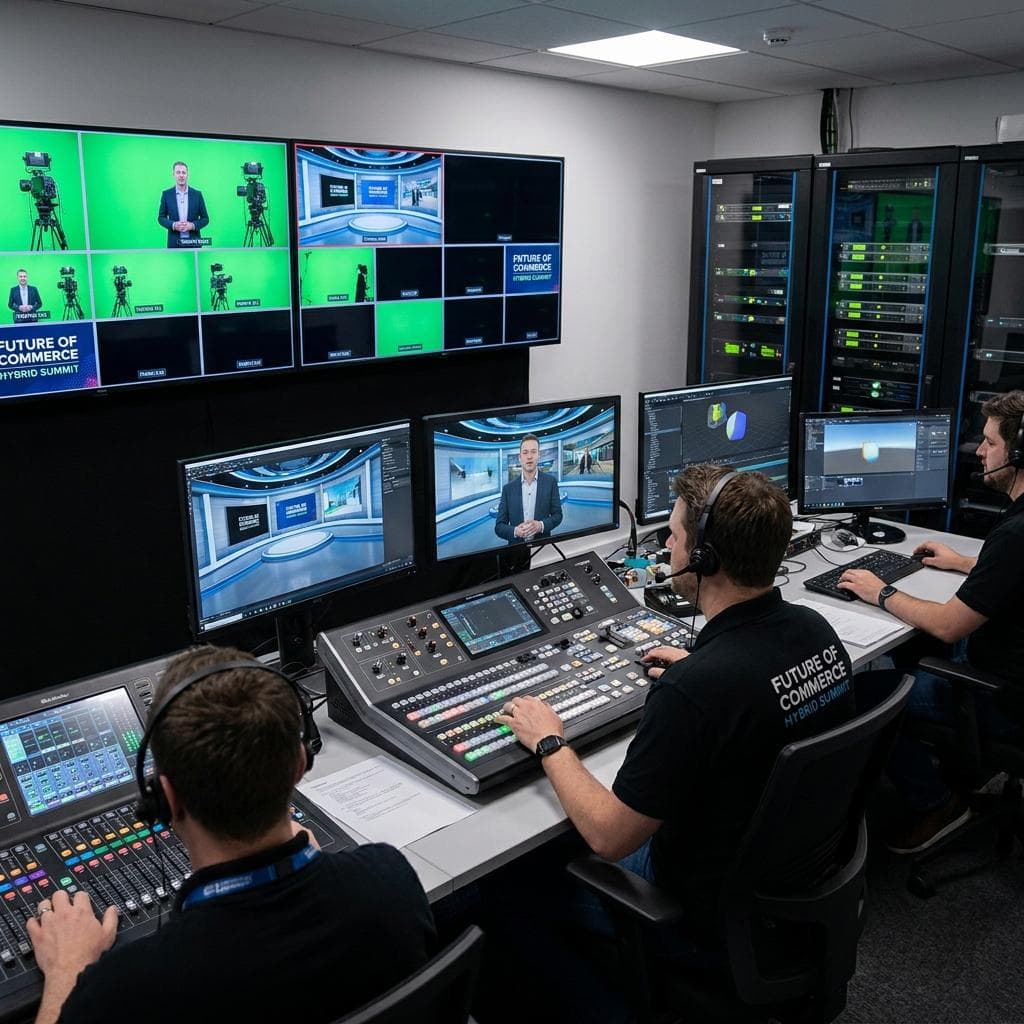
Operating a blended production requires a highly skilled technical director and a sophisticated video switcher to manage multiple camera feeds, virtual set layers, and graphics:
- Program and Preview Feeds: The video switcher manages the program (on-air) feed and a preview feed, allowing the technical director to prepare the next shot or scene. The output from the real-time render engine, which already contains the composited virtual set and keyed live video, is treated as a primary video source.
- Virtual Camera Control: In addition to physical camera cuts, the render engine allows for sophisticated virtual camera moves (e.g., dollying through a virtual set, orbital shots) that can be seamlessly integrated into the switching workflow. These virtual camera paths can be pre-programmed or controlled live via joysticks and touchscreens.
- Macros and Automation: For complex transitions involving multiple camera cuts, virtual scene changes, and graphic overlays, macros and automation systems (e.g., Ross DashBoard, Blackmagic ATEM Software Control) are invaluable. These allow for single-button execution of intricate sequences, ensuring consistency and precision.
- Talkback Systems: Robust talkback and intercom systems (e.g., Clear-Com, RTS) are essential for real-time communication between the technical director, camera operators, audio engineers, graphics operators, and talent. Clear, low-latency communication is vital for coordinating complex physical and virtual actions.
Advanced Integration and Scalability for Enterprise
For large-scale corporate events and enterprise clients, extending the capabilities of blended physical and virtual environments requires advanced integration strategies, cloud-based solutions, and robust scalability measures.
Cloud-based Rendering and Distributed Production
The computational demands of real-time 3D rendering can be substantial. Cloud-based rendering offers significant advantages for scalability and distributed production workflows:
- Scalable Compute: Leveraging cloud platforms (e.g., AWS, Google Cloud, Azure) for GPU-accelerated rendering allows for elastic scaling of compute resources on demand. This is particularly beneficial for complex virtual sets, multiple simultaneous virtual camera feeds, or distributed production teams.
- Remote Production Workflows: With cloud rendering, the production control room can be geographically separated from the physical stage. High-quality video and tracking data can be transmitted to the cloud render instances, and the composited program feed returned, using protocols like SRT (Secure Reliable Transport) for secure, low-latency, resilient transport over unreliable networks. This enables global talent pools and reduces on-site footprint.
- Edge Computing: For scenarios requiring extremely low latency or localized processing, edge computing solutions can place rendering capabilities closer to the physical stage, reducing reliance on long-haul internet connectivity while still offering cloud-like flexibility for resource allocation.
Enterprise Platform Integration and Hybrid Audience Engagement
The ultimate goal for B2B events is to engage both physical and virtual audiences seamlessly. This requires thoughtful integration with enterprise communication platforms:
- Unified Program Feeds: The final program feed, featuring the blended physical and virtual environment, is encoded and distributed to various platforms. For virtual audiences on platforms like Microsoft Teams, Zoom Events, or Webex, this stream provides a high-quality, professional presentation.
- Interactive Overlays: Virtual sets can incorporate dynamic data visualizations, polls, Q&A sections, and audience participation elements directly into the 3D environment. This creates a more cohesive and interactive experience for remote viewers, who see these elements as part of the unified set.
- Return Feeds and Multiview: For hybrid events, it is often necessary to integrate return feeds from remote presenters or audience Q&A into the physical stage monitors, allowing physical presenters to interact with their virtual counterparts. A multiview monitoring system in the control room provides comprehensive oversight of all live camera feeds, virtual set outputs, program feeds, and remote participant video streams.
- Accessibility Features: Incorporating real-time closed captioning and multi-language audio tracks into the streaming workflow ensures compliance and broader accessibility for a global B2B audience.
Redundancy, Failover, and Quality of Service (QoS)
Enterprise-grade B2B streaming demands robust redundancy and failover strategies to guarantee uninterrupted service and maintain high quality of service:
- N+1 Redundancy: Critical components such as video switchers, encoders, render engine workstations, and network switches should be configured with N+1 redundancy, meaning there is at least one backup unit ready to take over in case of a primary system failure.
- Dual-Path Network Connectivity: Network infrastructure should employ dual, independent network paths with automatic failover mechanisms to mitigate single points of failure. This extends to dual ISPs (Internet Service Providers) for outbound streaming.
- Power Redundancy: Uninterruptible Power Supplies (UPS) and backup generators are essential for all critical production equipment, ensuring continuity during power fluctuations or outages.
- Stream Health Monitoring: Real-time monitoring of all outbound streams, including bitrate, frame rate, audio levels, and latency, is crucial. Alerting systems should notify the technical team immediately of any deviations from established quality benchmarks.
- ISO Recording: Independent ISO (isolated) recordings of each camera feed, along with the clean program feed before encoding, provide invaluable assets for post-production editing, archiving, and disaster recovery. If a live stream encounters an issue, the ISO recordings ensure that high-quality content is still captured.
The seamless integration of physical props with 3D virtual set environments represents the pinnacle of modern B2B event production. It demands a sophisticated blend of technical expertise, creative vision, and robust infrastructure. From precise chroma keying and advanced camera tracking to high-bandwidth signal flow and resilient network architectures, every component plays a vital role in crafting immersive experiences. Spring Forest Studio specializes in navigating these technical complexities, transforming ambitious visions into technically flawless, highly engaging hybrid and virtual events. By partnering with experts, corporate event planners and production managers can confidently leverage these advanced methodologies to elevate their brand and captivate their target audience with truly unforgettable experiences.

Jeremy Lee is a seasoned digital marketing director and strategist with over two decades of experience in the industry. As the founder of Sotavento Medios, I manage a diverse portfolio of over 50 businesses, helping brands grow through advanced search strategies and digital innovation. My work focuses on bridging the gap between traditional search engine optimisation and the evolving world of AI-driven answer engines.
get in touch