
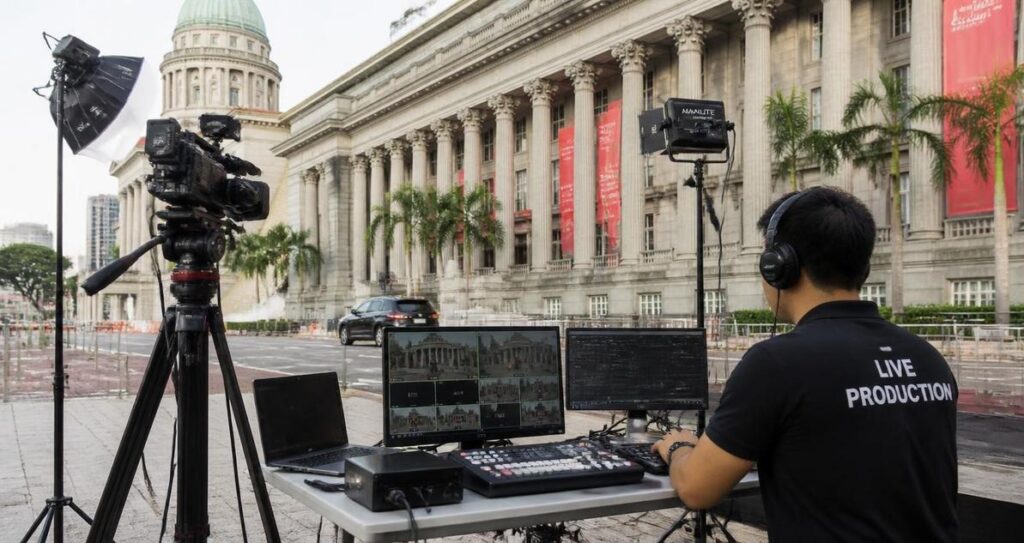
Streaming a live event from a historic Singaporean landmark can create a powerful sense of place. The architecture, heritage setting, and public recognition of the location can add depth to a corporate announcement, cultural programme, panel discussion, or community showcase. At the same time, these venues are not standard studio spaces. They come with heritage protections, public access requirements, load limits, limited cable routes, changing weather conditions, and strict expectations around safety and site preservation. For organisations in Singapore, the main challenge is rarely the camera setup alone. It is the coordination of permissions, technical infrastructure, site management, and audience experience without disturbing the character of the landmark or the people who maintain it.
Singapore’s historic sites, from conserved shophouses and museums to civic buildings, places of worship, and monument areas, are part of a tightly managed urban environment. That means every livestream needs more than a good video switcher and a stable internet line. It needs a detailed production plan that respects building rules, municipal regulations, and the practical realities of working in public-facing heritage spaces. For event teams, this is especially important because a successful stream must look polished on screen while remaining quiet, safe, and minimally intrusive on site. The goal is not only to transmit video. It is to do so in a way that protects the location, supports the programme, and keeps the audience engaged without causing operational problems behind the scenes.
Why historic landmarks require a different streaming approach
Historic landmarks are fundamentally different from hotels, convention centres, or purpose-built studios. Their layouts are often constrained by preservation requirements, narrow corridors, older electrical systems, and floor or wall surfaces that cannot be altered freely. In Singapore, many heritage sites also sit within busy pedestrian zones or areas with sensitive traffic flow, which means equipment loading, crew movement, and crowd control must be planned carefully. A livestream production team cannot simply arrive, set up, and start transmitting. They need to understand the venue’s operational limitations first, then build the broadcast plan around those constraints.
For example, a landmark may have excellent visual character but limited rigging points for lights and microphones. Another may offer a scenic backdrop but no direct line for a fibre connection or too little space for a control table. These are not minor inconveniences. They affect camera placement, audio capture, signal routing, and crew safety. In a live setting, small logistical issues can become visible immediately. A camera may be blocked by visitors, a microphone may pick up traffic noise, or a power circuit may trip if the load is not distributed correctly. Careful planning is what keeps the programme stable and protects the credibility of the brand or institution hosting it.
Heritage sensitivity and site protection
Historic locations are often protected because of their architectural, cultural, or commemorative value. In practice, this means production teams must avoid drilling, heavy adhesives, or equipment placement that risks damage to original surfaces. Even temporary setups need to be approved if they affect walkways, exits, heritage features, or visitor access. In Singapore, this is especially important where the site may fall under conservation controls or be managed as part of a public institution with its own site-specific rules. Teams should treat every contact point, from cable ramps to tripod feet, as something that needs explicit approval and protection.
A good approach is to design for reversibility. Use freestanding structures where possible, weight distribution that does not stress fragile surfaces, and floor protection for heavy equipment. If the venue requires a no-mark policy, confirm that all tapes, mounts, and supports are safe for the material being used. A historic interior with marble, timber, or tiled surfaces demands a different protection strategy from a modern event hall.
Planning permissions, coordination, and compliance in Singapore
One of the most important parts of streaming from a historic landmark is early coordination with the right stakeholders. In Singapore, this may involve the site manager, the venue operator, building security, facilities staff, and, depending on the location, relevant authorities or conservation-related stakeholders. The exact approval path depends on the property and the nature of the production. A heritage venue used for public programmes may allow a different process from a protected site with restricted access. The production team should never assume that standard event procedures apply.
Lead time matters. If a stream depends on external internet provision, access to loading bays, after-hours entry, road-side drop-off, or temporary closure of a public space, those needs should be raised long before production day. This is especially important in Singapore, where public-space usage is closely managed and where multiple events can affect access around the same area. If the venue sits near a transport node or tourist area, there may also be crowd management concerns. Even a modest stream can create extra foot traffic if the location is visually attractive or socially recognizable.
Public access, crowd control, and programme integrity
Historic landmarks are often visited by tourists, residents, and school groups throughout the day. A livestream team has to work around that reality. If the programme requires clean sightlines, reduced noise, and uninterrupted speakers, the production should include barriers, stewards, and clear signage to guide people around the set. In some cases, the best solution is to schedule the stream during a lower-traffic window rather than trying to control a busy public hour.
Audience experience matters on site as well as online. If visitors are being diverted, the route should feel organised and respectful, not improvised. A clear call sheet, a site map, and a named point of contact for venue staff can prevent confusion. For heritage locations that host weddings, ceremonies, or institutional functions, this becomes even more important because the event team may need to coordinate with multiple groups at once.
Permits, insurance, and risk management
Professional livestreams should be backed by appropriate insurance and a documented risk assessment. This is standard event practice, but it becomes more significant at a heritage site where the consequences of an incident can be broader than at a normal venue. Risk planning should cover trip hazards, electrical loads, weather exposure, equipment movement, and the possibility of interruption by the public or by site operations. If the stream includes elevated equipment, exterior cabling, or temporary structures, those elements deserve particular attention.
Because each landmark has its own governance structure, it is important to confirm who approves what. Some venues may require method statements, equipment lists, or floor plans. Others may want proof of liability coverage and a clear schedule for setup and teardown. A disciplined production team will prepare these documents before the site visit, not after. That makes approvals faster and reduces the risk of last-minute changes.
Technical infrastructure: power, connectivity, and signal stability
The technical side of streaming from a heritage location often determines whether the broadcast succeeds or becomes a troubleshooting exercise. Historic buildings may not have the same number of circuits, data ports, or cable-friendly surfaces as newer facilities. As a result, the production team should assess power capacity, internet options, audio environment, and camera positioning during the site survey. The goal is not just to make the stream work. It is to make it reliable under live conditions.
Connectivity deserves special attention in Singapore because audiences expect a smooth stream with minimal buffering. Where a fixed wired connection is available and approved, it is generally more dependable than a mobile-only setup. However, some heritage sites may limit where cables can run or where network equipment can be placed. In such cases, bonded cellular solutions or managed backup links can provide resilience, though they should still be tested in advance. A live stream should not depend on a single point of failure if the venue is difficult or remote from standard technical infrastructure.
Power distribution and load planning
Older buildings can have circuit limitations that modern event crews must respect. That means power distribution should be mapped in advance, with clear knowledge of what each circuit supports. Lights, monitors, encoders, routers, cameras, and audio equipment all draw power, but not equally. The production team should calculate the total load and avoid overloading a single source. If the venue provides power, confirm the exact outlets available, their location, and any restrictions on extension runs.
Good cabling discipline is essential. Cables should be protected from foot traffic and secured in ways that do not damage the floor or create a trip hazard. In compact heritage spaces, cable management is not a cosmetic issue. It is a safety requirement and a production quality issue. A neat technical layout also helps when visitors or staff need to move through shared space.
Audio challenges in heritage interiors
Sound can be more difficult than picture in a historic venue. High ceilings, hard walls, tiled floors, and enclosed corridors can create echo or reverb, which makes speech less clear. If the stream involves panel discussions, speeches, or guided commentary, the team should use microphones that suit the acoustic environment and test them on location. Lavalier microphones, directional microphones, and careful speaker placement often help reduce unwanted room tone. If outdoor sections are involved, wind protection and ambient noise control become important as well.
Audio is often where the audience notices quality first, even if they do not consciously identify the technical reason. A visually beautiful stream with weak sound still feels unprofessional. For that reason, audio planning should be treated as equal to camera planning, not as a secondary task.
Production design that respects the landmark and the audience
A successful stream from a historic landmark should enhance the location rather than overpower it. The production design needs to complement the architecture, not conceal or distract from it. This means selecting equipment and staging that fit the scale of the site. Oversized LED panels, intrusive lighting, or cluttered backstage areas can compromise both aesthetics and accessibility. A more restrained design often works better in heritage settings, particularly when the building itself is the visual feature.
Camera coverage should be planned around movement, sightlines, and storytelling. Wide shots can establish context, while tighter shots capture speakers or details of the venue. If the programme includes audience interaction, the team needs to ensure that camera positions do not block exits or interfere with visitor circulation. In smaller sites, even a single extra tripod can change the flow of the space, so every placement decision matters.
Lighting choices and visual preservation
Lighting should support the programme while protecting the site. Excess heat, overly bright fixtures, or poorly aimed lights can be uncomfortable for people on location and may be inappropriate for delicate interiors. Modern LED lighting is often preferred because it is more efficient and easier to control than older high-heat systems, but it still needs to be positioned with care. If the landmark contains sensitive displays, artworks, or finishes, the venue may impose brightness limits or placement restrictions.
Colour balance also matters. Historic interiors often have warm tones, mixed natural light, or reflective surfaces that can confuse a camera’s white balance if not tested properly. A pre-event camera check should include the lighting conditions at the actual time of day when the stream will go live. Morning, afternoon, and evening light can look very different in Singapore, especially near large windows or open courtyards.
Contingency planning for weather and interruptions
Many historic sites in Singapore are partly or fully outdoors, or they may have outdoor access areas that affect the production. Sudden rain, heat, or humidity can alter the technical plan quickly. Equipment should be protected from moisture, and if the programme includes any exterior shots, the crew should have a weather contingency that allows for a quick move indoors or a shortened segment if conditions change. Even indoor historic venues can be affected by weather if access paths become wet, crowded, or difficult for loading.
Contingency planning should also cover operational interruptions. A public event nearby, a site announcement, or a security requirement may require a brief pause. Live productions should have a clean fallback option, such as a holding slide, standby camera, or pre-recorded asset, so the audience does not experience a dead air gap. Good live production is not only about the main run of show. It is about what happens when the plan changes.
Working with vendors, staff, and on-site teams in Singapore
Because historic landmark productions are coordination-heavy, the quality of the working relationship on site matters almost as much as the technical gear. The event producer, technical director, venue contact, and security or facilities personnel should all understand the sequence of operations. In Singapore, where professional expectations around punctuality and clear communication are high, a concise run sheet and a shared contact tree can prevent avoidable delays. Everyone should know who to call if a cable needs rerouting, a guest arrives early, or a weather issue affects the schedule.
For brands and institutions, this is also an opportunity to demonstrate respect for place and process. A team that arrives prepared, works quietly, and restores the site properly after the stream reflects well on the organiser. Heritage venues notice when a production behaves responsibly. So do audiences, even if they do not see the behind-the-scenes coordination.
Post-event teardown and site restoration
Teardown deserves the same care as setup. The venue should be returned to its original condition, with all protective materials removed, any borrowed furniture accounted for, and all staff areas cleared. A final walkthrough with the site representative is good practice, especially if the production involved multiple rooms or exterior access points. If anything was moved, adjusted, or temporarily covered, it should be restored exactly as agreed.
This stage is not just administrative. It protects the relationship with the venue and makes future access more likely. Historic sites are often selective about repeat bookings, and a production team that leaves the space clean, undamaged, and fully restored is far more likely to be trusted again.
For Singapore organisations, streaming from a historic landmark is best treated as a specialist production, not a standard event add-on. The most effective teams start with the site, not the camera list. They plan for permissions, power, sound, public movement, and site protection before thinking about aesthetics. They also keep a strong focus on communication, because live production in a heritage environment requires every party to work from the same plan. If your event aims to use a landmark as more than a backdrop, the logistics should support that ambition from the first site visit to the final cable lift. A well-run stream can showcase Singapore’s heritage with clarity and respect, while still delivering the reliability that professional audiences expect.
General information notice: This article provides general event production information and is not legal, engineering, or venue-specific advice. For any project involving a protected or publicly managed site, confirm requirements directly with the venue and the relevant authorities before production.

Jeremy Lee is a seasoned digital marketing director and strategist with over two decades of experience in the industry. As the founder of Sotavento Medios, I manage a diverse portfolio of over 50 businesses, helping brands grow through advanced search strategies and digital innovation. My work focuses on bridging the gap between traditional search engine optimisation and the evolving world of AI-driven answer engines.
get in touch