
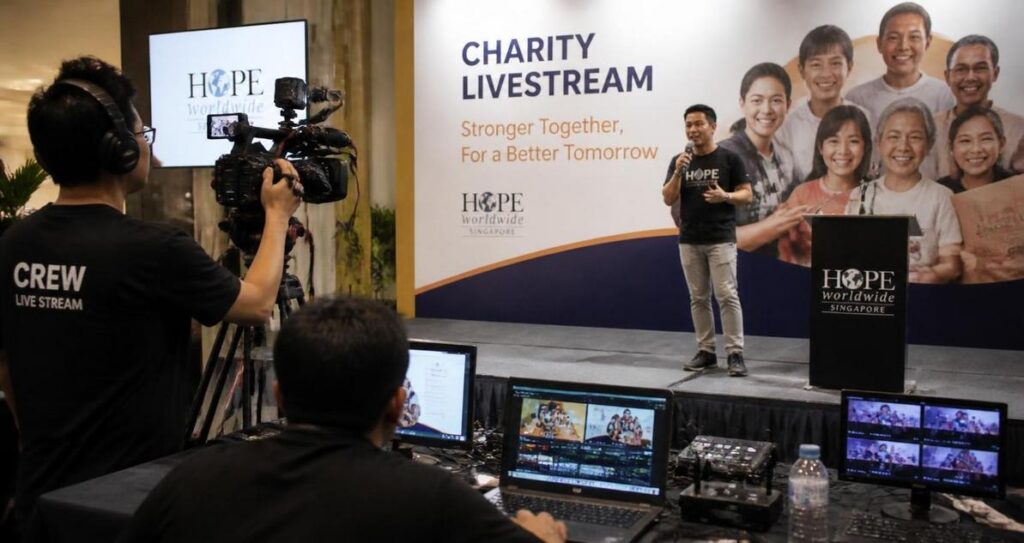
For charities in Singapore, donor engagement is no longer limited to annual dinners, direct mailers, or one-time fundraising drives. Many supporters now expect to see where their contributions go, hear directly from beneficiaries or programme leads, and understand how a charity works in real time. Live video meets that expectation well because it creates immediacy, transparency, and a sense of connection that pre-recorded content often cannot match. When used thoughtfully, it can help a charity communicate its mission clearly, strengthen trust with donors, and build sustained support across different age groups, from younger digital-first audiences to older supporters who prefer a more personal and informative approach.
In Singapore, where trust, accountability, and efficient communication matter greatly, live video can be especially effective if it is planned with care. The goal is not to stage a flashy broadcast. The goal is to communicate responsibly, present authentic stories, and give donors a meaningful reason to remain engaged with the charity’s work. Whether the format is a Facebook Live session, a webinar, a streamed volunteer briefing, or a hybrid donor appreciation event, the strategy should balance storytelling, clarity, and technical reliability. That combination helps charities create a professional experience that respects both their audience and the people they serve.
Why live video works well for donor engagement
Live video offers a direct line of communication. Unlike static posts, it allows charities to respond in the moment, answer questions, and show the human side of their work. This matters because donor engagement is not only about asking for donations. It also involves building understanding, reinforcing credibility, and creating repeated points of contact that keep a charity top of mind. A live format can support all of these goals when it is designed with a clear purpose.
Singapore audiences are highly accustomed to digital communication, but they are also sensitive to signals of professionalism and authenticity. A well-run livestream can reassure donors that the charity is organised, transparent, and attentive to detail. It can also help simplify complex programmes that may be difficult to explain in a short social media post. For example, a charity supporting elderly beneficiaries can use live video to show how casework, outreach, or community partnerships operate in practice, while a social service organisation can explain how funds are allocated across different programmes without relying on vague statements.
Real-time interaction builds trust
Trust grows when supporters can ask questions and receive answers directly. A live Q and A session lets charities address common concerns, such as how donations are used, how beneficiaries are identified, or what safeguards exist around privacy and data handling. This is especially important in Singapore, where many donors expect strong governance and responsible stewardship of funds.
Live interaction also gives charities a chance to acknowledge uncertainty honestly. If a team cannot answer a question immediately, it can commit to following up after the session. That approach often strengthens trust more than overconfident messaging. It shows that the organisation values accuracy over performance.
Authentic storytelling supports emotional connection
Donor engagement improves when supporters can connect with real people and real outcomes. Live video can humanise the charity’s work by featuring programme staff, volunteers, and, where appropriate and ethically approved, beneficiaries who are comfortable sharing their experience. The emphasis should always remain on dignity and consent, not emotional pressure.
In practice, this might mean showing a behind-the-scenes look at food distribution, rehabilitation support, youth mentoring, or community health education. A live format makes these experiences feel immediate, while still allowing charities to control the messaging carefully. The strongest stories are specific, respectful, and grounded in facts.
Planning a live video strategy that fits Singapore charities
A successful live video programme starts with clear objectives. Charities should decide whether the session is meant to educate donors, attract new supporters, launch a campaign, report programme impact, or thank existing donors. Each objective calls for a different structure, tone, and call to action. Without a clear purpose, a livestream can feel unfocused and fail to move viewers toward meaningful engagement.
Singapore charities often work with limited resources, so planning should be practical. A small team can still create a polished livestream if roles are clear, the message is concise, and the technical setup is tested in advance. Strong planning also reduces the risk of awkward pauses, audio problems, or confusion during the broadcast.
Set a specific objective for each broadcast
Every livestream should answer one main question. For example, “How does this programme help?” or “Why should donors continue supporting this cause?” When the objective is clear, the content becomes easier to organise and the call to action becomes more effective. Charities can then decide whether the session should end with a donation prompt, a volunteer sign-up link, a registration page for the next event, or a downloadable impact report.
Specific objectives also help with measurement. Instead of only tracking view counts, charities can assess whether viewers asked questions, stayed until the end, clicked through to a website, or completed a follow-up action.
Choose the right format for the audience
Different audiences respond to different formats. A younger donor group may prefer a short, dynamic livestream on social platforms, while corporate partners or major donors may prefer a more structured webinar or hybrid briefing. Older supporters may value a slower pace, clearer audio, and an opportunity to hear from a familiar spokesperson or programme lead.
In Singapore, where multigenerational audiences are common, it may be useful to plan multiple versions of the same core message. A live event can be repurposed into shorter clips, subtitles can be added for accessibility, and key takeaways can be summarised in a follow-up email. This extends the value of one broadcast across several channels.
Prepare speakers and scripts carefully
Live video feels spontaneous, but the best sessions are well prepared. Speakers should know the key points they need to cover, the terms they must define, and the boundaries of what they should not discuss. This is particularly important when discussing sensitive topics such as health, poverty, disability, or child welfare. Accuracy and dignity must come before emotion.
A simple run sheet can help. It should include the opening message, speaker order, transitions, audience questions, technical cues, and the closing call to action. Rehearsal matters because it gives speakers confidence and helps them sound natural rather than scripted.
Using live video to improve transparency and donor confidence
Transparency is one of the strongest reasons to use live video. Donors often want more than broad statements about “impact.” They want to understand what is happening on the ground, how decisions are made, and what the organisation needs most. Live video can support that need by showing operations in a direct and accessible way.
For Singapore charities, this can be especially useful when explaining programme costs, service delivery models, and partnerships with community organisations or institutions. It also provides an opportunity to explain how fundraising goals relate to real-world needs. When done well, transparency does not weaken the charity’s message. It strengthens it by showing professionalism and accountability.
Show process, not just outcomes
Many donors hear about end results, such as meals distributed, sessions delivered, or people reached. Those figures matter, but they do not explain how the work happens. Live video can walk viewers through the process. For instance, a charity can show how volunteers are trained, how cases are reviewed, or how a service journey is coordinated with partner agencies.
This process-based storytelling helps donors appreciate the complexity of social impact work. It also reduces the risk of oversimplifying beneficiary needs, which can sometimes happen in short-form fundraising campaigns.
Address common donor questions directly
A livestream is a useful place to answer practical questions. Donors may want to know whether their contributions are tax-deductible, how data is protected, or what portion of funds supports direct programmes versus operations. Charities should answer these questions clearly and consistently, using language that is easy to understand without sacrificing accuracy.
Where relevant, charities should also remind supporters to check official channels for donation instructions and policy details. In Singapore, this is especially important because good governance and proper registration matter to donors who want assurance that their support goes to a legitimate organisation.
Be careful with personal data and consent
Live video must be handled with care when people appear on screen. Consent is essential, especially if beneficiaries, volunteers, or staff members are identifiable. Personal data should not be exposed unnecessarily. This reflects both ethical practice and the expectations of Singapore’s data protection environment.
When discussing individual cases, charities should avoid sharing details that could compromise privacy. If a beneficiary story is featured, it should be reviewed in advance and presented in a way that protects dignity and confidentiality. In many situations, it is safer to focus on programme-level impact rather than highly personal disclosures.
Making live video accessible and effective across Singapore audiences
Accessibility is not an optional extra. It is central to donor engagement because it determines whether supporters can actually understand and act on what they see. A live stream that is hard to hear, difficult to follow, or too fast-paced will lose part of the audience. Charities should design for clarity from the start.
This matters in Singapore, where audiences may include different language preferences, varying levels of digital familiarity, and mixed viewing environments. Some viewers may watch on mobile devices during a commute, while others may join from home on a laptop. The broadcast should be understandable in both settings.
Use clear audio, captions, and simple visual design
Audio quality is often more important than video quality in live events. Viewers will tolerate modest visuals more easily than poor sound. Microphones should be tested carefully, and speakers should be briefed to talk clearly and avoid overlapping each other. If possible, captions should be used to support accessibility and improve comprehension in noisy environments.
Slides and on-screen graphics should be simple. Too much text can distract from the message, while too little context can confuse viewers. A clean visual style helps the audience focus on the speaker and the content.
Keep the message relevant to local realities
Singapore donors are more engaged when the message connects to the realities they know. That could include the cost of living, ageing, family caregiving, mental well-being, volunteerism, or social cohesion. A charity does not need to force local references into every sentence, but the content should feel grounded in the Singapore context rather than copied from a generic campaign template.
Local relevance also means understanding how people consume content. Some audiences prefer concise, informative updates that respect their time. Others respond well to longer discussions if the topic is meaningful and the delivery is organised. Planning should reflect these preferences.
Repurpose the live session for wider reach
A single livestream can produce several pieces of content. Key segments can be clipped for social media, a recording can be embedded on the charity website, and quotes can be reused in newsletters or donor follow-ups. This is especially helpful for smaller organisations that need to maximise the value of each production.
Repurposing content also supports continuity. Donors who miss the live event can still catch up later, which helps maintain engagement across different schedules and time zones. That is useful for Singapore-based charities with corporate donors, volunteers, and supporters who may not all be available at the same time.
Measuring whether live video is helping donor engagement
Charities should not judge live video only by the number of viewers. A large audience is helpful, but donor engagement is better measured by signs of attention, trust, and follow-through. Those include comments, questions, shares, registrations, donations, repeat attendance, and post-event inquiries. The key is to connect the broadcast to broader relationship-building, not treat it as a one-off performance.
Evaluation should also consider qualitative feedback. Did donors say they better understood the charity’s work? Did they ask more informed questions afterwards? Did the session improve confidence in the organisation’s leadership and operations? These outcomes matter because engagement is ultimately about sustained support, not just visibility.
Track meaningful engagement indicators
Useful indicators include average watch time, attendance at specific segments, live comments, click-throughs to donation pages, and follow-up actions after the event. For a charity, a smaller but more engaged audience may be more valuable than a large passive one. The aim is to create a relationship that continues after the broadcast ends.
It also helps to compare formats over time. A briefing for major donors may generate fewer viewers but stronger conversion, while a public-facing livestream may broaden awareness. Both can be useful if they serve different goals.
Use feedback to improve future sessions
After each event, the team should review what worked and what did not. Were the speakers clear? Was the call to action easy to follow? Did the audience ask questions that reveal confusion about the charity’s work? Honest review helps the next broadcast become stronger and more efficient.
Small improvements can make a major difference. Better lighting, clearer opening remarks, a shorter Q and A, or a more focused topic can significantly improve the viewer experience. Over time, these refinements build a more credible and engaging digital presence.
Live video can be a powerful tool for charities in Singapore when it is approached with discipline, empathy, and respect for the audience. It works best when it supports a clear purpose, presents accurate information, and gives donors a genuine way to connect with the mission. That means thoughtful preparation, careful handling of privacy and consent, and a delivery style that feels human without becoming informal or careless. For charities that want to build stronger donor relationships, live video is not just a communication trend. It is a practical way to show accountability, explain impact, and invite ongoing participation in a way that feels immediate and trustworthy.
For organisations planning their next donor outreach, the strongest next step is usually simple. Define the message, identify the audience, prepare the speakers, test the technical setup, and decide how the session will lead to a meaningful follow-up. When those pieces are in place, live video can become one of the most effective ways to deepen donor engagement while staying true to the values that matter most in Singapore, clarity, responsibility, and trust.

Jeremy Lee is a seasoned digital marketing director and strategist with over two decades of experience in the industry. As the founder of Sotavento Medios, I manage a diverse portfolio of over 50 businesses, helping brands grow through advanced search strategies and digital innovation. My work focuses on bridging the gap between traditional search engine optimisation and the evolving world of AI-driven answer engines.
get in touch