
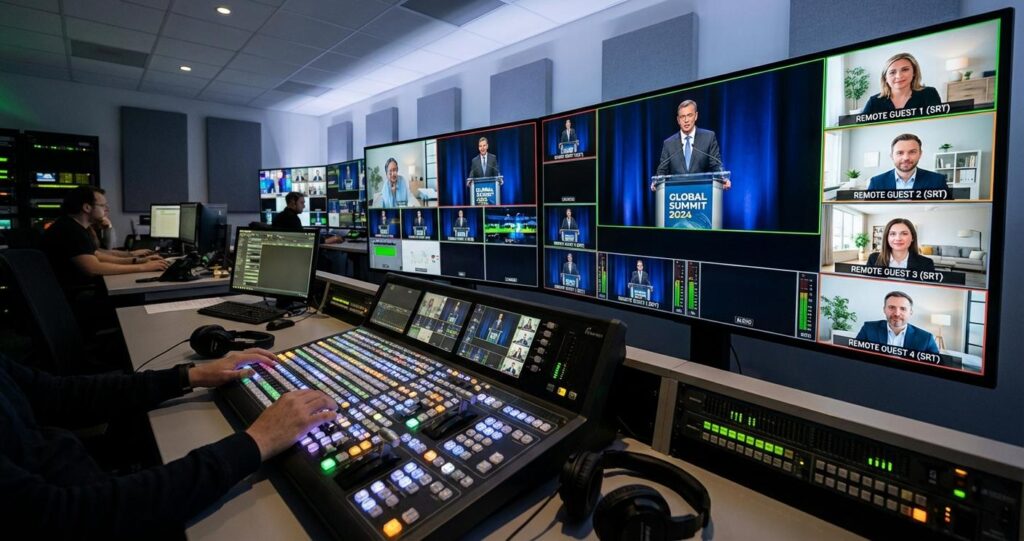
The contemporary global summit has fundamentally evolved. No longer confined to the physical constraints of a single venue, today’s high-stakes B2B events are sophisticated hybrid ecosystems, connecting keynote speakers, panelists, and audiences from every corner of the globe. This paradigm shift presents a significant logistical and technical hurdle: integrating remote speakers into a live production with the same quality, reliability, and seamlessness as their on-stage counterparts. Achieving broadcast-grade remote integration is not a matter of simply launching a video call; it demands a deep understanding of network protocols, signal flow architecture, and production redundancy. This article provides a comprehensive technical breakdown of the infrastructure, workflows, and protocols required to execute flawless remote speaker integration for enterprise-level global summits, ensuring a consistent and professional experience for all participants.
Architecting the Signal Path: From Remote Location to Master Control
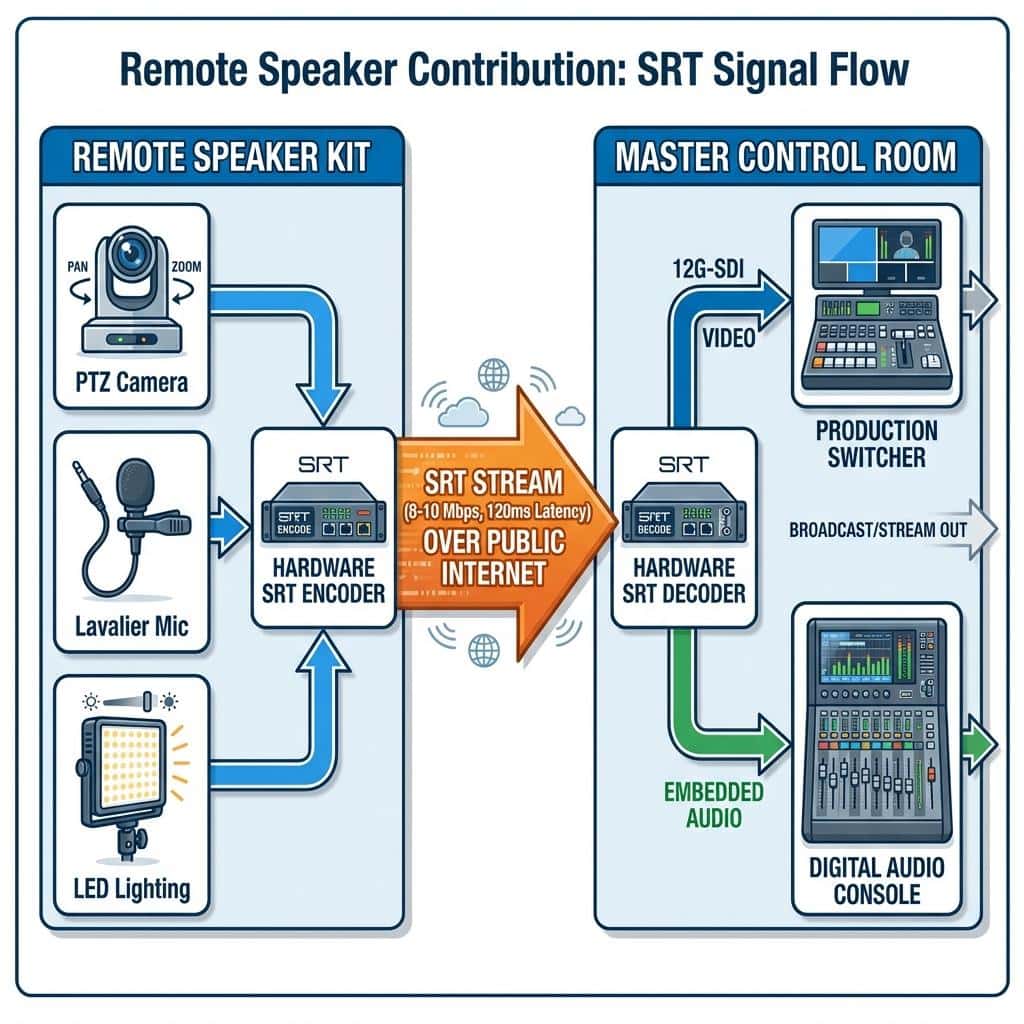
The foundation of successful remote speaker integration is a robust and meticulously planned signal path. This path begins with standardizing the acquisition hardware at the speaker’s location and choosing the correct transport protocol to move the signal across the public internet to the master control room. Each step must be engineered for quality and resilience.
Contribution Protocols: Choosing the Right Transport Stream
The choice of protocol for contributing the audio and video feed from the remote location is critical. While protocols like RTMP (Real-Time Messaging Protocol) are common for final distribution to platforms, they lack the error correction needed for contribution over unpredictable networks. The industry standard for this application is SRT (Secure Reliable Transport). SRT provides low-latency video transport with sophisticated packet loss recovery mechanisms, making it ideal for moving high-quality feeds over the public internet. It utilizes ARQ (Automatic Repeat Request) to retransmit lost packets, ensuring a clean signal arrives at the production hub. For a typical 1080p60 feed, an SRT stream might be configured for 8-10 Mbps with a latency buffer of 120-250ms, providing a strong balance of quality and responsiveness. In contrast, NDI (Network Device Interface) is a powerful protocol for high-quality, low-latency video over local area networks (LANs), but it is not inherently designed for transport over the wide-area network (WAN) without tools like NDI Bridge, which encapsulates the NDI signal within a more WAN-friendly protocol like SRT.
The Remote Speaker Kit: Standardizing the Source
Consistency in source quality is non-negotiable. To avoid the unpredictable results of consumer-grade webcams and microphones, a standardized remote speaker kit should be deployed to every participant. This kit forms the first link in the professional production chain. A typical enterprise-grade kit includes: a professional mirrorless or PTZ camera capable of outputting a clean 1080p or 4K/UHD signal via HDMI or SDI; a professional lavalier or shotgun microphone connected to an audio interface for clean, isolated audio; a three-point lighting setup (key, fill, and back light) to ensure a well-lit, professional appearance; and a dedicated hardware encoder. This encoder, such as a Haivision Makito X4 or an AJA HELO Plus, is responsible for taking the camera and microphone signals and encoding them into a stable SRT stream. Relying on a dedicated hardware appliance rather than software on a laptop minimizes CPU load and provides a much more stable and reliable transport stream.
Network Hardening at the Edge
The speaker’s local network is the most common point of failure. A hardwired ethernet connection is mandatory; Wi-Fi is unacceptable for professional contribution due to its susceptibility to interference and packet loss. The speaker’s internet connection should be qualified, ideally providing a minimum of 20 Mbps of sustained upload bandwidth, well above the 8-10 Mbps needed for the SRT stream to account for network overhead and fluctuations. Where possible, configuring Quality of Service (QoS) on the speaker’s router to prioritize traffic from the hardware encoder’s IP address can further stabilize the connection. For mission-critical keynotes, providing a bonded cellular solution (e.g., a Pepwave device) that combines the primary hardwired connection with one or two 5G cellular modems offers a powerful layer of network redundancy.
Centralized Ingest and Processing in the Virtual Green Room
Once the SRT streams leave the remote speakers, they must be ingested, decoded, and processed at a central production facility. This facility, whether a physical master control room or a cloud-based equivalent, serves as the hub where all remote and in-person sources are synchronized, color-matched, and prepared for the live program mix. This is the domain of the Virtual Green Room (VGR).
The Ingest Point: On-Premise vs. Cloud-Based Gateway
There are two primary architectures for ingesting SRT feeds. The on-premise model involves a physical master control room equipped with hardware SRT decoders, such as the Haivision Makito X4 Decoder or a Blackmagic Teranex AV. These devices receive the incoming SRT streams and convert them back to baseband video signals, typically SDI (Serial Digital Interface). These SDI signals can then be routed into a traditional production switcher (e.g., Ross Carbonite, Grass Valley Kula). This approach offers maximum control and minimal latency. Alternatively, a cloud-based architecture uses a cloud production platform like vMix on an AWS EC2 instance or Grass Valley AMPP. In this model, the SRT streams are sent directly to a cloud server, where all switching, graphics, and processing occur. The final program output is then streamed from the cloud. This offers immense scalability but requires careful network management to control latency between the cloud instance, the director’s interface, and the final distribution CDNs.
Signal Synchronization and Processing
Remote feeds will inevitably arrive with slightly different latencies. Before they can be integrated, they must be synchronized. Hardware frame synchronizers in an on-premise workflow or internal buffers in a cloud workflow ensure all video sources are aligned to the same master clock. Once synchronized, each remote feed must be processed to match the in-room cameras. This involves professional color correction using a vectorscope and waveform monitor to match exposure and color temperature. Audio processing is equally important. Each remote speaker’s audio feed must be run through an audio console or digital signal processor (DSP) to apply equalization (EQ), compression, and noise gating, ensuring their audio sounds as clean and present as the microphones used on the physical stage.
The Virtual Green Room Workflow
The Virtual Green Room is the technical and communication hub for all remote participants before they go live. In the VGR, each speaker is provided with a custom multiview feed. This allows them to see the main program output, a preview of the next shot, their own camera feed, and a timer.
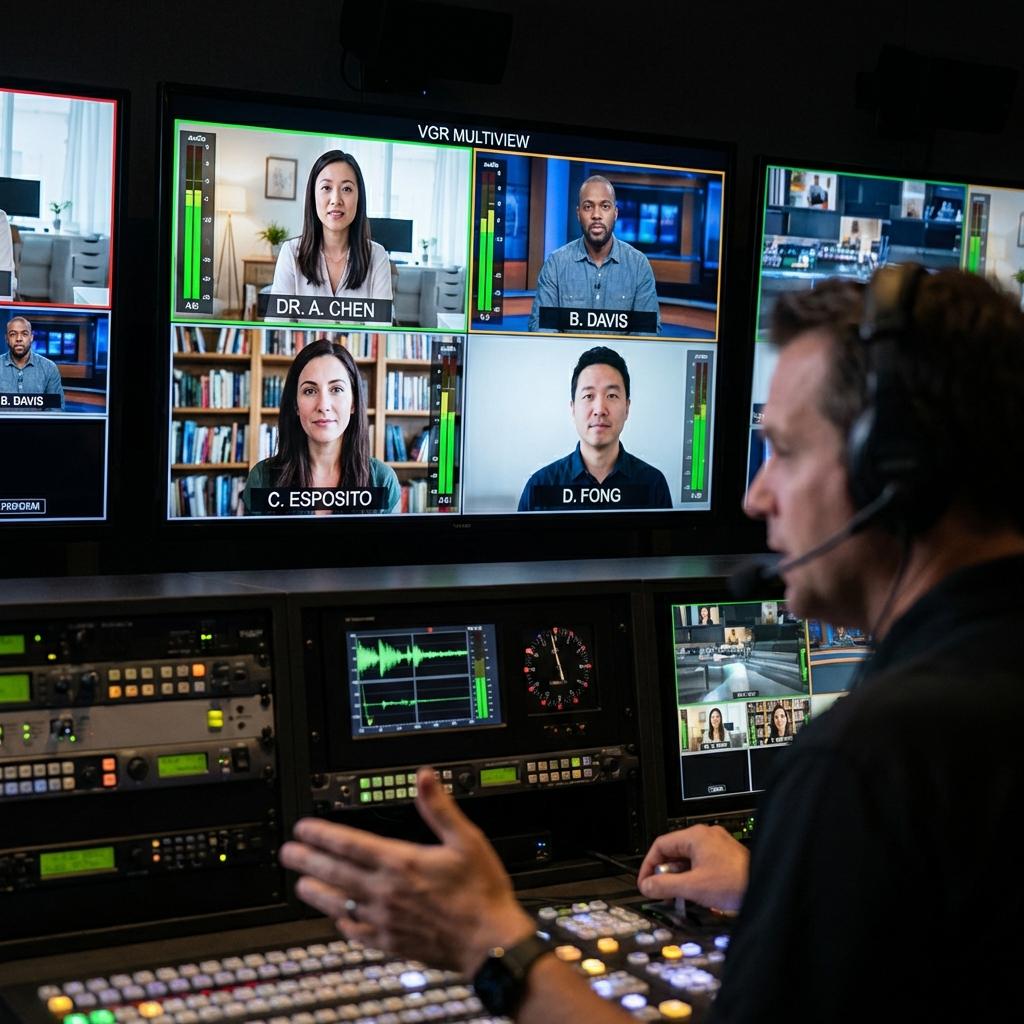
This comprehensive monitoring builds confidence and allows them to interact naturally with the live program. The VGR is also where a technical director confirms the quality of their audio and video, makes final adjustments to camera framing and lighting, and briefs them on show cues. It is a critical pre-show checkpoint that eliminates surprises and ensures every remote contributor is fully prepared for their segment.
Communication and Return Feeds: The Director’s Lifeline
Effective, real-time communication is the glue that holds a hybrid production together. The ability for the show director to speak to remote presenters without that communication going to air, and for presenters to hear and see the program, is essential for a tightly choreographed broadcast.
Implementing Mix-Minus for Clean Audio
A mix-minus is a specific audio feed sent to a contributor that contains the full program mix MINUS their own microphone audio. This is fundamental to preventing the remote speaker from hearing their own voice returned to them on a delay, which would otherwise create a disorienting echo and make it impossible to speak fluently. On a professional digital audio console, a mix-minus is created by sending the main program mix to an auxiliary (AUX) send, and then removing that specific speaker’s channel from that AUX send. Each remote participant requires their own unique mix-minus feed.
Low-Latency Talkback and IFB Systems
While the mix-minus provides program audio, the director and producers need a separate, private communication channel known as talkback or IFB (Interruptible Foldback). This allows the director to give private cues and instructions to the speaker (“You have 30 seconds left,” “Look to camera two”). Professional hardware intercom systems like Clear-Com or RTS can be extended over IP to remote locations. Alternatively, software-based solutions like Unity Intercom or Dante can run on a smartphone or computer, providing a very low-latency audio channel completely separate from the main program feed. This ensures communication is instantaneous and does not interfere with the broadcast audio.
Architecting the Program Return Feed
In addition to hearing the program via their mix-minus feed, speakers need to see the program. The video return feed sent to the speaker’s confidence monitor should be a low-latency output of the main program switcher. This allows them to see when their graphics are on screen, watch video roll-ins, and see the other panelists they are in discussion with. This program return video can be sent via the same SRT transport stream as the talkback audio, often on a secondary channel. Seeing the live program provides critical context, helping the remote speaker feel connected to the event and deliver a more dynamic and engaged presentation.
Redundancy and Failover Strategies for Enterprise-Grade Reliability
For any high-stakes corporate event, failure is not an option. A multi-layered redundancy plan is the final piece of the logistical puzzle, providing protection against network instability, hardware failure, and human error.
Protocol and Network Path Redundancy
SRT includes native support for stream bonding and seamless failover. A common strategy is to configure the remote encoder to send two identical SRT streams to the ingest point over two different network paths. Path one might be the primary fiber internet connection, while path two could be a bonded 5G cellular connection. The SRT decoder at the master control is configured to automatically and instantly switch to the secondary stream if it detects packet loss or a failure on the primary path, with no disruption to the video feed. This A/B stream approach provides robust protection against last-mile network issues.
Backup Source Integration
Beyond network redundancy, a full backup source should be prepared for every remote speaker. A common method is to have the speaker simultaneously connected to the event via a secondary platform, such as a dedicated Zoom or Microsoft Teams meeting. This feed can be brought into the production switcher as a lower-quality but immediately available backup. If the primary SRT feed fails completely, the director can instantly cut to the backup Zoom feed, preventing dead air. The technical director in the Virtual Green Room would have this backup source routed and ready on a switcher input at all times.
ISO Recording: The Ultimate Safety Net
ISO recording refers to the practice of recording an isolated, clean feed of every single video source, including each remote speaker, before it even enters the main production switcher. These ISO recordings, typically captured in a high-quality codec like Apple ProRes or Avid DNxHD, serve two purposes. First, they provide a pristine archive of each speaker’s contribution for post-production editing or on-demand content creation. Second, in a catastrophic live failure, the ISO recording can be played back, or the entire event can be re-assembled in post-production, ensuring the content is never lost. It is the ultimate safety net for protecting the valuable content generated during the summit.
In conclusion, the logistics of integrating remote speakers into a global summit are complex but entirely manageable with a rigorous engineering-led approach. By focusing on the key pillars of a standardized source kit, a resilient transport protocol like SRT, a centralized processing workflow within a Virtual Green Room, clear communication architecture, and multi-layered redundancy, production teams can elevate remote contributions to a broadcast-quality standard. This meticulous technical planning transforms remote speakers from a potential liability into a seamless and integral part of any world-class hybrid event.
Jeremy Lee is a seasoned digital marketing director and strategist with over two decades of experience in the industry. As the founder of Sotavento Medios, I manage a diverse portfolio of over 50 businesses, helping brands grow through advanced search strategies and digital innovation. My work focuses on bridging the gap between traditional search engine optimisation and the evolving world of AI-driven answer engines.
get in touch