
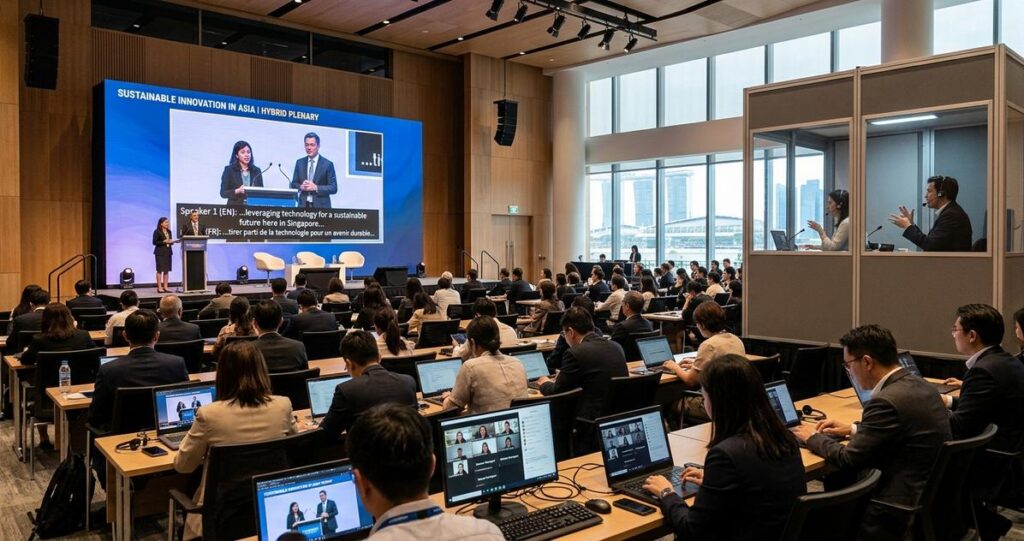
When a hybrid event brings together attendees in Singapore, Kuala Lumpur, Jakarta, Tokyo, London, and beyond, language translation is no longer a simple add-on. It becomes part of the core operating system of the event. For Singapore audiences in particular, this matters because the country is both multilingual and globally connected. A board meeting, town hall, medical symposium, product launch, or government briefing may need to serve people who prefer English, Mandarin, Malay, Tamil, or another language, while also accommodating remote participants joining from different time zones and cultural backgrounds. The challenge is not only about converting words from one language to another. It is about preserving meaning, timing, confidentiality, speaker intent, technical accuracy, and audience experience across both physical and digital environments.
In Singapore, where business meetings often involve regional stakeholders and where hybrid formats remain common for cross-border collaboration, translation logistics can determine whether a message lands clearly or gets lost. Poorly planned language support can cause delays, confusion, and lower engagement. Well-planned support, on the other hand, can make an event feel seamless, inclusive, and professionally managed. The practical question is not whether translation is needed, but how to design a workflow that supports accuracy, accessibility, and reliability from the first speaker brief to the final post-event recording.
Why translation logistics matter in hybrid events
Hybrid audiences create a different translation problem from fully in-person or fully virtual events. In an on-site event, interpreters can usually rely on controlled acoustics, direct line of sight to speakers, and a single venue workflow. In a fully virtual event, the language team can work within one digital platform, with fewer physical variables. In a hybrid event, both worlds exist at once. Interpreters may be serving people in the room and people online at the same time, often through separate audio pathways and different levels of delay.
That split environment increases the number of variables that must be managed. Audio quality, speaker pacing, microphone discipline, slide readability, platform configuration, and backup communication channels all affect translation quality. A translator or interpreter can only be as effective as the source material and the technical setup allow. This is especially relevant in Singapore, where events frequently involve regional business leaders, multinational teams, healthcare professionals, and public-sector stakeholders who expect precise communication.
Language support also has direct implications for inclusion. A participant who understands the content only through translation should have access to the same substance, not a simplified version that omits key points. That is why the logistics of translation should be planned at the same stage as stage design, livestream production, registration, and audience engagement. Treating language access as an afterthought often leads to rushed interpretation, inconsistent terminology, and frustration for speakers and attendees alike.
Choosing the right translation model for your audience
The first decision is not which interpreter to hire, but which mode of language support fits the event. Different hybrid settings call for different approaches, and the wrong choice can make the experience harder instead of easier.
Simultaneous interpretation
Simultaneous interpretation means the interpreter listens and speaks almost at the same time, with only a short delay. This is common for conferences, panel discussions, and multi-speaker events where time is tightly managed. It works well when the audience needs to follow the live flow of discussion without long pauses. In a hybrid setting, simultaneous interpretation is usually delivered through interpretation channels in the event platform, venue receivers, or mobile audio systems.
This model requires strong technical coordination. The sound feed must be clean, latency must be managed, and interpreters need enough context, such as speaker names, slides, and agenda notes. If the event uses technical terms, industry acronyms, or legal language, the interpreter team should receive a glossary in advance. For Singapore-based events involving finance, healthcare, technology, or government, this preparation is not optional.
Consecutive interpretation
Consecutive interpretation involves the speaker pausing after a segment, allowing the interpreter to render the message in the target language. This format is often used for interviews, small meetings, press briefings, or intimate executive sessions where precision and nuance matter more than speed. It is slower than simultaneous interpretation, but it can be very effective when the event includes complex information that benefits from careful delivery.
For hybrid meetings, consecutive interpretation can be easier to implement because it places fewer demands on real-time audio routing. However, it does require strong moderation and disciplined turn-taking. If several speakers interrupt each other, the process becomes difficult to manage. This is why the format should be selected based on event style, not just preference.
Live captioning and translated subtitles
For many hybrid events, especially corporate town halls, webinars, training sessions, and public education programmes, live captioning or translated subtitles may complement or partially replace interpreter-led services. Captions display the spoken words in text form, while translated subtitles provide text in another language. These tools can support accessibility and help attendees who prefer reading over listening.
However, captions are not the same as professional interpretation. Automatic speech recognition can make mistakes with accents, technical vocabulary, proper names, and overlapping speech. For that reason, live captioning should be treated as a separate service with clear quality expectations, and where possible, reviewed or supported by a human captioner or language specialist. In Singapore, where English may be spoken with different accents and where regional names and terms are common, this distinction matters.
The operational workflow behind accurate translation
Translation success depends on more than language skill. It depends on workflow. A hybrid event team must manage content intake, terminology preparation, speaker coordination, technical routing, quality assurance, and contingency planning in sequence. Each stage reduces the risk of miscommunication later.
Pre-event briefing and content collection
The translation team should receive event materials early. This includes agendas, slide decks, speaker bios, scripts, panel questions, product names, and any regulatory or medical terminology that may appear. Even short events can become difficult to interpret if the speaker uses unexplained abbreviations or local references. In Singapore, where events may involve regional market comparisons, cross-border compliance topics, or sector-specific jargon, context is essential.
A structured briefing helps the language team understand the audience profile. Are the attendees mostly English-speaking with selected language support, or do they require full multilingual access? Are there executives, regulators, clinicians, or consumers in the room? Is the event public-facing or internal? The answers affect terminology choices, tone, and whether formal or conversational language is more appropriate.
Terminology management and glossary control
One of the biggest risks in translation is inconsistent terminology. A company may use one English term internally, another in marketing materials, and a third in translated content. That inconsistency can confuse audiences and weaken trust. The practical solution is glossary management. A glossary is a shared reference list of approved terms, names, product titles, and preferred translations.
Glossary control matters particularly for events that use specialised vocabulary. For example, in healthcare settings, a term may have a precise clinical meaning and cannot be loosely paraphrased. In legal or financial settings, the wrong translation can alter interpretation of risk, responsibility, or compliance. In Singapore, where regional events often include ASEAN stakeholders and diverse professional groups, a shared glossary helps align both the live event and post-event materials.
Speaker pacing and stage discipline
Even the best interpreter cannot recover from chaotic delivery. Speakers should be briefed to speak at a reasonable pace, avoid overlapping with others, and pause for interpretation when required. They should also read from slides carefully, because fast slide changes and dense text can disrupt both the audience and the language team. In hybrid events, this is even more important because remote viewers may already be dealing with platform lag or audio delay.
From a production perspective, the stage manager, moderator, and interpretation team should operate as one unit. The moderator can help enforce turn-taking, remind speakers to pause, and keep the session on schedule. This coordination is especially useful for town halls in Singapore, where senior leadership may want a natural conversational style but still need structured language support for multilingual audiences.
Technical setup that supports reliable interpretation
Language translation quality can fail if the technical chain breaks. Hybrid events need an audio and platform setup that gives interpreters a stable source feed and gives attendees a clear listening pathway. This includes microphones, mix-minus audio, interpretation consoles or software, platform integrations, and backup channels.
Audio quality and microphone discipline
Interpreters need clear audio more than almost anything else. Background noise, echo, low volume, clipping, and speaker movement can all reduce accuracy. Headset microphones or properly managed lapel microphones are often preferred because they produce more consistent sound than handheld mics used casually. If the venue is large or acoustically challenging, the production team should test the room in advance and not assume that the speaker volume alone will solve the issue.
In hybrid environments, the sound heard by the in-room audience and the sound sent to remote attendees may not be identical. The language team should receive a dedicated audio feed with minimal noise and no unnecessary ambient mix. This is part of standard professional production practice, not an optional enhancement.
Platform integration and user experience
The event platform should support how participants will actually use translation. If the audience is on a webinar platform, the interpretation channels or caption settings must be easy to find. If attendees are joining from mobile devices, the interface should remain usable on smaller screens. If people are physically present, they may need receivers, headsets, or QR-code access to language tracks. Poor interface design creates avoidable friction and can make a well-translated event feel disorganised.
Accessibility also matters. Some attendees may prefer to read captions instead of listening to audio translation, while others may use a combination of both. A strong setup allows flexible access without forcing participants into one mode. For Singapore audiences, where device usage is high and attendees may move between office, home, and venue environments, convenience and clarity are important parts of event design.
Latency, synchronisation, and fallback planning
Hybrid translation must manage timing carefully. If the audio delay online does not align with the interpreter feed, remote participants may hear translation too late or too early. That mismatch creates confusion, especially during Q&A sessions or live demonstrations. The technical team should test the full route, from speaker microphone to interpretation feed to audience device, before the event begins.
Backup planning is equally important. If the primary platform fails, the team should know how to switch to a secondary channel, how to communicate with interpreters, and how to inform participants without disrupting the event more than necessary. This kind of planning is standard in professional event production because multilingual events have less tolerance for technical failure.
Managing cultural nuance and sensitive content
Translation is not only about language equivalence. It also involves cultural interpretation, tone, and context. A phrase that sounds natural in one language may seem too direct, too vague, or too formal in another. In corporate and institutional settings, this affects credibility. In public-facing events, it can affect comprehension and trust.
This is particularly relevant in Singapore, where speakers and audiences may come from very different linguistic and cultural backgrounds. A multilingual event might include local Singaporean expressions, regional business references, and international idioms in the same session. Skilled interpreters preserve meaning while adapting tone appropriately for the audience. They do not simply replace one word with another. They interpret intent, register, and context.
For sensitive topics, additional care is needed. Medical information, legal updates, regulatory announcements, and crisis communications should be handled with terminology that is clear, exact, and vetted in advance. If the content may affect health decisions or business compliance, event organisers should avoid informal improvisation. The language team should have approved source material and a clear escalation path for ambiguous terms.
General health information shared during events should be presented as informational content, not as a substitute for personal medical advice. When a speaker discusses a condition, treatment option, or symptom, the translation should remain faithful to the original meaning, while the event host can remind participants to consult appropriate professionals for individual concerns.
Practical planning checklist for Singapore-based organisers
For organisers managing hybrid events in Singapore, the most effective translation workflow is built early and tested thoroughly. A useful starting point is to think through the event from the audience’s point of view. What language do they hear first? How do they switch languages? What happens if the speaker changes pace or the connection drops? Answering these questions before the event helps avoid surprises on the day.
- Define audience language needs early. Identify which languages are required for the room and for remote attendees.
- Choose the right service model. Match simultaneous interpretation, consecutive interpretation, captions, or subtitles to the event format.
- Prepare a terminology pack. Include speaker names, brand terms, technical vocabulary, and approved translations.
- Brief speakers and moderators. Ask them to pause appropriately, avoid overlapping dialogue, and use microphones correctly.
- Test the full audio chain. Check venue sound, streaming audio, interpreter feed, and participant access channels before going live.
- Plan for backup. Have a contingency route for platform issues, audio failure, or interpreter replacement.
- Review recordings after the event. Post-event review can improve future translation quality and reveal recurring terminology issues.
These steps are not only useful for large conferences. They also apply to leadership briefings, internal training, medical education events, and investor communications. The scale may differ, but the principles remain the same.
For Singapore organisations working across Southeast Asia, language logistics are part of reputation management. When translation is accurate, timely, and technically stable, audiences can focus on the message instead of the mechanics. That creates better engagement, stronger understanding, and a more professional event experience. The best hybrid events are not the ones where translation is barely noticed. They are the ones where multilingual communication feels natural, dependable, and thoughtfully designed from start to finish.
Jeremy Lee is a seasoned digital marketing director and strategist with over two decades of experience in the industry. As the founder of Sotavento Medios, I manage a diverse portfolio of over 50 businesses, helping brands grow through advanced search strategies and digital innovation. My work focuses on bridging the gap between traditional search engine optimisation and the evolving world of AI-driven answer engines.
get in touch