
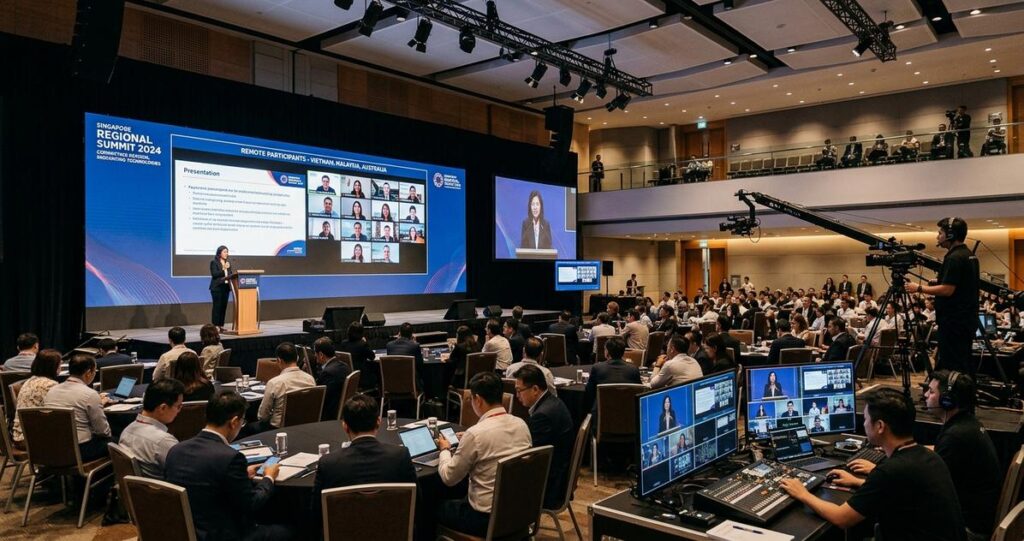
A hybrid regional summit is no longer just a day of presentations and networking. For many Singapore-based organisations, it is now a strategic touchpoint for customers, partners, regulators, employees, and regional stakeholders who may join from different cities, time zones, and viewing environments. The challenge is not simply to stream the event. The real opportunity lies in turning the summit into a library of high-impact highlights that extend its value long after the live programme ends. When done well, highlights can support lead nurturing, internal communications, training, brand building, and stakeholder engagement, while also making your summit more accessible to people who could not attend in full.
Singapore companies often operate across Southeast Asia, which means summit content must speak to audiences with different priorities, cultural expectations, and bandwidth realities. A keynote that energises the live room in Marina Bay may also need to work as a short clip on LinkedIn, a recap for regional sales teams, and an on-demand segment for attendees in Jakarta, Kuala Lumpur, or Bangkok. Creating strong highlights is therefore a production decision, a communications decision, and a content strategy decision. The most effective teams plan for highlights before the summit starts, capture them with editorial intent during the event, and package them with enough context to remain useful after the applause ends.
Start with a highlight strategy, not just a recording plan
Many organisations treat event highlights as an afterthought. They record the summit, then ask later what can be clipped. That approach usually produces generic edits that lack focus and do not support business goals. A better method is to define the purpose of each highlight before the event begins. Ask what you want people to do after watching: register for a product demo, remember a key message, share a thought leadership clip, or revisit a policy announcement. Clear objectives help the production team decide which sessions deserve priority, which speakers need close coverage, and which moments should be framed for short-form or long-form use.
For a hybrid regional summit, the content mix is often broader than a single conference. You may have keynote sessions, panel discussions, product demonstrations, fireside chats, sponsor segments, and audience Q&A. Not all of these will translate equally well into highlights. A keynote with a strong narrative and one or two memorable takeaways may work perfectly as a two-minute recap. A dense technical presentation may need a more careful edit, perhaps with supporting titles or a voiceover to provide context. The highest-impact highlights are usually the ones that preserve meaning while removing repetition, logistical pauses, and setup time.
Define the audience for each clip
Different audiences need different highlight styles. Senior decision-makers often prefer concise executive summaries that capture the strategic message. Sales and marketing teams may want clips that support campaign follow-up. Internal employees may value culture, recognition, and leadership messages. Regional partners may need a version that feels locally relevant while still maintaining the summit’s central theme. In Singapore, where business communication is often direct and time-conscious, a tighter edit with a clear opening and closing usually performs better than a long montage without structure.
It helps to map content to audience intent. For example, a 60 to 90 second speaker highlight can work for social media awareness, a 3 to 5 minute session recap can support email campaigns and website embeds, and a longer edited panel can be hosted on demand for people who want deeper detail. This layered approach makes the summit content more efficient and more reusable.
Capture the right moments during the live hybrid event
The quality of the final highlights depends heavily on what is captured live. Once the summit is over, you cannot recover missed reactions, weak audio, or poor camera framing. This is why hybrid production teams should prepare a capture plan that identifies the most important visual and editorial moments. In practice, this means more than pointing a camera at the stage. It means thinking about composition, timing, audience response, and the rhythm of the programme.
A strong highlights reel usually includes a mixture of speaker close-ups, wide shots of the venue, audience engagement, sponsor branding, and live interaction from the virtual audience. If the event includes a regional audience joining remotely, capture their presence too. That may mean screen mosaics, moderated chat reactions, live polls, or questions submitted from other countries. These details help reinforce that the summit was truly hybrid, not simply a live event with a video feed.
Prioritise clean audio and stable visual coverage
Audio is often the difference between a usable highlight and a clip that people skip. Speech must be intelligible, free from feedback, and properly mixed with any ambient sound. In a summit environment, that usually means capturing speaker audio through the event sound system and recording backup audio where possible. Visuals should be steady, well exposed, and cut in a way that respects the speaker’s pacing. If the room is brightly lit with LED displays, the camera and production settings must be tested in advance to avoid flicker, colour imbalance, or overexposed faces.
For hybrid summits in Singapore, venue conditions can vary widely, from hotel ballrooms to convention halls and corporate auditoriums. Each environment has different acoustics and lighting challenges. A sound check and camera rehearsal are not optional. They are essential parts of creating highlights that look credible and professional. If the live production itself is already structured for highlight capture, the post-event edit becomes much easier.
Plan for moments of energy and proof
High-impact highlights usually contain two elements: energy and proof. Energy is the emotional lift that keeps viewers watching. It may come from a compelling quote, applause, laughter, a product reveal, or a well-timed audience reaction. Proof is the evidence that the summit delivered substance. It may be a slide with a framework, a clear statement from a senior leader, a demonstration of a process, or a concise response to a difficult question. Clips that contain both are more likely to feel memorable and useful.
To support this, production teams should brief camera operators and technical crew on likely highlight moments. If a keynote speaker tends to pause before giving a strong statement, that pause should not be cut too aggressively in the live feed. If a panel discussion is expected to generate debate, multiple camera angles may help preserve the dynamic. In short, the live event should be recorded with editorial purpose, not simply archival intent.
Edit for clarity, context, and distribution
Post-production turns raw footage into content that can be understood quickly and shared confidently. For summit highlights, the edit must do three things well. First, it must communicate the main idea without forcing viewers to work too hard. Second, it must fit the platform where it will appear. Third, it must reflect the tone and credibility of the organisation. A highlight that works on a stage screen is not necessarily the same highlight that works on LinkedIn, YouTube, an internal portal, or a client email.
Editing should remove technical friction and preserve the core message. That often means trimming long introductions, eliminating repeated housekeeping remarks, and tightening transitions. But it also means deciding whether the viewer needs context. If a clip begins with a powerful statement that depends on previous discussion, the editor may need a title card, lower-third caption, or brief voiceover to explain what is happening. Context matters because an isolated quote can lose meaning when stripped from its setting.
Use captions and titles strategically
Captions are important for accessibility and comprehension. They also help viewers watching on mobile devices or in quiet settings, which is common in Singapore’s commute-heavy and office-based working patterns. Captions should be accurate, synchronised, and easy to read. If the highlight is distributed on social platforms, consider open captions so the text remains visible without sound. For summit audiences that include multilingual regional stakeholders, clear captioning can improve understanding even when the spoken language is English.
Titles should be concise and informative. Avoid vague labels like “Summit Highlights Reel” when a more specific title will help audiences understand the clip’s value. For example, “CEO keynote on regional growth priorities” or “Panel discussion on AI readiness for Southeast Asia” gives the viewer a clearer reason to click. Good titles are not marketing fluff. They are editorial signposts.
Design versions for different channels
A single edit rarely suits every channel. Short vertical clips may perform better on mobile-first platforms, while landscape edits may work better on websites and formal recaps. A social cut may need to open within the first few seconds with the strongest line or visual. A website highlight may benefit from a slightly slower pace and a more polished introduction. Internal communications may call for a more explanatory version with brand-safe framing and subtitled key messages.
For Singapore organisations operating regionally, it is sensible to create a content matrix before editing begins. This can define which highlight length, aspect ratio, and message angle will be produced for each channel. Doing so prevents last-minute re-edits and keeps the editorial team aligned. It also helps ensure that approved messaging remains consistent across markets.
Make the highlights work harder after the summit ends
High-impact highlights should not disappear after the event week. They can support a much broader communications plan if they are organised and distributed with intent. A strong post-summit content journey may begin with a fast social recap, continue with targeted follow-up emails, and later support website content, sales enablement, or thought leadership campaigns. This is especially useful for regional summits where a single live event can generate interest across multiple countries.
One practical approach is to think in layers. The first layer is the immediate recap, which preserves momentum and reminds attendees of the summit’s value. The second layer is topic-based clips, which let people explore the sessions most relevant to them. The third layer is evergreen assets, such as leadership insights, industry observations, or product commentary that remain useful beyond the event date. This layered method extends the return on the production investment without overstating the content’s purpose.
Match distribution timing to audience behaviour
Timing matters. If you release a highlight too late, the audience may have moved on. If you release it too soon without editing quality, it may feel rushed. For Singapore audiences, who are used to efficient and polished corporate communication, the first release should be prompt but considered. Internal teams may want a same-day teaser, while external audiences may respond better to a more refined edit delivered shortly after the summit. Regional audiences in different time zones may also need staggered releases so the content lands during their working hours.
Track performance using the metrics that align with your objective. For awareness, this may include views, completion rate, and shares. For lead generation, it may include click-throughs or registrations following the highlight. For internal engagement, it may include intranet visits or staff feedback. The key is to measure what the highlight was designed to achieve, rather than assuming that every view has the same value.
Maintain brand, compliance, and consent discipline
Hybrid summit content can involve speaker permissions, sponsor placements, attendee appearances, and regional privacy considerations. Before distribution, confirm that the appropriate consent and usage rights are in place for speakers, performers, and filmed participants. If the summit includes customer stories or product claims, the published clip should remain accurate and aligned with approved messaging. This is particularly important in regulated sectors and for organisations that communicate across multiple jurisdictions.
In Singapore, professional teams typically work closely with legal, compliance, and communications stakeholders to ensure the final asset is fit for publication. This does not mean every clip must be heavily sanitised. It means the highlight should be accurate, properly approved, and consistent with the organisation’s responsibilities to its audience.
What makes a highlight feel high-impact
The most successful summit highlights are rarely the longest or the most heavily branded. They are the ones that make a clear point, keep the viewer oriented, and leave a strong impression. Good highlights are built on editorial judgment, technical discipline, and an understanding of audience behaviour. They reflect the live energy of the summit while translating that energy into a format that works across digital channels.
For Singapore organisations, this is especially relevant because audiences expect quality, efficiency, and credibility. A highlight should feel purposeful, not decorative. It should answer a simple question for the viewer: why does this moment matter? If the answer is immediately clear, the clip is more likely to be watched, shared, and remembered. If the answer is buried under long intros or generic visuals, the opportunity is lost.
When planning your next hybrid regional summit, think beyond the live programme. Build a highlight plan from the start, capture with editorial intent, edit for clarity and reuse, and distribute with audience-specific purpose. That approach turns a one-day event into a multi-channel content asset that continues to deliver value for your organisation, your stakeholders, and your regional presence.
General information only, not medical advice. This article is intended for communications and event production planning. For guidance on legal permissions, privacy obligations, or sector-specific compliance, consult the appropriate professional advisers or regulatory references in Singapore.
Jeremy Lee is a seasoned digital marketing director and strategist with over two decades of experience in the industry. As the founder of Sotavento Medios, I manage a diverse portfolio of over 50 businesses, helping brands grow through advanced search strategies and digital innovation. My work focuses on bridging the gap between traditional search engine optimisation and the evolving world of AI-driven answer engines.
get in touch