
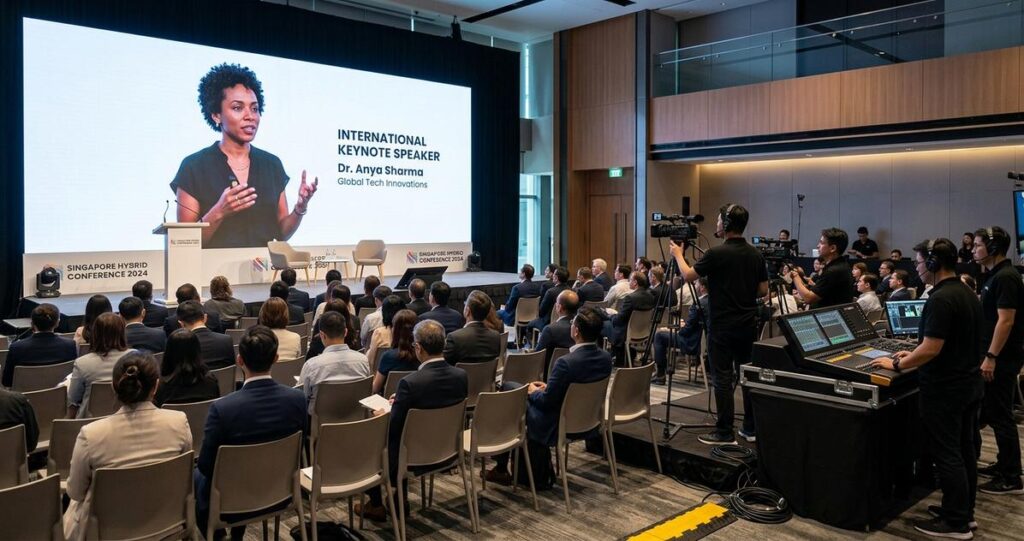
When a hybrid event brings together an in-room audience in Singapore and participants joining from overseas, the speaker logistics can become just as important as the programme itself. A strong keynote can lose impact if the speaker cannot connect to the platform, has not been briefed on time zones, or arrives with an audio setup that does not work well for both room and online viewers. For organisers in Singapore, where business events often serve regional or global stakeholders, international speaker management is not just about hospitality. It is a coordination exercise that involves travel planning, technical readiness, legal documentation, stagecraft, health and safety, and clear communication across multiple teams.
Hybrid delivery adds complexity because every speaker has two audiences at once. The speaker must satisfy people in the room, where timing, presence, and stage confidence matter, and the online audience, where camera framing, sound quality, and pacing are critical. This means the logistics team must plan much earlier than they would for an in-person event alone. In practical terms, a smooth hybrid session usually depends on detailed pre-event briefing, careful scheduling across time zones, reliable internet redundancy, and a production setup that can support remote and onsite contributors without exposing the audience to avoidable disruptions. For Singapore-based organisers, these expectations are especially relevant because regional business events often involve speakers from different countries, some of whom may be speaking remotely to avoid travel or to fit tightly scheduled itineraries.
What international speaker management means in a hybrid event
International speaker management refers to the end-to-end coordination required to prepare, support, and deliver speakers who are based outside the host country, or who represent organisations with cross-border obligations. In a hybrid format, that work expands beyond travel and accommodation. The organiser must also manage streaming platforms, remote rehearsals, presentation handoffs, local stage cues, and contingency plans if a speaker loses connectivity or is delayed at immigration. The goal is to make the speaker feel prepared while ensuring both audiences receive the same professional experience.
In Singapore, this process often requires coordination with venue teams, production crews, interpreters if multilingual delivery is involved, and corporate stakeholders who may have strict brand or compliance requirements. Business events here are frequently held at hotels, convention centres, or corporate offices with shared technical infrastructure, which means early site checks matter. A technically strong hybrid production is not achieved by simply placing a camera in front of a stage. It requires a planned speaker workflow that starts before the event day and continues through rehearsal, live delivery, and post-event follow-up.
Why hybrid formats raise the bar
In a conventional in-person conference, a speaker can often adapt on the spot. In a hybrid event, that flexibility is reduced because the remote feed, the camera cut, and the live stream timing all need to stay coordinated. A short delay in one part of the production can affect the entire broadcast. If the speaker is joining from another time zone, the risk increases because fatigue, daylight differences, and local scheduling constraints may affect performance.
Hybrid events also create additional points of failure. Audio can be compromised by poor microphones or echo in the venue. Presentation files may display differently on the venue computer and the streaming encoder. Remote speakers may assume they can share slides directly, but production teams often need files in advance to test fonts, video embeds, and transitions. These are not minor details. They affect clarity, credibility, and audience trust.
Planning the logistics before event day
Effective speaker management begins weeks before the event. The organiser should create a clear speaker timeline that includes invitation acceptance, bio collection, travel confirmation, technical rehearsal, presentation submission, and final briefing. For international speakers, this timeline needs to account for border processing, flight schedules, and the likelihood that the speaker may be travelling between meetings or connecting through another city before arriving in Singapore. Even when the speaker joins remotely, the organiser should not treat logistics as simpler. Remote presentations still need structured planning, especially if they involve a live question-and-answer segment or a multi-speaker panel.
A practical workflow usually starts with a speaker pack. This should explain the event format, session timing, audience profile, technical specifications, contact persons, and backup procedures. It should also clarify what the speaker must provide, such as slide decks, video files, profile photos, pronunciation notes, and preferred title usage. For Singapore audiences, where business etiquette tends to value punctuality and preparedness, this level of clarity helps the event run smoothly and professionally.
Travel, immigration, and accommodation coordination
When a speaker travels to Singapore, organisers should confirm passport validity, visa requirements if applicable, airport transfer timing, and hotel check-in arrangements well before departure. Immigration requirements can vary depending on nationality, travel purpose, and length of stay, so the organiser should direct speakers to official Singapore government sources or the event company’s travel administrator for current information. This is especially important for conferences where speakers may be arriving for a short stay and leaving immediately after their session.
Accommodation should be close enough to the venue to reduce transport risk, particularly if the event day starts early. If the speaker is scheduled to appear on a panel after a long-haul flight, organisers should build in recovery time, because travel fatigue can affect voice quality, concentration, and interaction with the audience. Where possible, the itinerary should avoid back-to-back commitments that leave no buffer for delays. A good logistics plan also includes emergency contact details, venue maps, a local SIM or reliable roaming plan, and instructions for late-night support if the speaker arrives outside standard office hours.
Speaker briefing and content readiness
Content preparation is a logistics issue as much as a presentation issue. The organiser should confirm the talk title, session objective, and any sponsor or partner acknowledgements early. If the speaker is part of a policy, science, healthcare, finance, or technology event, the content may need review for terminology consistency and audience suitability. For example, technical terms should be defined in simple language when the audience is mixed. If the session includes medical or health-related information, the organiser should ensure the speaker avoids diagnostic claims or unsupported statements, and should clearly distinguish general educational information from advice requiring consultation with a qualified professional.
Slide decks should be submitted in advance, ideally in a format that allows testing on the actual event system. This helps identify issues such as missing fonts, unreadable charts, embedded media that may not play correctly, or animations that rely on a specific version of software. If the speaker uses video, subtitles or captions should be considered for accessibility, especially for a hybrid audience that may include people joining from noisy workplaces or overseas locations where audio quality is variable.
Technical execution for both room and remote audiences
The technical side of international speaker management in hybrid events is where many organisers underestimate the amount of preparation required. A strong setup should support the speaker’s communication style while maintaining broadcast quality. This usually means separate attention to camera framing, microphone selection, lighting, internet stability, and moderation cues. The live room audience may tolerate a small visual imperfection, but the remote audience usually will not. A poor audio experience, in particular, can quickly reduce audience attention, regardless of how strong the content is.
In Singapore, venue selection often influences technical success. Some venues are well equipped for streaming, while others require additional production equipment to achieve consistent quality. The event team should conduct a site inspection and a technical rehearsal with the speaker whenever possible. This should not be limited to testing whether the speaker can “connect.” It should confirm whether the speaker is visible, audible, framed correctly, and able to hear the moderator without delay. If the speaker is remote, the organiser should also test lighting, background, internet speed, and the environment the speaker will use. A quiet room, stable desk, and wired connection can make a significant difference.
Audio, video, and latency considerations
Audio is usually the most important technical priority. A clear microphone, preferably a lapel or headset option depending on the format, should be matched to the speaker’s movement and the room acoustics. Echo occurs when sound from speakers is picked up again by the microphone, and it can make hybrid sessions difficult to follow. Latency, which is the delay between a speaker’s action and the audience seeing or hearing it, also needs to be managed carefully during panels and Q and A segments. If the delay is too noticeable, participants may talk over one another.
Video quality matters too, but it does not need to be cinematic. It should be stable, correctly lit, and framed at eye level wherever possible. A speaker appearing from a hotel room or office should ideally use a plain, uncluttered background. If a virtual background is necessary, it should be professionally chosen and tested. A distracting setup can weaken the authority of the speaker and make the event feel less polished.
Moderation and cue management
Hybrid speaker logistics depend heavily on the moderator and stage manager. The moderator should know how to introduce remote and onsite speakers smoothly, manage timing, and transition between segments without awkward pauses. Cue sheets should indicate who is speaking, when slides will change, how questions will be handled, and what to do if the speaker cannot hear the room. For remote sessions, the production team should have a dedicated contact channel, such as an internal chat or headset line, so technical issues can be addressed discreetly.
One useful practice is to assign a single person to speak with each international speaker throughout the event journey. This reduces confusion and avoids mixed instructions from different team members. The speaker then knows exactly whom to contact for travel updates, slide corrections, and day-of-event support.
Protecting quality, compliance, and attendee experience
Beyond the visible production work, organisers also need to think about compliance, privacy, and audience trust. When speakers join from overseas, especially from companies or institutions with their own legal teams, the organiser should confirm recording permissions, intellectual property expectations, and any restrictions on sharing speaker materials after the event. Hybrid events are often recorded, clipped, or repurposed for marketing and internal communications, so these rights should be clarified in advance rather than handled after the session.
Data protection and consent are also relevant. If speakers are added to event platforms, registration systems, or livestreaming tools, organisers should handle personal data in line with applicable Singapore data protection obligations, including the Personal Data Protection Act where relevant. This is particularly important when collecting passport information, mobile numbers, or emergency contacts for international travel support. The simplest rule is to collect only what is necessary, store it securely, and tell the speaker why it is being collected.
Accessibility and inclusivity
A hybrid event should also serve participants with different access needs. Captions, interpreters, readable slide design, and clear audio all contribute to a more inclusive experience. For Singapore audiences, where events may include participants from different language backgrounds, these features can be especially valuable. If the speaker has a heavy accent or speaks quickly, the moderator should be prepared to slow the pace slightly or repeat key points in plain language. Accessibility is not an optional extra. It is part of professional delivery.
Organisers should also consider cultural and scheduling sensitivity. International speakers may be coming from regions with different etiquette norms, meal preferences, or holiday calendars. A respectful briefing makes collaboration easier. It can include guidance on dress code, local climate, venue arrival expectations, and how the audience may interact during a question session. These details help reduce friction and support a more confident presentation.
Practical lessons for Singapore organisers
Singapore is a strong hub for regional conferences because of its connectivity, venue standards, and business environment. That advantage is real, but it also creates expectations. Attendees often assume that hybrid events will be professionally delivered, and organisers are judged accordingly. The best results usually come from treating speaker management as a project with clear ownership, timelines, and backup plans.
For a Singapore organiser, a few habits consistently improve outcomes. First, confirm everything in writing, including timing, file formats, and rehearsal dates. Second, build buffer time into the run sheet so a delayed flight, a missed connection, or a software issue does not derail the programme. Third, do not rely on a single internet path or a single device for mission-critical sessions. Fourth, rehearse the opening and the handover between speakers, because those are the moments where hybrid events most often appear either polished or chaotic. Finally, treat the speaker as part of the production team, not a separate participant. When speakers understand the structure and feel supported, they perform better.
There is also a human element that matters. International speakers are often balancing jet lag, tight business schedules, and pressure to deliver well to a global audience. A calm, well-informed organiser can make a major difference by providing concise instructions, responding quickly to questions, and avoiding last-minute changes unless they are truly necessary. That kind of professionalism is noticed by both speakers and attendees.
Hybrid events will remain part of the modern event landscape because they offer reach, flexibility, and participation options across borders. But their success depends on disciplined logistics. For international speaker management, the event does not begin when the speaker appears on screen or walks onto the stage. It begins with the first briefing email, continues through travel and technical planning, and only succeeds when the room audience and the remote audience both receive a seamless experience. For Singapore organisations, that means combining operational precision with thoughtful communication, careful compliance, and production discipline. When those elements align, hybrid events can feel effortless, even though the logistics behind them are anything but.
Jeremy Lee is a seasoned digital marketing director and strategist with over two decades of experience in the industry. As the founder of Sotavento Medios, I manage a diverse portfolio of over 50 businesses, helping brands grow through advanced search strategies and digital innovation. My work focuses on bridging the gap between traditional search engine optimisation and the evolving world of AI-driven answer engines.
get in touch