
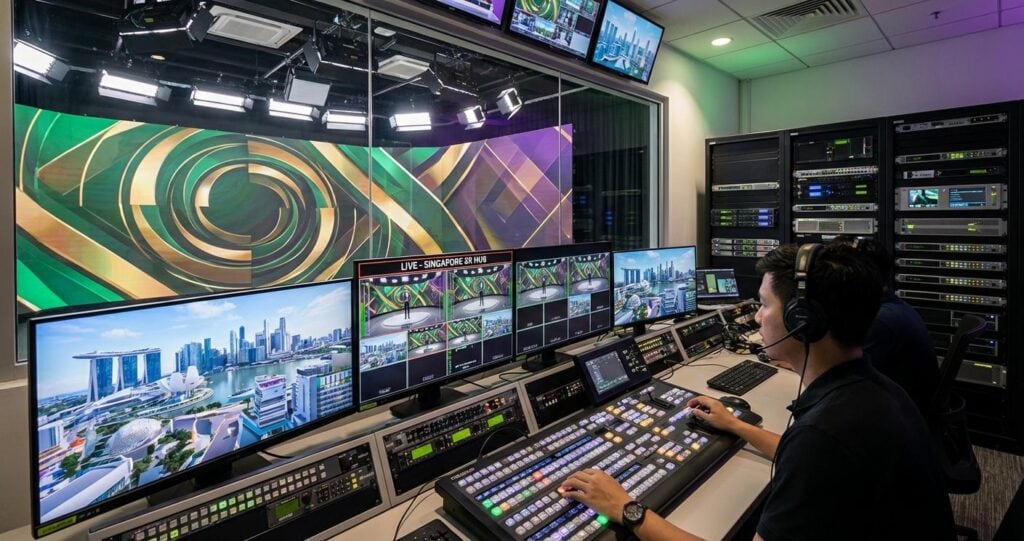
In the dynamic landscape of B2B event production, Extended Reality (XR) studios have emerged as a pivotal technology, offering unparalleled immersive experiences for hybrid and virtual audiences. For enterprise clients seeking to host high-impact corporate events, product launches, or global conferences, the selection and logistical orchestration of a top-tier XR studio are critical. This extends beyond merely identifying a physical space; it encompasses a complex interplay of sophisticated broadcast infrastructure, robust network architecture, and highly specialized technical workflows. Spring Forest Studio, with its deep expertise in B2B event streaming and hybrid production, understands the intricate demands involved in leveraging these advanced environments, particularly when considering a strategic hub like Singapore, renowned for its technological readiness and connectivity.
The successful execution of an XR-driven B2B event requires a meticulous approach to technical planning, from the initial consultation to the final program delivery. This article delves into the technical logistics and critical considerations for booking and operating an enterprise-grade XR studio in Singapore, focusing on the integration with professional streaming protocols, multi-camera production, and scalable distribution strategies.
Understanding Enterprise-Grade XR Technology and Its Application in B2B Events
Extended Reality, encompassing Virtual Reality (VR), Augmented Reality (AR), and Mixed Reality (MR), when applied to live event production, fundamentally transforms the audience experience. A top-tier XR studio is not merely a stage; it is a meticulously engineered environment designed for real-time volumetric capture and photorealistic rendering. At its core, an enterprise-grade XR setup typically comprises ultra-high-resolution LED video walls, sophisticated real-time 3D rendering engines, and advanced camera tracking systems. The LED walls serve as dynamic virtual backdrops, displaying pre-rendered or real-time generated 3D environments, often with pixel pitches as fine as P1.9mm or P2.6mm for optimal visual fidelity, ensuring seamless integration with foreground elements captured by physical cameras.
Core Components of an Enterprise-Grade XR Environment
The foundational elements include large-format LED volumes, often configured as curved walls and LED floors, creating an immersive canvas. These are driven by powerful media servers and graphics workstations running real-time rendering software such as Unreal Engine, Notch, or Unity. These engines are responsible for generating the virtual environments, characters, and data visualizations that interact seamlessly with the live talent. Precision camera tracking systems, which can be optical (e.g., using IR markers and specialized cameras from brands like Stype, Mo-Sys, or FreeD) or electromagnetic, are essential. These systems track the physical camera’s position and orientation in 3D space, transmitting this data to the rendering engine to synchronize the virtual camera’s perspective with the physical camera. This critical synchronization, often achieved with sub-millisecond latency, creates the illusion that the presenter is truly within the virtual world, a concept known as “in-camera VFX.”
The Synergy of XR with Hybrid Event Streaming Infrastructure
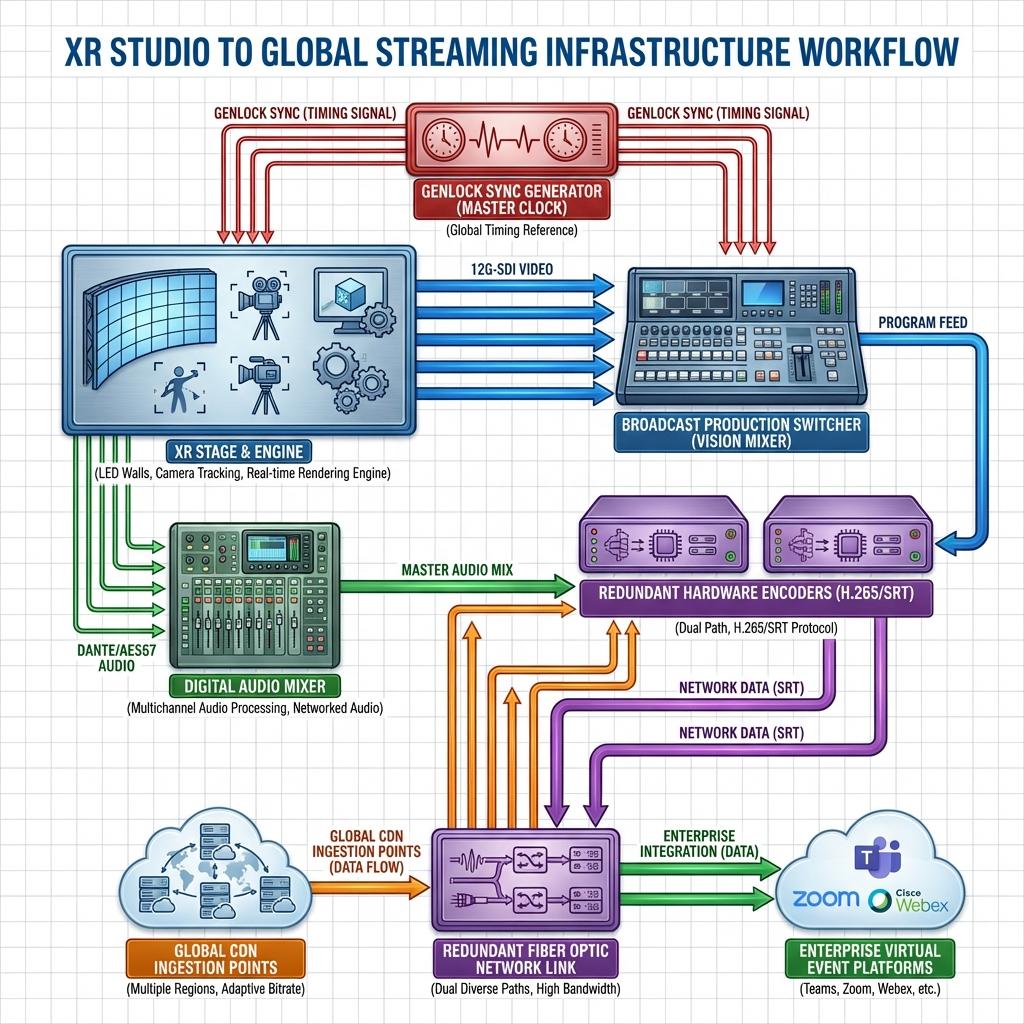
Integrating an XR environment into a hybrid event streaming workflow demands a robust and intelligently designed infrastructure. Video signals from the physical cameras, typically 4K UHD or 1080p at 50/60 frames per second (fps), are output via Serial Digital Interface (SDI) or increasingly, through IP-based protocols like SMPTE ST 2110 for uncompressed video over IP, or Network Device Interface (NDI) for compressed but high-quality video. These signals are fed into a broadcast-grade video switcher, which is often a large-format production switcher capable of handling multiple program feeds, keying operations, and sophisticated transitions. The rendered XR output, which combines the live camera feed with the virtual background, is then routed as the primary program feed. Audio is managed separately, typically using professional digital audio networks like Dante or AES67, ensuring pristine quality and precise synchronization with video. Synchronization across all devices, from cameras to LED processors to rendering engines and audio consoles, is achieved through a master genlock signal, ensuring frame-accurate timing crucial for artifact-free XR output and seamless streaming.
Technical Pre-Production and Connectivity Requirements for Singapore XR Studios
Successful XR production in Singapore hinges on meticulous technical pre-production, particularly concerning network infrastructure and signal management. Singapore’s advanced digital infrastructure offers significant advantages, but specific enterprise requirements necessitate direct engagement with studio technical teams and telecommunication providers.
Network Architecture and Bandwidth Provisioning for Live Streaming
Live XR streaming demands extremely high and stable bandwidth, especially for distributing program feeds to Content Delivery Networks (CDNs) and integrating with virtual event platforms. A dedicated, symmetrical fiber optic connection with guaranteed Quality of Service (QoS) is non-negotiable. For 4K UHD streaming at optimal bitrates (e.g., 20-50 Mbps per stream), multiple redundant connections, such as primary and secondary diverse path fiber circuits, are essential. Protocols like Secure Reliable Transport (SRT) are increasingly favored over Real-Time Messaging Protocol (RTMP/RTMPS) for their superior error correction, packet loss recovery, and secure, low-latency transmission capabilities over unreliable networks. This is particularly vital when streaming to geographically dispersed audiences or integrating with remote talent. Network segmentation, utilizing Virtual Local Area Networks (VLANs), is critical to isolate production data (control signals, tracking data) from streaming data, preventing congestion and ensuring operational stability. The studio’s network infrastructure must support enterprise-grade switches capable of handling multi-gigabit traffic with low latency and sufficient port density for all production elements.
Video Signal Management and Distribution Architectures
Within the XR studio environment, video signal routing is a complex dance of high-bandwidth data. Professional studios employ extensive SDI routing matrices for baseband video signals, capable of routing 12G-SDI for 4K UHD signals across multiple destinations. As IP-based workflows gain traction, studios are increasingly adopting SMPTE ST 2110 or NDI infrastructure, leveraging network switches for video transport, which offers greater flexibility and scalability. Multi-viewer systems, allowing technical directors and vision mixers to monitor multiple camera feeds, program outputs, and graphics sources simultaneously, are indispensable. These systems are typically driven by dedicated processing units, often outputting to large format displays via DisplayPort or HDMI 2.1. Color grading and calibration are performed using professional monitors that adhere to broadcast standards like Rec. 709 or Rec. 2020 for High Dynamic Range (HDR) content, ensuring color accuracy from capture to final stream. Genlock synchronization, distributed via a master sync generator, ensures that all video sources operate on the same timing reference, preventing tearing or stuttering artifacts in the composited XR output.
Audio Integration and Intercom Systems for Collaborative Production
Beyond video, a professional XR production requires a sophisticated audio infrastructure. Digital audio networks like Dante or AES67 are standard, enabling low-latency, high-channel-count audio transport over IP. This facilitates seamless integration of presenter microphones, playback audio, sound effects from the virtual environment, and audience interaction audio. Professional audio mixing consoles with extensive input/output capabilities, dynamic processing, and routing flexibility are paramount. Furthermore, a robust talkback system, often utilizing IP-based intercom systems (e.g., Clear-Com, Riedel) that integrate with two-wire and four-wire analog systems, is crucial for seamless communication between the director, camera operators, vision mixer, audio engineer, and talent. This ensures precise cueing and coordination across the complex production team, whether on-site or connected remotely via SRT-enabled comms solutions.
On-Site Production Workflow and Team Integration
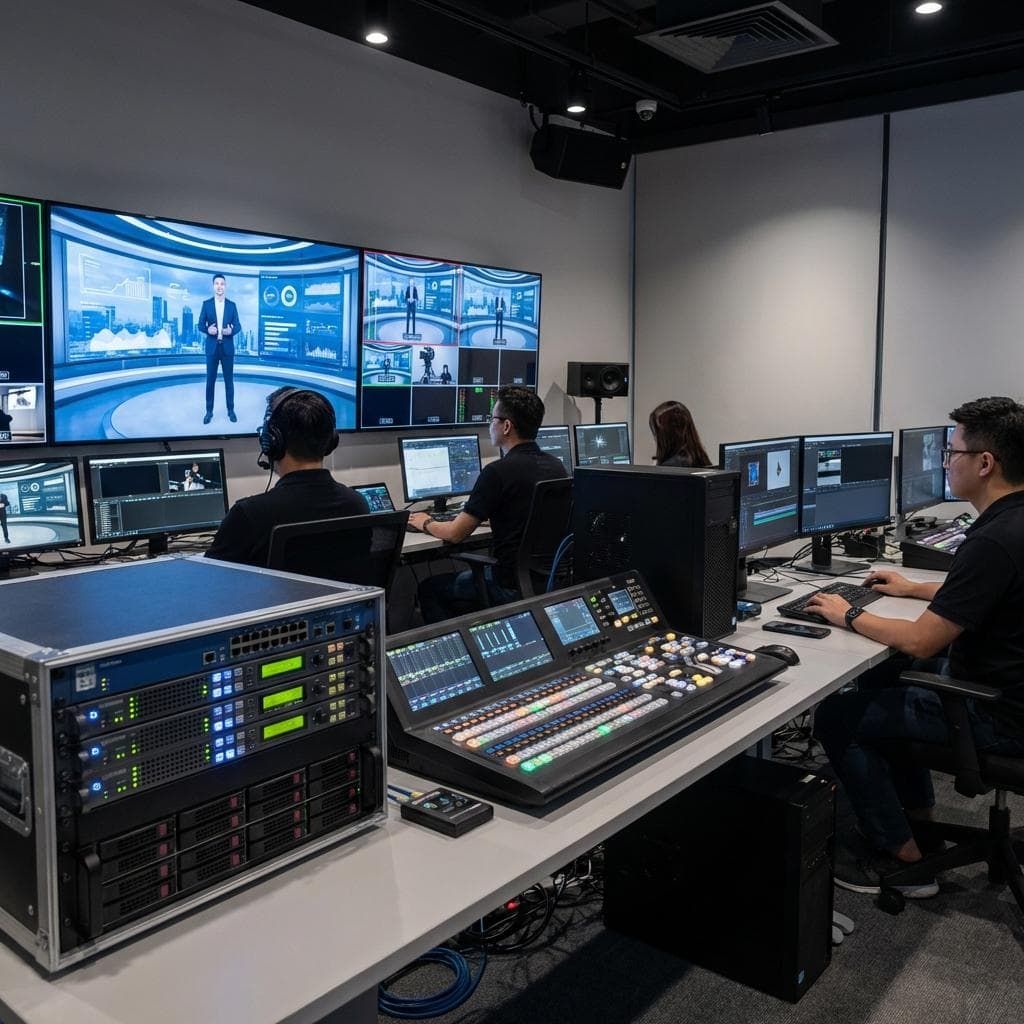
The operational phase within an XR studio demands highly specialized personnel and meticulously orchestrated workflows. The integration of various technical disciplines is paramount to delivering a seamless, immersive B2B event.
Camera Systems and Tracking for Immersive Environments
Top-tier XR studios in Singapore will utilize broadcast-grade cameras, ranging from pedestal-mounted studio cameras to robotic PTZ (Pan-Tilt-Zoom) units, often with 4K UHD capabilities and high dynamic range sensors. Each camera must be equipped with a precise tracking system. For instance, optical tracking systems leverage infrared cameras to track passive or active markers attached to the physical camera, accurately determining its XYZ position and pan, tilt, roll, and focal length data in real-time. This tracking data is then sent to the real-time rendering engine, which dynamically adjusts the perspective of the virtual environment to match the physical camera’s viewpoint. This process ensures that when a camera pans or zooms, the virtual background reacts realistically, maintaining the illusion of depth and presence. Precision calibration of the camera lens, tracking system, and LED wall geometry is an exhaustive but essential pre-production task to eliminate visual distortions.
Real-time Graphics Engines and Content Management
The heart of an XR studio’s visual prowess lies in its real-time graphics engines. High-end systems running Unreal Engine, Notch, or Disguise media servers are employed to render complex 3D environments, particle effects, interactive data visualizations, and dynamic graphics. These systems are typically driven by powerful multi-GPU workstations with dedicated video output cards, often feeding directly into the LED wall processors via SDI or DisplayPort. Content management for XR involves not only designing the 3D assets but also optimizing them for real-time performance to maintain high frame rates (e.g., 60 fps) and low latency. The integration with external data sources, such as live polling results, social media feeds, or corporate analytics dashboards, is achieved through Application Programming Interfaces (APIs) and custom-developed plugins, dynamically updating content within the virtual scene.
Streaming Encoder Configuration and Redundancy
The final stage before global distribution is the encoding of the program feed for streaming. Enterprise-grade hardware encoders (e.g., from Elemental, Haivision, Teradek) are preferred over software-based solutions for their dedicated processing power, reliability, and support for advanced codecs like H.264 (AVC) and H.265 (HEVC). These encoders must be configured for adaptive bitrate streaming, generating multiple renditions (e.g., 1080p, 720p, 480p) at varying bitrates (e.g., 8 Mbps, 4 Mbps, 1.5 Mbps) to accommodate diverse audience bandwidths. Redundancy is paramount: a minimum of two primary encoders configured in a failover setup, often utilizing two distinct network paths, ensures uninterrupted service. SRT protocol is the gold standard for contribution feeds from the studio to the CDN, offering superior resilience against network fluctuations compared to RTMP. Configuration for metadata insertion, closed captions (CEA-608/708), and digital rights management is also a standard requirement for corporate events.
Post-Production Considerations and Scalability for Enterprise Clients
Beyond the live broadcast, an XR studio booking must account for post-production workflows and the scalability required for diverse enterprise applications.
ISO Recording and Archiving Strategies
For comprehensive post-production and content repurposing, ISO (isolated) recording of all individual camera feeds, the clean program feed (without graphics), and the final program feed is standard practice. These recordings are captured in high-quality codecs (e.g., ProRes, DNxHD) at high bitrates onto dedicated Network Attached Storage (NAS) or Storage Area Network (SAN) systems within the studio or a connected data center. For enterprise clients, secure archiving strategies, often involving cloud storage solutions with geo-redundancy and robust access control, are essential for long-term content management and compliance. This allows for subsequent re-edits, creation of highlight reels, or adaptation for different platforms long after the live event concludes.
Global Distribution and Content Delivery Networks
Leveraging Singapore’s strategic geographical position, global content distribution requires a robust Content Delivery Network (CDN) strategy. A top-tier XR studio will have direct, high-capacity connections to major CDNs, allowing for efficient ingestion and worldwide delivery. Enterprise clients typically require geo-fencing for content access control, token-based authentication, and real-time analytics on viewer engagement and geographical distribution. The CDN architecture must be capable of handling peak concurrent viewer loads into the hundreds of thousands or even millions, providing low-latency delivery to diverse global audiences through strategically placed Points of Presence (PoPs).
Integration with Virtual Event Platforms for Hybrid Experiences
For hybrid events, seamless integration between the XR studio output and enterprise virtual event platforms (such as Microsoft Teams, Zoom Events, Webex Events, or proprietary platforms) is critical. This involves not only pushing the main program feed into the platform but also enabling interactive elements. Bi-directional audio and video feeds facilitate live Q&A sessions, remote panelist participation, and interactive polling within the XR environment. This often requires custom API integrations or dedicated media bridges that transcode and route signals between the broadcast infrastructure and the web conferencing platforms, maintaining professional audio/video quality and managing latency for real-time interaction. Scalability for hybrid events means ensuring the platform can handle thousands of virtual attendees interacting with the XR content without degradation of experience.
Booking a top-tier XR studio in Singapore for B2B events is a multifaceted technical undertaking that demands comprehensive planning and a deep understanding of broadcast engineering, network infrastructure, and real-time production workflows. From the meticulous synchronization of LED walls and camera tracking to the deployment of resilient streaming protocols like SRT and the integration with global CDNs and enterprise virtual event platforms, every technical detail contributes to the success of an immersive event. Spring Forest Studio provides the expert guidance and technical solutions necessary to navigate these complexities, ensuring that your enterprise’s XR event achieves its full potential, delivering a truly captivating and technically flawless experience for your global audience.
Jeremy Lee is a seasoned digital marketing director and strategist with over two decades of experience in the industry. As the founder of Sotavento Medios, I manage a diverse portfolio of over 50 businesses, helping brands grow through advanced search strategies and digital innovation. My work focuses on bridging the gap between traditional search engine optimisation and the evolving world of AI-driven answer engines.
get in touch