
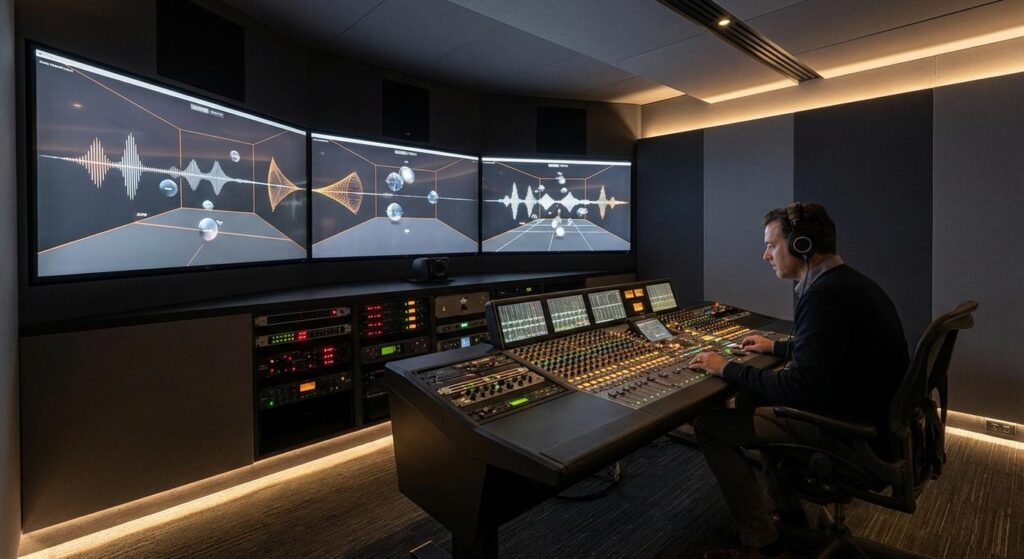
In the evolving landscape of B2B event production, the demand for immersive and engaging virtual and hybrid experiences continues to escalate. Beyond high-resolution video and seamless connectivity, the auditory dimension represents a powerful, yet often underutilized, vector for enhancing participant engagement and comprehension. This is where 3D spatial audio, a sophisticated technological advancement in sound reproduction, offers a transformative advantage. Unlike traditional stereo or mono audio, 3D spatial audio provides an auditory experience where sound sources are perceived to originate from specific positions in a three-dimensional space, mirroring real-world acoustics. For professional B2B events, this translates into a richer, more natural, and less fatiguing listening experience for virtual attendees, significantly elevating the production value of conferences, product launches, training seminars, and executive briefings.
Spring Forest Studio understands that integrating cutting-edge technologies like 3D spatial audio into enterprise-grade streaming solutions requires a deep understanding of complex audio signal processing, network infrastructure, and robust production workflows. Our expertise focuses on engineering bespoke solutions that not only meet the stringent technical demands of live event streaming but also deliver a palpable enhancement to the audience’s perception. This article delves into the technical intricacies of implementing 3D spatial audio within a professional B2B event context, exploring the underlying principles, required infrastructure, and practical application strategies for production teams and AV professionals aiming to push the boundaries of virtual engagement.
Understanding 3D Spatial Audio in Professional Event Contexts
Technical Foundations of Spatial Audio
3D spatial audio, often referred to as immersive audio, transcends conventional channel-based audio formats such as stereo (2.0) or surround sound (5.1, 7.1). Its core principle involves rendering sound objects in a virtual acoustic space, allowing listeners to perceive direction, distance, and elevation. This is achieved through various techniques including HRTF (Head-Related Transfer Function) processing, object-based audio, and scene-based ambisonics. HRTF, for instance, models how the pinna, head, and torso alter sound waves arriving at the eardrums, providing crucial psychoacoustic cues for localization. Object-based audio, as standardized by formats like MPEG-H Audio or Dolby Atmos, encodes individual sound elements (e.g., a presenter’s voice, a background music track, a sound effect) with metadata defining their position in a 3D coordinate system, rather than assigning them to fixed channels. This metadata, along with the audio stream, is then rendered in real-time by a spatial audio engine or decoder, adapting to the listener’s playback device and head movements if head-tracking is employed.
Advantages for B2B Virtual and Hybrid Events
For B2B events, the benefits of 3D spatial audio are multifaceted. Firstly, it significantly enhances speech intelligibility in complex multi-speaker scenarios. By spatially separating presenters, even when they are speaking concurrently or rapidly switching, attendees can more easily focus on individual voices without cognitive overload. This is particularly critical in panel discussions, collaborative workshops, or multi-track conference formats. Secondly, spatial audio creates a heightened sense of presence and immersion, reducing the psychological distance often felt in virtual interactions. Attendees feel more connected to the event, akin to being physically present in a large auditorium or meeting room, where sound naturally emanates from distinct sources. Thirdly, it offers superior accessibility by allowing users to orient themselves within the virtual soundscape, potentially benefiting those with certain hearing impairments or in environments with background noise. Finally, from a production perspective, spatial audio provides a powerful creative tool for directors to guide attention, convey spatial relationships in virtual environments, and build more impactful brand experiences.
Technical Architecture for Spatial Audio Integration in Hybrid Events
Audio Acquisition and Source Preparation
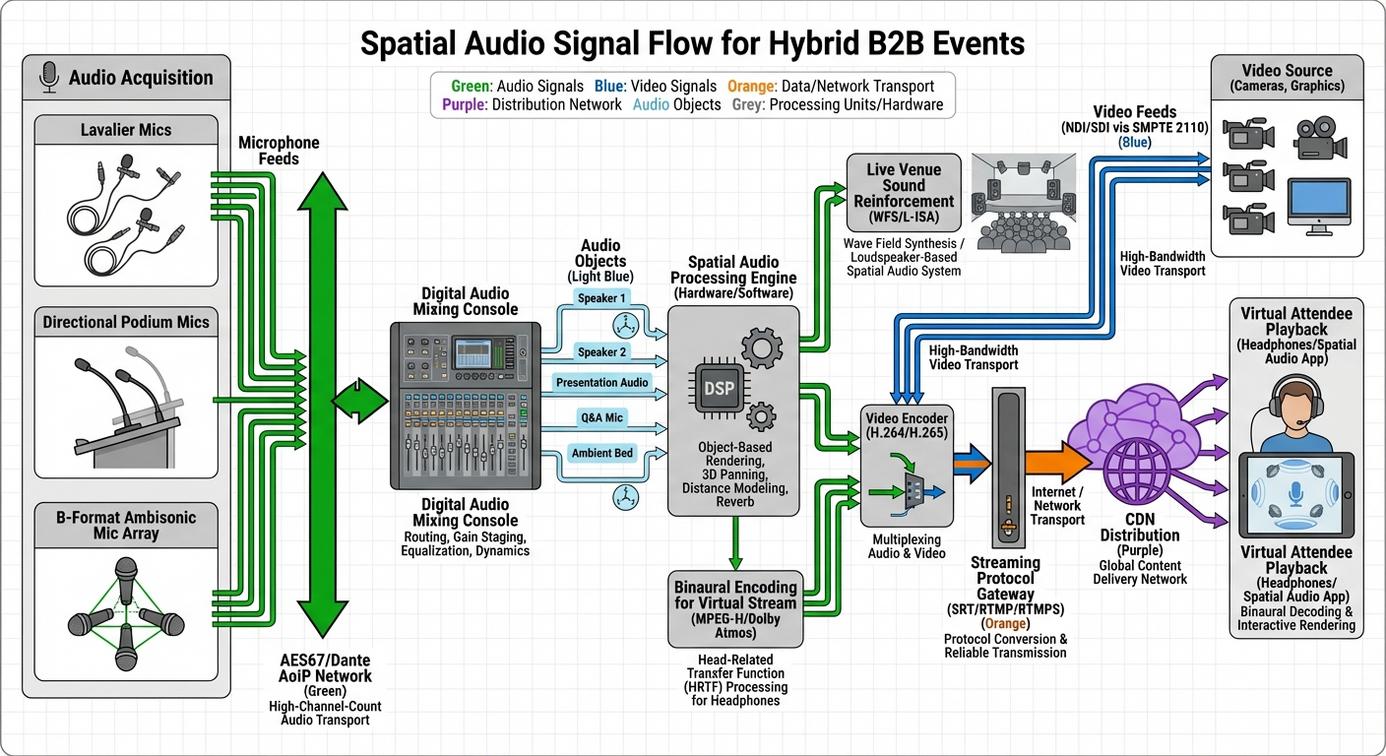
The foundation of any high-fidelity spatial audio production lies in meticulous audio acquisition. For B2B events, this typically involves a multi-microphone setup. While traditional close-mic techniques for presenters (e.g., lavalier microphones, directional podium mics) remain essential for clear speech capture, additional considerations arise for spatial rendering. Ambient microphones, particularly ambisonic microphones (e.g., A-format or B-format arrays), are crucial for capturing the overall acoustic signature of the physical event space and incorporating environmental spatial cues. These specialized microphones capture sound pressure from multiple directions, encoding the full sound field, which can then be decoded and manipulated in a spatial audio workstation. All audio sources, whether discrete channels from presenters, program audio, or ambisonic captures, must be routed through a professional digital audio mixer (e.g., Yamaha Rivage PM series, DiGiCo SD series) capable of high sample rates (48 kHz, 96 kHz) and bit depths (24-bit). Signal flow often leverages AES67 or Dante Audio-over-IP networks for resilient, low-latency transport across the production infrastructure, ensuring synchronization with video feeds which typically utilize NDI or SDI over IP (SMPTE ST 2110).
Spatial Audio Processing Engines and Software
At the heart of a spatial audio system is the processing engine. This can be hardware-based (e.g., dedicated audio DSPs from companies like L-Acoustics L-ISA, d&b Soundscape, Meyer Sound Spacemap Go) or software-based solutions running on high-performance workstations. These engines take discrete audio objects and their associated spatial metadata, applying complex algorithms, often incorporating HRTFs, to render the sound field. Object-based audio workflows are preferred for maximum flexibility, allowing producers to dynamically position and animate sound objects within the 3D space. The output of these engines can then be encoded into various spatial audio formats suitable for streaming. For virtual events, common delivery formats include MPEG-H Audio, Dolby Atmos, or proprietary binaural rendering codecs that are compatible with standard streaming protocols. Integration with existing streaming encoders (e.g., Elemental Live, Haivision Makito X) requires a robust audio interface, often Dante-to-SDI embedders or AES67 gateways, to ensure the spatial audio data is correctly multiplexed with the H.264 or H.265 (HEVC) video streams for distribution via RTMP, RTMPS, or SRT (Secure Reliable Transport) protocols to a Content Delivery Network (CDN).
Implementation Strategies: From Acquisition to Delivery
Production Workflow and Object-Based Mixing
Implementing 3D spatial audio necessitates a revised production workflow. The traditional stereo mix engineer transitions to an object-based mixer or spatial audio designer. This role involves not just balancing levels but also placing and animating individual sound objects within the virtual 3D soundstage. Advanced digital audio workstations (DAWs) like Avid Pro Tools Ultimate, Steinberg Nuendo, or Harrison Mixbus, equipped with spatial audio plugins (e.g., dearVR SPATIAL CONNECT, Waves Nx, Sennheiser Ambeo Orbit), become integral. The audio operator assigns each source (presenter A, presenter B, graphics audio, music bed) as an independent object, then uses a spatial panning interface, often a GUI representing the 3D space, to define its position, movement, and acoustic characteristics. For hybrid events, careful consideration is given to the physical sound reinforcement system in the venue, often leveraging techniques like WFS (Wave Field Synthesis) or advanced L-ISA processing, while simultaneously generating a separate spatial audio mix optimized for binaural rendering for the virtual audience.
Integrating Spatial Audio with Enterprise Streaming Platforms
The final delivery of spatial audio to virtual attendees poses specific challenges. While direct integration of advanced spatial audio codecs into widely adopted enterprise platforms like Microsoft Teams, Zoom, or Webex is still evolving, workarounds and specialized client-side applications are critical. One common approach involves streaming the spatial audio-encoded program feed (e.g., MPEG-H or binauralized stereo) as a distinct audio track alongside the primary video stream. Users then access this enhanced audio via a dedicated player application or a web-based client that can decode the spatial information, often requiring headphones for the full effect. For internal enterprise events with controlled environments, custom web applications utilizing Web Audio API with HRTF processing can provide client-side spatial rendering. The key is ensuring that the chosen delivery mechanism maintains low latency, particularly important for interactive Q&A sessions, and high quality of service (QoS). Redundancy is paramount; dual encoders feeding diverse CDNs (Content Delivery Networks) via SRT with forward error correction (FEC) ensure resilient delivery of both video and the complex spatial audio data, preventing dropouts or synchronization issues that would degrade the immersive experience.
Advanced Spatial Audio Production Workflows and Tools
Real-time Rendering and Virtual Acoustic Environments
The power of 3D spatial audio extends beyond static positioning; it involves dynamic, real-time rendering. Advanced spatial audio engines can simulate virtual acoustic environments, applying specific reverberation characteristics, early reflections, and absorption coefficients to each sound object, making it sound as if it’s truly in a large hall, a small meeting room, or even an open-air amphitheater. This involves convolution reverbs or algorithmic reverbs precisely tailored to the desired virtual space. For live events, these parameters can be dynamically adjusted by the audio engineer, responding to changes in the virtual scene or audience interaction. The ability to dynamically adjust parameters like spatial spread, object size, and distance attenuation provides unparalleled control over the perceived soundstage, allowing for subtle cues that enhance narrative or guide attention. For example, a presenter speaking remotely could be virtually placed on the main stage alongside an in-person host, creating a cohesive acoustic image despite their physical separation.
Monitoring, Quality Control, and Calibration
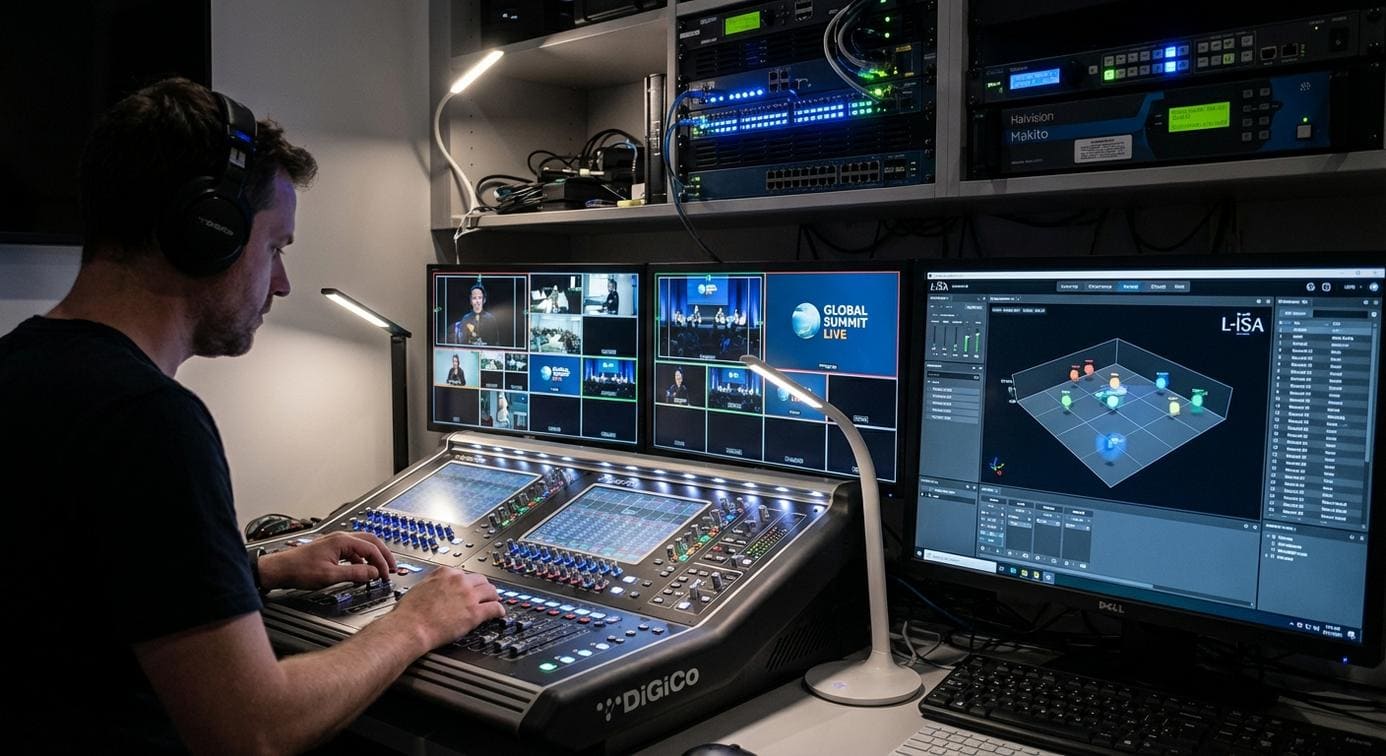
Accurate monitoring is critical for spatial audio production. Traditional stereo meters and even surround sound monitoring systems are insufficient. Producers and engineers require specialized tools for visualizing the 3D sound field, often through graphical representations of sound object positions and movements. Binaural monitoring via high-quality headphones (e.g., Sennheiser HD 800 S, Neumann NDH 30) is essential for evaluating the final spatialized mix as the end-user will perceive it. Regular calibration of playback systems, including headphone compensation profiles, is vital to ensure consistent spatial perception across different listeners. Quality control (QC) extends to ensuring that the spatial metadata is correctly embedded and transported alongside the audio stream, and that client-side decoders are rendering the spatial information accurately without artifacts or latency issues. Implementing ISO 20121 standards for event sustainability and adhering to SMPTE standards for audio and video synchronization (e.g., SMPTE ST 2067-20 for Immersive Audio Bitstream) underscore a commitment to professional excellence and interoperability.
Optimizing Network Infrastructure and Delivery for Spatial Audio
Bandwidth, Latency, and Jitter Management
3D spatial audio, especially object-based formats, can demand higher bandwidth compared to basic stereo audio, due to the additional metadata and potentially more discrete audio streams. While efficient codecs like MPEG-H Audio are designed to be bandwidth-friendly, a robust network infrastructure is non-negotiable. Enterprise-grade internet connections with symmetrical bandwidth provisioning (e.g., dedicated fiber optic lines with multiple gigabits per second capacity) are essential for both primary and redundant feeds. Latency management is paramount; for live, interactive B2B events, end-to-end latency targets often fall below 300 milliseconds. SRT (Secure Reliable Transport) protocol, with its advanced retransmission mechanisms and customizable latency settings, is highly effective for maintaining stable, low-latency delivery over unpredictable internet pathways. Jitter buffering must be carefully configured within encoders and decoders to smooth out network fluctuations without introducing excessive delay. QoS (Quality of Service) policies on routers and switches must prioritize spatial audio and video traffic to ensure consistent performance, even during periods of network congestion. This includes DSCP (Differentiated Services Code Point) marking for critical media streams.
Cloud-Based vs. On-Premise Processing and Delivery
The choice between cloud-based and on-premise spatial audio processing and delivery solutions depends on several factors, including event scale, security requirements, and existing infrastructure. On-premise solutions offer maximum control over the entire signal chain, lower internal latency (within the production facility), and are often preferred for highly secure or confidential corporate events. This involves dedicated hardware DSPs and local streaming encoders. Cloud-based solutions, leveraging hyperscale public cloud providers (AWS Media Services, Google Cloud Media CDN), offer unparalleled scalability and global reach, making them ideal for large-scale international events. Cloud-native spatial audio engines and rendering services are emerging, allowing for distributed processing and delivery. Hybrid approaches combine the strengths of both; for instance, on-premise acquisition and initial processing, with cloud-based encoding, distribution, and edge delivery. Regardless of the deployment model, redundant power supplies (UPS), network failover protocols (e.g., HSRP, VRRP), and N+1 encoder configurations are non-negotiable for enterprise-grade reliability, ensuring continuous spatial audio delivery even in the event of component failure.
Implementing 3D spatial audio in B2B event streaming is not merely an enhancement; it is a strategic investment in creating truly immersive, engaging, and memorable experiences for a global virtual audience. By meticulously planning the technical architecture, optimizing production workflows, and fortifying network infrastructure, production teams can unlock the full potential of spatial audio. Spring Forest Studio stands ready to partner with enterprise clients, leveraging our deep technical expertise to design, implement, and manage these advanced streaming solutions, ensuring your next virtual or hybrid event sets a new standard for excellence in professional communication.

Jeremy Lee is a seasoned digital marketing director and strategist with over two decades of experience in the industry. As the founder of Sotavento Medios, I manage a diverse portfolio of over 50 businesses, helping brands grow through advanced search strategies and digital innovation. My work focuses on bridging the gap between traditional search engine optimisation and the evolving world of AI-driven answer engines.
get in touch