
The Intelligent Event Stack: AI-Unified Production for 2026
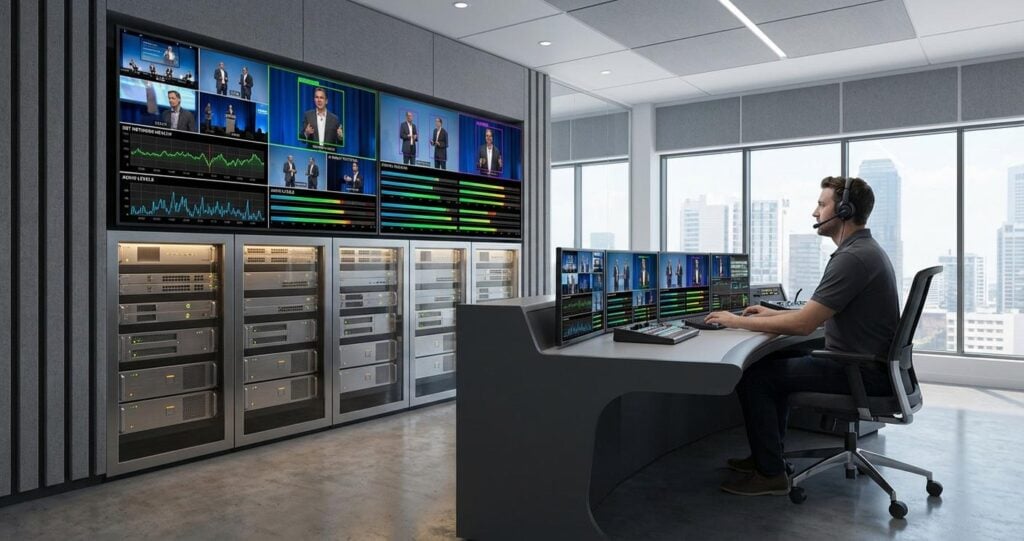
The operational complexity of enterprise-level B2B event production is reaching an inflection point. As hybrid events become the standard, production managers and IT directors are tasked with orchestrating a growing number of disparate systems: multi-camera SDI and NDI video sources, remote presenter contribution feeds via SRT, multiple audio busses, complex graphics packages, and simultaneous distribution to in-person displays and global virtual audiences. The traditional model, reliant on manual control and siloed workflows, introduces significant potential for human error, increases operational overhead, and struggles to scale effectively. By 2026, a new paradigm will be essential for success: The Intelligent Event Stack. This architecture represents a fundamental shift from manual operation to a unified, AI-driven production ecosystem that is predictive, self-optimizing, and resilient. It is not mere automation; it is the deep integration of artificial intelligence into the core logic of live event signal flow, distribution, and audience engagement, designed to meet the rigorous demands of the modern corporate event.
Core Architecture of the AI-Unified Production Hub
The foundation of the Intelligent Event Stack is the centralization of control and processing logic within an AI-powered core. This hub acts as the central nervous system for the entire production, moving beyond the capabilities of traditional hardware switchers and routing matrixes. It processes telemetry and metadata from every component in the chain, from cameras to encoders, enabling a level of sophisticated, real-time decision-making that is impossible to achieve manually. This architecture is built upon a flexible, IP-based infrastructure that treats video, audio, and control data as fungible network assets.
From Manual Patching to Intelligent Signal Routing
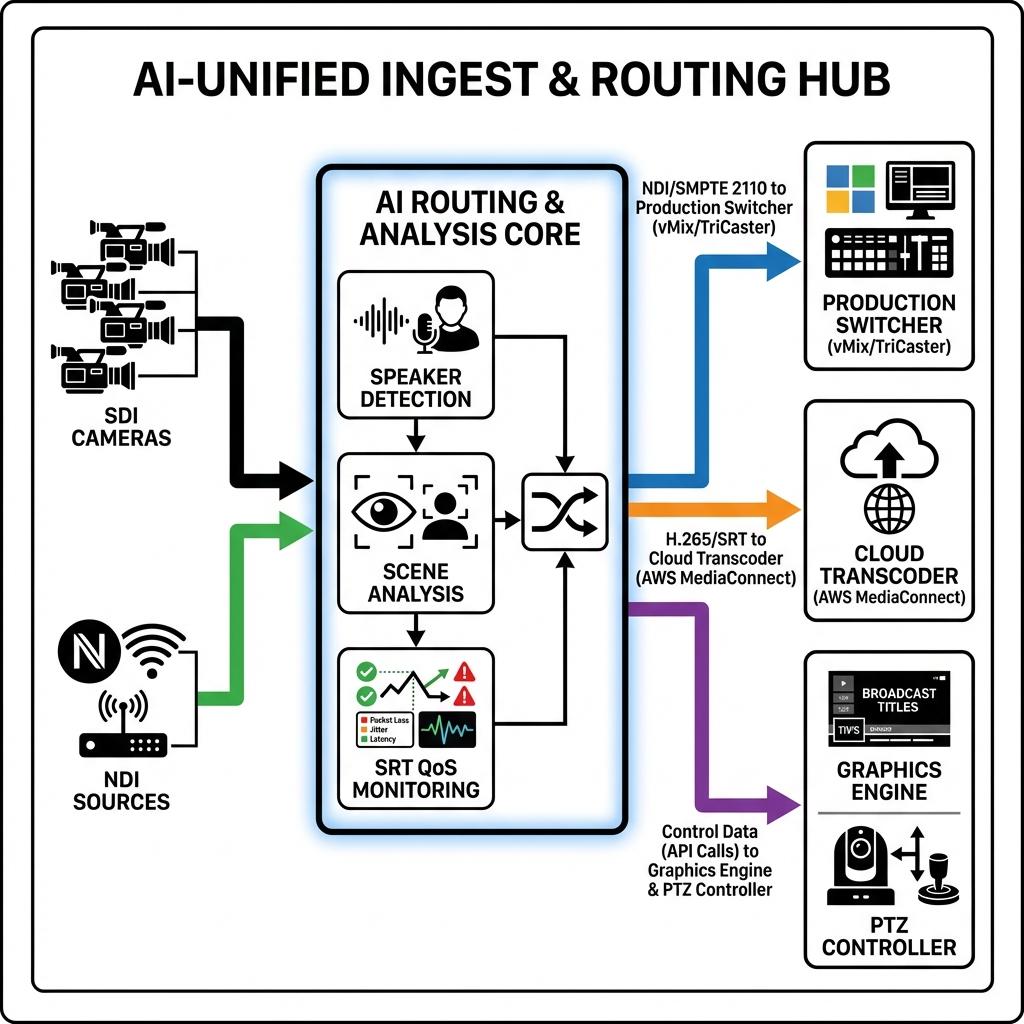
In a conventional production, signal routing is a rigid process. Physical SDI patch bays or digital routing matrixes establish fixed signal paths that require manual intervention to change. The Intelligent Event Stack replaces this with a dynamic, software-defined routing fabric. Utilizing IP-based protocols like NDI (Network Device Interface) and SMPTE ST 2110, every video and audio source becomes an accessible node on the production network. The AI core sits atop this fabric, functioning as a master control plane. It can dynamically reroute signals based on a complex set of triggers, including pre-programmed run-of-show data, real-time analysis of audio cues, or even computer vision analysis of the video feeds themselves. For example, in a multi-speaker panel discussion, an AI model can perform voice activity detection. Upon identifying the active speaker, it sends an API call to the production switcher, such as a vMix or Ross Carbonite system, to automatically execute a transition to the corresponding camera. This ensures perfect timing and frees the Technical Director (TD) to focus on higher-level creative decisions rather than reactive shot-taking.
Predictive Ingest and Encoding Optimization
Encoding for live streaming has historically relied on static bitrate ladders, a one-size-fits-all approach that fails to account for the dynamic nature of content. The AI-unified hub revolutionizes this process. The system performs real-time complexity analysis on the program feed before it reaches the encoder. For a static shot of a PowerPoint slide, the AI instructs the H.265 (High-Efficiency Video Coding) or AV1 encoder to allocate a lower bitrate, preserving bandwidth. When high-motion video or complex graphics appear, it instantly increases the bitrate allocation and adjusts quantization parameters to maintain visual fidelity. This content-aware encoding ensures the highest possible quality of service (QoS) for any given network condition. This process is deeply integrated with transport protocols like SRT (Secure Reliable Transport). The AI monitors SRT telemetry, including round-trip time (RTT), jitter, and packet loss, to predict network congestion. Before a link degrades to the point of causing visual artifacts, the AI can proactively lower the encoder bitrate, increase the SRT latency buffer, or even seamlessly failover the transport stream to a secondary bonded network path combining fiber and 5G cellular connectivity.
AI-Driven Content Automation and Enhancement
Beyond signal management, the Intelligent Event Stack actively participates in the creation and refinement of the final program output. By offloading repetitive and predictable tasks to AI models, production teams can achieve a higher level of consistency and quality, while reallocating human expertise to more critical, creative functions. This layer of the stack focuses on automating camera control, vision mixing, and graphics integration to build a more polished and engaging final product.
Automated Camera Operation and Vision Mixing
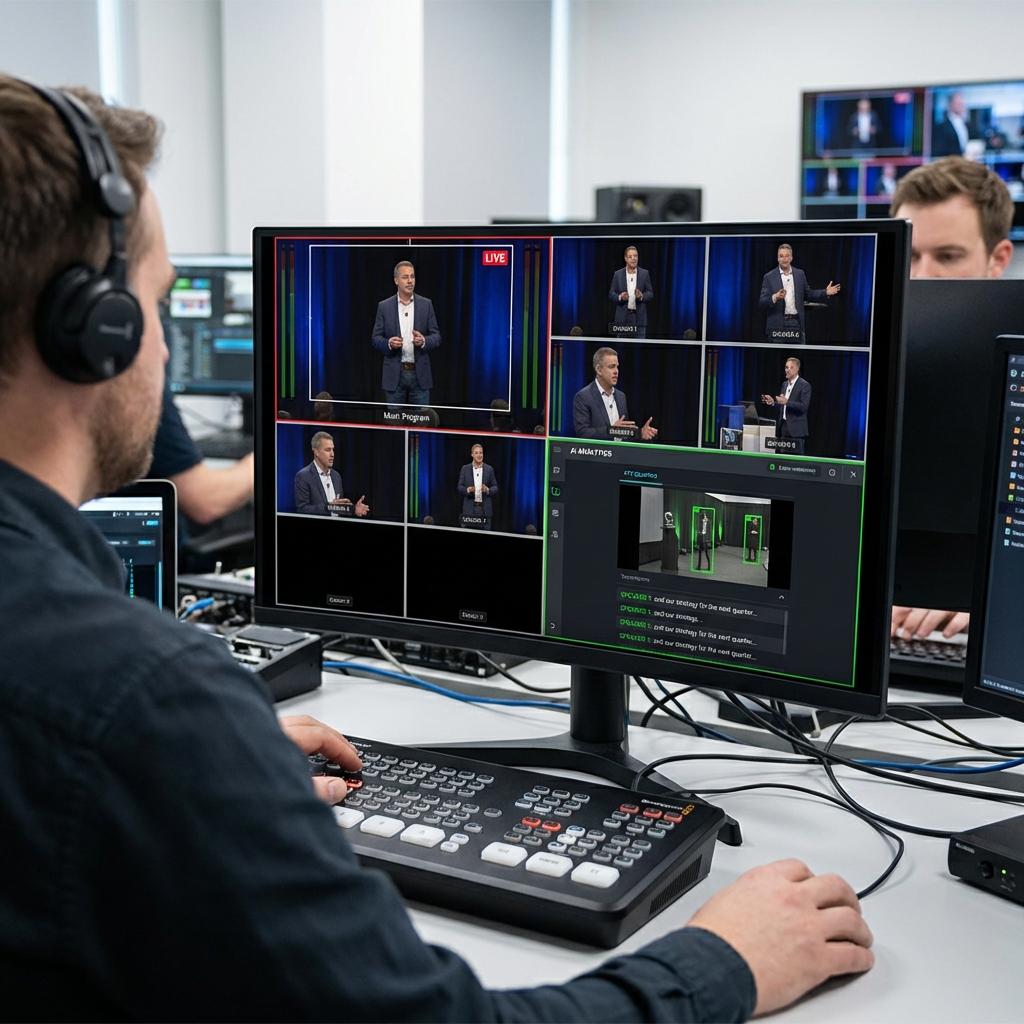
The use of robotic PTZ (Pan-Tilt-Zoom) cameras is standard in corporate events, but they traditionally require a dedicated operator. AI-driven automation transforms these cameras into intelligent acquisition devices. Using computer vision models trained on thousands of hours of professional event coverage, the system can autonomously track speakers as they move on stage, execute smooth and natural camera movements, and maintain ideal framing based on composition rules like the rule-of-thirds. This extends to vision mixing. The AI core can ingest multiple isolated (ISO) camera recordings and, based on its analysis of which camera has the best shot of the active speaker or relevant content, generate a “recommended” program edit. This AI-generated cut can be used as a primary PGM feed for smaller events or, in larger productions, can be presented on a multiviewer for a human TD to approve, override, or refine. This collaborative approach, where the AI handles the rudimentary shot selection, allows the TD to focus on the narrative flow and pacing of the event.
Real-Time Graphics and Data Integration
Graphics operation is a frequent source of error in live productions. A misspelled name or an incorrect title in a lower-third graphic can detract from the professionalism of an event. The Intelligent Event Stack mitigates this risk by automating graphics workflows. The AI core can integrate directly with event management platforms and presentation software. When a presenter advances to a new slide that contains their name and title, the AI system can use optical character recognition (OCR) or ingest slide metadata to trigger the graphics generator, like a Singular.live or Chyron system, to display the corresponding lower-third. It can also be connected to a speaker database. When the AI’s voice recognition identifies a new speaker, it automatically calls the correct graphic template with their information, ensuring 100% accuracy without manual intervention from a character generator (CG) operator.
Intelligent Network and Distribution Management
For hybrid events, the distribution network is as critical as the production hardware. The final layer of the Intelligent Event Stack is focused on ensuring a flawless and equitable experience for both the in-person and remote audiences. This requires predictive network management and a unified approach to content delivery and interaction, all orchestrated by the AI core.
Predictive Network Path Optimization with SRT and RIST
Ensuring a stable contribution feed from the venue to the cloud is paramount. While protocols like SRT and RIST (Reliable Internet Stream Transport) provide error correction, the AI stack adds a predictive layer of intelligence. The system continuously analyzes telemetry data not just from a single path, but from multiple redundant network paths simultaneously, such as primary fiber, secondary broadband, and bonded cellular. An AI model trained on network performance data can identify subtle patterns, like gradually increasing RTT or minor but consistent packet loss, that are leading indicators of future link failure. Before the link degrades sufficiently for SRT’s error correction to be heavily taxed, the AI can execute a seamless switch to the healthier backup path via a cloud gateway like AWS Elemental MediaConnect. This predictive failover is imperceptible to the remote audience and provides a level of resilience that is far superior to reactive, manual failover procedures.
Unified Hybrid Audience Experience Management
A key challenge in hybrid events is preventing the remote audience from feeling like passive observers. The AI stack works to unify the experience. Using advanced automated speech recognition (ASR) models, the system can generate highly accurate, real-time transcriptions of the event. This text can be fed to AI translation services to provide live subtitles in multiple languages for a global audience. The same transcription can be displayed on confidence monitors or in-venue screens for accessibility. Furthermore, the AI can analyze incoming data from audience engagement platforms like Slido or Teams Live Event Q&A. It can perform sentiment analysis on comments, identify trending topics in the chat, and group similar questions together. This synthesized information can be passed directly to the event moderator’s tablet or teleprompter, allowing them to address the remote audience’s concerns and questions as if they were in the room, creating a truly unified and interactive event.
Implementation Pathways and Enterprise Considerations
Deploying an Intelligent Event Stack requires careful architectural planning and a deep understanding of both production engineering and IT infrastructure. The approach must consider the specific needs of the enterprise, balancing latency requirements with scalability and security protocols.
On-Premise vs. Cloud-Based AI Processing
The physical location of the AI processing is a critical design choice. For ultra-low-latency tasks like real-time camera switching or audio-based shot selection, on-premise or edge computing is necessary. This often involves dedicated servers with high-end GPUs located within the production control room or mobile unit. For tasks that are less latency-sensitive, such as post-event analytics, transcription, or generating highlight clips, cloud-based AI platforms like Google AI Platform or Microsoft Azure AI offer immense scalability and processing power. The optimal architecture for 2026 will be a hybrid model. Real-time production tasks will be handled by on-premise edge AI, which then sends metadata and ISO feeds to the cloud for heavier, non-real-time processing and global distribution. This approach provides the immediate response needed for live production while leveraging the scale of the cloud for everything else.
Security, Redundancy, and Human Oversight
Introducing AI into the core production workflow necessitates a renewed focus on security and redundancy. The API endpoints that connect the AI core to production hardware like switchers and routers must be rigorously secured to prevent unauthorized access. The entire AI control plane must be built with N+1 redundancy, ensuring that a failure of the primary AI server does not bring down the entire production. Most importantly, the Intelligent Event Stack is designed to augment, not replace, human expertise. The role of the production engineer evolves from a hands-on operator to a system architect and supervisor. The TD, director, and engineers are the ultimate authority, overseeing the AI’s performance, refining its logic, and ready to assume full manual control at a moment’s notice. This human-in-the-loop model ensures creative control and provides the ultimate failsafe, combining the efficiency of AI with the experience and intuition of a professional production team. Contact the Spring Forest Studio technical team to begin architecting a resilient, intelligent production stack for your organization’s flagship events.
Jeremy Lee is a seasoned digital marketing director and strategist with over two decades of experience in the industry. As the founder of Sotavento Medios, I manage a diverse portfolio of over 50 businesses, helping brands grow through advanced search strategies and digital innovation. My work focuses on bridging the gap between traditional search engine optimisation and the evolving world of AI-driven answer engines.
get in touch