
The Hybrid Event ROI Challenge: Bridging Physical and Digital Production Overheads
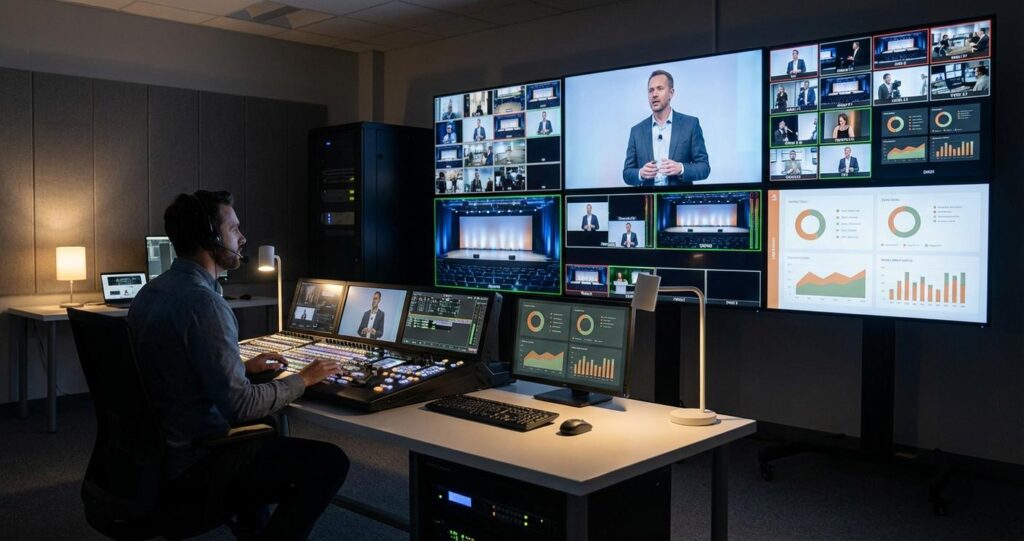
In the enterprise sector, the mandate for hybrid events presents a significant operational and financial challenge. The objective is no longer simply broadcasting a live feed; it is about creating two distinct yet cohesive experiences for both in-person and remote audiences. This duality inherently doubles the production complexity. On-site, production managers must engineer a flawless audio-visual experience with multi-camera setups, professional lighting, and intricate audio reinforcement. Simultaneously, a broadcast-quality virtual experience must be delivered, demanding robust streaming infrastructure, low-latency delivery, and interactive elements. This creates a resource-intensive environment where the Return on Investment (ROI) is constantly scrutinized. The traditional approach requires scaling up crewing, hardware, and management, leading to escalating budgets that can be difficult to justify. The core problem is managing the signal flow, production switching, and stream delivery for two audiences without a linear increase in operational expenditure. Enterprises require a solution that leverages technology to create efficiencies, not just add more layers of hardware and personnel.
The technical hurdles are substantial. Signal chains become convoluted, with the need for separate program feeds, mix-minus audio setups to prevent echo for remote presenters, and dedicated communication channels for geographically dispersed teams. A typical hybrid event requires a baseband infrastructure, often using Serial Digital Interface (SDI) for on-site camera runs and routing, which must then be converted and encoded for IP-based delivery. Protocols like Real-Time Messaging Protocol (RTMP) have been the standard but lack the robustness for high-stakes enterprise streams. More advanced solutions like Secure Reliable Transport (SRT) and Network Device Interface (NDI) are now critical for maintaining signal integrity over unpredictable networks. Managing the encoding parameters, ensuring multi-bitrate ladders for adaptive streaming, and guaranteeing Quality of Service (QoS) across a global audience adds another layer of specialized expertise. This is where AI-powered production systems introduce a paradigm shift, moving from manual, resource-heavy operations to intelligent, automated workflows that directly address these ROI pressures.
AI-Driven Production Automation: From Signal Ingest to Final Delivery
Artificial intelligence is fundamentally reshaping the live production workflow by automating repetitive, decision-heavy tasks that traditionally required dedicated human operators. This is not about replacing production crews but augmenting their capabilities, allowing a smaller team to execute a more complex and polished production. AI-powered systems can ingest multiple video and audio sources, analyze the content in real time, and make intelligent decisions based on pre-defined rules and learned behaviors. This automation spans camera control, source switching, audio management, and graphics insertion, creating a seamless and professional output with unparalleled efficiency. By offloading these cognitive and manual tasks to AI algorithms, production teams can focus on higher-level creative direction and managing the overall event experience, ensuring both the in-person and remote audiences receive a broadcast-quality presentation.
Intelligent Source Switching and Camera Automation
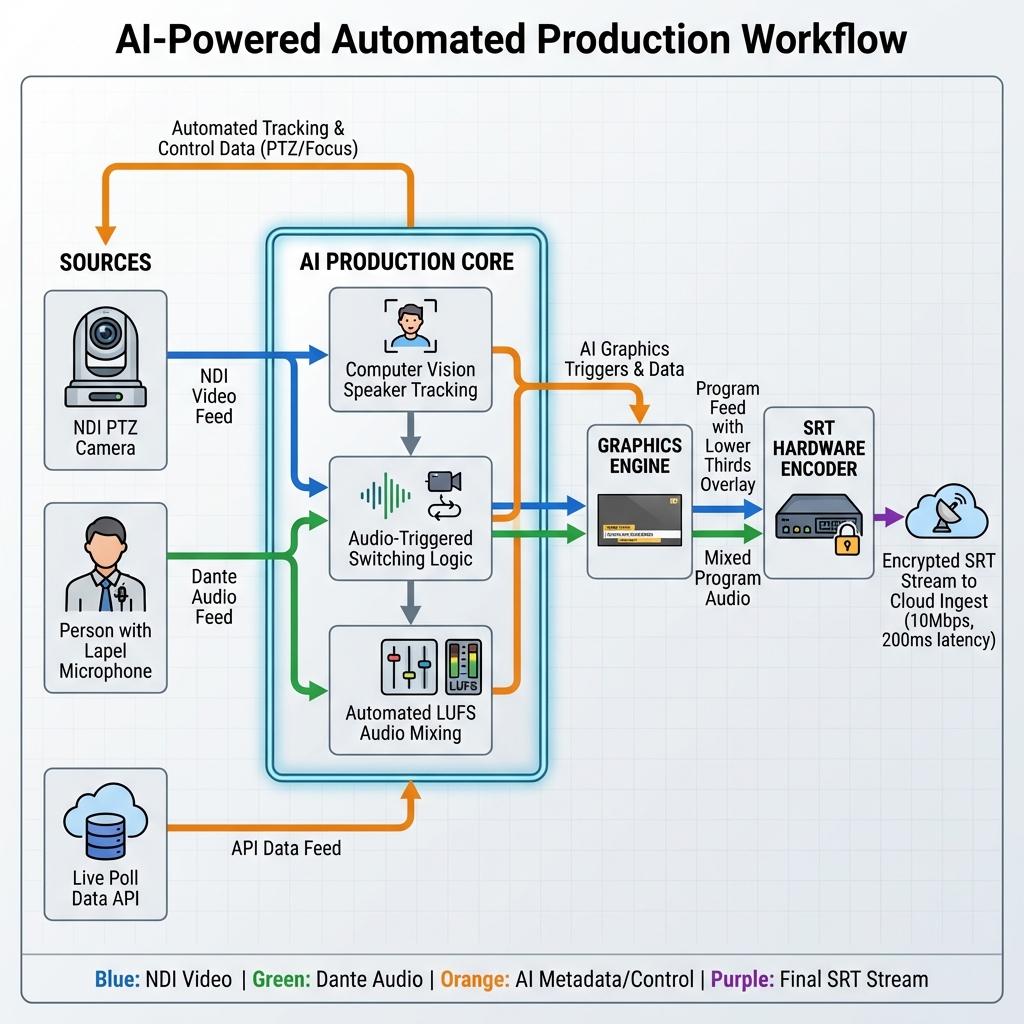
A primary application of AI in live production is automated camera switching. Modern AI systems use a combination of computer vision and audio-level detection to direct the program feed. For a panel discussion, the AI can identify the active speaker by analyzing audio from individual lapel microphones and automatically switch to the camera covering that person. It can be programmed with broadcast logic, such as holding on a wide shot if multiple people speak at once or cutting to a reaction shot of another panelist. Pan-Tilt-Zoom (PTZ) cameras can be fully automated; the AI tracks a presenter as they move across a stage, maintaining perfect framing without a human camera operator. This process utilizes NDI, which allows video, audio, and metadata to be transmitted over a standard IP network. The AI engine receives multiple NDI streams, analyzes the metadata (such as speaker identification or positional data), and controls the production switcher via API calls. This significantly reduces the need for multiple camera operators and a technical director focused solely on switching, directly lowering crewing costs while producing a dynamic, engaging program.
Automated Audio Mixing and Signal Processing
Audio consistency is critical for professional events and is a frequent point of failure. AI-driven audio solutions automate the complex task of gain staging, mixing, and processing. An AI auto-mixer can manage levels from dozens of microphones simultaneously, ensuring that the active speaker is always clear while suppressing background noise from inactive mics. This is far more sophisticated than a simple noise gate. The AI analyzes audio patterns to distinguish between speech and ambient noise, applying equalization (EQ) and compression dynamically to maintain vocal clarity and consistency. Furthermore, these systems ensure the final program mix adheres to broadcast loudness standards, such as the EBU R 128 standard, targeting a specific Loudness Units Full Scale (LUFS) level. This guarantees a consistent listening experience for the remote audience, regardless of their playback device, and prevents jarring shifts in volume. Automating this process removes the need for a dedicated A1 audio engineer for many corporate event scenarios.
Real-Time Graphics and Data Integration
The manual process of creating and deploying on-screen graphics, such as lower thirds for speakers or data-driven visuals, is prone to error and time-consuming. AI can automate this entire workflow. By integrating with event registration platforms or speaker databases via an API, an AI graphics system can automatically generate a lower third with the correct name and title when it detects a new speaker is active. For data-heavy presentations, AI can ingest real-time data from sources like financial market feeds or live polls, and render this information into on-brand graphical templates that are automatically keyed over the program feed. This ensures accuracy and timeliness of information while freeing up a graphics operator. The result is a more informative and visually compelling broadcast that rivals traditional television productions, produced with a fraction of the manual effort.
Optimizing Encoding and Distribution with AI-Powered Network Analysis
The most sophisticated on-site production is worthless if the stream cannot be delivered reliably to the remote audience. This is where AI plays a crucial role in optimizing the encoding and distribution pipeline, ensuring signal integrity from the venue to the end-user. Traditional streaming workflows rely on fixed encoding profiles and single-path delivery, which are vulnerable to network fluctuations. AI introduces a layer of intelligence that can adapt to changing conditions in real time, predict potential points of failure, and optimize resource allocation for the most resilient stream possible. This proactive approach to stream management is essential for enterprise events where a dropped frame or buffering can undermine the entire event’s credibility and impact ROI.
Content-Aware Encoding and Bitrate Optimization
Standard encoding practices use a fixed bitrate ladder, applying the same compression settings regardless of the on-screen content. This is highly inefficient. A static presentation slide does not require the same 8 Megabits per second (Mbps) bitrate as a high-motion video playback. AI-powered, content-aware encoding analyzes each frame of video in real time to determine its complexity. For low-complexity scenes, the AI reduces the bitrate, saving bandwidth without any perceptible loss in quality. For high-motion scenes, it allocates a higher bitrate to preserve detail and prevent artifacting. This process is particularly effective with modern codecs like H.265 (HEVC), which offers superior compression efficiency over the older H.264 standard. By optimizing bitrate allocation frame-by-frame, content-aware encoding can reduce total bandwidth consumption by up to 50 percent. For the enterprise, this translates into lower data transit costs from cloud providers and a more reliable stream for viewers on constrained networks.
Predictive Network Pathing and SRT Protocol Enhancement
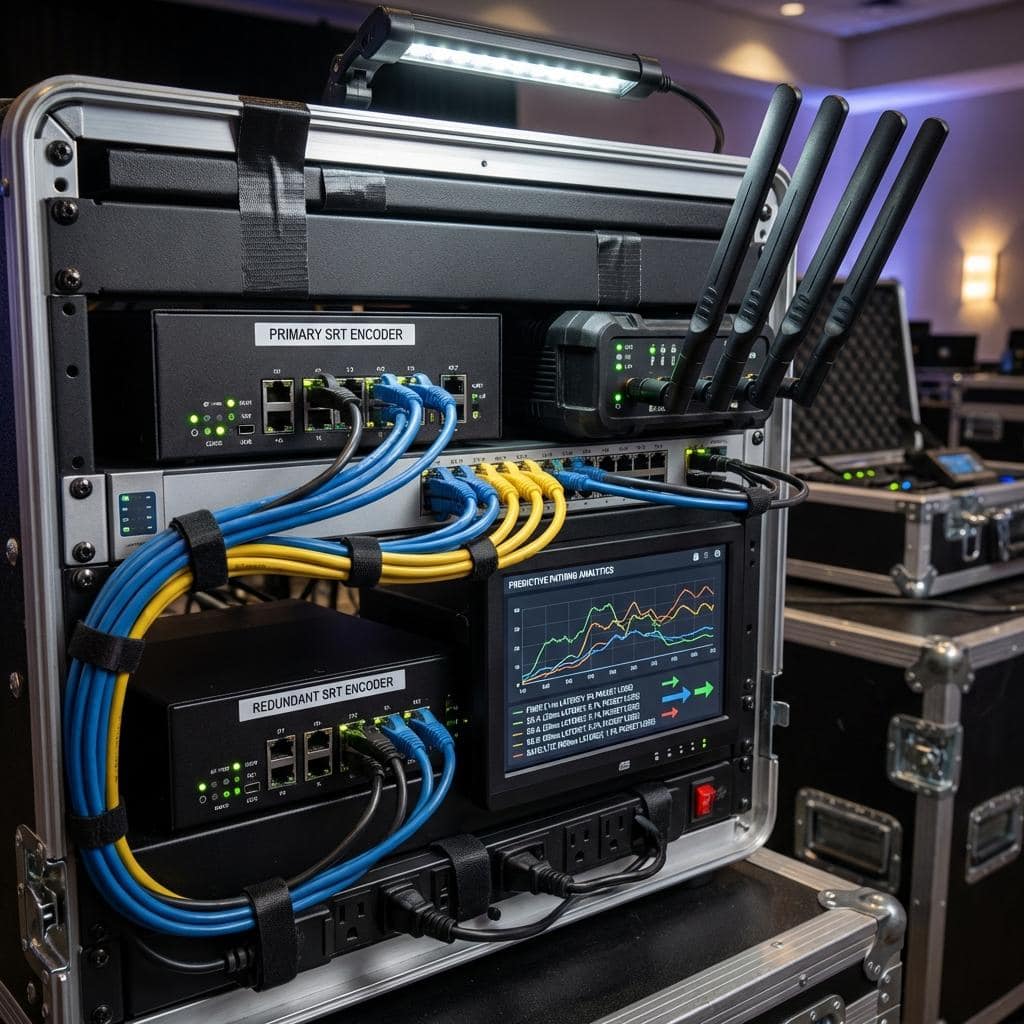
The SRT protocol was a significant advancement, providing error correction and security for streaming over public internet connections. AI enhances SRT’s capabilities through predictive network analysis. In a bonded network environment, where multiple internet connections (e.g., fiber, 5G cellular, satellite) are combined, an AI engine continuously monitors the performance of each path. It measures key metrics like latency, jitter, and packet loss. Instead of simply reacting to a failed path, the AI uses predictive modeling to identify degrading performance before it impacts the stream. It can then intelligently route SRT packets across the healthiest paths, seamlessly avoiding congestion and potential outages. This predictive pathing ensures a stable, low-latency connection from the on-site encoder to the cloud ingest server. This level of resilience, once only achievable with expensive dedicated fiber links, is now accessible through AI-managed bonded networking, providing the rock-solid reliability that corporate events demand.
Post-Event Asset Generation and Analytics: Maximizing Content Value
The value of a hybrid event extends far beyond the live broadcast. The recorded content is a valuable asset that can be used for marketing, training, and internal communications. However, the process of editing, transcribing, and packaging this content for on-demand consumption is traditionally a manual and time-intensive effort. AI accelerates this entire post-production workflow, enabling organizations to maximize the long-term ROI of their event content by making it discoverable, accessible, and insightful almost immediately after the event concludes.
Automated VOD Creation and Chaptering
Following a multi-hour event, an ISO (isolated) recording of the program feed can be fed into an AI processing engine. Using natural language processing (NLP) and image recognition, the AI can automatically transcribe the entire event with a high degree of accuracy. It can identify topic changes and different speakers to automatically generate a table of contents or video chapters. This allows viewers to navigate directly to the most relevant segments of the content. The AI can also generate concise summaries of each section, creating valuable metadata that improves the Search Engine Optimization (SEO) of the on-demand asset. This automated process transforms a monolithic video file into a searchable, user-friendly knowledge base in hours, not weeks.
Engagement Analytics and Sentiment Analysis
Measuring the impact of an event is key to proving ROI. AI can provide deep, actionable insights that go beyond simple viewership numbers. By analyzing the chat logs, Q&A submissions, and polling data from the event platform, AI-powered sentiment analysis can gauge the audience’s reaction to different topics and speakers in real time. It can identify key themes, frequently asked questions, and moments of high and low engagement. This data provides event planners with a clear understanding of what content resonated with their audience. This intelligence is invaluable for planning future events and demonstrating the tangible impact of the hybrid experience to key stakeholders, solidifying the business case for continued investment in high-quality production.

Jeremy Lee is a seasoned digital marketing director and strategist with over two decades of experience in the industry. As the founder of Sotavento Medios, I manage a diverse portfolio of over 50 businesses, helping brands grow through advanced search strategies and digital innovation. My work focuses on bridging the gap between traditional search engine optimisation and the evolving world of AI-driven answer engines.
get in touch