
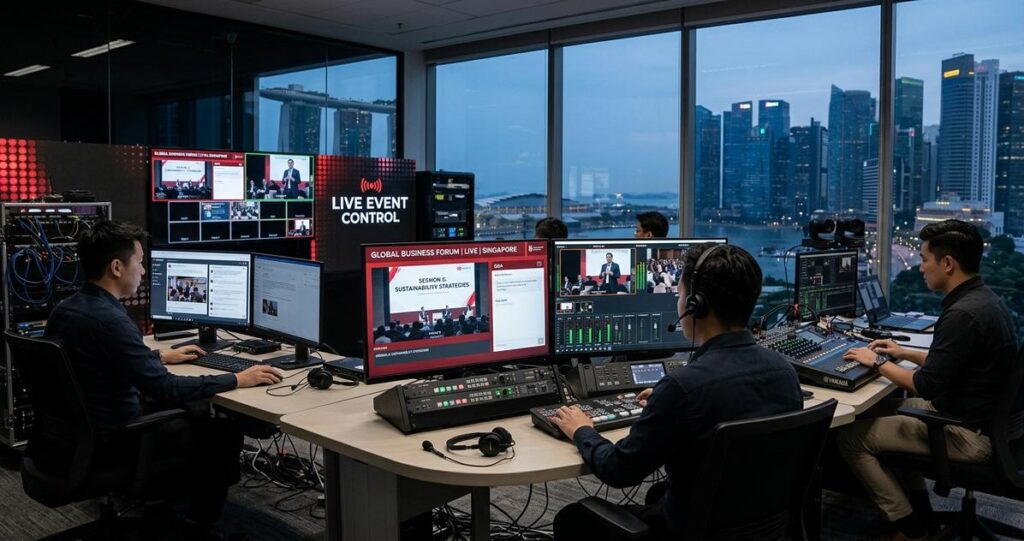
For corporate teams in Singapore, brand integrity is more than a logo, a colour palette, or a polished presentation deck. It is the consistent experience people have with your company across every touchpoint, from client meetings and town halls to investor briefings, product launches, and hybrid events. When a business outsources event streaming, live production, content creation, or platform support, the external partner can either strengthen that consistency or quietly weaken it. This is where white-labeling becomes important. A well-run white-label arrangement allows a specialist vendor to deliver work under your brand, without exposing the vendor’s identity to your audience, so the audience experiences one clear and coherent corporate presence.
In Singapore, where reputation, trust, and professionalism carry significant commercial weight, this matters even more. Many organisations work across multiple markets, manage multilingual stakeholders, and rely on frequent hybrid communication. If external service providers appear inconsistent, display their own branding, or interrupt the customer journey with mismatched visuals and messaging, the result can feel fragmented. White-labeling helps reduce that fragmentation. It supports a unified brand presentation, protects confidentiality, and lets companies present specialist services as part of their own ecosystem while maintaining control over how the audience perceives them.
What white-labeling means in a corporate setting
White-labeling refers to a business arrangement in which one company produces a product or service that another company rebrands and presents as its own. In corporate communications and event production, this can include streaming platforms, video overlays, landing pages, speaker interfaces, registration systems, post-event assets, and technical support delivered behind the scenes. The audience sees the commissioning brand, not the supplier brand. That distinction is particularly useful when the company wants a seamless outward identity and does not want technical vendors to distract from the main message.
For example, a Singapore-based multinational may host a hybrid leadership summit for employees in multiple regions. If the event platform shows the production vendor’s logo, uses inconsistent naming conventions, or routes attendees to third-party branded pages, the company’s identity can feel diluted. A white-label setup lets the organisation maintain its own look and feel across registration, streaming, moderation, and follow-up. The external specialist still handles the technical work, but the experience stays aligned with the company’s own brand standards.
Brand integrity and why it matters
Brand integrity means the brand presents itself consistently, honestly, and professionally across all communications and experiences. It is not only about design, but also about reliability, tone of voice, privacy expectations, and how the organisation handles sensitive information. When a corporate audience receives a message from a brand that looks polished in one place and disjointed in another, trust can erode quickly. In B2B settings, especially where decisions involve large budgets or strategic partnerships, trust is often built through repeated consistency rather than one spectacular campaign.
White-labeling supports that consistency by removing unnecessary visual and operational clutter. It allows the company to show one coherent identity, even when multiple vendors contribute to the delivery. This is valuable in Singapore, where many businesses serve highly discerning clients, government-linked stakeholders, financial institutions, healthcare partners, and regional teams that expect professional standards at every stage.
Why white-labeling protects the corporate brand
White-labeling is often associated with convenience, but its deeper value is brand protection. A corporate brand can be weakened when external service providers remain visible to end users in ways that confuse the relationship between the company and its audience. If a customer attends a webinar and sees another company’s logo on the login page, receives technical emails from an unfamiliar domain, or encounters mismatched templates, the brand experience becomes less credible. White-labeling reduces that risk by keeping the presentation under one umbrella.
It also helps organisations maintain tighter control over messaging. Corporate communications often need to align with legal, regulatory, and reputational requirements. In Singapore, where companies may operate under sector-specific rules or cross-border governance frameworks, a misaligned third-party message can create unnecessary compliance and brand risk. White-labeling does not remove the need for review and governance, but it makes it easier to ensure that what the audience sees matches the company’s approved narrative.
Consistency across customer touchpoints
Customers and stakeholders rarely judge a brand on a single interaction. They form impressions through a series of touchpoints, such as invitation emails, event registration, reminder messages, platform screens, live presentation visuals, and post-event resources. White-labeling helps make those interactions feel like part of one designed journey rather than a series of separate vendor handoffs.
For Singapore businesses, that consistency can be especially useful when addressing bilingual or multilingual audiences, regional leadership teams, or a mix of internal and external stakeholders. A standardised branded environment allows the company to adapt content for different audiences while preserving the same visual and editorial identity. That is important for companies that want to look established, dependable, and precise.
Confidentiality and discretion
Corporate events sometimes involve sensitive material, such as product launches, investor briefings, merger updates, internal policy communications, or unreleased commercial plans. White-labeling can support discretion by ensuring that external suppliers do not become visible to attendees or clients. While confidentiality still depends on the contract, security measures, and internal controls, a white-label approach reduces unnecessary exposure of the vendor relationship and keeps the focus on the commissioning company.
This can be particularly relevant in Singapore’s business environment, where professionalism and discretion are often part of the expected service standard. A clean branded experience signals that the organisation has thought carefully about the audience journey and the handling of important information.
How white-labeling supports hybrid events and digital delivery
Hybrid events have made white-labeling more important because attendees now interact with brands through multiple digital layers. They may receive calendar invites, email communications, registration forms, virtual lobbies, live streams, polls, chat functions, breakout sessions, and on-demand replay pages. Each layer is a chance to reinforce the brand, or to break the illusion of a seamless experience. White-labeling allows the company to extend its identity across these layers, so the digital environment feels like part of the same organisation.
For event teams in Singapore, this is especially relevant because many corporate gatherings now involve remote participation from regional offices or overseas guests. A white-label system can help maintain visual continuity across time zones, platforms, and content formats. It can also reduce confusion when multiple service providers are involved, such as the event planner, AV crew, streaming vendor, and content designer. The client-facing brand stays central, while the specialist partners work in the background.
Better audience experience
A branded digital journey feels more professional because it reduces friction. Attendees can recognise the sender, the event, and the context immediately. This can improve engagement because users are less distracted by unfamiliar vendor branding or inconsistent layouts. It also makes follow-up communication easier to trust, since post-event materials come from the same branded environment they experienced before and during the event.
In practice, a Singapore corporate team might use a white-label registration portal, a branded streaming page, custom lower-thirds for speakers, and a follow-up resource hub with company colours and fonts. The audience then experiences one continuous brand story. That continuity strengthens recognition and supports the company’s credibility.
Operational efficiency for internal teams
White-labeling is not only an outward-facing branding decision. It can also improve internal workflows. Marketing teams, corporate communications teams, and event managers often spend considerable time checking that vendors use the correct assets, naming conventions, and message hierarchy. A well-structured white-label system, supported by brand guidelines and pre-approved templates, can reduce this repetitive work.
That matters in fast-moving corporate environments, where teams may need to support frequent events, leadership communications, or campaign rollouts. When a trusted partner can deliver within the brand framework, internal teams can focus on governance, content quality, and stakeholder management rather than reworking every touchpoint from scratch.
What Singapore companies should look for in a white-label partner
Choosing a white-label partner is not simply about removing a logo. The provider should be capable of operating as an extension of the company’s brand and process standards. That means technical competence, confidentiality, responsiveness, and the ability to follow the brand system precisely. Companies in Singapore should ask whether the partner can work with existing brand assets, multilingual content requirements, and different stakeholder approval processes.
It is also important to consider data handling and privacy expectations. If the white-label service involves attendee information, email systems, registration data, or video platforms, the company should review contractual protections and operational safeguards carefully. In Singapore, personal data is governed by the Personal Data Protection Act 2012, commonly known as the PDPA. Organisations that collect, use, or disclose personal data must have appropriate consent or another valid basis under the law, and they must make reasonable security arrangements to protect that data. A white-label vendor should support, not weaken, those obligations.
Questions to ask before engaging a vendor
- Can the vendor fully remove its own branding from the attendee-facing experience?
- Can the vendor follow our corporate identity guidelines across live and digital assets?
- How are attendee data, recordings, and access credentials protected?
- Can the vendor support bilingual or regional content if required?
- What review process is used to approve templates, screens, and communications before launch?
- How quickly can the vendor respond if an on-air or platform issue affects brand presentation?
These questions help determine whether the partnership can maintain brand integrity under real operating conditions, not just in a pitch deck. A reliable white-label partner should be able to demonstrate disciplined processes, not just creative polish.
Governance and brand control
White-labeling works best when the company establishes a clear governance model. That usually includes approved brand assets, tone of voice guidelines, escalation paths, and defined sign-off responsibilities. It may also include a checklist for event assets, such as speaker slides, holding screens, chat prompts, reminder emails, and replay pages. When governance is weak, white-labeling can become inconsistent and create the very confusion it was meant to prevent.
In Singapore, many organisations operate within matrix structures, where regional, local, and functional teams all have input. A good governance model helps prevent last-minute changes from compromising the brand. It gives everyone a shared framework for decision-making while keeping the public-facing experience consistent.
Practical ways white-labeling strengthens reputation in Singapore
Singapore is a highly connected business hub, and many companies use events and digital platforms to communicate with clients, employees, regulators, partners, and investors. In this environment, reputation can be shaped by small details. A polished white-label experience can make a company appear more organised, more mature, and more trustworthy. That does not mean branding alone creates credibility, but it does mean branding can support the credibility that operational excellence already deserves.
For example, a professional services firm hosting a client briefing at a central business district venue may want every digital and printed element to reflect the same brand language, from sign-in pages to presentation lower-thirds and follow-up downloads. A healthcare provider running an internal update for staff may need a controlled, branded environment that communicates seriousness and clarity. A technology company launching a regional product update may need to look consistent across Singapore, Malaysia, and beyond. In each case, white-labeling helps keep the message coherent.
There is also a practical culture fit. Singapore audiences generally expect efficiency, clarity, and professionalism. A white-label system supports those expectations because it removes unnecessary friction and keeps attention on the content, not the supplier infrastructure. For B2B organisations, that can make every interaction feel more considered and more premium without relying on exaggeration.
Making white-labeling part of a long-term brand strategy
White-labeling should not be treated as a one-off technical fix. When integrated properly, it becomes part of a long-term brand strategy that supports every event, campaign, and stakeholder communication. The goal is not to hide partners for its own sake. The goal is to ensure that the audience experiences one consistent brand, with no distracting seams between internal teams and external specialists.
Companies that benefit most from white-labeling are usually those with frequent events, sensitive communications, regional audiences, or strict brand standards. They understand that brand integrity is cumulative. It is built through repetition, precision, and disciplined execution. A white-label framework helps protect those qualities, especially when the company relies on third parties to deliver high-visibility work.
For organisations in Singapore, the takeaway is straightforward. If your brand appears in public, on screen, in inboxes, or across event environments, every touchpoint should reflect the same standards of care. White-labeling is one of the most practical ways to make that happen. It supports consistency, confidentiality, and audience trust, while allowing specialist partners to do the technical work behind the scenes. When used thoughtfully, it becomes a quiet but powerful part of corporate brand integrity.
If your organisation is planning a hybrid event, executive briefing, or branded digital experience, it is worth reviewing whether your current setup truly presents a unified brand. A strong white-label approach can help you present a polished, professional identity that matches the quality of the work you do.

Jeremy Lee is a seasoned digital marketing director and strategist with over two decades of experience in the industry. As the founder of Sotavento Medios, I manage a diverse portfolio of over 50 businesses, helping brands grow through advanced search strategies and digital innovation. My work focuses on bridging the gap between traditional search engine optimisation and the evolving world of AI-driven answer engines.
get in touch