
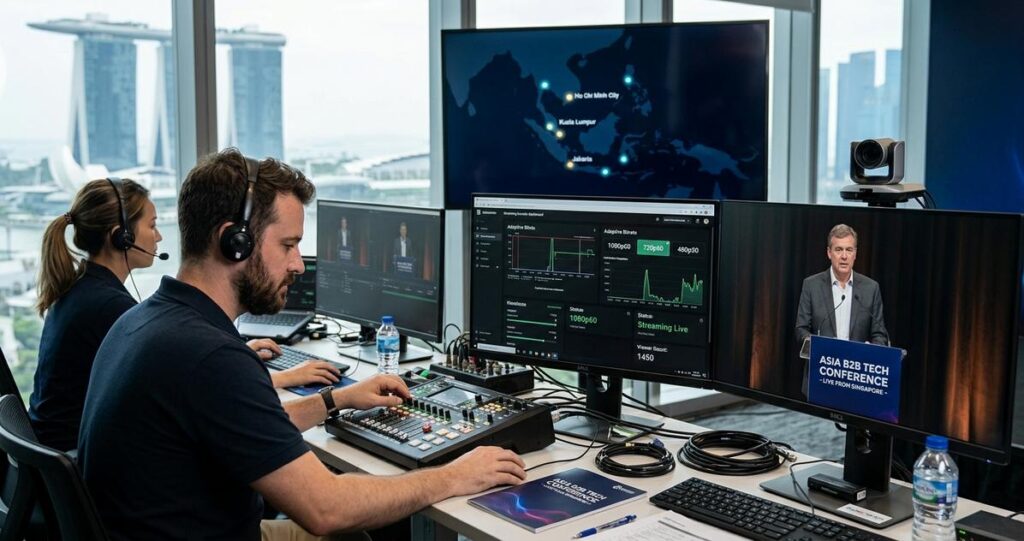
For many Singapore-based teams producing regional B2B events, low bandwidth is not an occasional inconvenience, it is a practical reality that can shape how well a webinar, hybrid conference, product launch, or investor briefing is received across Southeast Asia. A polished studio feed may look effortless in Singapore, but once the audience extends into regional markets, viewers may be joining from office networks with strict firewalls, mobile connections, shared Wi-Fi, or unstable last-mile infrastructure. In B2B settings, this matters because the audience is often there for decision-making, training, procurement, or sales enablement. If the stream buffers, the audio drops, or the slides lag behind the speaker, the event loses credibility very quickly.
Singapore hosts a large number of regional headquarters, technology vendors, professional services firms, and cross-border commercial teams, which makes it a natural production base for Asia-Pacific communication. That also means local producers and in-house corporate teams need a reliable approach for viewers joining from Indonesia, Malaysia, Thailand, Vietnam, the Philippines, India, and other regional markets where bandwidth conditions can vary widely. The goal is not simply to make a stream look good at the source. The goal is to make it understandable, accessible, and stable for the widest possible audience, including viewers who may be watching on constrained connections. This requires careful technical planning, disciplined content design, and realistic expectations about how online video behaves when network conditions are not ideal.
Why low bandwidth remains a real issue for regional B2B audiences
Low bandwidth means the available network capacity is not enough to carry video and audio smoothly at the chosen quality level. In practical terms, that can result in long loading times, pixelated video, frozen frames, audio desynchronisation, and repeated buffering. For a consumer entertainment stream, a viewer may tolerate some degradation. In a B2B event, viewers are often trying to absorb product details, compare features, follow a panel discussion, or take part in a live Q and A. Even small interruptions can make the content harder to trust and harder to use.
Regional audiences also consume content in very different network environments. One person may be on a corporate desktop in an office with stable fibre. Another may be on a mobile phone during a commute, or attending from a branch office with bandwidth shared across multiple applications. This is common in ASEAN markets where internet infrastructure and workplace connectivity can differ significantly between urban centres and secondary locations. A production plan that assumes every attendee has strong fibre or 5G access is not a robust plan for regional B2B delivery.
For Singapore-based organisers, the challenge is amplified by the fact that local expectations are often high. Singapore audiences are accustomed to clean audio, sharp slides, and responsive digital experiences. When an event is designed from Singapore for a regional audience, the production team must balance high standards with network resilience. That balance is central to professional event streaming.
What breaks first when bandwidth is limited
Video quality usually degrades before audio, because video uses far more data. However, when systems are poorly configured, both can suffer. Common failure points include high-resolution camera feeds, multiple simultaneous sources, heavy motion graphics, and screen shares with dense text that become unreadable after compression. If the presenter speaks quickly and the slide deck is visually busy, compressed video becomes even harder to follow.
Audio often matters more than video in B2B streaming. Viewers can usually continue if the picture becomes softer, but they may leave immediately if they cannot hear clearly. That is why a low-bandwidth strategy should always protect audio first, then preserve presentation legibility, and only then consider video aesthetics.
Designing streams that survive constrained connections
A resilient stream starts with production choices that reduce unnecessary data use without compromising the message. This is not about making the event look cheap. It is about making sure the content reaches the audience consistently. Professional teams should think in terms of prioritisation, redundancy, and simplicity. When the network is uncertain, every part of the workflow should support graceful degradation, meaning the stream still functions acceptably even if quality drops.
Use the right encoding settings from the start
Encoding converts raw camera and screen sources into a stream that viewers can receive. If the bitrate is too high, low-bandwidth viewers will struggle. Bitrate is the amount of data transmitted per second, and it directly affects how much bandwidth the stream requires. Adaptive bitrate streaming, which sends different quality levels to different viewers based on their connection, is one of the most effective safeguards for regional audiences. It allows the player to shift between higher and lower quality variants automatically depending on available bandwidth.
Resolution should also be chosen with audience conditions in mind. For many B2B events, a 1080p source may be useful for capturing a clean master feed, but that does not mean every viewer needs to receive 1080p at all times. A well-built delivery stack can offer lower variants, such as 720p or 540p, to maintain watchability. The important principle is that the viewer should still be able to understand the content at the lower setting.
Frame rate should be kept sensible. High frame rates use more bandwidth and are often unnecessary for keynote talks, panels, or product walkthroughs. For most business presentations, a standard frame rate is sufficient. This helps preserve bandwidth for the elements that matter most, especially speech clarity and readable slides.
Prioritise clean audio and simple visuals
In low-bandwidth conditions, audio is the backbone of comprehension. Use a dedicated microphone, monitor levels carefully, and avoid room acoustics that create echo or reverberation. A noisy or hollow sound can make the speaker seem less authoritative even if the video remains acceptable. In Singapore, where many events are produced from hotel ballrooms, studio spaces, or corporate boardrooms, sound control should be part of the initial venue check rather than an afterthought.
Visual design should also support compression. Slides with large fonts, strong contrast, and limited on-screen clutter perform better than slides packed with small text or multiple data tables. If a speaker needs to present a complex chart, it is better to break it into smaller sections or provide a downloadable handout in advance. Lower motion graphics usage can also help, because rapid scene changes are harder to compress efficiently. A steady camera shot of the presenter, paired with clean slide content, is often more effective than a visually elaborate production that looks impressive in the control room but performs poorly on weak connections.
Prepare redundant delivery paths
Redundancy is the practice of building fallback options so the event can continue if one path fails. For low-bandwidth regional viewers, redundancy can mean offering both a primary stream and a lower-bandwidth alternative, or making a recorded version available quickly after the live segment. In some cases, a simulcast on a more bandwidth-efficient platform or a backup audio-only dial-in can preserve access for participants who cannot sustain full video playback.
For internal or closed B2B events, organisers should also consider distributing key documents beforehand. If viewers lose the stream, they can still follow the material through the provided deck, agenda, or FAQ sheet. This is especially useful for procurement presentations, technical briefings, and compliance sessions where specific details matter.
Operational practices that improve reliability during the event
Technical planning is only one part of the solution. The live operation itself has to anticipate network instability and user behaviour. Regional viewers often join from different devices, browsers, and connection types. A strong production team tests not only the broadcast chain, but also how the audience will experience the stream under constrained conditions. That means reviewing playback on mobile data, older laptops, and standard office networks where possible.
Test in realistic network conditions
Testing should include low-bandwidth simulation, not just perfect office internet. Teams can use controlled network throttling during rehearsals to see how the stream behaves at lower speeds. This helps reveal whether slides remain legible, whether audio remains stable, and how quickly the player adapts when the connection fluctuates. It is better to discover these issues before the event than during a live panel with executives on stage.
For Singapore organisers serving regional markets, it is useful to involve at least one regional viewer profile in testing. For example, a colleague joining from a mobile hotspot can help identify issues that may not appear on Singapore fibre. This kind of operational realism is a hallmark of trustworthy event production.
Keep the agenda tight and the cues simple
Long, meandering sessions increase the chance that viewers will experience network fatigue or session drop-off. A concise agenda with clear segment changes helps maintain engagement even if the connection is not perfect. When bandwidth is limited, viewers benefit from predictable structure. Announce transitions clearly, keep speaker handovers smooth, and minimise dead air. If the audience needs to wait, make the reason explicit, for example, a short pause while a product demo is loaded or a speaker changes screen share.
Lower-bandwidth viewers also benefit from strong moderation. A moderator can restate key points, summarise questions, and keep the pace steady. This helps compensate for moments when the stream quality dips. For B2B settings, this is especially valuable because the audience is often listening for precise information rather than passive entertainment.
Have a clear fallback plan for critical moments
When a keynote, earnings update, or product announcement carries high business importance, the fallback plan should be written and rehearsed. If the stream quality drops below an acceptable threshold, the team should know whether to switch to a lower-quality feed, pause briefly, continue audio-only, or move to a pre-recorded segment. The right choice depends on the type of event and the audience expectation, but the decision should not be improvised under pressure.
It is also wise to identify which moments require extra attention, such as live demos, surveys, or audience Q and A. These segments can be bandwidth-sensitive because they often involve rapid screen changes or interaction with multiple systems. A well-run event protects these moments with more testing and simpler execution.
How to support viewers without overcomplicating the experience
Reducing bandwidth demands should not mean giving viewers less support. Good communication helps them prepare for the event and use the stream successfully. This is particularly relevant in Singapore, where many B2B events are multilingual or regional by design and where attendees may join from both desktop and mobile devices. If the instructions are clear before the event begins, fewer viewers will struggle during playback.
Set expectations before the stream starts
Send practical joining instructions that explain recommended browsers, whether mobile viewing is supported, and whether the session includes downloadable materials. If a low-bandwidth option is available, make that clear in advance. Viewers should know whether they can switch to a lighter stream or whether an audio-first approach will be available if their connection weakens.
For regulated or high-stakes business topics, organisers may also want to tell participants how to handle disconnections. For example, if the session includes a recording or an on-demand replay, say when that will be available. This reassures attendees and reduces pressure on the live stream to perform perfectly at every moment.
Use accessible communication habits
Speak clearly, avoid talking over slide changes, and give the audience time to absorb each point. Since low-bandwidth viewers may experience a short delay, presenters should not assume the live feed is perfectly synchronous for everyone. Simple phrasing helps. So does pausing after important statements so viewers can catch up. If a session includes acronyms, define them once in plain language. This improves understanding for all viewers, including those joining under less-than-ideal network conditions.
Captions and transcripts can also improve usability, especially when audio quality is compromised or the viewer is in a noisy environment. While captions are not a substitute for a stable stream, they provide an important accessibility layer. For Singapore audiences and regional viewers alike, this is a practical way to make the event more inclusive and useful.
Singapore context, procurement expectations, and long-term planning
Singapore businesses often work with regional partners, clients, and distributors, so the quality of a streamed event can affect how a brand is perceived across multiple markets. A smooth broadcast supports professionalism, while repeated technical failures can create avoidable friction with prospects and stakeholders. In procurement discussions, it is sensible to ask vendors how they handle adaptive delivery, low-bandwidth playback, backup workflows, and audience support. These are not niche questions. They are core operational questions for modern regional communication.
There is also a strategic benefit to designing for constraint. A stream that works well under poor network conditions usually performs very well under normal conditions. In other words, low-bandwidth resilience is not only a defensive measure, it is a sign of mature production planning. That mindset aligns well with the expectations of Singapore organisations that value reliability, precision, and professional execution.
For companies that regularly deliver regional B2B content, it is worth building low-bandwidth readiness into the standard operating process. That includes equipment selection, venue checks, rehearsal planning, slide design guidance, and post-event review. After each event, teams should examine where viewers may have struggled, which segments were easiest to consume, and what would improve future delivery. Over time, this creates a more dependable regional streaming model.
Low-bandwidth planning is ultimately about respect for the audience. If a company asks people to spend time on a live session, it should make reasonable efforts to ensure the session is accessible across real-world network conditions. That is especially important in regional B2B communication, where clarity, credibility, and continuity all matter. By using adaptive delivery, clean audio, simple visuals, strong moderation, and realistic testing, Singapore-based organisers can produce streams that serve both local expectations and regional realities.
For B2B teams, the practical takeaway is straightforward. Build for the weakest likely connection, protect audio first, simplify visuals, test with realistic network conditions, and give viewers a clear fallback path. Those steps do not just improve technical performance. They improve the business value of the event itself.

Jeremy Lee is a seasoned digital marketing director and strategist with over two decades of experience in the industry. As the founder of Sotavento Medios, I manage a diverse portfolio of over 50 businesses, helping brands grow through advanced search strategies and digital innovation. My work focuses on bridging the gap between traditional search engine optimisation and the evolving world of AI-driven answer engines.
get in touch