
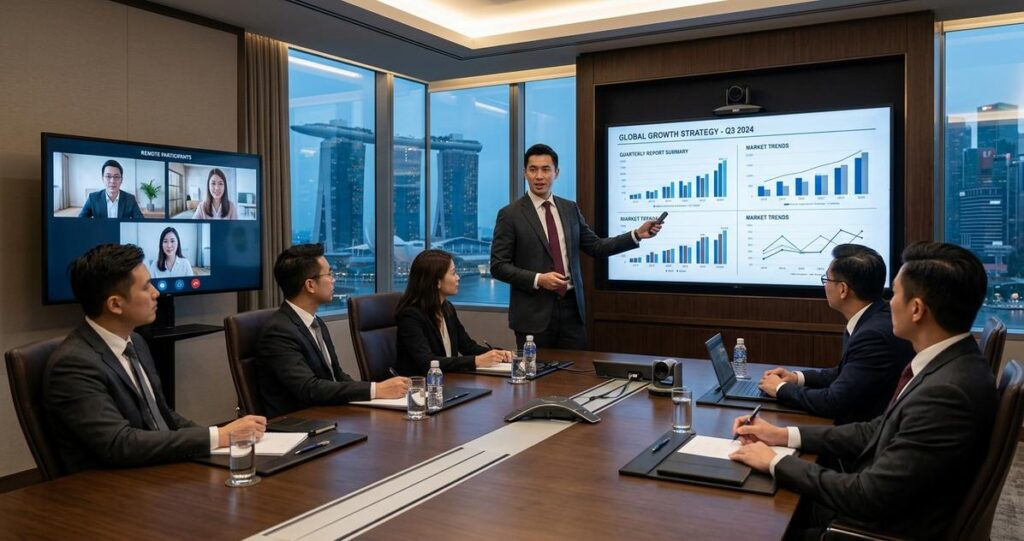
High-end investor briefings are not ordinary corporate meetings. In Singapore, where investor expectations are shaped by a strong finance culture, strict compliance norms, and a highly connected business environment, the platform you choose can directly influence how credible, secure, and polished your briefing feels. Whether you are presenting to family offices, private equity partners, listed company stakeholders, venture capital prospects, or cross-border investors joining from overseas, the delivery platform is part of the message. A stable and well-designed platform supports confidence, protects sensitive information, and helps your leadership team communicate with clarity.
The wrong choice, by contrast, can weaken even the strongest investment story. Choppy audio, poor slide rendering, weak access control, or complicated joining steps can make the experience feel unprofessional and raise concerns about operational readiness. For investor briefings, especially those involving financial data, forecasts, deal updates, or strategic plans, the platform must do more than transmit video. It must support confidentiality, reliability, interactivity, and a presentation standard that reflects the seriousness of the occasion.
For Singapore-based companies, this decision often involves more than selecting a familiar video call tool. The ideal platform depends on the size of the audience, whether the briefing is in person, virtual, or hybrid, the level of confidentiality required, and how much control you need over branding, access, and audience engagement. A thoughtful platform choice helps your team deliver a briefing that is clear for local participants, accessible for overseas stakeholders, and consistent with professional expectations in Singapore’s business environment.
What a high-end investor briefing platform must deliver
A high-end investor briefing has a different set of priorities from an internal town hall or a general webinar. Investors usually want information that is accurate, concise, and easy to evaluate. That means the platform must support a presentation format that feels seamless, not distracting. It should allow speakers to maintain authority, help attendees focus on the content, and reduce friction at every stage, from registration to post-event follow-up.
At a minimum, the platform should provide stable video and audio, secure access controls, reliable screen sharing, and support for multiple speakers or presenters. For investor briefings, professional production quality matters because visual clarity can affect comprehension of charts, financial models, and deal timelines. If your team is presenting market data or strategic roadmaps, the platform should preserve image resolution and avoid compression that makes text hard to read.
For Singapore organisations, local relevance also matters. Many investor audiences are regional or global, so your platform should support timezone coordination, remote access from different jurisdictions, and strong data handling practices. Singapore businesses commonly work with board members, financial advisers, legal teams, and regional stakeholders, so the platform needs to fit into a broader governance process rather than sit apart from it.
Security and access control
Security is one of the first criteria to assess. Investor briefings often contain non-public financial information, business strategy, or pre-deal updates. That means the platform should support unique access links, waiting rooms or controlled entry, passcode protection, and the ability to restrict attendance by invitation only. If recordings are involved, you should also confirm who can access them, where they are stored, and how long they remain available.
In Singapore, where many companies operate in regulated sectors or handle commercially sensitive information, the platform should align with internal governance requirements and any relevant confidentiality obligations. If your investor briefing includes personal data, the organisation should also consider the requirements of Singapore’s Personal Data Protection Act, commonly called the PDPA, which governs the collection, use, and disclosure of personal data in Singapore. A secure platform does not replace legal review, but it supports compliance by reducing unnecessary exposure.
Presentation quality and audience experience
High-net-worth and institutional audiences expect a smooth, polished experience. Poor audio, delayed slides, awkward transitions, or unstable camera switching can reduce attention and distract from the message. A strong platform should support high-definition video, low-latency delivery where possible, and clear screen sharing that keeps financial charts readable. If you are showcasing product demonstrations, executive interviews, or live Q and A, the platform should handle these elements without technical clutter.
Equally important is the participant experience. The platform should make it easy for investors to join, view materials, submit questions, and move between session segments. The best platforms remove unnecessary friction. A briefing that feels simple for the audience often reflects careful planning behind the scenes.
Matching the platform to your briefing format
Not every investor briefing needs the same setup. Some events are fully virtual, some are entirely in person, and many are hybrid, with a live room in Singapore and remote attendees joining from elsewhere. The right platform depends on which format you are using and how much interaction you need between the speaker team and the audience. Choosing with the format in mind helps you avoid overbuying features you do not need, or under-specifying the tools needed for a demanding audience.
Singapore’s business community often operates across borders, so hybrid delivery is common for investor communications. This makes format planning especially important. A platform that works well for a small internal webinar may not be suitable for a live investor event with multiple presenters, a moderator, a Q and A segment, and remote attendance from different countries.
Virtual investor briefings
A virtual briefing is often the most efficient option when participants are spread across regions or when the goal is to deliver a focused presentation with limited logistics. For this format, the platform should prioritise reliability, easy access, and speaker control. It should also allow for polished transitions, branded presentation layouts, and moderation tools that keep questions organised.
Virtual briefings can work well for results updates, fundraising introductions, or portfolio progress reports. However, they can feel impersonal if the platform is not designed for high engagement. If your audience is expected to ask detailed questions, the platform should offer features such as moderated Q and A, chat controls, or a structured hand-raise function. This helps maintain order while preserving a professional tone.
Hybrid investor briefings
Hybrid briefings are increasingly relevant in Singapore because they let organisations host a select in-room audience while welcoming remote investors, analysts, or partners from overseas. This format demands more from the platform because it must bridge two experiences at once. On-site participants need a premium live event feel, while remote participants need a clean and uninterrupted digital experience.
The platform should support multi-camera production, real-time switching, clear speaker audio, and strong moderation. It should also allow the remote audience to feel included rather than secondary. For example, if questions will be taken from both the room and online, the platform should make that workflow manageable. A hybrid event succeeds when both audiences feel the briefing was built for them, not added as an afterthought.
In-person briefings with digital extensions
Some investor meetings are mainly in person but still benefit from digital tools, such as live streaming to a closed audience or recording for later distribution. In these cases, the platform may be used more as a secure broadcast layer than as a full interactive event system. That can be a practical choice for confidential briefings where attendance is tightly controlled.
For this model, reliability and discretion matter more than flashy interactivity. The digital extension should be stable, private, and aligned with the physical venue setup. This is especially useful for Singapore teams hosting foreign investors who cannot travel in, while preserving the face-to-face quality for local attendees.
Technical, legal, and operational factors to check before you decide
A platform decision should be made through a structured review, not by convenience alone. Investor briefings often involve senior stakeholders, and the risks of a technical failure or access breach can be reputational as well as operational. In Singapore, where many organisations work with legal, compliance, finance, and corporate communications teams, the right process usually includes technical testing, security review, and event rehearsals.
It helps to think in three layers: technical performance, legal and compliance readiness, and operational usability. If a platform excels in one layer but fails in another, it may still be the wrong choice for a high-end investor audience.
Technical stability and redundancy
The platform should be proven to handle the expected audience size and content complexity. Ask whether it supports the number of presenters you need, whether it can tolerate bandwidth fluctuations, and whether there are fail-safe measures if one part of the production chain goes down. For important investor communications, backup audio paths, alternate streaming options, and rehearsal of contingency plans are not luxuries. They are basic professionalism.
If the briefing includes pre-recorded segments, embedded videos, live demonstrations, or multiple remote presenters, the platform should be tested under realistic conditions. A production team should confirm that the platform handles browser compatibility, device variability, and the types of networks common in Singapore offices, homes, and overseas locations. Even the best content can be weakened by a poor technical setup.
Compliance, confidentiality, and data handling
For investor briefings, confidentiality is often as important as presentation quality. Platform selection should therefore include review of data storage location, user authentication, access logs, and recording retention policies. If recordings or registration data are collected, the organisation should understand how that data is processed and who controls it.
Singapore organisations should also align platform use with internal data governance, cross-border data transfer considerations, and any sector-specific obligations. A platform used for investor communications should be vetted as carefully as any other business-critical tool. This is especially true where briefing materials include unpublished financial performance, merger discussions, or strategic plans that must not be exposed beyond the intended audience.
Branding and executive presence
Investor briefings are also brand moments. The platform should allow you to present a consistent visual identity, from registration pages to on-screen graphics and speaker backdrops. A cohesive branded experience reinforces professionalism and helps investors associate the briefing with organised leadership and operational maturity.
Executive presence matters too. Leaders should appear confident on camera, and the platform should support that with clean layouts, proper lighting, stable framing, and speaker management tools. Even a strong investment thesis can lose impact if executives appear distracted or the visual environment feels improvised.
How to evaluate vendors and production partners in Singapore
Many organisations do not use a platform on its own. They also work with a production partner, event team, or communications agency to manage the briefing from planning to delivery. That is often the best approach for high-stakes investor events because the technology and the event direction must work together. A capable partner helps you choose the right platform, configure it properly, test it thoroughly, and manage the live event calmly.
In Singapore, where executive standards are typically high and time is often limited, it is sensible to evaluate both the platform and the team supporting it. A technically strong platform without experienced operators can still fail under pressure. A skilled production team can often make the difference between a briefing that feels merely functional and one that feels truly premium.
Questions to ask before committing
When reviewing platform options, ask practical questions. How does the platform handle security and invite-only access? Can it support the audio and visual quality needed for financial presentations? Does it allow live moderation and controlled Q and A? Can the production team conduct rehearsals, run a technical backup, and support the event on the day? Is the platform suitable for Singapore-based audiences and overseas participants?
It is also wise to ask how the platform performs when combined with venue infrastructure. A platform may appear excellent in a demo, but investor briefings often rely on microphones, displays, internet connectivity, and switching equipment at the venue. Compatibility between the digital platform and the physical environment is critical for a smooth result.
Why local experience matters
Working with a team that understands Singapore’s business context can reduce risk. They are more likely to anticipate scheduling across time zones, venue constraints, bilingual presentation needs, and the expectations of financial and corporate stakeholders. They can also advise on venue logistics, speaker run-throughs, and contingency planning, which are essential for investor briefings where first impressions matter.
Local experience is especially valuable when the briefing includes executives flying in from different regions, board members joining remotely, or investors who expect a formal and precise delivery. A production partner familiar with Singapore’s event environment can make the process smoother without adding unnecessary complexity.
Choosing the right platform for a high-end investor briefing is not just a technology decision. It is a governance decision, a communication decision, and a reputation decision. The right choice supports security, clarity, and confidence, while the wrong one can introduce avoidable risk. For Singapore organisations, the best platform is the one that fits the briefing format, protects sensitive information, and gives every participant a polished experience, whether they are in the room or joining from abroad.
If you are planning an investor briefing, start with the audience profile, confidentiality needs, and event format. Then test the platform against practical requirements such as access control, audiovisual quality, moderation tools, and compliance considerations. In many cases, the most effective solution is not simply the most familiar platform, but the one that is professionally configured and carefully supported from start to finish. For a high-end investor audience, that preparation is what turns a presentation into a credible, memorable briefing.
Jeremy Lee is a seasoned digital marketing director and strategist with over two decades of experience in the industry. As the founder of Sotavento Medios, I manage a diverse portfolio of over 50 businesses, helping brands grow through advanced search strategies and digital innovation. My work focuses on bridging the gap between traditional search engine optimisation and the evolving world of AI-driven answer engines.
get in touch