
The Critical Role of Signal Flow Integrity and Source Validation
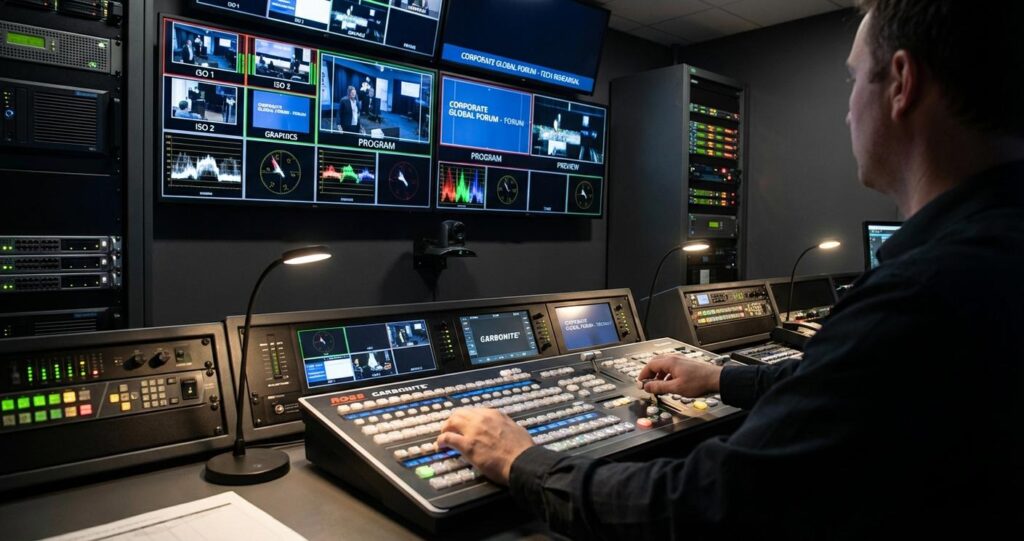
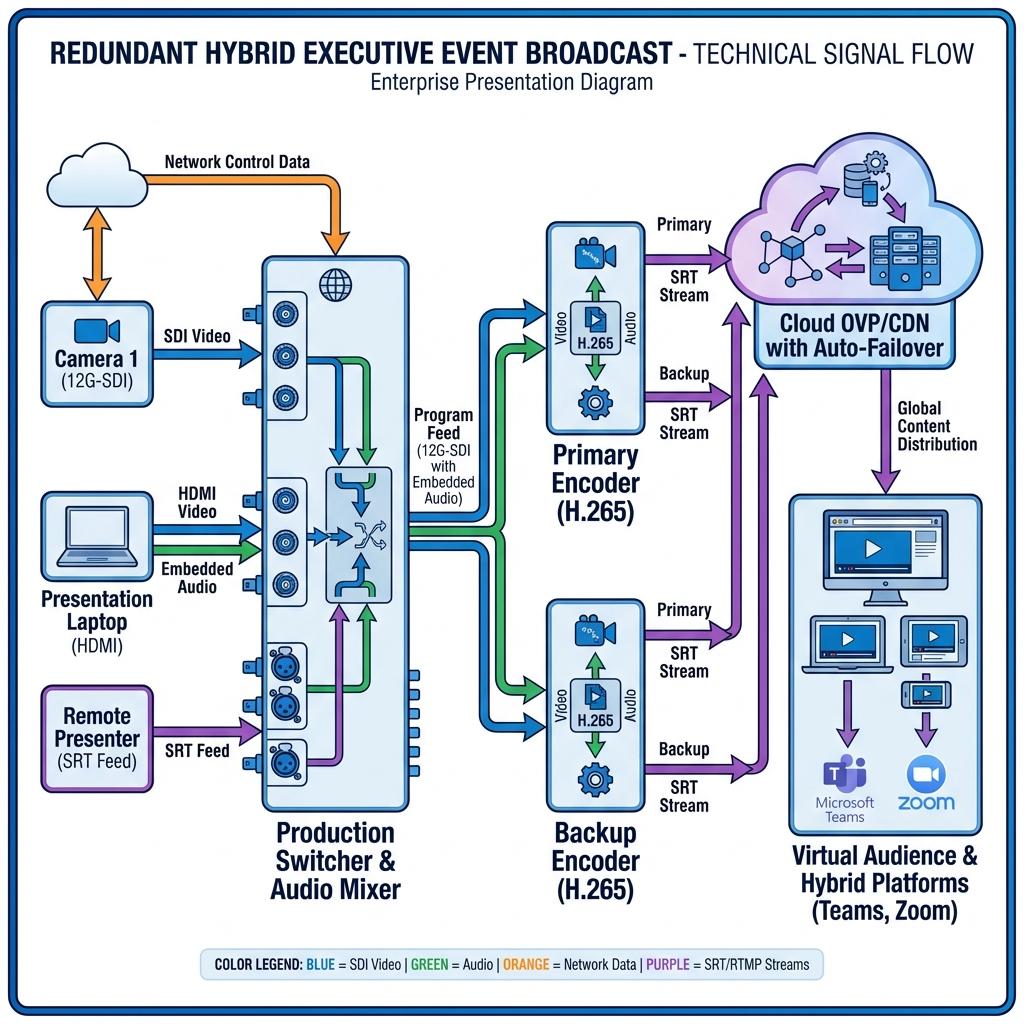
The foundation of any successful high-stakes broadcast is pristine signal integrity from every source to the final distribution point. A technical rehearsal is the only environment to systematically validate this complex chain. For executive events, sources are increasingly diverse: they range from 4K studio cameras connected via 12G-SDI (Serial Digital Interface), to presentation laptops outputting HDMI 2.1, to remote executives contributing via Secure Reliable Transport (SRT) protocol over the public internet. Each path presents unique failure points that must be identified and mitigated before the event goes live.
End-to-End Signal Path Verification
Our process begins with a full signal path audit for every input. For on-premise sources, this involves verifying every physical connection. We test each 12G-SDI cable run from camera to the video router, like a Ross Ultrix or AJA KUMO, ensuring compliance with SMPTE ST 2082 standards for 4K/UHD transmission at 59.94 frames per second. Signal integrity is measured using waveform monitors and vectorscopes to confirm correct luminance, chrominance, and timing. We validate that every source appears correctly on the multiviewer monitor fed by the production switcher, such as a Blackmagic ATEM Constellation or NewTek TriCaster. For IP-based workflows utilizing Network Device Interface (NDI), the rehearsal is crucial for confirming that the network infrastructure can handle the high-bandwidth requirements of multiple NDI streams without packet loss, which requires properly configured multicast DNS (mDNS) and QoS (Quality of Service) on managed network switches.
Audio Chain Synchronization and Gain Staging
Audio is arguably more critical than video for executive presentations. A technical rehearsal allows the audio engineer (A1) to perform a meticulous end-to-end audio check. This involves tracing the signal from the microphone capsule, whether a DPA lavalier or a Shure lectern microphone, through the preamp, into a digital audio console like a Yamaha QL5, and finally embedding it into the primary SDI program feed. We use this time to set precise gain staging at every point in the chain, ensuring maximum signal-to-noise ratio without clipping. Most importantly, we diagnose and correct any audio/video synchronization issues. Lip-sync drift, often caused by video processing latency, is rectified by applying precise audio delays, typically measured in milliseconds or video frames, within the console or a dedicated embedder. For remote contributors, we test the mix-minus feed extensively, ensuring they hear the program audio without hearing their own voice returned to them, which is a common and distracting issue.
Network Infrastructure and Streaming Protocol Stress Testing
Once signal flow is confirmed internally, the focus shifts to the external delivery path. The reliability of the stream is entirely dependent on the network infrastructure and the chosen streaming protocols. A high-stakes executive event cannot rely on a standard office internet connection. We mandate dedicated, symmetrical fiber circuits with a Service Level Agreement (SLA) that guarantees uptime and bandwidth. The technical rehearsal is where we stress test this connection, pushing it beyond the planned operational load to find its breaking point.
Bandwidth Allocation and Quality of Service Validation
During the rehearsal, we configure our primary and backup encoders, such as Haivision Makito X4 or an Elemental Live hardware encoder, to stream at a Constant Bitrate (CBR) that is approximately 150% of the target live bitrate. For a target 1080p60 stream at 8 Mbps, we will run a sustained test at 12 Mbps for at least an hour. This test validates that the network circuit can handle the load without significant packet loss or jitter. On the local network, we work with the client’s IT department to configure QoS policies that prioritize streaming traffic. This ensures that a sudden surge in general office data traffic does not impact the egress bandwidth dedicated to our RTMP (Real-Time Messaging Protocol) or SRT streams, preventing buffering and connection drops for the virtual audience.
Protocol Resilience and Encoder Configuration
The choice of streaming protocol has significant implications for stream resilience. While RTMPS remains a common ingest protocol for many platforms, its reliance on TCP (Transmission Control Protocol) makes it susceptible to packet loss over unstable networks. For high-stakes events, we strongly advocate for SRT. Its UDP-based architecture includes robust ARQ (Automatic Repeat Request) error correction, allowing it to recover from packet loss and maintain a stable stream over less-than-perfect internet connections. The rehearsal provides the ideal opportunity to fine-tune SRT parameters like latency and buffer size to match the specific network conditions. We also finalize our encoder settings, typically using the H.264 codec for maximum compatibility or H.265 (HEVC) for higher quality at a lower bitrate. We confirm GOP (Group of Pictures) size, keyframe interval, and rate control to achieve the optimal balance between low latency and high visual fidelity.
Redundancy, Failover, and Platform Integration Drills
Flawless execution is not about preventing every possible failure; it is about having robust, tested recovery systems in place. High-stakes events demand a multi-layered redundancy strategy that covers encoding, network connectivity, and power. The technical rehearsal is where we execute controlled failure drills to ensure these backup systems engage seamlessly and transparently, with minimal or zero disruption to the viewing audience.
Validating Primary and Backup Encoder Failover
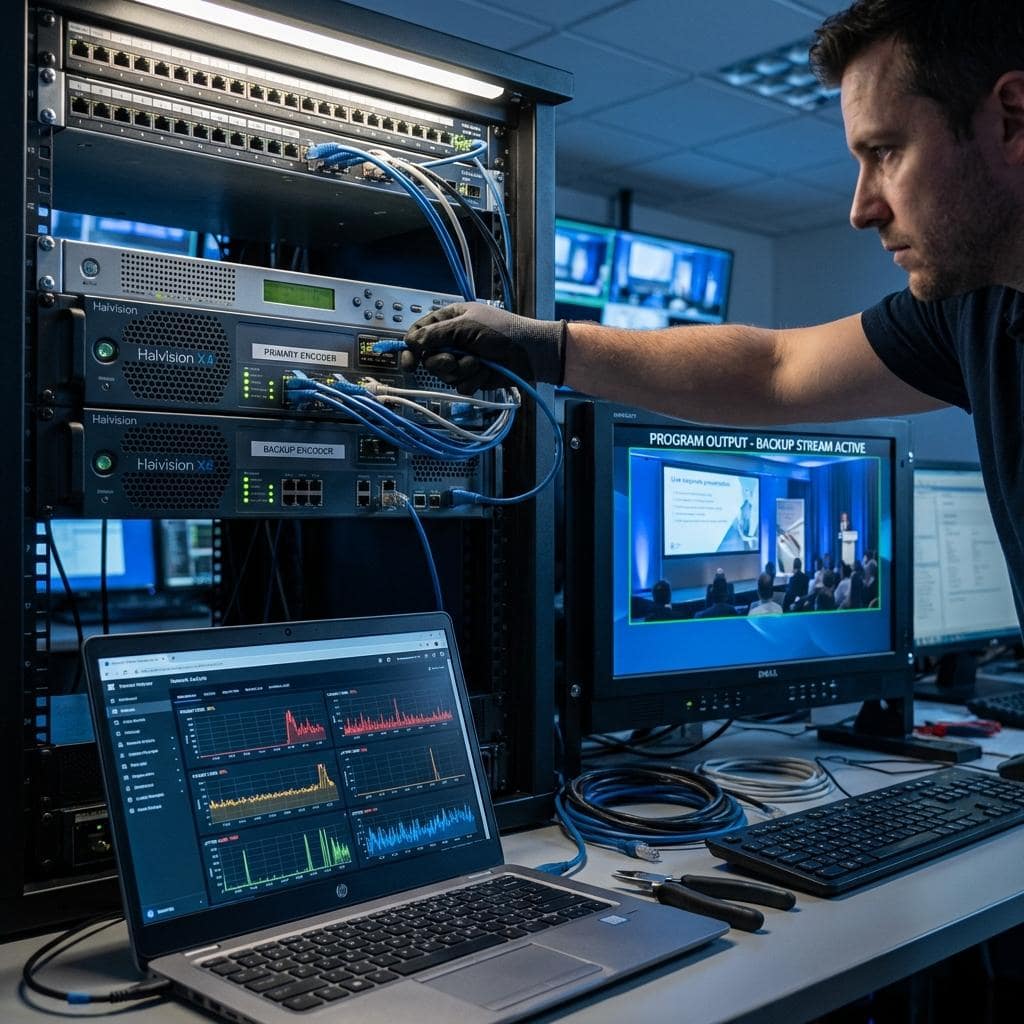
A true professional streaming workflow employs a fully redundant encoder and network path. We configure a primary and a backup encoder, each fed by the same SDI program output. Each encoder is connected to a separate network switch and, ideally, a separate internet service provider. Both encoders stream simultaneously to the primary and backup ingest URLs provided by the Online Video Platform (OVP) or Content Delivery Network (CDN). During the rehearsal, we conduct live failover tests. The most common drill is to abruptly disconnect the network cable from the primary encoder. We then monitor the OVP’s backend and the public-facing video player to confirm that the platform automatically switches to the backup stream. We measure the failover time, which should be less than a few seconds, to ensure the transition is virtually invisible to the audience.
Hybrid Platform Integration and Remote Contributor Management
Hybrid events introduce another layer of complexity: integrating remote presenters from platforms like Microsoft Teams, Zoom, or Webex into a broadcast-quality production. These platforms introduce their own variables, including consumer-grade audio processing, fluctuating video resolutions, and unpredictable network latency. A rehearsal is non-negotiable for this workflow. We use professional integration hardware, such as a Newtek TalkShow or a dedicated video capture device, to ingest the remote participant’s feed and convert it to a stable SDI or NDI source for our production switcher. This allows us to have full control over their audio and video within our professional environment. The rehearsal is also used to perfect the Interruptible Foldback (IFB) or talkback system, allowing the director to communicate privately with the remote presenter without being heard by the audience. We run through slide sharing, video roll-ins, and Q&A sessions to ensure the remote experience is as seamless as the in-room experience.
Communication Systems and Crew Coordination
Finally, a technical rehearsal solidifies the most critical system of all: human communication. The production crew, including the Director, Technical Director (TD), Audio Engineer (A1), Graphics Operator (CG), and Video Engineer (V1), must operate as a cohesive unit. We test every channel of the intercom system, whether a hardwired Clear-Com system or an IP-based solution like Riedel Bolero. The director will run through the show’s run-of-show document, calling camera shots, graphics cues, and transitions. This process builds muscle memory for the crew, eliminates ambiguity in commands, and ensures that when a real issue arises during the live event, the communication protocol for resolving it is already established and practiced. This disciplined coordination is the ultimate safety net, turning a collection of talented individuals into a focused, efficient production team.
In conclusion, treating a technical rehearsal as an optional pre-flight check is a significant risk for any high-stakes executive event. It should be viewed as an essential, structured engineering phase designed to stress-test every component, validate every workflow, and drill every contingency plan. This rigorous process is what transforms a potentially fragile technical setup into a robust, resilient production system capable of delivering a flawless experience. At Spring Forest Studio, this meticulous preparation is not just a best practice; it is the core of our commitment to excellence for our enterprise clients.
Jeremy Lee is a seasoned digital marketing director and strategist with over two decades of experience in the industry. As the founder of Sotavento Medios, I manage a diverse portfolio of over 50 businesses, helping brands grow through advanced search strategies and digital innovation. My work focuses on bridging the gap between traditional search engine optimisation and the evolving world of AI-driven answer engines.
get in touch