
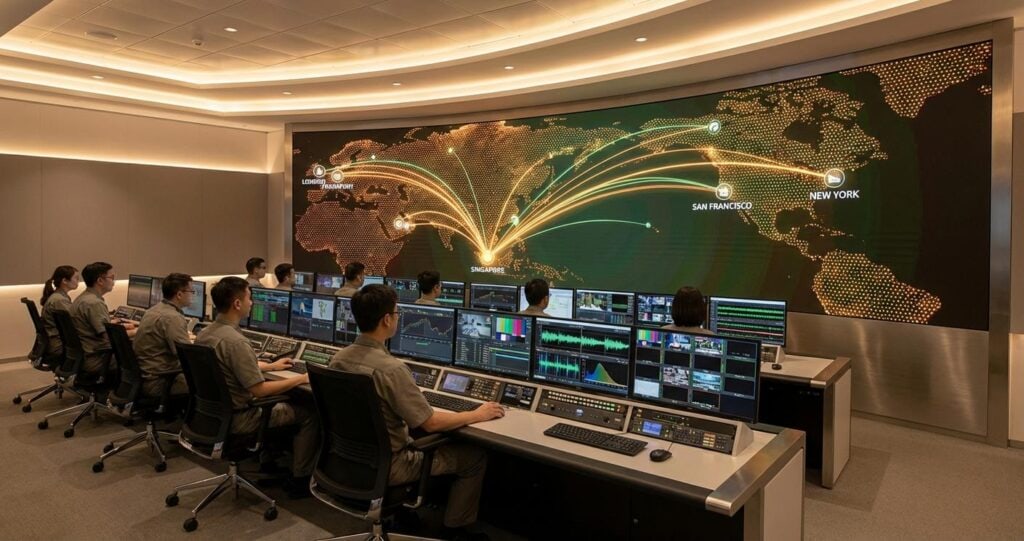
Mastering the Source: Core Production Infrastructure in Singapore
Successfully broadcasting a global event from Singapore begins with an uncompromising commitment to the production source. The quality, stability, and redundancy of the on-site infrastructure directly dictate the maximum quality achievable for viewers in London, New York, or San Francisco. For enterprise-level B2B events, this foundation is non-negotiable and requires broadcast-grade equipment and workflows. The entire global delivery chain is only as strong as its first link: the signal acquisition and processing hub in Singapore.
Multi-Camera Signal Acquisition and Routing
The process starts with signal acquisition from professional camera systems, typically outputting via 12G-SDI (Serial Digital Interface) to support uncompressed 4K UHD signals at 59.94 frames per second. A centralized routing system, such as a Blackmagic Design Videohub or Ross Ultrix, is critical for managing signal flow. This allows any camera source, graphics feed, or playback server to be routed to any destination, including production switchers, monitors, and encoders. While SDI provides robust, low-latency, on-premise connectivity, IP-based protocols like NDI (Network Device Interface) offer immense flexibility. NDI allows for high-quality, low-latency video to be transported over a standard 10GbE network infrastructure, simplifying cabling and enabling decentralized production elements. A hybrid approach, using SDI for core camera chains and NDI for graphics and remote contribution feeds, often provides the optimal balance of reliability and flexibility.
Redundant Production Switching and Encoding
The core of the live production is the video switcher. A primary and a secondary (backup) switcher, configured in a fully redundant arrangement, is standard practice for mission-critical events. For example, a Ross Carbonite Ultra serves as the primary, with a secondary unit ready for an immediate failover. The final program feed from the switcher is then sent to a pair of independent hardware encoders. These are not consumer-grade software encoders; we rely on enterprise solutions like the Haivision Makito X4 or AJA HELO Plus. Each encoder receives the same program feed but operates on separate power and network circuits. They are configured to encode the stream to a high-bitrate mezzanine format, typically H.264 or H.265 (HEVC), at around 15-20 Mbps for a 1080p60 feed. This high-quality contribution stream is the master source for all global distribution.
Enterprise-Grade Audio and Comms Integration
Audio is managed through a digital audio console with Dante (Digital Audio Network Through Ethernet) integration. This allows for all audio sources, from microphones to video playback, to be routed over the network. A critical component for global events is creating multiple mix-minus feeds. This ensures that remote speakers in different regions hear the full program audio minus their own voice, preventing distracting echo and delay. Integrating talkback and IFB (Interruptible Foldback) systems for communication between the director in Singapore and camera operators or remote talent requires careful network configuration to minimize latency and ensure clear, reliable communication channels across continents.
The Trans-Continental Hand-Off: Contribution Protocols and Network Strategy
Once a pristine audio and video signal is encoded, it must traverse thousands of kilometers of public and private networks to reach global ingest points. This “first mile” is the most vulnerable part of the entire chain. Sending a high-bitrate stream from Singapore across the Pacific and Indian Oceans is a significant technical challenge where standard protocols like RTMP (Real-Time Messaging Protocol) are inadequate. Success hinges on a robust contribution strategy built on modern protocols and network diversity.
SRT vs. RTMP: Selecting the Right Protocol for Global Reach
For long-haul contribution, SRT (Secure Reliable Transport) is the industry standard. Unlike RTMP, which is TCP-based and struggles with fluctuating network conditions, SRT is built on UDP and includes its own error-correction mechanism called ARQ (Automatic Repeat reQuest). When a packet of video data is lost in transit, the receiving server requests the encoder in Singapore to resend only that specific missing packet. This allows for the recovery of data loss, which is common over long-distance internet links. For a stream from Singapore to a server in Frankfurt, the round-trip time (RTT) can be 200-250ms. The SRT latency buffer must be configured to be at least 4 times the RTT (e.g., 800-1000ms) to give the protocol enough time to request and receive lost packets before they are needed for playback. This makes SRT far more resilient than RTMP for high-bitrate contribution feeds.
Bonding and Network Diversity for First-Mile Stability
To mitigate the risk of a single network failure, we employ network diversity at the broadcast location. This involves using multiple, physically separate internet connections from different Internet Service Providers (ISPs). Furthermore, for ultimate resilience, we utilize cellular bonding technology from providers like LiveU or TVU Networks. These devices bond multiple cellular connections (4G/5G) from different carriers with ethernet connections, creating a single, highly reliable data pipe. The SRT protocol can leverage this bonded path, ensuring the stream remains stable even if one of the underlying network links experiences degradation or complete failure. This multi-layered approach to connectivity is essential for guaranteeing the contribution feed from Singapore reaches its destination.
Architecting Global Distribution: From Ingest to Playback
With a stable SRT feed originating from Singapore, the next stage is to architect a global distribution network that provides a low-latency, high-quality viewing experience for every user, regardless of their location. This requires a shift from a single delivery point to a multi-region cloud architecture that brings the content closer to the audience. Relying on a single data center to serve a global audience is a recipe for high latency and poor Quality of Experience (QoE).
Leveraging Cloud-Based Media Workflows
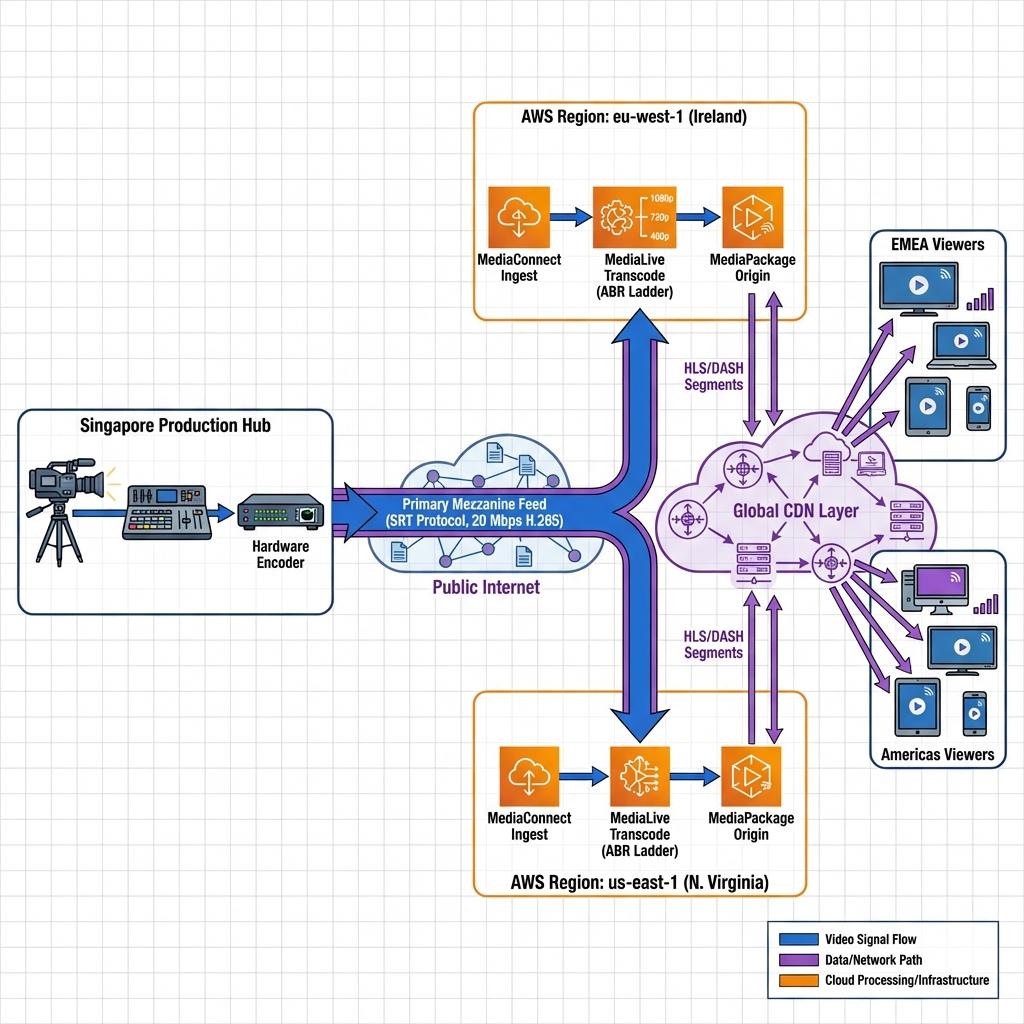
The high-bitrate SRT mezzanine stream from Singapore is not sent directly to viewers. Instead, it is delivered to cloud-based media services like AWS Elemental MediaConnect or Google Cloud CDN Interconnect. These services are designed to handle high-quality live video ingest reliably. Our strategy involves sending the primary SRT feed from Singapore to at least two geographically diverse cloud ingest locations simultaneously. For an event targeting EMEA and the Americas, we would establish ingest points in both a European region (e.g., AWS eu-west-1 in Ireland) and a North American region (e.g., AWS us-east-1 in North Virginia). This immediately reduces the trans-oceanic journey for a significant portion of the audience and builds in geographic redundancy.
Multi-Region Transcoding and Adaptive Bitrate Packaging
Once ingested into the cloud, the 20 Mbps mezzanine feed is processed by a cloud transcoding service like AWS Elemental MediaLive. In each region (Europe and North America), the transcoder creates an adaptive bitrate (ABR) ladder. This involves re-encoding the single high-quality source into multiple smaller streams at different resolutions and bitrates (e.g., 1080p at 6 Mbps, 720p at 3 Mbps, 480p at 1.5 Mbps). These streams are then packaged into formats like HLS (HTTP Live Streaming) or MPEG-DASH. The ABR package allows the viewer’s video player to automatically select the best possible quality stream based on their current network conditions, ensuring smooth playback without buffering.
CDN Selection and Geo-Routing for Final Delivery
The final step is delivering the ABR packages from the cloud origin to the end-users. This is handled by a Content Delivery Network (CDN), a global network of edge servers. For true global scale, a multi-CDN strategy is often employed, using providers like Akamai, Cloudflare, and Fastly. When a user in London presses play, a geo-DNS request routes them to the closest CDN edge server, which is likely also in London. That edge server, in turn, pulls the video segments from the nearest cloud origin, which would be the AWS region in Ireland. Similarly, a user in Los Angeles would be routed to a local edge server that pulls content from the AWS region in North Virginia. This multi-tiered, geo-routed architecture is the key to minimizing latency and ensuring a broadcast-quality experience for a globally distributed audience.
Monitoring, Failover, and Ensuring Flawless Global Delivery
A complex global streaming architecture is not a “set and forget” system. It requires constant, end-to-end monitoring and pre-configured failover plans to handle any potential point of failure, from the encoder in Singapore to a CDN edge server in the Americas. Proactive management is essential to delivering the seamless experience that B2B audiences expect.
End-to-End Monitoring and Real-Time Analytics
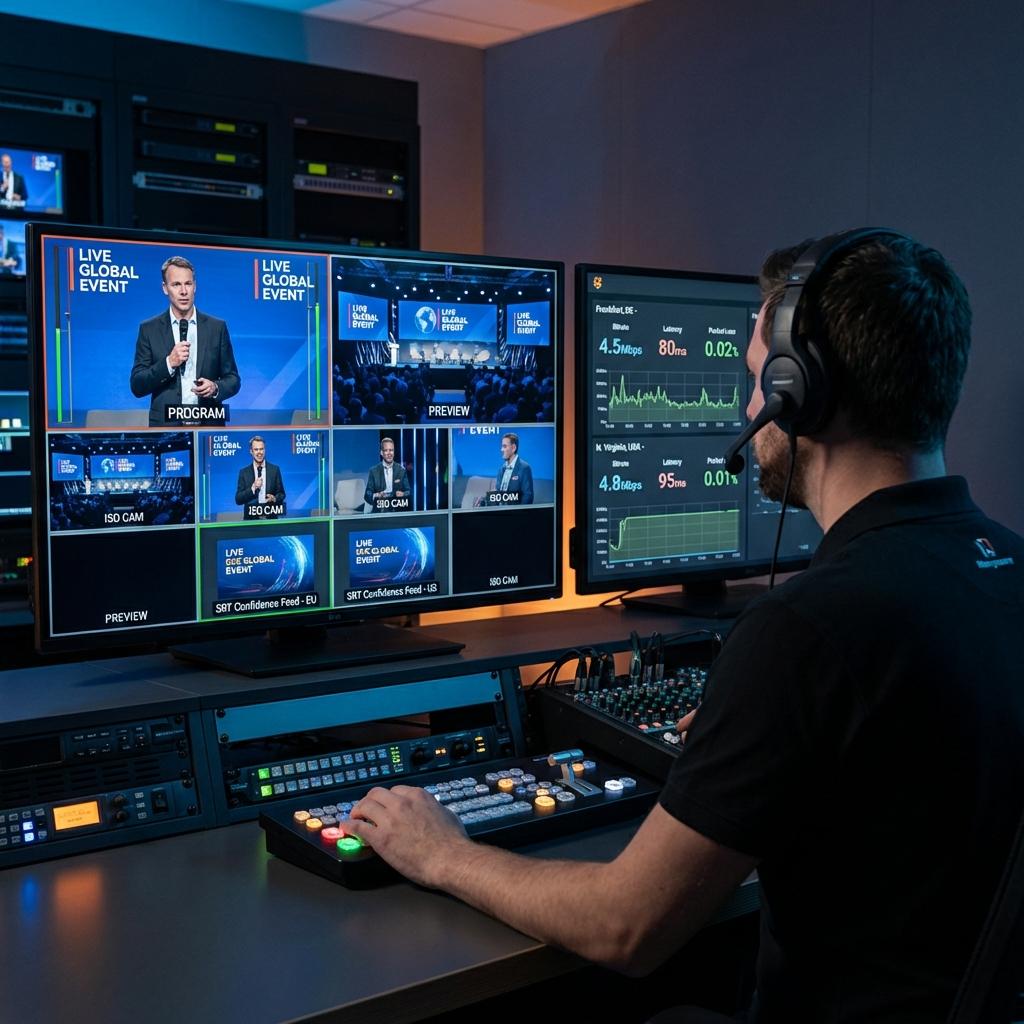
We deploy monitoring probes at every critical point in the signal chain. This includes monitoring the output of the encoders in Singapore, the health of the SRT contribution feeds, the status of the cloud transcoders in each region, and the performance of the CDNs. Dashboards provide real-time analytics on key metrics like stream availability, buffering ratios, viewer concurrency, and latency. This allows our network operations center (NOC) team to spot potential issues, such as packet loss on a specific network path or errors with a particular CDN, and react before they impact the viewer experience. This level of visibility is crucial for managing a global-scale broadcast.
Implementing Seamless Failover and Redundancy
Redundancy is built into every layer. We have redundant encoders in Singapore, each capable of sending a primary and backup SRT stream. These streams are sent over diverse network paths to the primary and secondary cloud ingest regions. For example, Path A might be Encoder 1 -> ISP 1 -> AWS North Virginia, while Path B is Encoder 2 -> ISP 2 -> AWS Ireland. If the primary encoder or network path fails, the cloud infrastructure can be configured to automatically switch to the backup SRT source with minimal disruption. Similarly, if one cloud region experiences an issue, traffic can be re-routed to the healthy region at the CDN level. This multi-layered failover strategy ensures the event stays online even in the face of significant technical failures, providing the resilience required for high-stakes corporate town halls and product launches.

Jeremy Lee is a seasoned digital marketing director and strategist with over two decades of experience in the industry. As the founder of Sotavento Medios, I manage a diverse portfolio of over 50 businesses, helping brands grow through advanced search strategies and digital innovation. My work focuses on bridging the gap between traditional search engine optimisation and the evolving world of AI-driven answer engines.
get in touch