
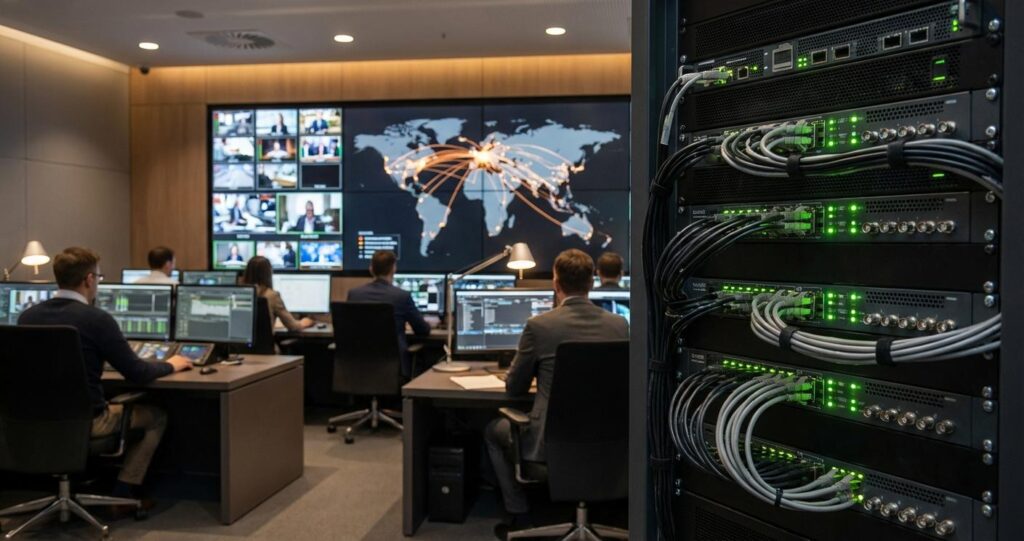
A flawless enterprise-wide live stream is a non-negotiable requirement for modern corporate communication. When the CEO addresses the company, or a critical product update is announced, every regional office, from Silicon Valley to Singapore, expects a crisp, uninterrupted video feed. Yet, the reality for many organizations is a frustrating cycle of buffering, pixelation, and dropouts, particularly for remote satellite offices. The common reaction is to blame the network or increase bandwidth. While network capacity is a factor, the root cause of these failures often lies with an inadequate encoding and transport strategy. Consumer-grade software or simplistic streaming solutions are fundamentally ill-equipped to handle the complexities of a corporate Wide Area Network (WAN). This is where professional-grade hardware encoders and modern transport protocols become the critical infrastructure that separates a successful global town hall from a communication breakdown. They provide the processing power, codec efficiency, and network resilience necessary to deliver pristine video quality over imperfect, real-world corporate networks, ensuring every employee has a front-row seat, regardless of their location.
Understanding the Enterprise Network: A Hostile Environment for Video
Delivering high-quality, low-latency video across a corporate WAN is fundamentally different from streaming over the public internet. Enterprise networks are complex, managed ecosystems designed primarily for data integrity, not real-time media delivery. This environment introduces unique challenges that standard streaming protocols struggle to overcome, leading directly to the buffering and quality degradation that plagues internal corporate events.
The Unpredictable Nature of Corporate WANs and SD-WAN
Unlike a direct fiber line, a corporate WAN is a shared resource. Data from CRM systems, file transfers, VoIP calls, and now, high-bitrate video, all compete for priority. This contention creates unpredictable bottlenecks. Technologies like SD-WAN (Software-Defined Wide Area Network) are designed to route traffic efficiently, but this can mean video packets are dynamically rerouted through paths with varying latency and capacity. This constant fluctuation is poison to protocols that expect a stable, predictable connection, creating a perfect storm for stream failure in a regional office connected via a contended link.
The Technical Trio of Stream Disruption: Jitter, Packet Loss, and Latency
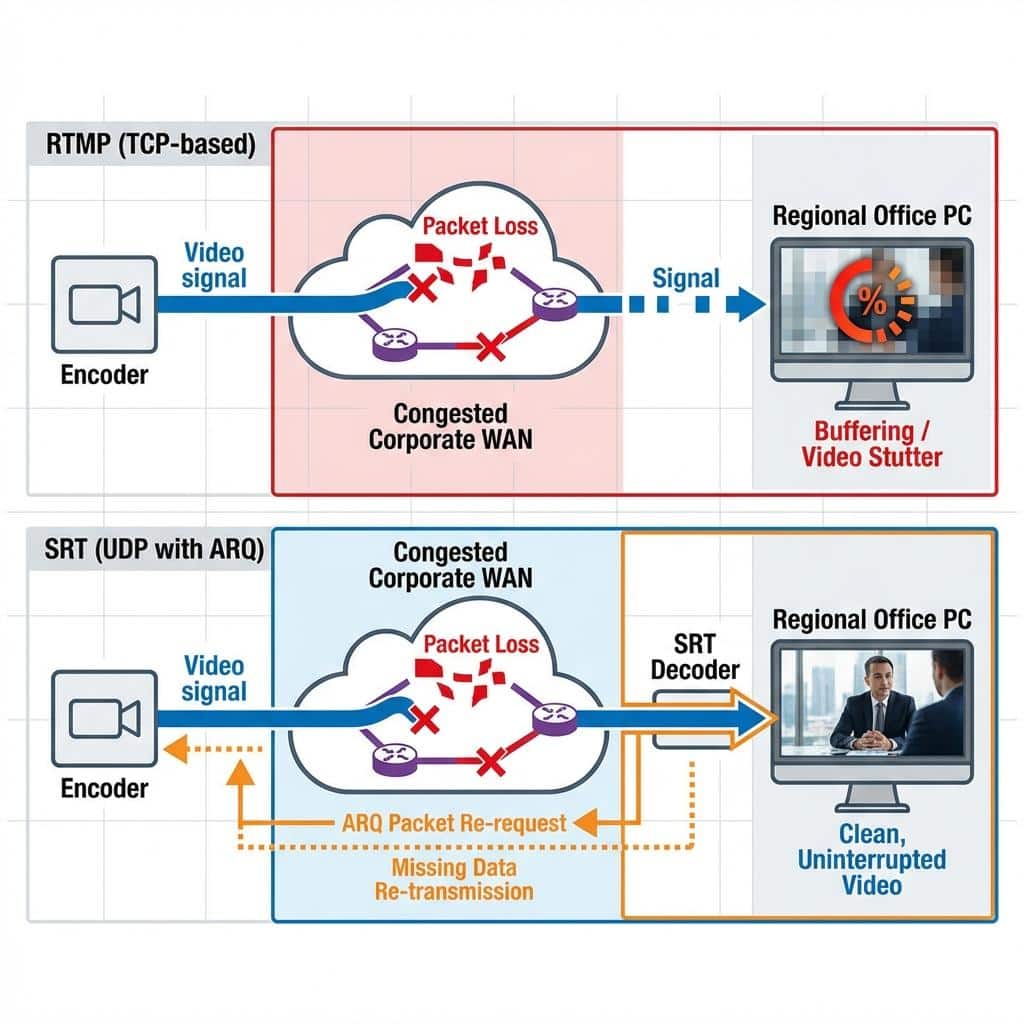
These three factors are the primary culprits behind poor stream quality. Latency is the time it takes for a packet to travel from the encoder at headquarters to the viewer in a branch office. High latency can delay the stream. Jitter is the variation in that latency. When packets arrive out of order or with inconsistent timing, the decoder struggles to reassemble the video frames correctly, resulting in stuttering or freezing. Packet Loss is the most destructive element. When video data packets are dropped by a congested network switch or router, portions of the video frame are permanently lost. This forces the viewer’s player to pause and re-request the data, causing the dreaded buffering wheel to appear on screen.
The Inherent Weakness of RTMP for Professional B2B Streaming
For years, RTMP (Real-Time Messaging Protocol) was the de facto standard for streaming. However, it was designed for a different era of the internet. RTMP is based on the Transmission Control Protocol (TCP), which requires every single packet to be received and acknowledged in the correct order. While this guarantees data integrity, it makes RTMP extremely sensitive to the jitter and packet loss common on a WAN. A single lost packet can cause the entire transmission to halt until it is successfully re-sent and acknowledged, leading to significant buffering and potential stream collapse over long-distance or unstable connections.
Professional Encoders: The First Line of Defense
Professional encoders are purpose-built appliances designed to combat the hostile network environment of a corporate WAN. They employ a combination of dedicated hardware, advanced video compression, and intelligent streaming techniques to create a resilient and efficient video stream that software-based solutions running on general-purpose computers cannot match.
Dedicated Hardware vs. Software Encoding Performance
Software encoders like OBS Studio are powerful tools, but they rely on a computer’s CPU or GPU, sharing resources with the operating system and other applications. This resource contention can lead to dropped frames, encoding errors, and instability during a long broadcast. Professional hardware encoders utilize dedicated ASICs (Application-Specific Integrated Circuits) or FPGAs (Field-Programmable Gate Arrays) for video processing. This purpose-built hardware provides rock-solid stability and consistent performance, capable of running 24/7 without performance degradation. They also feature professional inputs like SDI (Serial Digital Interface) and HDMI 2.1, ensuring pristine signal integrity from production switchers and cameras, and eliminating issues related to consumer-grade capture cards.
Advanced Codec Efficiency: The H.265 (HEVC) Advantage
Bandwidth is often limited at regional offices. Professional encoders leverage advanced codecs like H.265, also known as High Efficiency Video Coding (HEVC), to maximize quality while minimizing data consumption. Compared to the older H.264 (AVC) standard, H.265 offers up to a 50% improvement in compression efficiency. This means a 1080p stream that required 6 Mbps using H.264 can be delivered at the same or better quality using just 3 Mbps with H.265. This significant bandwidth reduction makes a high-quality stream feasible even over constrained network links, directly reducing the likelihood of buffering caused by network saturation.
Adaptive Bitrate (ABR) Ladders for Dynamic Network Conditions
A key feature of professional encoders is their ability to generate a multi-bitrate encoding ladder simultaneously. Instead of a single 6 Mbps stream, the encoder produces several parallel streams, or renditions, at varying qualities and bitrates; for example, 1080p at 6 Mbps, 720p at 3 Mbps, 540p at 1.8 Mbps, and 360p at 900 kbps. These streams are sent to the media server or CDN. The video player at the regional office can then intelligently request the highest quality stream the current network conditions can support. If it detects a surge in packet loss or a drop in available bandwidth, it seamlessly switches down to a lower bitrate rendition. The viewer experiences a momentary drop in resolution instead of a complete halt for buffering, ensuring the continuity of the message.
Modern Transport Protocols: Ensuring Packet Delivery with SRT
While efficient encoding is crucial, the video packets must still traverse the unpredictable corporate WAN. This is where modern transport protocols, specifically designed for real-time video over imperfect networks, become essential. The most important of these for enterprise streaming is SRT (Secure Reliable Transport).
The Technical Power of SRT (Secure Reliable Transport)
Developed to solve the exact problems of streaming over the public internet and private WANs, SRT is the modern replacement for RTMP. It is built on User Datagram Protocol (UDP), which does not require the strict, ordered packet acknowledgment of TCP. On its own, UDP is unreliable. However, SRT adds a sophisticated error-correction layer on top of UDP. Using a mechanism called ARQ (Automatic Repeat Request), the receiving device (a decoder or media server) identifies lost packets and requests only those specific missing packets from the encoder. This is far more efficient than the TCP method, which can stall the entire stream. SRT can recover from significant packet loss with minimal added latency, making it exceptionally resilient for long-distance, high-latency, or congested network paths to regional offices.
Practical SRT Implementation: Caller, Listener, and Rendezvous
SRT operates in different modes to navigate corporate firewalls. In a typical setup, the professional encoder at the main production hub is configured in “Caller” mode. It initiates an outbound connection to a professional decoder or media server at the regional office, which is in “Listener” mode. This configuration is often easier to manage from a network security perspective, as it only requires a specific inbound port to be opened at the destination. This creates a stable, secure, and self-healing tunnel for the video stream, effectively bypassing the issues that would cripple an RTMP feed.
Building a Resilient Streaming Architecture
Beyond the core encoding and transport technology, a truly professional B2B streaming solution incorporates redundancy and monitoring at every level. This ensures that a single point of failure, whether it’s a network link, a cable, or a source feed, does not jeopardize the entire corporate event.
Network Bonding and Path Redundancy
Enterprise-grade encoders often include multiple network interfaces, such as two Gigabit Ethernet ports and integrated 4G/5G cellular modems. These can be used for network bonding, where the stream’s data packets are distributed across all available network paths simultaneously. If one connection, like the primary corporate WAN link, experiences a sudden spike in latency or packet loss, the encoder’s bonding algorithm seamlessly reallocates more traffic to the other stable links, such as a secondary fiber line or a cellular connection. This provides hitless protection against network failures, ensuring the stream to the regional offices remains online without interruption.
Seamless Source Failover and ISO Recording
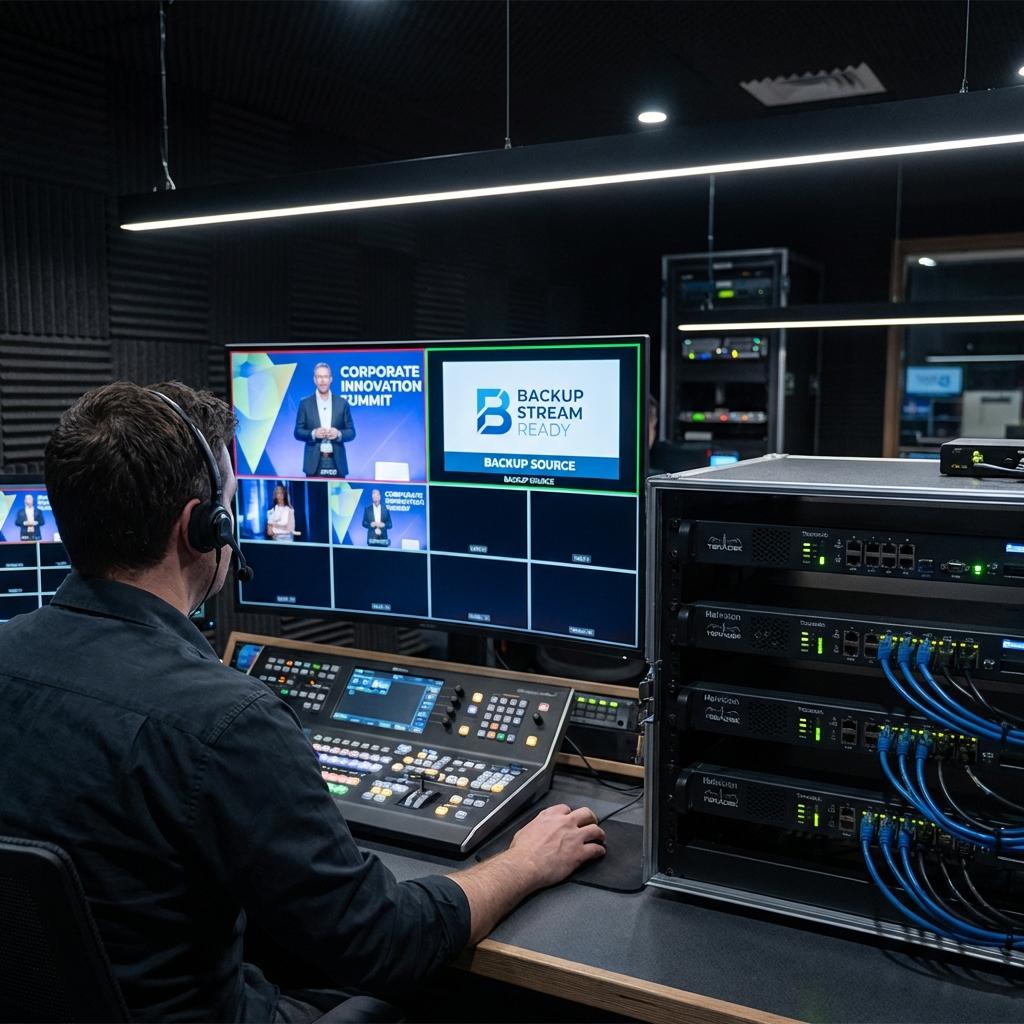
Professional production workflows demand source-level redundancy. High-end encoders feature multiple video inputs (e.g., dual 12G-SDI ports) and the logic for automatic failover. The primary program feed from the video switcher is connected to input one, while a backup source, such as a static “Please Stand By” graphic or a secondary camera, is connected to input two. If the encoder detects a loss of signal on the primary input, it instantly and cleanly switches to the backup source. This prevents a jarring loss of video for all viewers. Many encoders also support ISO (isolated) recording, capturing the incoming video feed directly to internal storage. This provides a high-quality master recording that is independent of any streaming or network issues, securing a perfect archival copy of the event.

Jeremy Lee is a seasoned digital marketing director and strategist with over two decades of experience in the industry. As the founder of Sotavento Medios, I manage a diverse portfolio of over 50 businesses, helping brands grow through advanced search strategies and digital innovation. My work focuses on bridging the gap between traditional search engine optimisation and the evolving world of AI-driven answer engines.
get in touch