
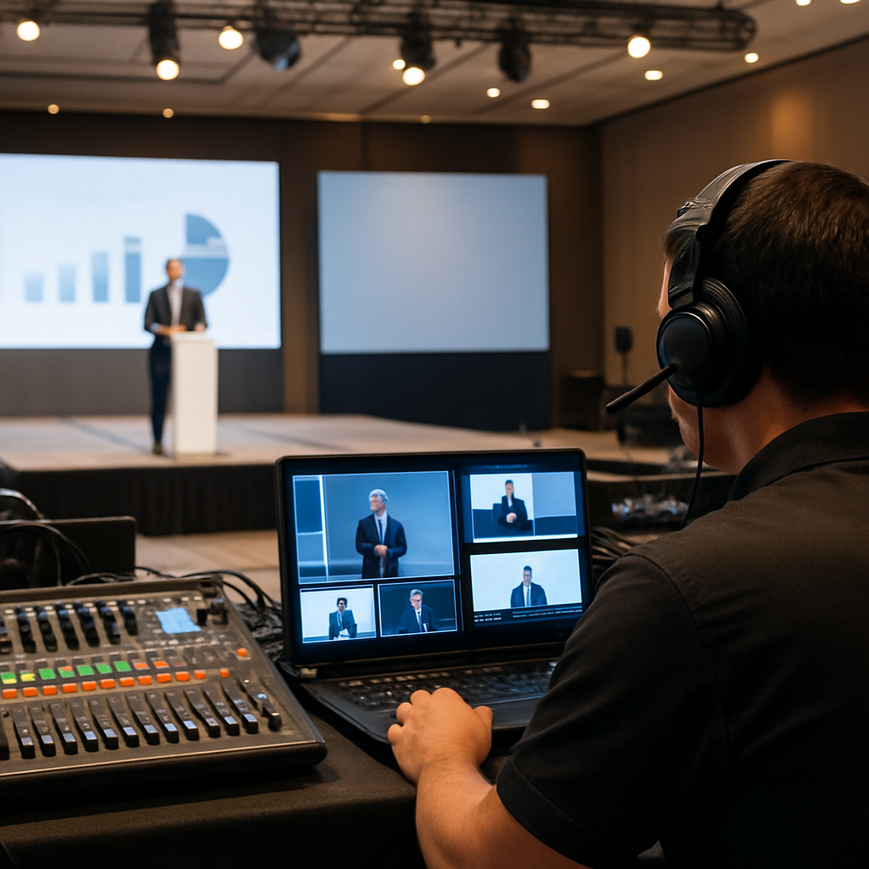
For many organisations in Singapore, on-demand video is no longer a nice-to-have. Corporate events, town halls, training sessions, product launches, medical briefings, and hybrid conferences are increasingly recorded so they can be watched later by employees, partners, and customers who could not attend live. In this setting, the quality of the original master recording matters far more than many teams realise. A master is the highest-quality source file captured during production, and it becomes the foundation for every edit, archive copy, clipped highlight, subtitle version, and streaming encode that follows. If the master is weak, every downstream version starts from a disadvantage.
That is especially relevant in Singapore, where organisations often need content that can serve multiple purposes across different time zones, regional offices, and multilingual audiences. A live event may only happen once, but the recording may continue to carry value for months or even years. When the capture is technically sound, the footage remains usable for internal learning, executive communications, compliance documentation, marketing repurposing, and post-event distribution. When it is not, even a well-produced event can lose clarity, credibility, and long-term usefulness.
High-quality masters also reduce operational friction. Editors spend less time trying to rescue exposure problems, audio distortion, or compression artefacts. Speakers appear more polished. Slides remain legible. Subtitles are easier to sync. Most importantly, the audience can focus on the message rather than struggling with visual noise or poor sound. In a market such as Singapore, where audiences are accustomed to professional presentation standards across corporate, public sector, and education settings, recording quality directly affects how a brand or institution is perceived.
Why the master recording is the most important file in on-demand production
A master recording is not simply a backup copy. It is the original high-fidelity asset from which all distribution versions are derived. In professional video production, the master should preserve as much detail as possible in both image and sound, so later processing does not compound existing flaws. This matters because every export, transcode, or compression step can remove information. If the source is already compromised, the final on-demand version can never be better than what was captured.
For organisations distributing content online, the master also supports flexibility. A single event might later need a full-length replay, a shorter highlight reel, square-format social clips, training modules, or internal archive copies. Each version requires different framing, trimming, graphics, and audio treatment. High-quality masters give editors room to crop, stabilise, colour-correct, denoise, and subtitle without introducing obvious degradation.
The issue is not purely technical. A master recording is often part of a company’s institutional memory. For healthcare providers, educational institutions, government agencies, and multinational firms in Singapore, recordings may need to be retained for communication, reference, or governance purposes. A master that is too compressed, improperly exposed, or badly mic’d can make the material less usable and less trustworthy over time.
What makes a master recording “high-quality”
High-quality does not necessarily mean “biggest file size possible.” It means that the recording preserves detail, dynamic range, and consistency in a way that supports reliable post-production and distribution. In practical terms, a strong master should have stable resolution, clean colour reproduction, controlled exposure, low compression artefacts, and intelligible audio with minimal background noise.
Audio often matters even more than video. Viewers may tolerate slightly soft visuals, but they disengage quickly when speech is muffled, distorted, or difficult to hear. That is why professional production teams usually prioritise proper microphone selection, gain staging, room acoustics, and backup audio capture. If the speaker is not clear, the on-demand asset loses much of its value.
How poor masters affect on-demand performance and audience trust
On-demand content must work without the benefit of a live presenter correcting mistakes or drawing attention away from problems. In a replay setting, every technical weakness becomes more noticeable. Low-resolution capture can make slides unreadable. Incorrect white balance can distort skin tones and brand colours. Audio pumping, clipping, or echo can make even an excellent presentation feel amateurish. These issues are not just aesthetic, they affect comprehension, retention, and perceived professionalism.
Compression is another common problem. Many teams assume that if a file uploads successfully, it is good enough. In reality, heavily compressed footage can produce blockiness, banding, motion smearing, and text shimmer, especially when slides contain charts or fine fonts. Those defects become more obvious when the video is replayed on larger monitors, projectors, or high-resolution devices. For Singapore audiences who frequently consume content on laptops, tablets, and smartphones, the master should be robust enough to adapt cleanly across screens.
Trust is also linked to technical quality. A poorly recorded corporate address can unintentionally signal haste or lack of preparation. In regulated industries, poor audio or missing visual detail can also make it harder for internal teams to verify what was said or shown. A professional master helps preserve not only the message, but the credibility of the organisation delivering it.
Technical issues that are difficult to fix later
Some problems can be corrected in post-production. Others cannot. Severe clipping, which happens when audio peaks exceed the recording’s headroom and distort, is very difficult to repair cleanly. Extreme motion blur, soft focus, and missed exposure are similarly limited. If a speaker is out of frame or a key slide is obscured, editing can only do so much. That is why production planning at the capture stage is so important.
In a hybrid event setting, a common risk is mismatch between the live switching feed and the archival master. A program feed may be suitable for live delivery, but the ideal master often includes cleaner isolated sources, such as separate camera angles, presentation outputs, and audio tracks. This gives post-production teams more control and allows them to create stronger on-demand deliverables later.
Singapore production realities that make master quality even more important
Singapore’s event environment creates specific demands on recorded content. Many venues host multilingual audiences, corporate stakeholders, regional teams, and partner organisations at the same event. Content is often repurposed for different audiences after the live session ends. That means the master has to preserve both technical quality and editorial flexibility. A recording intended only for immediate live use is rarely enough.
The local climate also affects production planning. Humidity, room cooling, reflective surfaces, and ambient noise from ventilation or nearby activity can influence both audio and video capture. These are familiar issues in hotel ballrooms, convention spaces, office auditoriums, and training rooms across Singapore. Professional crews account for them by using appropriate microphones, checking room acoustics, managing lighting carefully, and monitoring signal quality throughout the event.
Multilingual communication adds another layer. Many Singapore-based organisations need English-language content that may later be subtitled or repackaged for Mandarin, Malay, or Tamil-speaking viewers, or for regional offices across Asia-Pacific. If the master audio is clean, subtitle creation, translation review, and versioning become much more accurate. If the source audio is noisy, everything downstream becomes more time-consuming and less reliable.
Accessibility and subtitle accuracy
On-demand accessibility depends heavily on source quality. Clear speech makes it easier to create accurate subtitles and captions, which benefit viewers who are hearing-impaired, watching without sound, or navigating content in a second language. Professional captioning workflows work best when the audio is clean, the speakers are clearly separated, and background noise is controlled.
For Singapore organisations, this is particularly practical. Many viewers switch between devices and environments, such as commuting, working in open-plan offices, or watching from home. Clean masters support accurate subtitles, which improves comprehension and user experience without requiring the viewer to constantly adjust volume or replay sections.
What to capture during production so the master remains usable later
Strong on-demand content starts with planning before the event. The production team should decide what the final recording needs to support. Is the goal a full replay, a training module, a clip library, a board-level archive, or all of these? Each outcome affects the capture approach. A single program feed may be insufficient if the team later needs alternate camera angles, isolated speaker audio, or presentation-only recording.
At minimum, the master should be captured with attention to audio integrity, stable image quality, and clean source separation. When possible, teams should record the presentation output separately from the camera feed, capture microphones as dedicated audio channels, and maintain a clean feed from the switching system. This allows editors to balance visuals and sound more effectively later.
Monitoring during the event is equally important. A master can be ruined if no one notices that a cable has loosened, a microphone battery is failing, or the presentation feed has dropped resolution. Real-time checks help prevent small technical issues from becoming permanent archive problems.
Helpful production practices for Singapore events
- Use dedicated audio capture, not only the camera microphone or room sound.
- Record a presentation-only feed so slides remain readable in replay.
- Keep backup recording paths for critical events, including redundant audio where possible.
- Test lighting and exposure in the actual venue before guests arrive.
- Check venue noise sources, including air-conditioning, nearby corridors, and external traffic.
- Maintain naming and file discipline so masters can be identified and archived properly.
These practices are especially useful for conferences, medical seminars, board briefings, and internal learning sessions in Singapore, where recordings may need to be revisited long after the event ends. Good file management also helps teams respond quickly when a department requests a replay, a compliance team needs a reference, or a marketing group wants to cut highlights for future campaigns.
How high-quality masters support long-term value and efficient repurposing
Recording a strong master is one of the most efficient ways to increase the return on event production. A single high-quality recording can generate many derivatives. For example, one keynote can become a replay, a testimonial clip, a short social teaser, a training extract, or an internal knowledge asset. If the master is clean and well structured, these derivative assets can be created without visible quality loss.
This approach is particularly practical for Singapore-based businesses that need to maximise budgets and production time. Instead of filming each asset separately, teams can capture once and adapt later. The key is to start with a master that can survive cropping, format conversion, subtitle overlays, and platform compression. Poor source footage limits all of these options.
There is also a preservation angle. Events often carry messages that organisations want to archive for future reference. Leadership updates, expert panels, product demonstrations, and educational talks may remain relevant beyond the event date. A high-quality master ensures that the archive remains usable and professional, rather than becoming a difficult file that no one wants to reuse.
For organisations working with external production partners, the question to ask is not only whether the event will be recorded, but how the master will be captured, stored, and prepared for future use. That conversation should happen before production day, not after the event when problems are already locked into the file.
High-quality masters are not a luxury detail. They are the core asset that determines whether on-demand content feels clear, credible, and adaptable. When the master is strong, teams have room to edit, distribute, subtitle, archive, and repurpose with confidence. When it is weak, even a well-run event can leave behind footage that is hard to use and difficult to trust.
For Singapore organisations planning webinars, hybrid conferences, training sessions, or executive communications, the most practical step is to treat the master as a strategic deliverable from the start. Plan the recording path, protect the audio, monitor the signal, and capture with future versions in mind. If the final video may live far longer than the event itself, the original master deserves the highest level of care.
Medical note: This article focuses on media production and on-demand video quality. It does not provide medical advice. If your organisation produces health-related content, such as patient education or clinical briefings, review the material with qualified healthcare professionals and follow the relevant local regulatory and institutional requirements.
Jeremy Lee is a seasoned digital marketing director and strategist with over two decades of experience in the industry. As the founder of Sotavento Medios, I manage a diverse portfolio of over 50 businesses, helping brands grow through advanced search strategies and digital innovation. My work focuses on bridging the gap between traditional search engine optimisation and the evolving world of AI-driven answer engines.
get in touch