
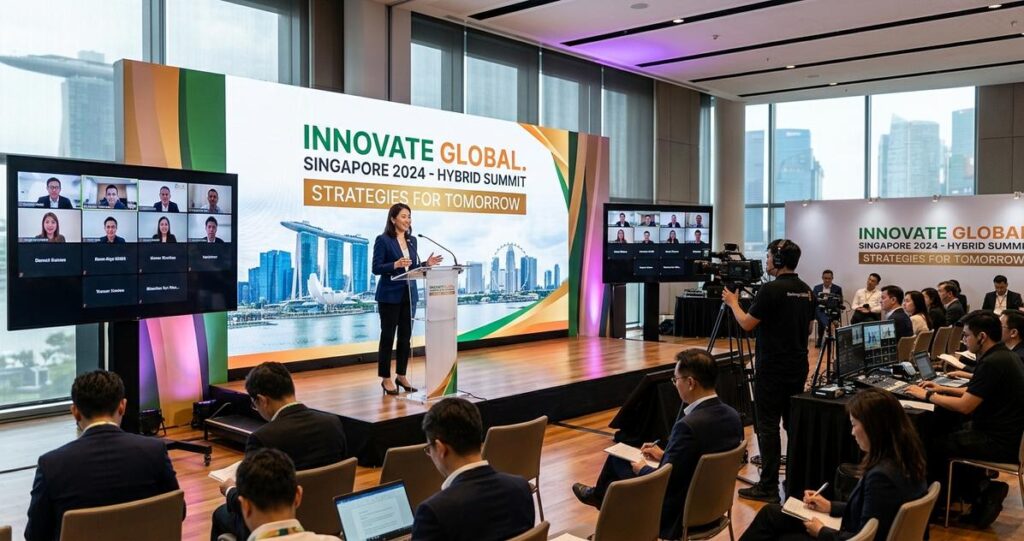
For businesses in Singapore, hybrid events have become a practical way to reach both in-person attendees and remote audiences without limiting engagement to one location. Whether it is a product launch at Marina Bay, a leadership conference in the Central Business District, a townhall for regional teams, or a training session streamed to employees working from home, the visual quality of the event now carries a direct impact on how the brand is perceived. High-definition visuals are not simply about looking polished. They shape trust, improve comprehension, and help a brand appear consistent across physical and digital touchpoints.
In hybrid branding, the audience experiences the event through screens, camera feeds, slides, graphics, stage design, lighting, and platform interface. If any of these elements appear soft, pixelated, poorly lit, or inconsistent, the impression can be immediate and lasting. In Singapore’s competitive professional environment, where many organisations serve regional markets and communicate with stakeholders across multiple countries, visual clarity is part of brand credibility. A high-definition production standard supports clearer messaging, stronger audience attention, and a more professional presentation of the organisation’s identity.
Why high-definition visuals matter in hybrid branding
Hybrid branding is the practice of presenting a brand consistently across both physical and virtual event experiences. The objective is not only to broadcast an event, but to make sure the brand feels coherent no matter where the audience is participating from. High-definition visuals are essential because they reduce the gap between the live room and the online stream. When visuals are sharp and well composed, remote participants can see facial expressions, read on-screen text, and follow demonstrations without strain.
Good visuals also help preserve the intent of the brand. A company may invest heavily in stage design, brand colours, motion graphics, or product displays, but these details can be lost if the camera setup or encoding quality is inadequate. High-definition capture, usually meaning at least 1080p resolution and in some cases 4K acquisition for post-production flexibility, allows finer detail to remain visible during live streaming and recording. This is especially valuable for product launches, healthcare education sessions, financial briefings, and technical demonstrations where precision matters.
In practical terms, high-definition visuals support the audience’s cognitive processing. Clear images reduce the effort required to interpret what is being shown, which can improve comprehension and retention. When a speaker’s slides are legible and camera framing is stable, viewers spend less energy decoding the presentation and more energy engaging with the message. For brands, that means the visual system is doing part of the communication work, instead of creating friction.
How visual quality shapes brand perception
Branding is not limited to logos and taglines. It includes the full set of cues that tell people what a company stands for, how carefully it operates, and how seriously it treats its audience. Visual quality is one of those cues. A crisp, well-balanced stream suggests planning, competence, and attention to detail. A poorly lit or blurry feed can suggest the opposite, even if the event content is strong.
For Singapore audiences, this matters because professional standards are often high across sectors such as finance, technology, education, healthcare, logistics, and government-linked organisations. Audiences are used to efficient communication and clean presentation. When hybrid events match that expectation, they reinforce the impression of an organised, modern, and dependable brand. When they do not, the weak visual execution can distract from the message and lower confidence in the organisation.
Consistency across venue and screen
One of the main challenges in hybrid branding is ensuring that the physical venue and the online feed feel like one integrated experience. High-definition visuals help maintain consistency by showing stage colours accurately, preserving corporate branding elements, and making transitions between speaker shots, slides, and video inserts feel seamless. This is particularly important when an event includes different modes of participation, such as keynote sessions, panel discussions, live demonstrations, and Q&A segments.
Consistency also includes how people appear on camera. Skin tones, clothing textures, and facial expressions are all influenced by lighting and camera quality. When these are handled well, the online audience feels closer to the live environment. That proximity matters because hybrid branding depends on trust and familiarity. The audience should feel that the remote stream is not a secondary version of the event, but a deliberate extension of the brand experience.
First impressions and audience confidence
For many viewers, the first few seconds of a stream shape their willingness to stay engaged. A sharp opening frame, a clear title card, and good audio-visual alignment create a sense of readiness. That first impression can influence whether the audience assumes the event is worth their time. In a business setting, this can affect attendance retention, participation in live polls, and follow-through on calls to action.
Professional hybrid branding also helps organisations appear prepared for cross-border communication. Many Singapore-based companies present to regional stakeholders in Southeast Asia, China, Australia, Europe, or the Middle East. High-definition output helps the brand maintain a professional standard regardless of where the viewer is located or what device they are using. That is especially important when events are recorded for later reuse in internal learning, investor communication, or marketing archives.
The technical foundation of clear hybrid visuals
Strong visuals do not happen by accident. They depend on a coordinated set of production choices, including camera selection, lens choice, lighting, encoding, composition, and display design. Each element influences how the final brand experience looks on screen. A clear understanding of these basics helps organisations make better decisions about event production, especially when the aim is to protect brand quality across both live and digital formats.
Camera resolution and framing
Resolution refers to the amount of detail a camera can capture. In many hybrid events, 1080p is a common baseline because it delivers full high-definition quality and remains practical for live streaming platforms. In some production setups, 4K is used for capture, even if the live stream itself is delivered at a lower resolution, because the extra detail can improve cropping flexibility and support future editing. The key is not to chase higher numbers for their own sake, but to choose a standard that supports the event format, venue size, and streaming platform.
Framing matters just as much as resolution. A well-framed speaker should be clearly visible without awkward cropping, excessive empty space, or distracting background elements. For panel discussions, the camera plan must allow each participant to appear balanced and easy to follow. For demonstrations, the lens and angle should show the product or process with enough detail for remote viewers to understand what is happening.
Lighting and colour accuracy
Lighting is one of the most important drivers of perceived image quality. Even a high-end camera will produce poor results if the subject is underlit or unevenly lit. Professional event lighting helps separate the speaker from the background, improves facial clarity, and reduces noise, which is the grainy appearance that often appears in low light. Colour temperature also matters because mismatched lights can make the scene look unnatural or inconsistent.
Accurate colour rendering is especially relevant for branded environments. Corporate colours, LED wall graphics, and product packaging should look close to their intended appearance. While no screen can perfectly replicate every display environment, careful lighting and camera calibration help ensure that brand colours remain recognisable and polished. This is useful for product launches, retail activations, and annual presentations where visual identity is central to communication.
Streaming encoding and platform delivery
Even when the camera feed is high quality, the final result can be undermined by poor encoding or unstable delivery settings. Encoding converts the video signal into a format suitable for streaming. If the bitrate is too low, the picture may become blocky or blurred, especially during motion. If it is too high for the available internet connection, the stream may become unstable. For hybrid branding, the production team should match the encoding settings to the event platform and network conditions so that the audience receives a smooth and visually reliable stream.
Singapore venues often have strong connectivity, but production teams should still plan for redundancy, including backup internet paths and testing before the event. This is not a luxury. It is part of basic professional risk management. A technically stable stream protects brand continuity and reduces the likelihood of visible disruptions that could affect audience confidence.
Why high-definition visuals are especially useful in Singapore
Singapore’s business environment places strong value on efficiency, precision, and international readiness. Many organisations host multilingual, multicultural audiences and need their event content to work across different professional contexts. High-definition visuals help meet those demands by making content easier to consume, whether the viewer is in the venue, at home, or joining from another country.
The local audience is also highly familiar with digital services and expects clear video quality in everyday use, from corporate webinars to government communications and live commerce. This means hybrid events are judged quickly. If the visuals are muddy or inconsistent, viewers may assume the event was not carefully prepared. On the other hand, a clean and polished visual presentation signals professionalism and respect for the audience’s time.
Another Singapore-specific factor is the prevalence of indoor event spaces in hotels, convention centres, offices, and co-working venues. These spaces vary in ceiling height, lighting conditions, and acoustic treatment. High-definition visuals help unify the look of the event across different environments, but they must be planned together with the room layout and staging. For example, a conference room with reflective surfaces may require more careful lighting control, while a large ballroom may need stronger camera coverage to maintain detail across the space.
Practical examples from common Singapore event formats
Consider a corporate AGM streamed to shareholders and staff. The event needs readable slides, clear speaker shots, and reliable motion graphics for voting or agenda transitions. Or consider a healthcare education seminar where a clinician presents procedural diagrams. In that case, visual clarity is not only a brand issue, but also a communication issue because the audience must understand detailed information accurately. A tech company launching a new product may need close-up shots, screen capture integration, and branded overlays that remain crisp across devices.
In each of these examples, high-definition visuals improve the professionalism of the event and reduce the risk of miscommunication. They support better accessibility as well, because viewers who rely on screen magnification or watch on smaller devices can still follow the content more easily when the source image is sharp and well designed.
Building a practical high-definition strategy for hybrid events
Effective hybrid branding begins long before the event day. Organisations should plan the visual system as part of the overall communications strategy, not treat it as a separate technical layer. This includes defining brand colours, slide templates, lower-third graphics, speaker backdrops, and camera angles in a way that supports both the live room and the stream. The goal is to create a visual identity that looks intentional in every frame.
It is also important to test the full chain from source to screen. That means checking the venue lighting, camera output, encoder settings, platform playback, and display quality before the event starts. Rehearsals should include not only content flow, but also visual checks from the perspective of a remote viewer. If text appears too small, if a logo is hard to see, or if a speaker is lost in the background, these problems should be corrected before the audience joins.
Organisations should also think about reusability. High-definition event footage can be repurposed for social clips, internal training, marketing, and archive use. When the original capture is strong, it has a longer life cycle and offers better value. This is especially relevant for Singapore companies that produce regular leadership updates, product briefings, and regional meetings. Strong production standards help a single event continue supporting branding after the live session ends.
Questions to ask before choosing a production approach
- Will the event be viewed primarily on laptops, phones, or large displays?
- Does the content rely on fine details such as charts, product features, or on-screen text?
- How important is brand colour accuracy in the final presentation?
- Will the footage be reused for post-event marketing or training?
- Does the venue support the lighting and network setup needed for stable delivery?
These questions help organisations decide whether a basic webcast setup is enough or whether a more robust event production plan is required. For brands that value professionalism and audience trust, the answer often lies in treating visual quality as a strategic asset rather than a cosmetic extra.
High-definition visuals are now a core part of hybrid branding because they affect how people see, understand, and remember an organisation. They help align the live venue with the online stream, preserve the integrity of the brand, and support a better audience experience. For Singapore businesses, where professional communication is closely tied to credibility, this matters across industries and event formats. A strong visual standard does not just make an event look good. It helps the brand communicate clearly and consistently at every touchpoint.
For organisations planning hybrid events, the most practical takeaway is simple. Build the visual experience with the same care as the content itself. Start with clear objectives, use the right production standards, test the full viewing journey, and ensure the stream reflects the quality of the brand behind it. When high-definition visuals are handled well, they strengthen trust, improve engagement, and make hybrid branding work as a true extension of your organisation’s identity.
General information only: This article is intended to support awareness and planning for hybrid event production. For specific production, technical, or brand implementation needs, consult a qualified event production professional or relevant specialist.

Jeremy Lee is a seasoned digital marketing director and strategist with over two decades of experience in the industry. As the founder of Sotavento Medios, I manage a diverse portfolio of over 50 businesses, helping brands grow through advanced search strategies and digital innovation. My work focuses on bridging the gap between traditional search engine optimisation and the evolving world of AI-driven answer engines.
get in touch