
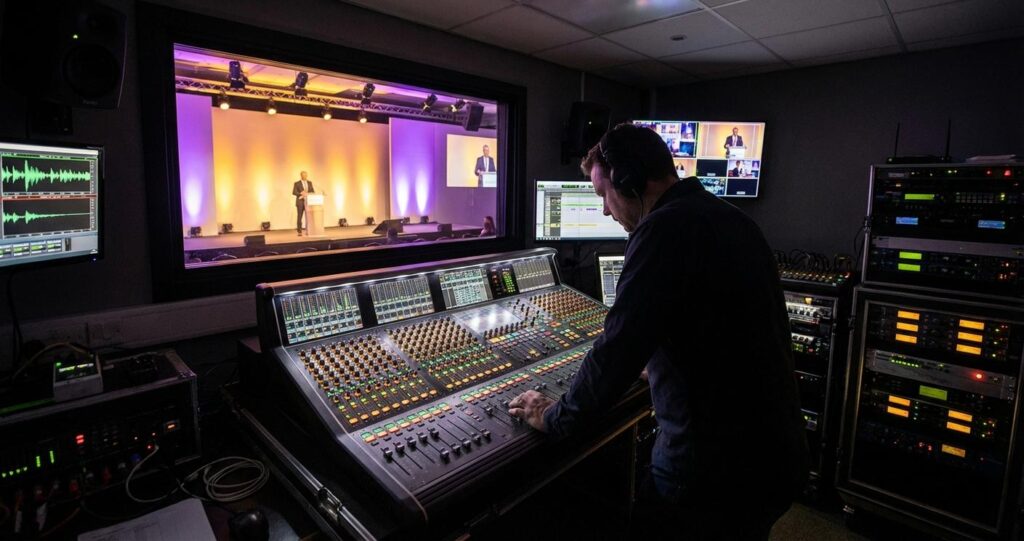
The Unforgiving Nature of Audio in Live Corporate Productions
In the high-stakes environment of mission-critical B2B events, a momentary video glitch might be distracting, but a catastrophic audio failure is an event killer. The entire message, the keynote speaker’s impact, and the brand’s credibility can be instantly nullified by silence, distortion, or unintelligible speech. For corporate event planners, production managers, and IT directors, ensuring flawless audio delivery is not merely a technical goal; it is a fundamental pillar of event success. While video often consumes the majority of planning resources, seasoned engineers understand that an audience will forgive a brief video buffer, but they will immediately disengage from a production with poor audio. This is why a multi-layered audio redundancy strategy is not an optional add-on but an absolute necessity for any corporate town hall, product launch, or hybrid shareholder meeting where the message must be delivered with perfect clarity and unwavering reliability.
At Spring Forest Studio, our approach to live production is built on a foundation of broadcast-level engineering principles, where failure is not an option. This involves architecting a complete audio ecosystem, from the presenter’s microphone to the global Content Delivery Network (CDN), with redundant paths, automated failover mechanisms, and comprehensive monitoring. This article provides a deep technical analysis of the critical layers of audio redundancy required to execute a flawless, mission-critical corporate event. We will move beyond simple backups and explore the specific hardware, protocols, and workflows that constitute a truly resilient audio infrastructure for both in-person and hybrid audiences.
Foundational Redundancy: Signal Acquisition and On-Premise Transport
The integrity of the entire audio chain is determined by its first link. Redundancy must begin at the point of sound capture and be maintained throughout the on-site signal transport infrastructure. A failure at this stage will cascade through the entire system, and no amount of downstream processing can recover a signal that was never successfully captured or routed.
Dual-Element Sourcing for Critical Inputs
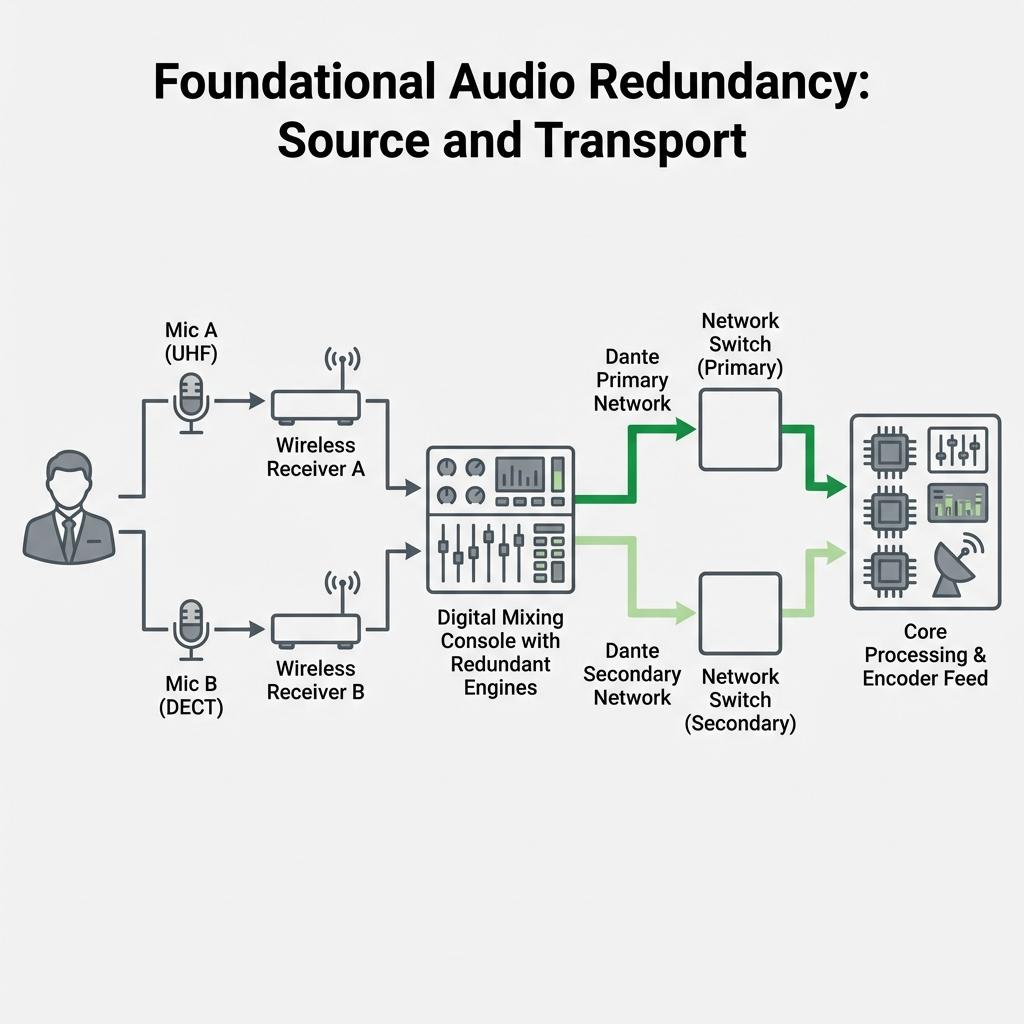
For any primary speaker, a single microphone represents a single point of failure. A comprehensive strategy involves using two physically independent microphone sources. A common professional configuration is to equip a presenter with two low-profile lavalier microphones, each connected to a separate wireless bodypack transmitter operating on a different, carefully coordinated frequency block. For example, one transmitter might operate in the 500 MHz UHF (Ultra High Frequency) band while the backup operates in the 1.9 GHz DECT (Digital Enhanced Cordless Telecommunications) band to mitigate frequency-specific RF interference. These two independent sources are then routed to two separate channels on the audio mixing console. Alternatively, a primary lavalier can be paired with a secondary microphone on the lectern, providing both redundancy and a different sonic characteristic if needed. This dual-sourcing ensures that a battery failure, RF interference, or even physical damage to one microphone does not interrupt the program audio.
Redundant Digital Audio Networking: Dante, MADI, and MILAN
Once captured, audio signals must be transported from the stage to the audio control room. Modern productions rely on digital audio-over-IP (AoIP) protocols. Dante is the industry leader, offering a straightforward primary and secondary network topology. In this setup, every Dante-enabled device (such as a stage box, mixing console, or amplifier) has two Ethernet ports. The primary network carries the main audio traffic. A completely separate, parallel network of switches and cabling is connected to the secondary ports. In the event of a switch failure, cable disconnect, or other disruption on the primary network, all devices will seamlessly and automatically switch to the secondary network with no audible interruption. For higher channel counts and guaranteed point-to-point reliability, MADI (Multichannel Audio Digital Interface) over dual-coaxial or fiber optic lines remains a broadcast standard. One cable carries the main 64-channel feed, while the second acts as a hot backup. Newer standards like MILAN (Media-integrated Local Area Network), built on the AVB (Audio Video Bridging) specification, also provide this level of network-level redundancy with added guarantees for timing and bandwidth.
Core Processing and Infrastructure Resilience
The audio control room is the heart of the production, where signals are mixed, processed, and routed. This central hub is a critical point where hardware or power failure could have a catastrophic impact. Therefore, redundancy must be built into the core processing hardware and its supporting infrastructure.
Failover at the Mixing Console and DSP Level
Professional broadcast and live event mixing consoles are designed for continuous operation. Many high-end digital consoles, such as those from DiGiCo, Calrec, or Lawo, feature redundant processing engines. A second, mirrored engine runs in parallel, ready to take over instantly if the primary engine experiences a fault. For productions utilizing external Digital Signal Processors (DSPs) for complex room equalization or speaker management, a similar strategy is employed. Two identical DSP units are configured with the same settings. The primary unit processes the main program audio, while the backup unit receives the same inputs. An upstream matrix switcher or a dedicated auto-switching device constantly monitors the health of the primary DSP. If it detects silence or a corrupted signal, it can automatically reroute audio through the backup DSP in milliseconds, a switchover that is imperceptible to the audience.
Redundant Power and Network Infrastructure
No amount of signal path redundancy can protect against a power failure. Every critical component in the audio chain, from the digital stage box to the mixing console, encoders, and network switches, must be equipped with dual Power Supply Units (PSUs). Each PSU should be connected to a separate Power Distribution Unit (PDU). In a robust setup, these PDUs are fed from two independent electrical circuits, which are in turn backed by an Uninterruptible Power Supply (UPS) and, for large-scale events, a generator. This ensures that the failure of any single component, from a PSU to a building circuit, does not bring down the system. Similarly, the network infrastructure supporting AoIP and control data must be resilient. Core network switches should feature redundant PSUs and be interconnected with bonded or link-aggregated fiber optic cables to prevent a single switch or link failure from severing network connectivity.
Delivery and Distribution Redundancy for Hybrid Events
For hybrid events, the audio workflow extends beyond the physical venue into the cloud and to a global audience. The final stages of encoding and distribution require their own dedicated layers of redundancy to ensure the stream reaches virtual attendees with the same reliability as the in-room PA system.
Dual-Path Encoding and Transmission
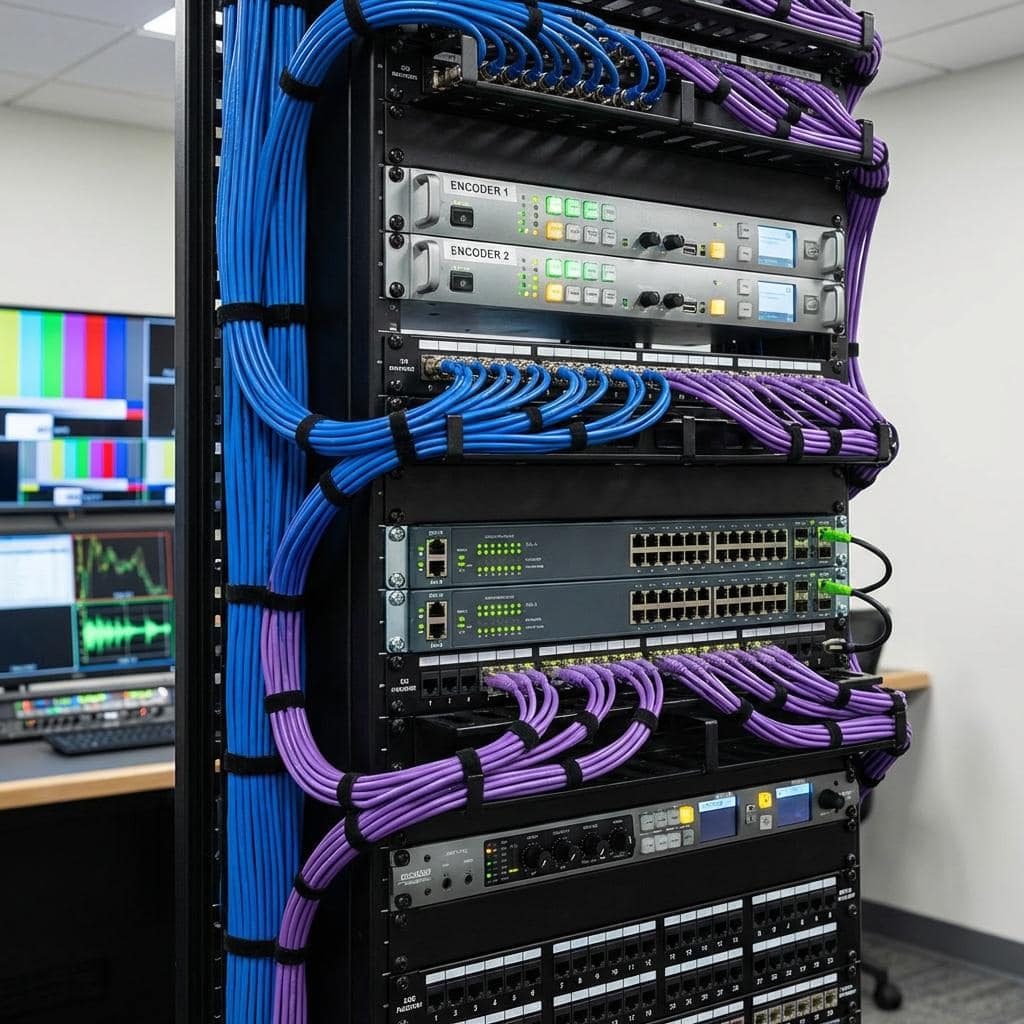
The process of encoding the final program audio and video for streaming is a critical step. A single encoder is a significant point of failure. The professional standard is to use at least two separate hardware encoders. The final Program Out SDI (Serial Digital Interface) signal, with audio embedded, is split and fed to both the primary and backup encoders. These encoders should be configured with identical settings (codec: H.264/AVC or H.265/HEVC, bitrate, resolution) but are set to publish their streams to different ingest URLs provided by the CDN. For example, the primary encoder might send a 1080p60 8Mbps RTMPS (Real-Time Messaging Protocol Secure) stream to a primary ingest server in North America, while the backup encoder sends an identical stream to a secondary ingest server in Europe. This protects against not only encoder hardware failure but also regional network congestion or ingest server issues.
Leveraging Resilient Protocols like SRT
While RTMP is a common standard, the Secure Reliable Transport (SRT) protocol offers superior performance over unstable networks. SRT includes sophisticated packet loss recovery mechanisms like ARQ (Automatic Repeat reQuest) that can gracefully handle the typical packet loss found on the public internet, preventing audio glitches and dropouts. A robust SRT workflow can involve two encoders sending streams to a single SRT gateway in the cloud. This gateway can be configured in a “listen” mode with a primary and backup stream, automatically selecting the healthiest one for redistribution to the CDN. This protocol-level resilience provides a powerful layer of protection for the critical first-mile connection from the venue to the cloud.
Multi-CDN Strategies for Global Reach
Relying on a single CDN for a mission-critical global event introduces a massive single point of failure. A multi-CDN strategy provides the ultimate layer of distribution redundancy. In this architecture, the primary and backup encoded streams are sent to two entirely different CDN providers. A sophisticated video player or a DNS-based global server load balancing (GSLB) service can then dynamically direct viewers to the optimal CDN based on their geographic location and real-time performance metrics. If the primary CDN experiences a major outage, traffic can be automatically rerouted to the backup CDN, ensuring uninterrupted viewing for the global audience. This represents the pinnacle of broadcast-grade resilience for enterprise streaming.
Active Monitoring and Validated Failover
Implementing redundant systems is only half the battle. Without active, intelligent monitoring and regularly tested failover procedures, a backup system may fail to engage when needed. A passive backup is an unknown variable; an audited and tested backup is a reliable recovery plan.
Comprehensive Confidence Monitoring
Dedicated audio engineers must monitor the entire signal chain. This includes pre-fader listens on input channels, post-fader monitoring of the main mix, and critically, monitoring the audio post-encoding. This “return feed” monitoring involves decoding the live stream from the CDN just as a viewer would. This is the only way to be certain that the audio has survived the entire encoding and distribution process intact. Visual tools like loudness meters (measuring LUFS – Loudness Units Full Scale) and phase correlation meters are used to identify not just failures but subtle quality degradation.
Automated Switching and System Audits
While manual intervention is possible, automated failover systems provide the fastest and most reliable response. Hardware silence detectors can monitor SDI-embedded audio or AES/EBU digital audio feeds. If the audio level drops below a configurable threshold for a set duration (e.g., -60dB for more than 3 seconds), the device can trigger a relay to instantly switch to a backup source. Before any event, the entire redundancy plan must be tested. This involves systematically “failing” primary components: unplugging the primary microphone receiver, disconnecting the primary Dante network cable, powering down the primary encoder. These drills validate that the backup systems engage as designed and provide the production team with the confidence to manage any real-world failure scenario.
Ultimately, audio redundancy is a discipline that requires a holistic view of the production ecosystem. It is an investment in certainty. For the high-value communication that defines corporate events, ensuring every word is heard perfectly is the most critical mission of all. By partnering with a technical production team that engineers this level of resilience into every workflow, enterprise clients can protect their message and guarantee a professional, seamless experience for every attendee, no matter where they are.
Jeremy Lee is a seasoned digital marketing director and strategist with over two decades of experience in the industry. As the founder of Sotavento Medios, I manage a diverse portfolio of over 50 businesses, helping brands grow through advanced search strategies and digital innovation. My work focuses on bridging the gap between traditional search engine optimisation and the evolving world of AI-driven answer engines.
get in touch