
Leveraging Cloud-Based Production for Scalable Corporate Broadcasts
The paradigm for enterprise-level video communication has fundamentally shifted. Global all-hands meetings, high-stakes product launches, and multi-day investor relations events now demand broadcast-grade quality delivered to a geographically dispersed audience of employees, partners, and clients. Traditional on-premise production infrastructures, built around significant capital investment in hardware and physical control rooms, are increasingly challenged by the need for elastic scalability, global accessibility, and operational agility. The logistical and financial constraints of shipping broadcast flypacks and deploying large technical crews are giving way to a more efficient and powerful model: cloud-based production. This architectural evolution moves the core of the production workflow, from video switching and graphics insertion to encoding and distribution, into a virtualized environment. For corporate event planners and IT directors, this transition offers a solution to seamlessly scale from a departmental webinar to a global broadcast without the limitations of physical hardware, enabling a level of production quality and reach previously reserved for major television networks.
The Architectural Shift: On-Premise vs. Cloud-Native Production Infrastructure
Understanding the transition to cloud-based broadcasting begins with a clear analysis of the traditional on-premise model and its inherent limitations compared to the capabilities of a cloud-native architecture. The differences extend beyond mere location; they represent a fundamental change in resource management, scalability, and operational workflow for any corporate event.
Deconstructing the Traditional On-Premise Broadcast Control Room
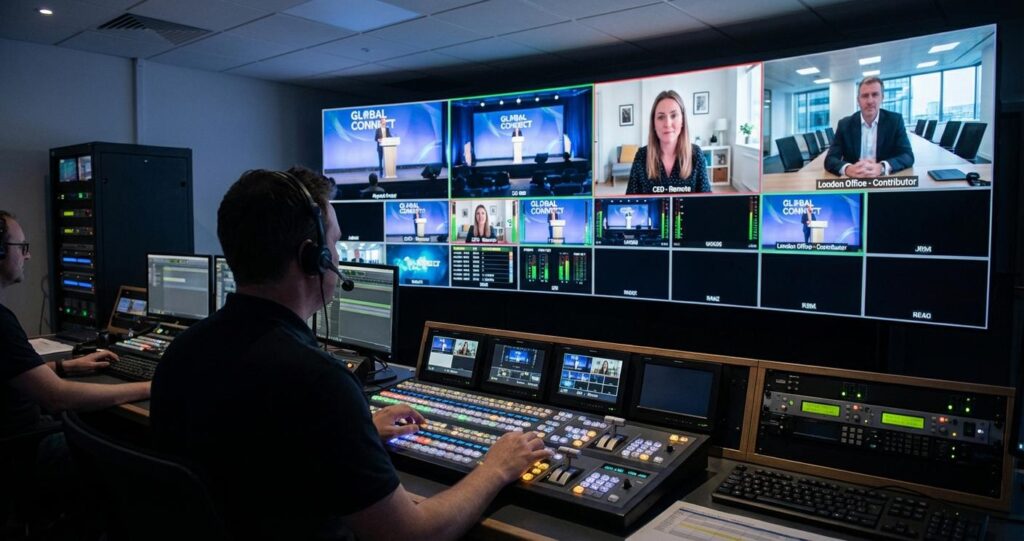
A conventional broadcast control room or production flypack is a complex ecosystem of specialized hardware interconnected via a baseband video routing matrix, typically using Serial Digital Interface (SDI) cabling. The signal flow is rigid and hardware-dependent. Camera feeds, usually 1.5G-SDI for HD or 12G-SDI for 4K/UHD, are routed to a physical production switcher, such as a Blackmagic Design ATEM Constellation or a Ross Video Carbonite. Dedicated hardware systems manage downstream keys for graphic overlays, with platforms like ChyronHego or Vizrt generating fill and key signals. Audio is managed through hardware mixers, often using Dante or MADI for multi-channel transport. The final program feed is sent to hardware encoders for compression and subsequent streaming via Real-Time Messaging Protocol (RTMP) or satellite uplink. This entire infrastructure requires significant capital expenditure (CapEx), a controlled physical environment with adequate power and cooling, and a highly skilled on-site engineering crew. Its primary limitations are scalability, which is capped by the number of physical inputs and outputs on the hardware, and its geographical inflexibility, making remote contribution and control inherently complex.
Defining the Cloud Production Environment
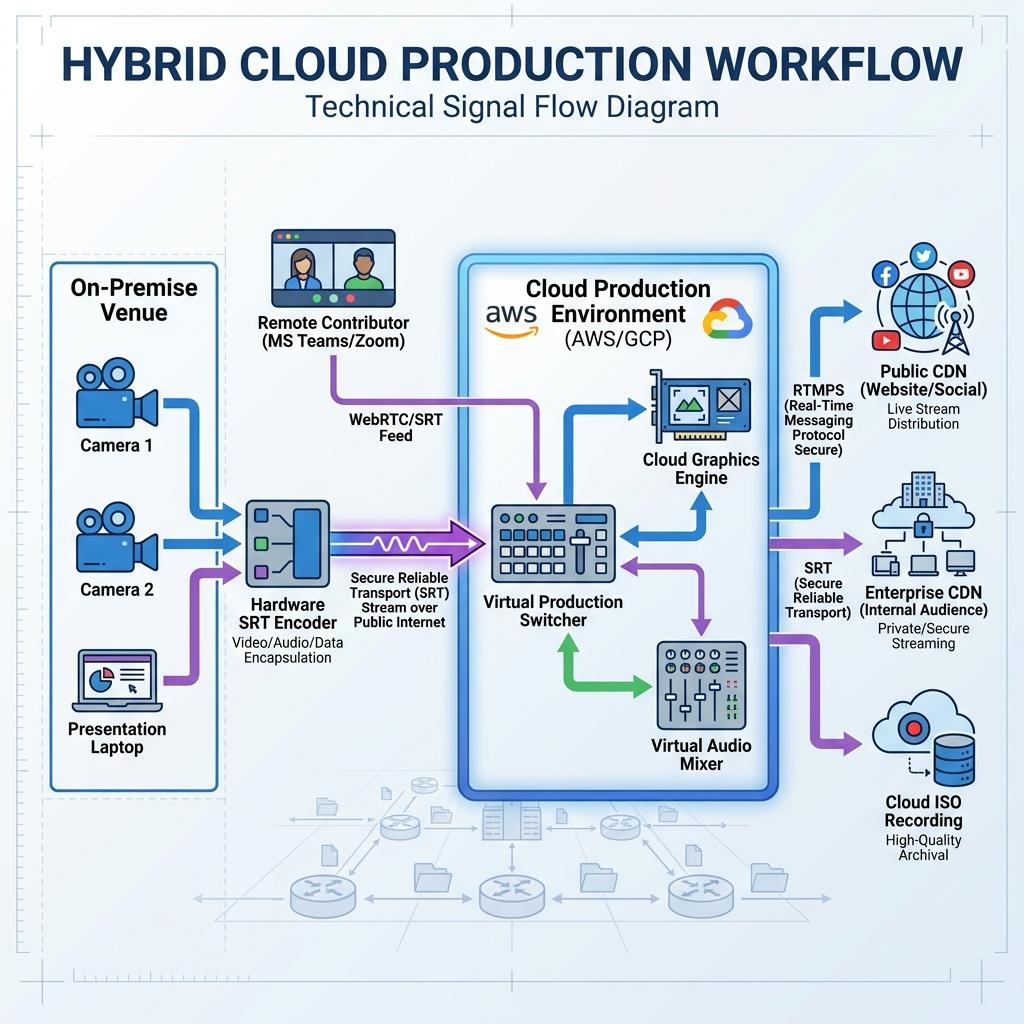
In contrast, a cloud production environment replicates this functionality using virtualized software running on high-performance computing instances within a cloud provider’s data center, such as Amazon Web Services (AWS) or Google Cloud Platform (GCP). Instead of SDI, the primary transport mechanism for ingesting video sources is IP-based, with Secure Reliable Transport (SRT) emerging as the industry standard. SRT is a UDP-based protocol designed for high-performance video streaming over unpredictable networks like the public internet. It provides the security of AES-256 encryption and the reliability of packet-loss recovery through an Automatic Repeat Request (ARQ) mechanism, making it vastly superior to RTMP for contribution. Once ingested into the cloud instance, these feeds become sources in a virtualized production switcher like vMix, Blackmagic Cloud, or dedicated cloud-native platforms such as Grabyo. This virtual environment handles all production tasks: multi-camera switching, graphics rendering using HTML5 overlays, audio mixing, and ISO recording of all camera inputs. The output is then encoded and distributed directly from the cloud, providing a highly efficient, operationally flexible, and scalable alternative to hardware-based workflows.
Contribution Protocols and Ingest Strategy for Cloud Workflows
The success of any cloud-based production hinges entirely on the reliability and quality of the video and audio feeds contributed from the event location and remote participants. This requires a robust ingest strategy centered on modern, network-aware transport protocols that can maintain signal integrity over public and private IP networks.
SRT as the Cornerstone of Reliable Cloud Contribution
SRT has become the definitive protocol for professional cloud contribution, effectively replacing RTMP for high-quality source transmission. Its strength lies in its ability to mitigate network-related issues like jitter and packet loss. When configuring an SRT stream from an on-site hardware encoder (e.g., a Haivision Makito X4 or an AJA HELO Plus) to a cloud ingest point, engineers must configure several key parameters. Latency settings, typically between 120ms and 500ms, create a buffer that allows the ARQ mechanism to recover lost packets before they affect the video stream. A unique Stream ID and a secure passphrase are used to ensure the correct feed is routed to the correct cloud input and that the connection is secure. A practical scenario involves a four-camera production at a corporate town hall. Each camera’s SDI output is fed into a multi-channel encoder, which then transmits four independent 1080p60 10-bit 4:2:2 streams at 15-20 Mbps each via SRT over the venue’s standard internet connection. This high-quality contribution allows for post-production color grading and pristine ISO recordings in the cloud, a feat impossible with the limitations of RTMP.
Integrating Remote Contributors and Hybrid Sources
Modern corporate events are inherently hybrid, requiring the seamless integration of remote presenters using platforms like Microsoft Teams, Zoom, or Webex. Bringing these participants into a broadcast production environment requires a specialized workflow to elevate their consumer-grade video into a professional source. Simply screen-capturing a video call is unacceptable due to resolution loss and interface artifacts. The professional solution involves using cloud-native tools or NDI-based workflows to extract clean, isolated video and audio feeds for each remote participant. These feeds can then be treated as individual sources within the cloud switcher. A critical component of this integration is audio management. A mix-minus feed must be generated for each remote contributor. This is an audio mix containing the full program audio minus that specific contributor’s own microphone, preventing the echo and feedback that would otherwise make the interaction unintelligible. This complex audio routing is managed within the cloud production environment’s virtual audio mixer.
NDI and Cloud Integration: Opportunities and Challenges
Network Device Interface (NDI) is a powerful protocol developed by NewTek for high-quality, low-latency video transport over local area networks (LANs). While it excels for on-premise IP-based workflows, its application for cloud contribution is more nuanced. Tools like NDI Bridge allow for the extension of NDI signals across a wide area network (WAN) and into a cloud environment. This can be effective for connecting two fixed facilities with high-bandwidth, low-latency network connections. However, NDI is significantly more bandwidth-intensive than compressed transport streams like SRT. A single full NDI stream in 1080p60 can consume over 125 Mbps, compared to 15-20 Mbps for a high-quality SRT equivalent. For contribution over the public internet, where bandwidth can be variable and packet loss is a concern, SRT remains the more resilient and efficient choice. NDI’s primary role remains in on-prem and studio environments, while SRT dominates the link between the venue and the cloud.
Mastering Production and Operations in the Cloud
Migrating the technical infrastructure to the cloud also transforms the operational experience for the production team. The control room becomes a distributed, virtualized entity, accessible from anywhere with a stable internet connection, offering unprecedented flexibility and powerful new capabilities for redundancy and scalability.
The Virtualized Control Room: Switching, Graphics, and Audio
A technical director or broadcast operator connects to the cloud production instance, typically a high-performance Windows Server GPU instance, via a remote desktop protocol like Parsec or Teradici, which are optimized for low-latency video and precise user control. From their location, they operate the virtual switcher software just as they would a hardware panel. They can build custom multiviewers to monitor all incoming sources, program, and preview outputs. Advanced productions utilize cloud-based HTML5 graphics platforms like Singular.live, which integrate directly with the switcher to provide dynamic, data-driven lower thirds, titles, and full-screen graphics. Audio engineers can manage multi-channel inputs, create separate mixes for broadcast and in-venue reinforcement, and ensure audio levels adhere to broadcast standards (e.g., -23 LUFS). This decentralized approach allows for a “follow the sun” production model, where operators in different time zones can manage a continuous, 24-hour broadcast without being physically co-located.
Redundancy, Scalability, and Geo-Distribution
The cloud provides redundancy and failover capabilities that are financially and logistically prohibitive in most on-premise setups. A best-practice implementation involves running two identical production instances in separate cloud availability zones (AZs). The primary and backup encoders on-site send mirrored SRT streams to both instances simultaneously. If the primary instance or AZ experiences an issue, the production can failover to the backup instance with minimal or no interruption to the output stream. This 1+1 redundancy model is a core principle of broadcast engineering. Furthermore, scalability is elastic. For a standard HD event, a mid-tier GPU instance may suffice. For a 4K/UHD production with extensive graphics and multiple outputs, a more powerful instance can be provisioned for just the duration of the event and then decommissioned. This on-demand resource allocation, an operational expenditure (OpEx) model, is a significant financial advantage over the CapEx model of purchasing hardware that may sit unused for long periods.
Output, Delivery, and Enterprise Integration
The final stage in the cloud production chain is the encoding, packaging, and distribution of the finished program feed to the intended audience, whether they are internal employees on a secure network or external viewers across the globe. This stage must be as robust and scalable as the production itself.
Encoding Ladders and Multi-Platform Distribution
From the cloud production switcher, the final program feed is sent to a cloud-based transcoding service. This service creates an adaptive bitrate (ABR) ladder. The high-quality mezzanine feed (e.g., 1080p60 at 10 Mbps) is transcoded in real-time into multiple lower-resolution and lower-bitrate versions (e.g., 720p at 5 Mbps, 480p at 2 Mbps, 360p at 900 Kbps). These versions are packaged for delivery via protocols like HLS or DASH. When a viewer presses play, their player automatically selects the highest quality stream their device and current network conditions can support, ensuring a smooth playback experience without buffering. The cloud environment can then push these streams via RTMPS or SRT to multiple destinations simultaneously: a public Content Delivery Network (CDN) for the corporate website, social media platforms, and crucially, to Enterprise Content Delivery Networks (eCDNs). An eCDN, like those from Kollective, Ramp, or Hive, is essential for large-scale internal broadcasts, as it intelligently caches the video within the corporate network to prevent overwhelming the main internet gateway.
Implementation Guidelines for Enterprise IT
A successful cloud broadcast requires close collaboration between the production partner and the enterprise IT department. IT directors must be prepared to facilitate the workflow by ensuring network readiness. This involves configuring firewalls to allow outbound SRT traffic (typically over UDP port range 4000-5000) from the event venue. Implementing Quality of Service (QoS) policies on the corporate network can prioritize SRT packets to protect them from other less critical network traffic. From a security perspective, all endpoints must be secured. This includes using strong passphrases for SRT streams, implementing access control lists for cloud instances, and integrating with the company’s single sign-on (SSO) solution to manage operator access to the production environment. Open communication and joint planning between the production team and IT are not just recommended; they are critical for flawless execution.
Ultimately, leveraging cloud-based production is more than a technological choice; it is a strategic decision that aligns with the needs of the modern, globally connected enterprise. The inherent scalability, operational flexibility, and potential for significant cost efficiencies make it the definitive architecture for high-impact corporate broadcasts. Partnering with a technically proficient team like Spring Forest Studio ensures that the complexities of signal flow, protocol management, and cloud infrastructure are expertly managed, allowing your organization to focus on delivering its message with clarity and impact.
Jeremy Lee is a seasoned digital marketing director and strategist with over two decades of experience in the industry. As the founder of Sotavento Medios, I manage a diverse portfolio of over 50 businesses, helping brands grow through advanced search strategies and digital innovation. My work focuses on bridging the gap between traditional search engine optimisation and the evolving world of AI-driven answer engines.
get in touch