
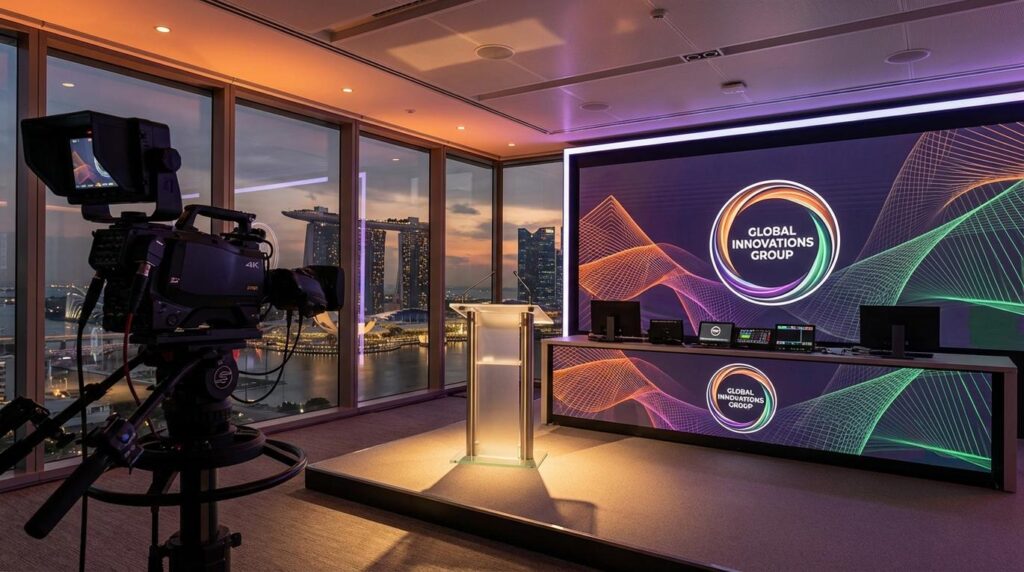
Orchestrating a Flawless Virtual Press Conference for Singaporean Media
Conducting a virtual press conference is not a task of delegating a video call link. For corporate event planners and IT directors in Singapore, it represents a high-stakes broadcast operation where brand reputation, message clarity, and technical execution are scrutinized by a discerning and technologically adept press corps. The transition from a physical press event to a virtual one introduces complex variables in signal flow, network architecture, and audience interaction that demand broadcast-level engineering and production discipline. This is not about consumer-grade streaming; it is about deploying an enterprise-grade, resilient infrastructure capable of delivering a seamless, high-quality experience that upholds corporate standards. The challenges include ensuring ultra-low latency for interactive Q&A sessions, managing multiple incoming and outgoing feeds, providing robust security, and accommodating multilingual requirements inherent in the Singaporean landscape. Successfully navigating these technical hurdles is paramount to achieving the desired communication objectives.
Core Production Infrastructure: From Signal Acquisition to Contribution
The foundation of any professional virtual event is the production workflow that captures, processes, and prepares the audio and video signals for transmission. This stage dictates the ultimate quality and reliability of the entire broadcast. An ad-hoc setup using webcams and basic software is insufficient for a corporate press conference. An enterprise approach requires dedicated broadcast hardware and a clearly defined signal path to ensure uncompromising quality from the source.
Professional Signal Acquisition and Routing
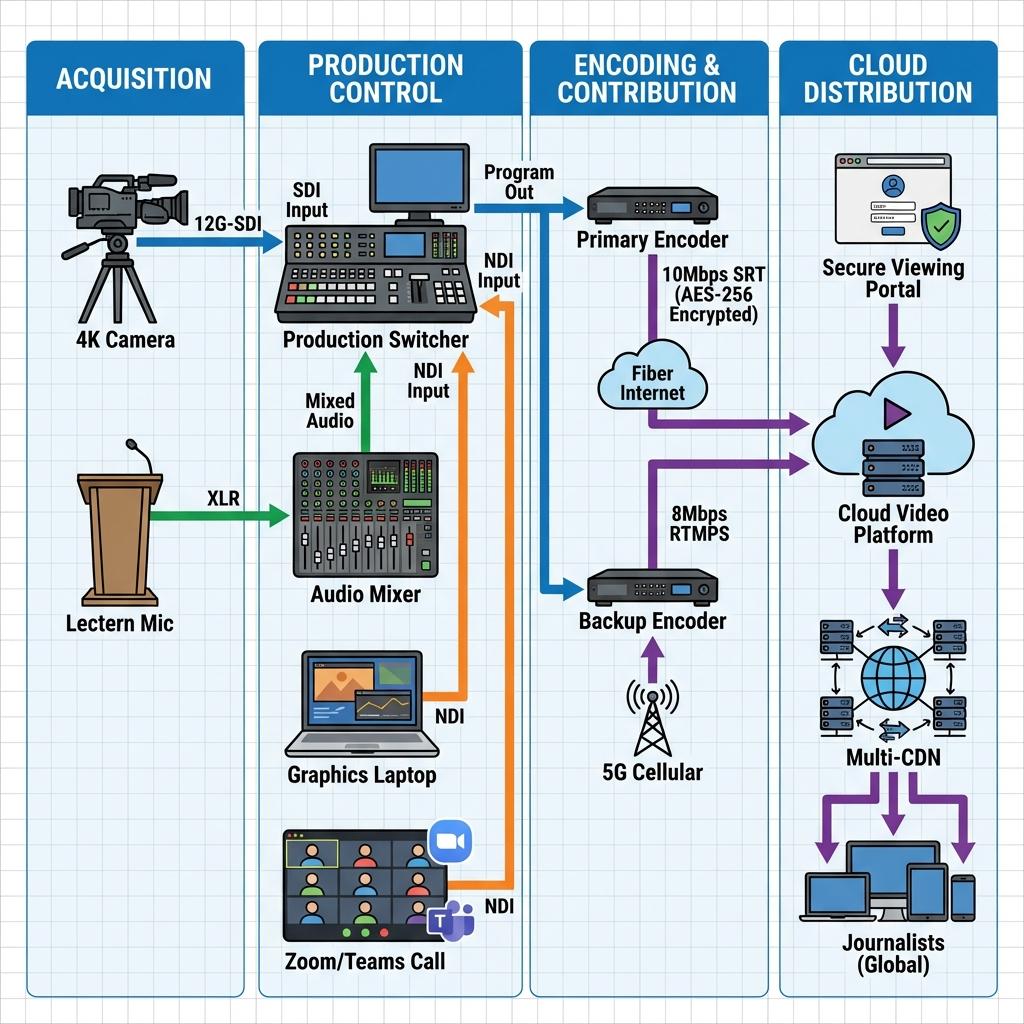
The signal chain begins with professional cameras and microphones. We recommend using broadcast-quality cameras, such as 4K-capable PTZ (Pan-Tilt-Zoom) units or manned studio cameras with professional lenses. These cameras provide superior image fidelity, color accuracy, and depth of field compared to webcams. Critically, they output a clean, high-bitrate signal via SDI (Serial Digital Interface) or NDI (Network Device Interface). An SDI workflow, typically using 6G-SDI or 12G-SDI for UHD resolutions, offers a robust, point-to-point connection with near-zero latency, ideal for a controlled studio environment. Alternatively, a mature NDI infrastructure allows for video and audio signals to be routed over a standard Gigabit Ethernet network, offering immense flexibility in setup. For audio, the goal is pristine clarity. This involves using professional microphones, such as lavalier mics for speakers and shotgun mics for environmental control, fed into a dedicated audio mixer. The audio engineer must create a main program mix and a separate mix-minus feed for any remote participants to prevent audio echoes and feedback loops. This mixed audio is then embedded into the SDI or NDI video signal to maintain perfect synchronization.
Vision Mixing and Real-Time Graphics
All video and audio sources converge at a production switcher, or vision mixer. This is the heart of the live production. Hardware switchers like the Blackmagic Design ATEM Constellation or Ross Video Carbonite series provide the reliability and tactile control needed for a high-stakes event. The production team uses the switcher to cut between different camera angles, integrate pre-recorded video packages, and overlay graphics. This includes professionally designed lower-thirds to identify speakers, full-screen title cards, and picture-in-picture compositions for panel discussions. Presentation slides from a dedicated graphics computer are brought into the switcher as another video source, typically via HDMI or NDI. The output from the switcher, known as the Program feed, is the final polished video that will be sent to the encoder.
Encoding and Resilient Contribution Protocols
The Program feed is sent to a hardware encoder for conversion into a streamable format. The choice of contribution protocol, the method used to send the encoded stream from the production location to the cloud distribution platform, is a critical decision. While RTMP (Real-Time Messaging Protocol) is widely supported, we strongly advocate for using SRT (Secure Reliable Transport) as the primary contribution protocol. SRT is an open-source protocol optimized for unpredictable networks. It features packet loss recovery and jitter correction, ensuring a stable, high-quality stream even over congested internet connections. We typically configure an SRT stream at 1080p50 or 1080p60 with an H.264 or H.265 (HEVC) codec, at a bitrate between 8 and 12 Mbps. For full redundancy, we establish two separate contribution paths: a primary SRT feed over a dedicated fiber internet line and a secondary feed, which could be RTMPS (RTMP over a TLS/SSL connection) running over a bonded cellular or 5G network. This dual-path approach ensures the stream continues uninterrupted even if the primary network connection fails.
Distribution Architecture and Interactive Engagement
Once the encoded stream reaches the cloud, the next challenge is distributing it reliably to the entire press corps and managing the crucial interactive Q&A session. This requires a hybrid architecture that combines the scale of a Content Delivery Network (CDN) with the low-latency interactivity of a conferencing platform. A single-platform approach often compromises either scale or interactivity.
A Hybrid CDN and Conferencing Strategy
For the main broadcast, the primary SRT feed should be ingested by a robust, enterprise-grade video platform or CDN with strong Points of Presence (PoPs) in Singapore and the APAC region. This minimizes buffering and latency for the viewing journalists. The video player should be embeddable on a secure, custom-branded landing page. However, for the Q&A segment, latency is the primary concern. A typical CDN stream has a latency of 15-30 seconds, which makes real-time conversation impossible. To solve this, we implement a hybrid model. Journalists are invited into a moderated video conferencing session, such as Zoom or Microsoft Teams. This session is exclusively for their interaction. The key is how this session is integrated into the main broadcast. We establish a dedicated production computer that joins the conference call and outputs the video and audio of the active journalist speaker via NDI or an HDMI capture card. This feed is then brought into our main production switcher as another video source.
Moderating and Producing the Q&A Flow
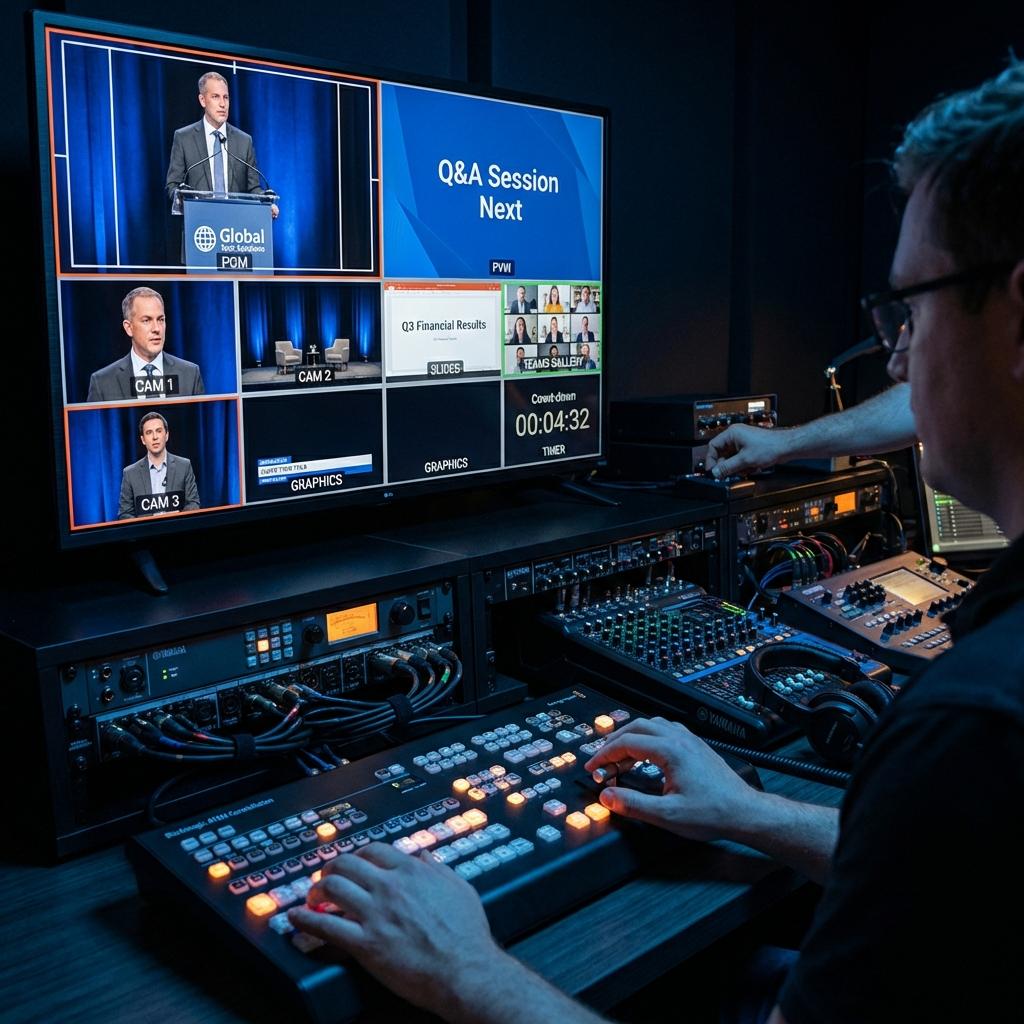
This hybrid setup gives our production team full broadcast control over the Q&A. A moderator manages the queue of questions within the conferencing platform. When a journalist is selected to ask their question, our director switches their video feed into the main program. We can display their name and publication using a custom lower-third graphic, creating a professional, television-style presentation. The audio from the journalist is routed through our main audio mixer, allowing the engineer to ensure levels are correct and clear. This workflow prevents the chaotic “all-hands” nature of a standard video conference from spilling into the public-facing press event. It elevates the Q&A from a simple meeting to a structured, professionally produced segment of the broadcast, providing a far better experience for both the presenters and the viewing audience.
Implementing Redundancy for High Availability
For a Tier-1 corporate event like a press conference, redundancy must be implemented at every stage of the distribution chain. The encoders should be configured in a 1+1 or primary/backup arrangement. The stream should be sent over diverse network paths to a cloud ingest point. The CDN itself should offer failover capabilities, automatically switching to a backup stream if the primary feed is interrupted. We also record the entire program feed locally in high resolution, known as an ISO recording. This provides a master copy for archival purposes and allows for a rapid VOD (Video on-Demand) release immediately following the live event.
Network Infrastructure and Security Protocols
The underlying network infrastructure and security posture are as critical as the broadcast equipment. An unstable or insecure network can undermine the entire production. Enterprise IT and production teams must collaborate to provision the necessary resources and implement security measures that protect the integrity of the event.
Bandwidth Provisioning and Quality of Service
Streaming high-quality video requires dedicated and uncontended bandwidth. For a primary 1080p60 SRT stream at 10 Mbps, we recommend a provisioned circuit with at least 25-30 Mbps of symmetrical upstream and downstream capacity to handle overhead and other production traffic. It is crucial that this bandwidth is not shared with general office traffic. On the corporate network, Quality of Service (QoS) policies should be implemented. QoS prioritizes the streaming packets (identified by protocol and port) over less time-sensitive data like emails or file transfers. This prevents packet loss and jitter caused by internal network congestion, which is a common point of failure for streams originating from corporate environments.
Securing the Broadcast End-to-End
Security is a primary concern for any corporate communication. The contribution stream must be encrypted using SRT’s built-in AES-256 encryption or by using RTMPS. On the distribution side, access to the stream should be tightly controlled. We employ multiple layers of security. Token-based authentication, or “signed URLs,” ensures that only viewers with a unique, time-limited token can access the video player. Geo-fencing can be configured at the CDN level to restrict access to IP addresses originating from specific regions, such as Singapore. Finally, the viewing portal itself should be password-protected, with credentials distributed securely to the invited journalists beforehand. These measures prevent unauthorized access and protect the confidential information being shared.
Supporting Multilingual and Accessibility Needs
To effectively communicate in Singapore’s diverse environment, multilingual support is often necessary. This can be achieved in several ways. A sophisticated approach involves encoding multiple audio tracks into the stream, allowing viewers to select their preferred language in the video player. A more common method is to provide live human captioning or translation. A live captioner listens to the program audio and generates real-time captions, which are delivered as a WebVTT or SRT sidecar file to the player. This not only supports multiple languages but also ensures the press conference is accessible to individuals with hearing impairments, aligning with modern corporate social responsibility standards.
Ultimately, a successful virtual press conference for Singaporean journalists is a broadcast engineering endeavor. It requires meticulous planning across production, distribution, and network infrastructure. By adopting professional protocols like SRT, implementing a hybrid architecture for interactive Q&A, and enforcing robust security and redundancy, organizations can deliver a compelling and polished event that commands attention and respect from the media. This level of technical execution is the hallmark of a professionally managed corporate broadcast.
Jeremy Lee is a seasoned digital marketing director and strategist with over two decades of experience in the industry. As the founder of Sotavento Medios, I manage a diverse portfolio of over 50 businesses, helping brands grow through advanced search strategies and digital innovation. My work focuses on bridging the gap between traditional search engine optimisation and the evolving world of AI-driven answer engines.
get in touch