
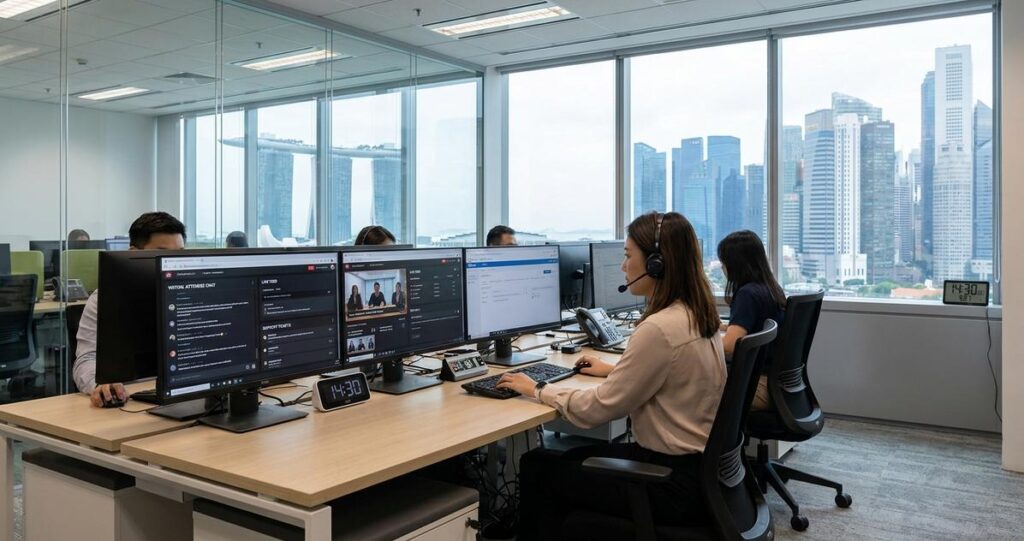
Hybrid events have become a practical choice for many organisations in Singapore, from financial institutions and government-linked bodies to medical associations, universities, and multinational companies. When an event is streamed to a remote audience, technical delivery is only part of the experience. Viewers who are not physically present still expect clarity, responsiveness, and a sense that the event was designed for them, not treated as an afterthought. This is where a dedicated remote audience concierge matters. A remote audience concierge is the person, or coordinated function, responsible for supporting online attendees before, during, and after the live programme. The role is not simply administrative. It helps protect attendee engagement, reduce confusion, and create a more reliable hybrid event experience for people joining from offices, homes, hospitals, co-working spaces, or while commuting across Singapore.
For Singapore audiences, this role is especially relevant because many events are consumed in fast-moving, multilingual, and highly time-sensitive settings. Attendees may join from different time zones if the event serves regional stakeholders, and local viewers may be balancing work schedules in a compact but demanding urban environment. If remote participants do not know where to click, when to ask questions, how to access slides, or what to do if audio drops, the event loses value quickly. A dedicated concierge helps close those gaps with immediate guidance and thoughtful support, which is essential for trust, participation, and professionalism.
In hybrid production, the audience concierge also supports the broader duty of care that organisers have toward participants. For events involving health education, regulatory updates, financial briefings, or other sensitive subjects, accuracy and timely communication are central to credibility. Clear support reduces avoidable frustration and helps ensure that remote attendees receive the same quality of access as those in the room. For organisations operating in Singapore’s standards-driven environment, that consistency can strongly shape how an event is perceived.
What a dedicated remote audience concierge actually does
A remote audience concierge is the primary human touchpoint for online participants. This role may be handled by one trained person for smaller programmes or by a coordinated team for larger broadcasts. The concierge monitors the attendee journey and responds to common issues such as log-in problems, access questions, chat moderation, language support, and escalation of technical concerns. Unlike a general event moderator who may focus on agenda flow, the remote audience concierge focuses on the viewer experience from the audience side.
In practical terms, the role starts before the broadcast begins. The concierge can send joining instructions, clarify system requirements, and check whether attendees understand how to use the platform. During the live event, the concierge watches for signals that viewers are struggling, such as repeated questions in chat, private messages about broken links, or sudden drops in engagement. After the event, the concierge can direct participants to recordings, reference materials, follow-up forms, or support contacts. This continuity matters because a hybrid event does not end when the livestream stops. The audience often continues to need guidance after the live session finishes.
Pre-event support that reduces friction
Many attendee problems begin before the programme even starts. The most common sources of friction include unclear registration emails, forgotten passwords, incompatible devices, blocked browser permissions, and uncertainty about where to find the live stream. A concierge can address these issues by preparing clear instructions in advance and answering questions in a timely manner. For Singapore-based audiences, concise instructions are especially useful because many people open event links from a workplace desktop during office hours or from a mobile device while commuting. If the setup is not straightforward, viewers may leave before the session begins.
Pre-event support also includes setting expectations. The concierge can explain whether the event will include live Q and A, whether captions are available, whether the session is in English or another language, and whether slides will be shared later. These details may seem minor, but they have a large impact on whether viewers feel prepared and respected. In a professional Singapore setting, clarity is not optional. It is part of the service quality that stakeholders expect.
Live event guidance that preserves participation
Once the event is live, the concierge helps make sure the audience can actually participate. Remote attendees often need help with chat features, polling tools, Q and A submission, or switching between video windows and presentation materials. A dedicated support role prevents the moderator or speaker from being distracted by operational issues. That separation of duties improves the flow of the broadcast and allows presenters to stay focused on content delivery.
This live support is particularly valuable during events that involve compliance updates, continuing professional education, or complex technical topics. If viewers cannot hear a key segment or do not understand how to submit a question, the educational value of the session decreases. A concierge can intervene quickly, acknowledge issues, and guide the attendee without disrupting the speaker. In hybrid environments, this creates a more polished and reliable experience.
Post-event follow-through that extends value
The concierge role should not end at the closing slide. Many remote attendees only review related materials after the session, especially if they were interrupted by work duties. They may need a recording, a certificate of attendance, or clarification about a resource mentioned by the speaker. Prompt post-event support reinforces professionalism and helps the organiser build long-term trust.
For brands serving Singapore’s business community, this follow-through can be important for relationship management. It shows that the organiser values the attendee’s time, not just their registration. It also reduces the chance of support enquiries being lost in a general inbox, which can create the impression that the organiser is hard to reach or disorganised.
Why remote audience concierge support matters in Singapore
Singapore is a high-connectivity market, but that does not mean remote event experiences are automatically smooth. The local audience is diverse, discerning, and used to efficient service. Many participants expect fast responses, straightforward digital journeys, and precise communication. In this environment, a remote audience concierge serves both a practical and reputational function.
Hybrid events in Singapore often bring together local and regional stakeholders, which adds complexity. An audience may include office workers in the Central Business District, clinicians finishing a shift, educators working across campuses, or executives joining from other Southeast Asian cities. Each group may have different device preferences, language needs, and availability windows. A concierge helps reduce the burden on attendees by translating event logistics into simple, responsive support.
There is also a trust dimension. A well-managed remote experience signals that the organiser has planned carefully and values attendee access. Poor support, by contrast, can make even strong content feel difficult to engage with. In regulated sectors such as healthcare, finance, and public sector communication, that can be especially damaging because audience confidence is tied to professionalism and accuracy.
Accessibility and inclusion considerations
Accessibility is a core part of audience care. While the exact requirements may vary by event type and platform, a concierge can help participants navigate captioning, replay options, screen-reader compatible materials, or alternate ways to submit questions. Remote audiences may also include older adults, first-time platform users, or people who are less comfortable with digital interfaces. A human support layer can make the difference between passive attendance and meaningful participation.
In Singapore, where audiences are often multilingual and cross-generational, inclusion also means anticipating different communication styles. A concierge who communicates clearly, patiently, and without unnecessary jargon helps create a more welcoming environment. That support is not merely courteous. It contributes to equitable access.
Cultural and operational expectations
Singapore audiences often value timeliness, order, and responsiveness. A delayed answer to a basic access question may feel disproportionally frustrating in a setting where the attendee is already working within a packed schedule. A dedicated concierge helps meet those expectations by providing quick confirmation, structured guidance, and calm escalation when needed. This is especially relevant for events held during lunch hours, after-work slots, or weekends, when viewers may have limited patience for avoidable technical issues.
From an operational standpoint, the concierge also reduces pressure on the production team. Instead of splitting attention between stream stability and audience support, the technical team can focus on broadcast quality while the concierge manages attendee communication. That division of labour is a recognised best practice in hybrid event design because it improves both reliability and audience experience.
The impact on engagement, brand trust, and event outcomes
Audience engagement is not just about keeping people online. It is about helping them remain attentive, informed, and willing to interact. A remote audience concierge supports that goal by removing barriers that interrupt participation. When viewers receive fast assistance, they are more likely to stay with the programme, respond to polls, ask questions, and view the organiser as responsive and credible.
Brand trust also benefits. In a hybrid setting, attendees often judge the whole organisation by the smallest friction point. If the registration link fails or the Q and A function is confusing and nobody responds, viewers may assume the organiser is equally unprepared in other areas. A concierge helps prevent that impression. The presence of organised, human support communicates competence.
For event outcomes, the impact is measurable in practical rather than speculative terms. Better support typically leads to fewer unresolved access issues, smoother participation, and cleaner handover between the live event and follow-up materials. While organisers should avoid relying on unsupported claims or inflated promises, it is reasonable to say that audience support improves the conditions for stronger event performance. The more effectively participants can engage, the better the event can deliver on its intended purpose.
Common failure points a concierge helps prevent
Several recurring problems can undermine a remote event if they are not managed proactively:
-
Attendees cannot find the correct access link or meeting room.
-
Audio issues are reported late because no one is watching audience messages.
-
Questions are submitted in the wrong channel and never reach the speaker.
-
Participants do not know where to find slides, handouts, or recordings.
-
First-time users abandon the session because they are unsure how to navigate the platform.
A concierge does not eliminate every problem, but it shortens response time and prevents small issues from becoming event-wide disruptions.
How to build an effective remote audience concierge workflow
Creating a strong concierge function requires more than assigning someone to watch chat. It involves planning, role clarity, and tools that support fast communication. The best workflows are simple enough to execute during a live broadcast yet structured enough to handle a range of attendee needs. For Singapore organisations, that usually means aligning the concierge plan with the event objective, the audience profile, and the level of technical complexity involved.
One effective approach is to map the attendee journey from registration to post-event follow-up. At each stage, identify the questions likely to arise and decide who will answer them. The concierge should know the event platform, the timing of keynote segments, the process for escalating technical issues, and the organiser’s approved messaging. If the event includes sensitive subject matter, the concierge should also know what can and cannot be clarified publicly.
Communication scripts and escalation paths
Prepared responses save time and reduce confusion. Short, clear scripts can address common questions about logging in, muting microphones, accessing captions, or locating slides. The concierge should also have a defined escalation path for serious issues, such as persistent platform failure, speaker audio problems, or urgent attendee complaints. In a professional environment, fast internal escalation matters as much as the external reply.
It is also helpful to agree on tone. The concierge should sound calm, respectful, and efficient. Avoiding vague replies helps maintain confidence. In Singapore, where audiences may include senior executives and subject-matter specialists, concise and accurate communication is a sign of professionalism.
Coordination with moderation and production teams
The concierge works best when integrated with the moderator, producer, and technical crew. The moderator handles agenda flow and speaker transitions, the production team manages the stream, and the concierge manages the audience-facing support layer. If these roles overlap too much, issues can slip through because everyone assumes someone else has responded. Clear ownership prevents that problem.
During rehearsals, the team should test the chat flow, attendee visibility, handover process, and fallback communications. This is especially important when using multiple platforms or when the event involves both local and overseas attendees. A well-rehearsed concierge function is more likely to stay composed when live conditions change.
Metrics that matter without exaggeration
Organisers should track practical indicators rather than chase inflated performance claims. Useful measures may include the number of unresolved access questions, average response time to audience enquiries, attendance retention through key segments, and the volume of follow-up support requests after the event. These indicators help organisers understand where friction remains and where the audience journey can be improved.
Importantly, these measurements should be used responsibly. They are tools for quality improvement, not proof that every event will perform the same way. Different audiences, topics, and platforms produce different results. A disciplined feedback loop is more credible than broad marketing language.
What Singapore organisers should prioritise next
For organisations planning hybrid or fully streamed events in Singapore, a dedicated remote audience concierge should be treated as part of core event design, not as an optional extra. The role supports access, engagement, and professionalism across the entire attendee journey. It also protects the credibility of the event by ensuring that online participants receive timely, human support when they need it most.
When planning your next programme, start with a simple question: if a remote attendee cannot access the event, understands the content but cannot submit a question, or needs help after the session ends, who is responsible for helping them? If that answer is unclear, the event is vulnerable to avoidable friction. A dedicated concierge closes that gap.
For Singapore audiences, where service expectations are high and time is limited, the value of this role is difficult to ignore. It helps the event feel intentional, responsive, and trustworthy. And in a hybrid environment, that human layer is often what turns a technically adequate stream into a genuinely professional experience.
General information only: This article is intended to support awareness of hybrid event planning and audience support practices. For specific operational, accessibility, or regulatory requirements, organisations should review their event platform capabilities, internal policies, and the applicable professional standards for their sector.
Jeremy Lee is a seasoned digital marketing director and strategist with over two decades of experience in the industry. As the founder of Sotavento Medios, I manage a diverse portfolio of over 50 businesses, helping brands grow through advanced search strategies and digital innovation. My work focuses on bridging the gap between traditional search engine optimisation and the evolving world of AI-driven answer engines.
get in touch